Deflection of starlight by the sun’s gravitational field, measured during a solar eclipse and confirming a central prediction of Einstein's general relativity, was announced at a joint meeting of the Royal Society and the Royal Astronomical Society #OTD in 1919.
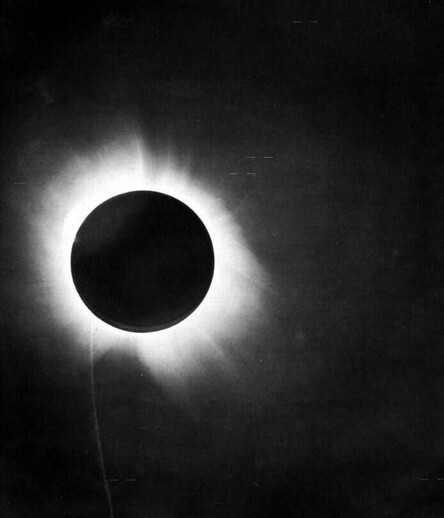
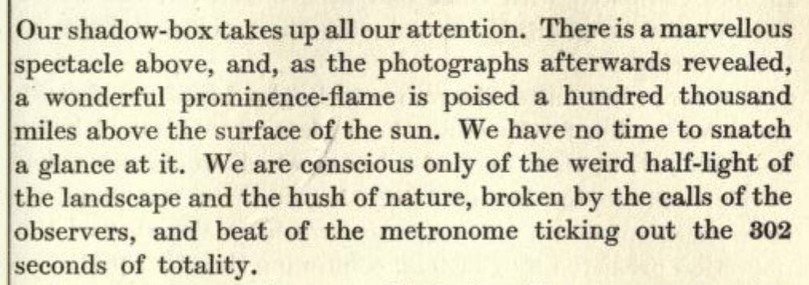
The measurements were made by two teams during the total solar eclipse on May 29 of that year. Eddington led an expedition to Principe; Crommelin led an expedition to Sobral. Eddington would later recount the five minutes of totality in one of his books. A copy is available here:
https://archive.org/details/spacetimegravita00eddirich/page/114/mode/2up?view=theater
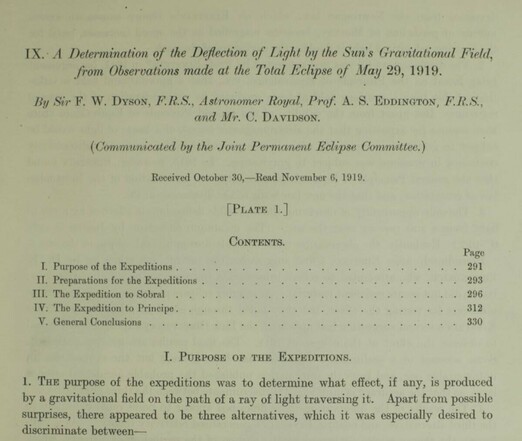
Data from the Sobral expedition suggested that the trajectory of light from distant stars was bent by about 2 seconds of arc as it grazed the limb of the Sun. The Principé data gave about 1.6 seconds of arc.
https://royalsocietypublishing.org/doi/abs/10.1098/rsta.1920.0009
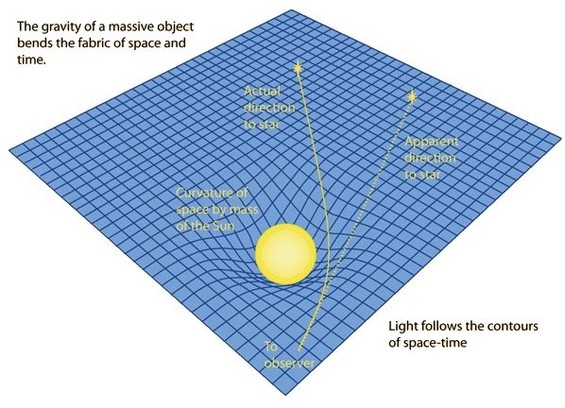
The full moon covers about half a degree on the sky. There are 60 arcminutes per degree, 60 arcseconds per arcminute. So 2 arcseconds is about 1/1000 of the angular width of the moon! It’s a very small effect, greatly exaggerated in this diagram.
Image: http://hyperphysics.phy-astr.gsu.edu/hbase/Relativ/grel.html
To get even this miniscule effect, the light really does have to pass very close to the Sun. And the Sun, being very bright, makes it pretty hard to see distant stars. This is why they had to wait for a total solar eclipse.
❌: 🧐 ☀️ ★
✅: 😃 🌑 ⭐
(In 1913, Einstein wrote to astronomer George Hale asking if it might be possible to observe stars passing near the sun without the benefit of an eclipse. Hale patiently explained that, no, the eclipse really was necessary.)
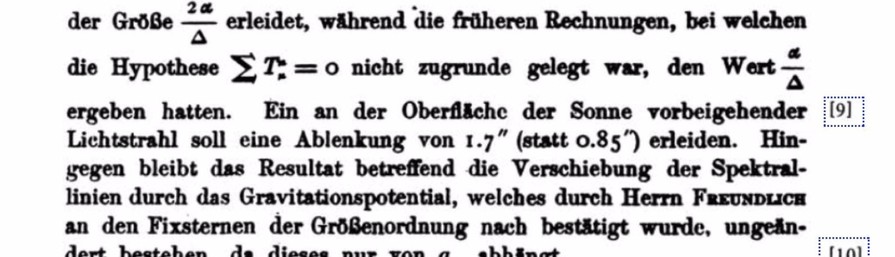
Anyway, this was a very good measurement! In Einstein’s 1915 paper “Explanation of the Perihelion Motion of Mercury from the General Theory of Relativity,” he had used his new theory to predict a 1.7 arc-second deflection for a light ray just grazing the sun. This was a correction to the 0.85 arc-second deflection he had predicted just a few years earlier, by applying the equivalence principle to Newtonian gravity.

Most of the meeting's attendees, led by Eddington and Sir Frank Dyson (the Astronomer Royal), viewed these measurements as a striking confirmation of general relativity. A stubborn few, including Oliver Lodge, clung to old theories despite the new evidence.

In closing remarks at the end of the meeting, JJ Thomson said: "This is the most important result obtained in connection with the theory of gravitation since Newton's day... This result [is] one of the highest achievements of human thought."

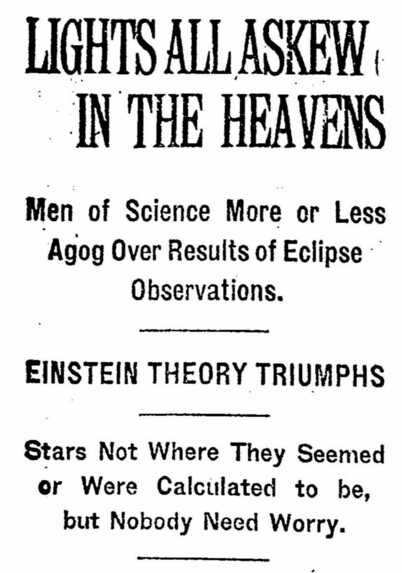
In the days following the meeting, headlines began to appear in newspapers around the world. "Lights All Askew in the Heavens," read the New York Times. "Stars Not Where They Seemed or Were Calculated to be, but Nobody Need Worry."

(Apologies for the very of-its-day gendered language in the subhed.)

https://www.nytimes.com/1919/11/10/archives/lights-all-askew-in-the-heavens-men-of-science-more-or-less-agog.html

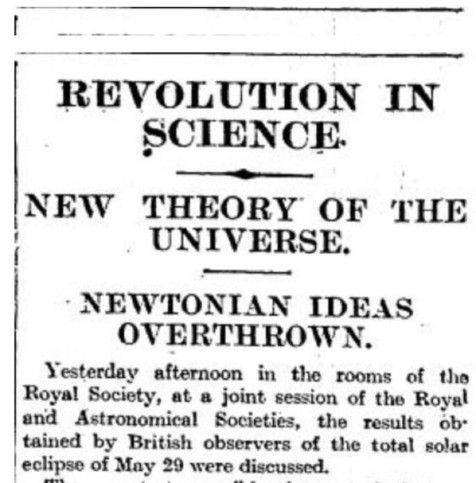
The very next day, the Times of London ran with “Revolution in Science. Newtonian Ideas Overthrown.”

Einstein embarked on a well-deserved victory tour. Scientists in almost every country celebrated the success of his radical theory.

The one exception was Germany. Most scientists there were excited by relativity and supported Einstein's work. But a few, like Lenard, were envious of Einstein. Seeing his ideas as a threat to the status of experimental physics, they exploited anti-semitism and Nationalism to sow distrust of his work.

(Lenard, of course, went on to become a high-ranking Nazi.)

But among legitimate scientists, there was little doubt that the results presented #OTD in 1919 marked a turning point in our understanding of the universe.

There is a very funny story that Chandrasekhar told, about an encounter between Eddington and the physicist Ludwik Silberstein at a party after the meeting.

Silberstein said "Professor Eddington, you must be one of three persons in the world who understands general relativity."

This made Eddington very quiet.

"There’s no need to be modest," offered Silberstein.

“On the contrary,” said Eddington, “I am trying to think who the third person is."

@mcnees I recall reading that, personally, Einstein was convinced that he did it right when he correctly calculated the perihelion motion. All the rest was icing on the cake for him.