Hello #Astrodon

I'm a gravitational-wave astronomer researching the formation and evolution of black holes and neutron stars

I primarily work on LIGO–Virgo–KAGRA data analysis, inferring source properties, but I'm also interested in space-based observatories like LISA

I enjoy #SciComm (I want to get back into blogging https://cplberry.com/blog/), and I'm currently a member of the community-science Gravity Spy project https://gravityspy.org/

I also like cake

#Introduction

Christopher Berry

Gravitational-wave astronomer

Christopher Berry

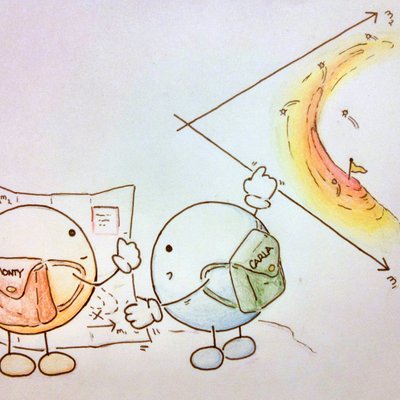
My avatar pic is a doodle I drew for a LIGO Magazine article about how we infer the properties of a #GravitaitonalWave source for the signal, for example how we measure the masses of merging black holes

https://www.ligo.org/magazine/LIGO-magazine-issue-7.pdf#page=32

The Doodle shows Monty and Carla exploring the distribution of source masses. The names are a pun as we use Markov-chain Monte Carlo samplers as part of our analysis

#Introduction

Gravitational-wave astronomy uses observations of gravitational waves—ripples in spacetime created by accelerating masses—to learn about the Universe. But how do we go from gravitational-wave data to measuring the masses of the black holes that emitted the signal?

This infographic explains how information about the properties of a binary black hole coalescence is encoded in the waveform

📈 : https://www.ligo.org/magazine/LIGO-magazine-issue-8-extended.pdf#page=6

#Astrodon #FediScience #GravitaitonalWaves

@cplberry this is very useful! Thank you!
@cplberry this is so cute! I love Monty and Carla. Scientific illustrations are always such a lovely introduction to concepts!
@cplberry that is good! 🤩
@mmylova Thank you! Monty and Carla are pleasantly round. They are shaped like friends. All inference algorithms should be friendly