
Since #37C3 is confirmed ( https://content.events.ccc.de/cfp/37c3/index.en.html ), I'm thinking about submitting a talk about the narratives hackers choose to describe themselves. Let me know what you think about these titles:

1. Hackers' narratives on themselves and why they are important

2. How cyberpunk stories can hurt hackers and their communities

3. The death of a Cyberpunk hacker - the birth of a Solarpunk one

4. Cyberpunk is Deprecated. We need a new language
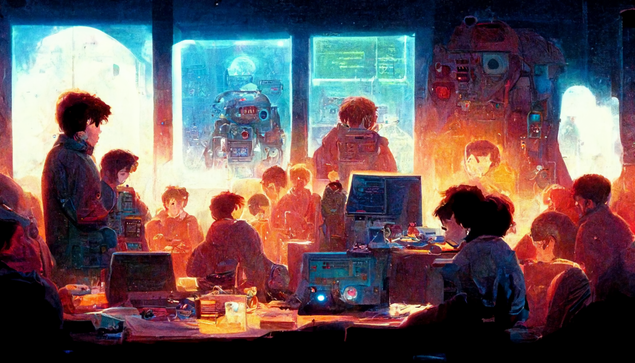
#solarpunk #cyberpunk #ccc

37C3 Call For Participation

@alxd 1 The importance of Hacker Narratives
Is best. The others go negative.

What are the main 3 points?

@ryancoordinator asking for spoilers 3 months in advance? ;)

It will require a lot more work, but in short:

1. Cyberpunk (in popculture) is about a rebellion, not creating a consistent and comprehensive alternative

2. A lot of hackers internalize the aesthetics and values of cyberpunk, willingly portraying themselves as rebels, not builders

3. In order to be seen as more than just destroyers (in popculture), they need to paint a world they would like to create, which could be Solarpunk

@alxd I'm with you spiritually, solarpunk is important and spreading the narrative of building does matter (see my work on Greenpilling)

But the megacorps that are the hacker adversary in cyberpunk have never been more powerful and omnipresent, and the aesthetic continues to be cool

@ryancoordinator they sure are. Soon I'll finish translating my latest essay on that (already premiered in Polish). Let me give you a single quote:

"In our fight against corporations and capitalism, cyberpunk made us very save - because predictable - rebels." The corporations know the playbooks and know how to "play" every hacker story, because we agree for them to dictate the narrative.

To truly fight capitalism, you need to imagine an alternative.

@ryancoordinator going back to my HOPE2020 talk -

I don't believe hackers will succeed in re-taking the narrative until we can tell stories about Wikipedia. A global, civilization-level project, understandable by near everyone, and yet we don't talk about it in our culture! Wikipedians are not heroes, archivists and librarians are not spoken about, because we are supposed to be blind to the value of cooperation.

@ryancoordinator
> and the aesthetic continues to be cool

And this is one of the biggest problems. The aesthetics are cool because they were _marketed_ and _engineered_ to be cool, to appear cool, to be internalizable even by the very people whose values they speak against. Cyberpunk wants lone wolves and individuals. Hackers are communal and work in groups, share projects.

How does no one see the obvious contradiction? Why do we still continue to promote ourselves this way?

@alxd yeah, please dig into that. I'm not sure this is clear enough for me to see your point.

Is it like... 'Cool is bad, even the SS had cool costumes, that is not enough'?

@ryancoordinator I would take a jab at the SS' aesthetics, but I wouldn't go as far as "cool is bad".

I would say "let's make our own cool". Our own dirty, communal, flawed but awesome projects, let them be cool. Let the cluttered workshop of Miyazakis movies, a whole community squabbling and working together be cool. Let us laugh at the sleek and corporate, single-use things. Let's make old, modified, repairable, rusted but trusty things cool.

@ryancoordinator has any hacker read the original https://www.goodreads.com/en/book/show/550165 and not think "hey those devices made specifically to be modifiable and repairable, with the blueprints / documentation available to everybody are cool"? "I can totally get why the newspaper prints a whole page of <CONTRIBUTORS.md>", "Those standarization groups advising against some broken products should be a normal thing."
Ecotopia

A novel both timely and prophetic, Ernest Callenbach’s …

Goodreads
@alxd this is the Public Goods narrative, which still needs help to be more sexy
@ryancoordinator which Public Goods are you talking about? There are several things / movements using this name ;)

@alxd I took the Public Goods narratives to be about the same thing.

The one about libraries, parades, free software and good governance.

My entry point narrative wise was at Gitcoin.
What alternatives are you talking about?