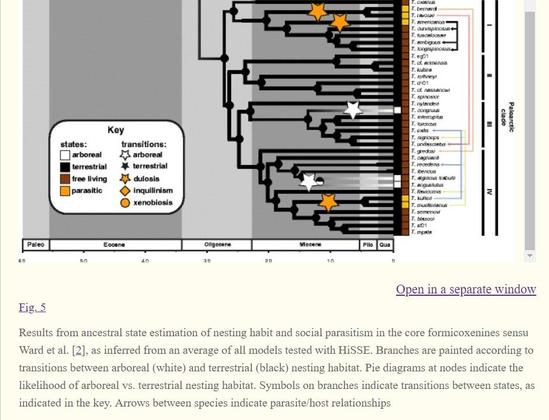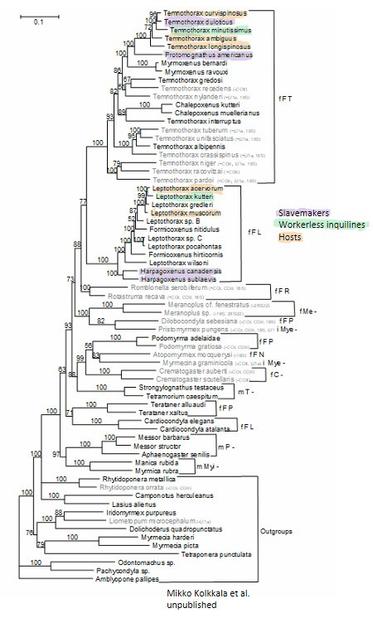
Unfortunately, two very interesting social parasite species - workerless inquiline #Temnothorax #minutissimus and slavemaker T. #duloticus - seem to be missing from this study

https://ncbi.nlm.nih.gov/pmc/articles/PMC5729518/

#phylogeny #ants #parasitism #SocialParasitism #workerless #inquiline #slavemaker

Insights into the evolution, biogeography and natural history of the acorn ants, genus Temnothorax Mayr (hymenoptera: Formicidae)

Temnothorax (Formicidae: Myrmicinae) is a diverse genus of ants found in a broad spectrum of ecosystems across the northern hemisphere. These diminutive ants have long served as models for social insect behavior, leading to discoveries about social learning ...

PubMed Central (PMC)
Unfortunately, two very interesting social parasite species - workerless inquiline #Temnothorax #minutissimus and slavemaker T. #duloticus - seem to be missing from this study ncbi.nlm.nih.gov/pmc/articles... #phylogeny #ants #parasitism #SocialParasitism #workerless #inquiline #slavemaker

Possible solution to the mystery of the rapid, parallel, and #sympatric #evolution of #ant #workerless social #parasites (#inquilines): a single #mutation in a #supergene.

https://cell.com/current-biology/fulltext/S0960-9822(23)00136-7 Trible et al. 2023

A caste differentiation mutant elucidates the evolution of socially parasitic ants

Trible et al. report a variant strain of the clonal raider ant that expresses queen-like traits in individuals that would normally become workers. These obligately parasitic variants have a mutated supergene and arose directly from their free-living parent strain, suggesting a genetic mechanism for the evolution of ant workerless social parasites.

Current Biology