 (Roughly) Daily
“Cauliflower is nothing but cabbage with a college education”*…
Mark Twain (the author of the observation above) was more correct than he may have understood. Alex Wakeman explains that, while most other plants have a single “most useful” element, wild cabbage has many. This makes it perfect for breeding….
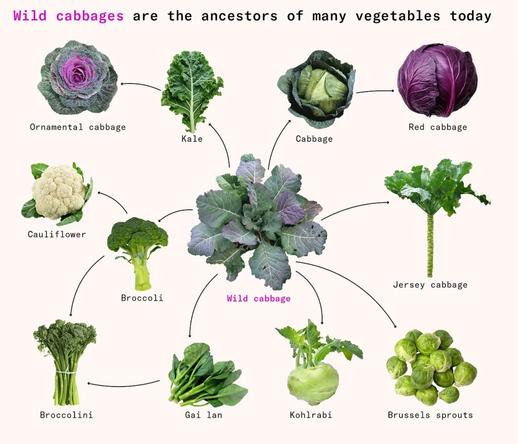
Every crop we consume came from a wild ancestor. Through breeding, people selected for bigger grains, juicier fruit, more branches, or shorter stems – gradually turning wild plants into improved yet recognizable versions of their originals. The rare exception is Brassica oleracea, wild cabbage: the origin of cabbage, bok choy, collard greens, broccoli, Brussels sprouts, cauliflower, and much else.
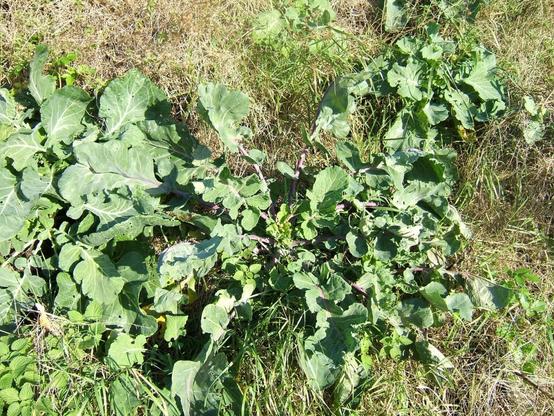
Wild cabbage is unassuming: some untidy leaves and a few thick, coarse stems on the browner side of purple that poke out from the soil. Nothing about it looks appetizing.
Wild cabbage (Brassica oleracea) growing in Northumberland. SourceNevertheless, many cultures have recognized something special in this plant. By selecting plants with denser layers of leaves, ancient people created modern cabbage and kale. Others bred for the inflorescence, a dense bundle of small flowers that forms the head of cauliflower and broccoli. By favoring large, edible buds, thirteenth-century farmers living around modern day Belgium created Brussels sprouts. Under different selection pressures, Brassica oleracea has become German kohlrabi, or Chinese gai lan, or East African collard greens.
This level of morphological diversity is unusual. Modern tomatoes, for example, vary in size, shape, and color, but are all recognizably tomatoes. Since the 1920s, scientists have worked to understand how Brassica oleracea was domesticated and to deepen our knowledge of evolution and artificial selection.
By combining modern genetics, genomics, and molecular biology with linguistic, historical, and sociological sources, researchers are now beginning to develop conclusive answers…
Read on: “How an unappetizing shrub became dozens of different vegetables,” from @worksinprogress.bsky.social.
* Mark Twain
###
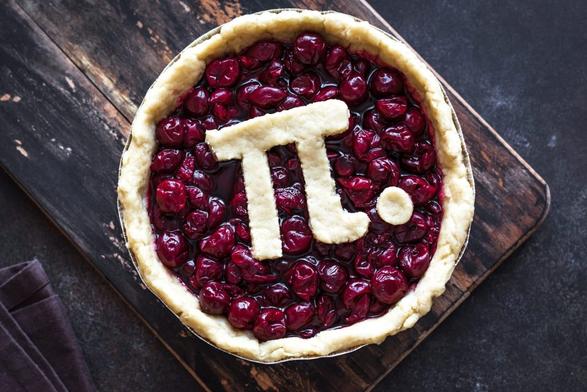
As we contemplate cruciferous, we might note that today (3.14) is Pi Day. Do have a slice, enjoy these celebratory logic puzzles and games… and see the almanac entry here for an apposite tale…
#artificialSelection #biodiversity #botany #breeding #culture #evolution #history #pi #PiDay #Science #vegetables #wildCabbage