What Did We Learn from Web3, Crypto?

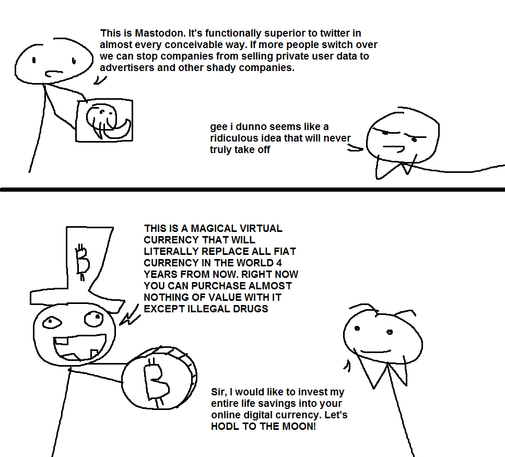
Looking back from the mid-2020s, the arc of #web03, #NFTs, and blockchain culture is very clear. What once promised (lied about) decentralisation, liberation, and a break from corporate capture now looks like the same, mess, #techcurn pattern repeating itself, yes it had new language, new branding, but it was easy to see it had the same underlying mess making dynamics. As these #geekproblem projects hollowed out, the signs became hard to ignore. The technical optimism faded, the user bases […]

https://hamishcampbell.com/what-did-we-learn-a-history-of-web3-crypto/

#openweb vs #closedweb is the battle for the Internet

We need better, more hopeful understanding of this technology. The internet’s origins are tangled with the military-industrial complex, designed for resilience in the face of catastrophe. But the protocols themselves, once set loose, created a tool box for anarchistic experimentation. The lack of centralized control allowed people to build without permission, and that openness birthed the wild, decentralized internet we briefly glimpsed. It was an accident, but an accident we can repeat. […]

https://hamishcampbell.com/openweb-vs-closedweb-is-the-battle-for-the-internet/

The future grows from what we choose to cultivate today

The #web03 crowd were #dotcons in disguise, wearing the clothes of decentralization while perpetuating the same extractive models. They took the language of progress, twisted it, and fed it back to us as an illusion. All the projects that claimed to be building a better future ended up accelerating the same closed, greed-driven dynamics. It’s not innovation; it’s the #deathcult hiding behind #PR smoke and mirrors. The way out isn’t through another cycle of empty promises. It’s […]

https://hamishcampbell.com/the-future-grows-from-what-we-choose-to-cultivate-today/

Our future grows from what we cultivate today – Hamish Campbell

Over the last few decades, the web’s evolution has been shaped by competing ideals. Early on, we witnessed the shift from the “better” ##closedweb corporate controlled paths to an ##openweb ##DIY explosion—a time when collaborative, decentralized approaches thrived. ##Mainstreaming efforts to recapture this #4opens spirit failed for years, but eventually, corporate-driven dot-coms platforms captured the majority of people. Activist voices were muffled as ##dotcons pushed mainstream interests, pulling away the community-driven power the web once enabled. This phase was a bait-and-switch operation, leading to surveillance capitalism and making it harder to stand up for collective, public-first internet paths.

A key aspect here is that this decline wasn’t caused by isolated figures but by broader, recurring social forces, like ##fahernistas and the ##geekproblem, who fell into patterns of adopting dominant narratives by failing to recognize the alt values of “native” open tech paths. As this happened, the ##NGO world came in with “nice funding,” which subtly aligned activist tech initiatives with liberal, watered-down approaches. This pushed and promoted co-option over the power of change. The result was tech stagnation, with communities gradually losing their voice and control, the mess we were in 5 years ago.

The current openweb revival is due to protocols like ##ActivityPub, coinciding with the rise of ##web03, which was about re-implements ##closedweb paths. This presents both a challenge and an opportunity, especially as the rotting of dotcons reveals the hollowness of centralization. While this ##reboot has potential, it’s often bogged down by the same forces that hindered past movements. The ##fahernistas focus on transient tech trends and individualistic coding projects that ignore the power of collective working, and the ##web03 uncritical push of ##encryption as a solution without a broader social strategy results in mountains of ##techshit.

What works? Building from simple foundations: As digital activists and ##DIY tech communities try to reboot the web, it’s essential to start with simplicity: ##KISS principles (Keep It Simple, Stupid) offer a practical foundation. Instead of complex, flashy approaches, this mindset prioritizes clarity, accessibility, and collective agency. Each simple, intentional step creates a more durable basis to counter ##mainstreaming forces.

What do we need: Self-organization tools within community are needed to reshape the path. Hashtags, for instance, have devolved into self-branding tools (fashernista), whereas they originally provided decentralized organizing power. Reclaiming these tools for grassroots purposes helps bring DIY activism to the forefront and build cohesive networks across digital paths.

What needs balance: The ##VC poison of “nice funding” and ##NGO co-option, are the big challenges facing the ##openweb movement. Often, well-intentioned tech initiatives accept NGO money to sustain themselves, but this financial support is not neutral. The NGO world, embedded in liberal agendas, steers projects toward safe, palatable solutions that appeal to funders rather than fostering the radical shifts needed for real change. This sugar-coated poison draws tech initiatives away from their roots and into a cycle of compromise, weakening the collective power that grassroots projects depend on.

What can we do? As we look at ways to reignite a meaningful openweb, these lessons from history are crucial. Without seeing these patterns, we are repeating the same mistakes and allowing corporate and liberal to dictate the paths we take to build our shared digital commons. How we actually make this work is not obverse, but the current ##fedivers reboot is a seed that is in the ground and growing.

I use the #4opens as a tool to do this as it’s simply ##foss development with ##openprocess added on, a useful tool to get past what people say their projects are about. And what they are actually about https://unite.openworlds.info/Open-Media-Network/4opens we need tools like this to compost the piles of ##techshit people keep creating, if we are to have soil to grow tech seeds of hope, like ##Activertypub

The path is simple, who is coming down it with me and meany others?

https://hamishcampbell.com/the-activist-history-of-the-web-lessons-we-can-learn/

#4opens #activertypub #activitypub #closedweb #diy #dotcons #encryption #fahernistas #fedivers #FOSS #geekproblem #KISS #mainstreaming #NGO #openprocess #openweb #reboot #techshit #VC #web03

closedweb – Hamish Campbell

We can work towards a future

The discussion surrounding the classification of different versions of the web, such as ##Web01, ##Web02, ##Web03, ##Web04, or ##Web05, is not merely an academic exercise but an aspect of understanding the evolving nature of the digital landscape. However, the proliferation of these hashtags can lead to confusion and contribute to the spread of fear, uncertainty, and doubt (FUD) among users.

In response to this confusion, the hashtags ##openweb and ##closedweb offer a clear and concise way to delineate between platforms that embrace openness, transparency, and community control (#openweb) and those that prioritize proprietary technology, centralized control, and lack transparency (#closedweb). By using these hashtags, we can foster a better understanding of the ideological and technical underpinnings of different web platforms.

Projects like ##indymediaback and ##OMN exemplify grassroots efforts to promote decentralized, community-controlled media and communication platforms. These initiatives are vital in challenging the dominance of large corporations in shaping the digital landscape and in advocating for a more inclusive, diverse, and community-controlled approach to technology development.

At the heart of this discussion lies the ##geekproblem, which refers to the tendency among technologically inclined people to prioritize technical solutions without considering their broader societal implications or the needs of ordinary people. By recognizing the ##geekproblem, we can begin to address the inherent biases and limitations of tech-centric approaches to problem-solving and advocate for solutions that are more inclusive and community-driven.

The solution to this problem lies in developing social tech that transcends the ##geekproblem and focuses on the needs and perspectives of the community. This entails involving a diverse group of people in the development and decision-making process and promoting open-source code, open standards, open governance, and open data in technology development. By embracing these principles, we can create a more equitable, transparent, and collaborative #4opens digital ecosystem.

However, achieving this vision requires overcoming challenges, including the resistance of the status quo and the fear of change. By actively using the #4opens—open participation, decentralization, transparency, and interoperability—we can challenge the prevailing narrative, call out pointless technologies, and compost the ##techshit that contributes to the perpetuation of harmful social dynamics.

Moreover, it is essential to recognize that the struggle for a more equitable and sustainable future is inherently political. The dominance of large corporations and the perpetuation of ##neoliberal ideologies pose significant barriers to progress. Therefore, it is imperative to mobilize collective action and advocate for policies and initiatives that prioritize the needs and well-being of communities over profit-driven interests.

In conclusion, the use of hashtags such as ##openweb, ##closedweb, and #4opens serves as a powerful tool for organizing and mobilizing grassroots efforts to challenge the status quo. By embracing these hashtags and the values they represent, we can work towards a future where technology serves the interests of the many rather than the few.

#4opens #closedweb #geekproblem #indymediaback #neoliberal #OMN #openweb #techshit #Web01 #Web02 #web03 #Web04 #Web05

https://hamishcampbell.com/?p=3314

Web01 – Hamish Campbell

@aral @serapath

OK so it clearly comes from the #web03 mess, I was smelling this, good to have a link, thanks @aral

Like most blockchain mess, they have stepped away... now the question is the tech they have built useful or useless, can it be run as unbranded community projects? Rather than branded #NGO tech fail. Anyone have information on this, please?

A actavist history of the web

The “better” #closedweb (ISP intranets) was “surprisingly” destroyed by the “inferer” #openweb which then exploded in use to spread everywhere.

The #mainstreaming thinking then tried and failed to recapture this #4opens project for ten years as it takes up global space, and was a real challenge change, that the “common sense” said should not exist.

This working alternative was finally sold out by our own #fahernistas, who bribed with money and statues members of the “unthinking” #geekproblem to build the #dotcons that rapidly took over the #openweb space.

Our wider activist #fashernistas created “liberal stories” about how embracing the #dotcons was a good path. The wider #fahernistas flocked to these #closedweb spaces to grasp at the real early power they provided, after society had finished this shift, the bate and switch took this power away, and we were left with “servalence capitalism” and no social power, as was obvuse at the time it was a con.

Our #fahernistats then pissed tech change/challenge agenst the wall for ten years. While the #openweb user facing technology withered, ignored and irrelevant to #mainstreaming

A few years ago we had an “accidental” #openweb reboot with #activitypub and soon after pushing of the next generation of #closedweb projects with #web03 leaving us in the current messy times.

Yes now the #dotcons are roting, but the #openweb is only a small change challenge due to our #fahernistas and #geekproblem actively #BLOCKING the change challenge inherent to the project.

Where are we now and what can we learn from this?
Liberalism in tech are often active prats, co-opting, bait and switch and taking the easy #NGO funded path when the choice comes.
They are #friendlyenemies, even when they deny this with all their “common sense”
Ideas to mediate this, please?

Do you except that “new” is often #deathcult (neo-liberalism) and #postmodernism because this is “common sense” what is your plan/idea to get around these problems?

I have had 20 years of “new” and am very underwhelmed, actually it’s almost all #blocking or adding to the #techshit to be composed. This is obviously a problem that needs to be mediated, what is your plan/process to have a better outcome?

Remember that the only thing that has worked in the last 10 years has been copying #dotcons with #activertypub every themselves has failed, what can we learn from this?

This is an important question that the #OMN project mediates.

A activist history of the web

The “better” #closedweb (ISP intranets) was “surprisingly” destroyed by the “inferer” #openweb which then exploded in use to spread everywhere.

The #mainstreaming thinking then tried and failed to recapture this #4opens project for ten years as it takes up global space, and was a real challenge change, that the “common sense” said should not exist.

This working alternative was finally sold out by our own #fahernistas, who bribed with money and statues members of the “unthinking” #geekproblem to build the #dotcons that rapidly took over the #openweb space.

Our wider activist #fashernistas created “liberal stories” about how embracing the #dotcons was a good path. The wider #fahernistas flocked to these #closedweb spaces to grasp at the real early power they provided, after society had finished this shift, the bate and switch took this power away, and we were left with “servalence capitalism” and no social power, as was obvuse at the time it was a con.

Our #fahernistats then pissed tech change/challenge agenst the wall for ten years. While the #openweb user facing technology withered, ignored and irrelevant to #mainstreaming

A few years ago we had an “accidental” #openweb reboot with #activitypub and soon after pushing of the next generation of #closedweb projects with #web03 leaving us in the current messy times.

Yes now the #dotcons are roting, but the #openweb is only a small change challenge due to our #fahernistas and #geekproblem actively #BLOCKING the change challenge inherent to the project.

Where are we now and what can we learn from this?
Liberalism in tech are often active prats, co-opting, bait and switch and taking the easy #NGO funded path when the choice comes.
They are #friendlyenemies, even when they deny this with all their “common sense”
Ideas to mediate this, please?

Do you except that “new” is often #deathcult (neo-liberalism) and #postmodernism because this is “common sense” what is your plan/idea to get around these problems?

I have had 20 years of “new” and am very underwhelmed, actually it’s almost all #blocking or adding to the #techshit to be composed. This is obviously a problem that needs to be mediated, what is your plan/process to have a better outcome?

Remember that the only thing that has worked in the last 10 years has been copying #dotcons with #activertypub every themselves has failed, what can we learn from this?

This is an important question that the #OMN project mediates.

We live in interesting and dangurus times for rebooting the #openweb

https://www.ngi.eu/opencalls/ and https://www.ngi.eu/ngi-projects/ngi-zero/

Their funding moved over the last year from pouring money down thee drain on #web03 to pouring money down the drain on #openweb

#NGI #NGIzero the crumbs that are left from the obviously pointless #NGO feeding do a bit of good for more "native" grassroots #openweb projects.

NGI Open Calls | Next Generation Internet

NGI Research and Innovation Actions (RIAs) provide support to projects from outstanding researchers, hi-tech startups and SMEs. Get funded!

Next Generation Internet

@[email protected] @Matt_Noyes

https://www.ngi.eu/opencalls/ and https://www.ngi.eu/ngi-projects/ngi-zero/

Their funding moved over the last year from pouring money down the drain on #web03 to pouring money down the drain on #openweb

#NGI #NGIzero the crumbs that are left from the obviously pointless #NGO feeding do a bit of good for more "native" grassroots #openweb projects.

NGI Open Calls | Next Generation Internet

NGI Research and Innovation Actions (RIAs) provide support to projects from outstanding researchers, hi-tech startups and SMEs. Get funded!

Next Generation Internet