Advancing the Line, Emboldening the People

Reflections on the One-Year Anniversary of the UCLA Palestine Solidarity Encampment

By a militant organizer from the UCLA encampment with assistance from outside agitators.

Download a zine version to print/fold here.

Due to the violence and fierce collective self-defense that characterized the action, the UCLA Palestine Solidarity encampment became one of the major sparks and infamous stories of the 2024 “Student Intifada.” There are many political lessons to be learned from the student intifada, both from the height of its militancy and from the counterinsurgency which took hold soon after. This counterinsurgency contains many parallels to the containment of resistance after the George Floyd uprisings, with contradictions heightened by the limitations of a student-centered movement. My hope with this anniversary reflection is to keep the memory of militancy alive while also critiquing how it has been erased or misrepresented, and to close with suggestions on how we proceed from these lessons. What follows is not a well-known story.

Many reflections on the UCLA encampment (April 25–May 2nd 2024) prefer to dwell on the victimhood of the students, and the failure of the UC administration to protect these victims and the beautiful community they created. These analyses reflect a severely defanged tendency that effectively demobilized the student movement and mired it in self-congratulating and self-infantilizing narratives. The militant resistance of the camp is rarely uplifted because it contradicts the image of non-threatening peaceful protesters.

We were not victims or heroes; we were a militant, confrontational force of students and community members committed to risking and sacrificing in solidarity with Palestine. Due to the unique conditions at UCLA, where violent Zionists attempted to physically assault students from day one, everyone was quickly forced to see the necessity of self-defense and the need for a highly organized and robust security team that took on round the clock shifts. People were forced to deprioritize personal comfort, safety, and ego, practice self-control and yes, follow rules, much to the chagrin of those who fetishize the freedom of individualism. Militancy was pushed and nurtured by leadership that treated the encampment like the war zone it was, and discipline was collectively strengthened by the practical concerns that we had to face every day to preserve the camp, like instituting quiet hours so folks could recharge to fight the next day. The standoff against the pigs was made possible by the resilience, training, and discipline built after a week of warding off Zionist attacks on the barricades.

We chose a strategic hilltop location to avoid taking the low ground beneath Zionists and police, both of whom attacked us with projectiles. In the 48 hours prior to the morning of 4/25/24, when we crept onto Royce Quad to set up, organizers amassed a large quantity of scrap wood and pallets to assemble barricades immediately. The encampment required a logistics team for food, water, barricades, and medical supplies, a medic team to administer care, a media team to interface with journalists, and a security team to prevent the university, the police, and local fascists from harming the community. This reflection centers on the effort to maintain a militant, disciplined movement in the face of external and internal pressures.

Those who stood on the frontlines of the Royce Encampment at UCLA remember the power of our community as we broke the line of the Zionist attackers and drove them away from our barricades three nights in a row. We remember how the Zionists fled. We remember the fear in the eyes of 30 LAPD officers when we kettled them and drove them from the encampment. And we remember feeling the blossoming militant potential of a thousand people committed to our collective struggle.

Many accounts of the 6-hour police sweep have described the concussion grenades, the wounds, and the beatings. Accounts of the Zionist attack have described the bear mace and broken bones. These accounts only narrate what was done to us and the choices the pigs made, obscuring the choice that hundreds of people made that night to courageously hold ground against a militarized and aggressive police force the night after fighting off a fascist mob. Everyone knows about the rubber bullets. Do people know that one encampment defender was shot in the knee, and after being bandaged and encouraged to rest, went straight back to the frontline because he had been shot by the IOF as a child and this “was nothing in comparison?” Do people know that countless comrades who were bear maced on the night of the Zionist attack went to the medics to get their eyes flushed, went back to the frontline, and did this for multiple rounds? Do people know that we drove off all three major Zionist attacks by advancing our line against them, in unison, forcing them to panic and flee? Is anyone aware of the defeats, humiliations, and injuries Zionists sustained in their failed attempts to destroy the camp? Was the sweep a brutalization or was it a battle? That night, a collective of people who had been radicalized by the necessity of militant defense against Zionists became soldiers.

We are at war– against the university, against the Zionist entity, against global imperialism, and against the infrastructure of genocide.  If we don’t maintain a clear militant line of needing to fight the police, rather than expecting their protection, then we risk losing the political clarity behind what an anti-imperialist movement in the imperial core requires. The struggle against imperial violence abroad is always a struggle against domestic warfare at home, especially given the influence of the military on American police forces.

A year later, as memorialization and celebrations of the student intifada proliferate and atrocities continue in Gaza, it is our duty to critique not only the encampment itself but also how people have chosen to characterize and remember it. How did we get there? What made it possible? Where have we gone since? It is worth quoting recently exiled student organizer Ziyan Mataora, who shares much with my analysis:

“We cannot recommit to the struggle without first truly and absolutely acknowledging that our movement was militant for a brief period of time — then collapsed due to internal contradictions combined with a lack of sustainable infrastructure to combat state repression, degenerating into a movement that has become largely toothless out of fear and liberal tendencies of a lack of discipline and disorganization. Despite the insistence of national organizations such as NSJP and PYM and many others in their social media campaigns, I do not think that romanticizing the student movement is acceptable, especially when we cannot name material victories in the fight for Palestine in American universities, primarily universities actually divesting from weapons manufacturers, not just symbolic victories of passing divestment resolutions.”


Spontaneity, “Leadership,” Autonomy, and Building Militancy

The UCLA encampment radicalizing to the point of fighting the pigs for 6 hours resulted from a combination of strong leadership and collective buy-in that disciplined and empowered the right people to become militants. When liberals realized the militancy of the camp had exceeded what they were comfortable with, they often left. Alienating liberals strengthens the militant potential of our movement and discourages the liberal tendencies in people who are radicalizing in real time, as it did the night we expanded our barricades.

Leadership and autonomy are not mutually exclusive, and strong militant leadership is important, especially when dealing with a large group of conflicting political visions. This type of leadership is necessary for quelling liberalism in the mostly petty bourgeois student movement, where careerism and respectability politics stifle interest in radical disruption. There were also alignments beyond just student and non-student. There was the non-direct actionist community support, mostly non-student, and often from cultural groups or organizations focused on housing, education, etc. This included local Arabs and Muslims that didn’t organize but would show up for Palestine. There was also support from autonomous anarchists and direct actionists, as well as from the progressive, non-activist student body who did not belong to any organizations or affinity groups. The makeup of encampment leads was also varied, though mostly affiliated with undergraduate and graduate Students for Justice in Palestine and the Rank-and-File Caucus for a Democratic Union, UAW 4811. Some were adults who had lived in L.A for years and had organized for even longer, with experience in direct action and connections to local non-student organizations and/or autonomous action networks. Others were much younger and receiving a crash course in confrontational action, learning and adapting quickly but susceptible to the interference of counterinsurgents and liberals.

The first day or so of the encampment internally resembled a music festival: complacent, indulgent, and with very little desire to be confrontational. People were getting high and drinking, sitting around chatting, and calling it resistance to genocide because a Palestine flag was on their tent. We quickly instituted strict no drinking or smoking rules to foster a culture of responsibility; this was not a party nor a place to have fun. The camp was a tactic of resistance, and the constant threat outside required vigilant, alert, and sober situational awareness. Zionist counter protesters began assaulting and trying to breach the encampment the first day by tearing at the barricades, stalking and attacking protestors, playing IOF torture music throughout the night (and every night that followed), rushing the barricades, brandishing knives, releasing infected mice, and more. Those who were not serious about defending the camp saw themselves out, and those who stayed despite the risks were radicalized and became heavily invested. We demarcated five zones that Zionists often tried to breach, limited entry to only two zones, and established a complex check-in, wristband, and vouching system once Zionists wearing keffiyehs began infiltrating the camp. It is a delusion to imagine that planning and implementing all this, in addition to the logistics of feeding, politically educating, and training hundreds of people each day, could happen without leadership. Some crews like the food tent, medic tent, and media team became basically autonomous while still coordinating with leaders. The negotiation between autonomy and leadership was a constant struggle, but for the most part mutual respect and a shared commitment to the camp left room for both.

Autonomy among encampment participants often did not translate into militancy, and liberals took it upon themselves to autonomously peace-police. Due to constant threats, we needed 24/7 security across most of the perimeter and a lot of manpower.  De-escalation training was intended to instill a baseline level of self-control, but among the more liberal people working security, non-violence became a fetish to impose on others through peace-policing. The limits of de-escalation became apparent the very first night of 4/25, when Zionist counter protesters continued to harass protestors until individuals broke out in random and unplanned brawls to chase them away with limited success. This demonstrated that when provoked, some people would escalate against Zionists on their own in an uncoordinated fashion. The hesitancy to stray from de-escalation and enforce a more aggressive self-defense strategy was a failure of leadership to decisively harness and direct energy. However, even as leads shifted away from de-escalation in the security trainings, this did not stop the autonomous peace policing.

There is also critique necessary against the romanticization of “community” which compelled some leaders to capitulate but which also undergirds anti-leadership proponents of encampment horizontality. Not everyone is valid, not every sympathizer organically supports escalation, and the people who want to police the insurgency of our movement legitimize their counterinsurgency on the basis of democratic participation. In contexts so full of contradictions like an elite university, militant leaders must not only guard against the neutralization of rebellion but also actively convince people of the necessity to fight.

The moral superiority of peaceful protest has been entrenched in mainstream discourse by progressive politicians and celebrities, especially following the pacification of the George Floyd uprisings in 2020. By condemning rioters and uplifting the goodness of non-confrontational and peaceful protests, NGOs and mass media characterized rebellion, escalation, and anything that deviated from pacifism as being instigated by disruptive thrill seekers who endanger others. As Martin Schoots-McAlpine writes about the 2020 uprisings, “the goal of the ruling class was to separate ‘peaceful’ liberal protestors from the more radical element, both to avoid radicalization of the moderate protestors but also to isolate the radicals within the movement.” Given that the anti-police uprisings of 2020 were some of the most visible, explosive, and subsequently defanged protests in recent American history, this manufactured commitment to “good” pacifist protest influenced the fixation on peaceful protest held by the average progressive liberal in the UCLA camp. Thus, it is no surprise that an entrenched aversion to escalation and a belief in the moral superiority of de-escalation was diffuse and difficult to overcome.

Positional Warfare: Advancing the Line, Emboldening the People

Planning and spontaneity are not antithetical, and flexibility is necessary to adapt the former to the conditions of the latter. If you can’t adapt, you can’t respond. And yes, while some liberals fled the mounting culture of militancy that began to characterize the camp, others who had been fearful in the moment looked around at how we chased away the Zionists to expand our territory and their mentality began to change. This was the political education of the camp, much more so than any teach-in or reading discussion.

On April 28th, encampment leaders sketched a plan on how to expand the barricades since a massive Zionist mobilization to take down the encampment had been announced for the next day. The expanded perimeter would use the walls of the adjacent buildings to our advantage, limiting Zionist access to two sides when previously we had been surrounded on all sides by Zionists. This would also escalate the disruptive effect of the encampment, since Royce Hall and Powell would become non-functional for public use when absorbed into the perimeter. However, around 1 am a sizable group of counter protestors began surrounding the camp, tearing at the barricades with knives, and playing loud music while harassing and threatening protestors. A handful of leads (with only quick discussion, and not among all leads) realized it was an opportune time to expand the barricades, because the issues with a surrounded perimeter were manifesting in real time and using the barricades to push Zionists back would be an offensive maneuver to change the political tone of our camp. We assessed the strategic value, we decided to do it, we spread the word to encourage confidence over trepidation, and we picked up the barricades to advance in line formation. Caught off guard by the wood pallets and metal barricades suddenly approaching them, the Zionists panicked and scattered like cockroaches, and the encampment was secure again. Spontaneously executing our plan exposed the enemy’s cowardice, since they felt most emboldened when we were passive.

Zionists were counting on our fear, but many people had already built resilience and were more interested in improving our position than in being sitting ducks. They were starting to think like soldiers and see the encampment as territory to defend and strengthen rather than just something to sustain and enjoy. This neat and effective escalation was quickly soured by members of the encampment who feared spontaneous militancy and leaned on ideals of democratic participation to criticize the brave for acting decisively in combat without calling for a townhall or collective agreement. Courageous leadership and respect for initiative is necessary in these moments. We couldn’t afford to have a town hall for every strategic maneuver we made: when to go on lockdown, when we returned to the vouching system, how we would expel an infiltrator, how to respond to renewed and unpredictable waves of counter protesters, such as on the nights of April 29th and April 30th.

On April 29th, the night after the first expansion, a large group of counterprotesters again attempted to breach the encampment after failing to do so during the massive Zionist rally in the daytime. Once again, a lead saw a spontaneous opportunity, and after convincing the frontline security on shift that offensive advancement would successfully force out Zionists (as demonstrated by the first expansion), they pushed the attackers back about 30 feet by moving the barricades. As expected, most of the spineless agitators scattered and fled upon finding themselves on the defensive.

The third counteroffensive took place during the largest Zionist attack, on April 30th. The highly publicized details of this attack don’t need to be rehashed: fireworks, bear mace, beatings. Zionists failed to breach the barricades. The two prior expansions were crucial to building courage for this night; there was undoubtedly panic, confusion, and fear among the camp, but there was also a crop of people who had been previously emboldened to be confrontational and were willing to do it again. The barricades were our strength and fully remaining behind them would have been the most strategic response. At first, the autonomous “peaceful protest” ethic won out over the more militant leads, and people across the line discouraged folks from coordinating an escalation akin to the counteroffensives on the two nights prior. Without any direction or leadership, some frustrated people broke the line to fight as individuals. Abandoning the barricades to fistfight Zionists on open ground was unwise, and lead to many unnecessary injuries, but this outburst of energy reflects a boldness and bravery, which— if directed —could be highly productive.

Militant leads channeled this energy, disciplining the organic desire to resist into a more effective tactic. My comrade risked injury several times extracting impulsive people from the fascist mob to pull them back behind the barricade and prepare for an offensive. Upon establishing buy-in among the frontline to coordinate a forward push, we advanced around 40 feet and scattered the mob before pulling back to the original perimeter and demanding people stick behind the barricades. Upon failing to breach, suffering a sharp reversal with numerous injuries, and seeing fewer reckless stragglers to attack, most of the counter protestor Zionists gave up and left around 4 am.

As with almost every confrontation during the encampment, initiating and building support for disciplined, courageous, and controlled counter offensives was the essential role of militant leadership. Leaders also sought consent from everyone on the line so as to move with decisive coordination. This often required modeling confidence and pushing people to embrace the flexibility, daring, and quick decisions that our conditions required.

Leadership also solicited input from people on the front lines who proved themselves to be brave, sharp, and serious, building trust and mutual respect. The stakes were too high to compromise with liberals, entertain individualism disguised as autonomy, indulge in deliberation that stalled spontaneous militancy, or soothe the moral qualms of every person still invested in peaceful protest. If the enemy has the intent to maim and kill, passivity only serves to endanger people, break morale, and limit collective power. If one person on the line refuses to advance out of personal disagreements, they endanger their comrades to the left and right.

Beyond Free Speech – Forcing Confrontation with the Pigs

When the encampment first went up, Vice Chancellor Michael Beck informed other administrators that their goal was to “quarantine the encampment as quickly and effectively as possible, to prevent further growth.”  University leadership decided to allow the tents to remain “as an expression of students’ 1st Amendment rights practices” and requested that police not yet be involved in the security plan according to UCPD police chief at the time, John Thomas. When we set up at UCLA, USC had just had their encampment swept by LAPD in 12 hours, Columbia’s repression was in all the headlines, and encampments were spreading quickly across the U.S. When a university sweeps a peaceful encampment, it sours the public perception of it as a learning institution with ethical obligations surrounding free speech. Public relations are essential instruments of counterinsurgency that reinforce the legitimacy of universities and this explains why UCLA originally elected to let the encampment stand before both protestors and Zionists began escalating. Rather than come down hard against us, UCLA chose this moment to brand itself as a tolerant university that defended free speech. Furthermore, the UC “systemwide community safety plan” advises police deployment as “a last resort” after UC Davis police set off heavy backlash and controversy upon pepper-spraying peaceful protesters in 2011. As militants we must sharpen contradictions and not allow facades of legitimacy to obfuscate our struggle; at UCLA this meant abandoning the spectacle of protest which the administration was friendly to and provoking them into open conflict with us.

One of the most prescient stalwarts of liberal counterinsurgency regarding the function of protests and police is the “right” to free speech. The liberal counterinsurgent narrative claims that the circumspect permissions of the First Amendment codified by law (that is, forms of political expression that do not break or threaten the rule of law) are the essence of “good” protest. Likewise, it is why modern policing emphasizes the necessity of friendliness and discretion towards peaceful protesters, uplifting one version of the movement and criminalizing another. In the 2022 crowd management manual for LAPD, it states that  “peace officers must carefully balance the First Amendment rights and other civil liberties of individuals with the interventions required to protect public safety and property.” This is accomplished through coordinating with organizations and their protest marshals whenever possible. When principled actionists call protest marshals “peace police” it is because they are actually coordinating with police to assist in command and control. The way police are trained to respond spells it out for you in the manual- “organizers provide safety marshals to assist with protester control (“if you police yourself, we don’t have to”).” The university followed the same logic and publicly communicated its support for our “free speech.”

If we weren’t a threat to the university they would let us stay, but if we moved beyond free speech they would be forced to act.  Since the administration was guarding against expansion and disruption more so than “protest” itself, the act of expanding our barricades alone served as an escalatory tactic. To do so as a form of fighting back attackers also undermined their legitimacy by demonstrating that we effectively kept each other safe through nonpeaceful methods. The UCLA encampment was not simply besieged by Zionists while we sat peacefully awaiting an inevitable sweep. We were defending ourselves and escalating in calculated steps due to the militant leadership that kept pushing the camp to be bolder. It is not victim blaming to say that we caused our confrontation with the pigs, because we are not victims. In a reflection on their 2009 occupation of Kerr Hall at UCSC, students describe this form of agency which is often erased in moral appeals to our innocence that many of us at UCLA have been subject to:

“The point is that there was nothing out of the ordinary or irrational about the way the administration or the police acted on that day. Administrators acted like administrators, and police acted like police. Anyone who was surprised or appalled by their actions seems to us naive in their understanding of the dynamics of power and resistance. The truth is that there was no ‘peaceful resolution’ to the occupation, because the occupiers refused to allow it. It was not the administration’s fault that the police were called. The outcome was forced by the students themselves.”

The Discipline to Sleep and the Courage to Fight

Around 10 pm on May 1st, less than 24 hours after the last and largest Zionist attack on the UCLA encampment, my comrade began going around with a megaphone yelling at people to quiet down and go to sleep. Chancellor Gene Block had announced that the police intended to sweep the camp at 6 pm, and indeed around 6 pm UCPD began announcing over speakers that everyone must clear out. Instead, we collected gas masks, handed out goggles and helmets, and prepared to hold our ground while the pigs slowly staged. Everyone was exhausted from the 4 hour long Zionist attack the night prior and needed to rest, especially those who had been defending the camp from relentless Zionist violence the entire week. We needed to recharge and conserve energy since the pigs clearly intended to wait us out late into the night and catch us tired. However, newer arrivals and a few other undisciplined encampment members continued to blast music, chant, and treat the camp like a party until someone came through with a megaphone telling people to take the impending sweep seriously and allow their comrades some rest before the next fight. Sometimes discipline isn’t exciting.

Before taking my couple hours of rest, I walked around to admire the graffiti concentrated under the arches of Royce Hall, feeling both calm and restless. Earlier around 6 pm the camp had been buzzing with anticipation and energy as people donned helmets and called their friends to come support. I was under no illusion that we could hold the camp forever- the question was how hard we would fight to make it as difficult as possible for the pigs. All the work to maintain, defend and expand the camp had led to this moment. I had watched people literally transform day after day through struggle, and Royce had also transformed into a collage with political messages telling cops, settlers, and Israel to fuck off. A drawing of a burning cop car on the wall with “COPS OUT OF UNIVERSITIES WORLDWIDE” neighbored messages of love to Gaza, embodying what tonight would bring. I took a picture of “Viva Viva, Tortuguita,” a slogan honoring the forest defender Tortuguita from the Stop Cop City movement who had been murdered by Georgia state troopers the year prior. Our enemy was clear.

At 1 am the battle truly begins. Community members from all over Los Angeles are still flooding into Westwood to support the camp defense while pigs deploy stun grenades over our heads. Clusters of protestors armed with shields have taken position at each zone, but I can see people who are clearly infiltrators running around yelling that cops are breaching at other areas, causing people to leave their positions and create gaps in our defense. The one I catch and confront denies everything, so I go around to each zone to warn of the infiltrators and remind people of the discipline we’ve been practicing- hold the line, move together with intention, and be brave. As pigs armed to the teeth start pressing in from different directions the screaming intensifies but no one moves an inch. The screams aren’t afraid, they’re outraged, and the courage to hold our ground is so strong that the pigs cannot advance and so they begin picking people off. The line doesn’t weaken—when someone falls or is violently yanked by a pig, another picks up their shield.

Eventually at around 2 am the pigs breach not by force but because of one disjointed line with poor communication. However, those inside quickly reappropriate barricades as shields to form a quasi-barricade enclosing the pigs and preventing further advance. Supporters outside the encampment make it difficult for more cops to follow the first contingent, and energy builds as it becomes clear that the pigs are kettled by protestors who vastly outnumber them. Our enemy was clear. We yell with hatred at these defenders of genocide and capital, and the frontline takes initiative to push forward with their new barricades. I am a few lines from the front and stand on tiptoe to watch the pigs swivel their heads around at the angry and fearless crowd surrounding them. As they begin nervously stepping back while pointing their “less lethal” firearms at us, I too began to scream from joy mixed with hate. Slowly and methodically, we push, they are forced to retreat, and as they file out of the encampment with tails tucked between their legs the fervor reaches a new level. When the last pig leaves and the perimeter closes behind him the curses turn to cheers, and though I know the long battle is just beginning I look at the strangers around me and feel I could cry. To have experienced that concentrated collective power and triumph remains one of the best moments of my life.

We fought until the sky began to lighten. A particularly difficult zone to defend sandwiched between hedges falls and the pigs rush in after the 6-hour standoff. We are mostly able to quickly retreat, but a group is surrounded and begins facing mass arrest. My nerves are racked but I am not tired at all, and I immediately go with a comrade to pick up food for jail support.

Why Would the Police Protect Us When We are at War with the Police?

When sympathetic narratives critique how police “did nothing” or say the school “failed its students” and simply stood by throughout the Zionist attacks, it is objectively true, but it assumes that the legitimate function of police is to protect people and that the university is made legitimate by serving and protecting its population (just like police). The problem with the pigs both structurally and on the major Zionist attack on April 30th is not that they failed to “protect and serve.” The police were in fact doing their job, because the only thing they protect is capital. We oppose police not purely because of what they do, but because of who they are and their social role in enforcing existing conditions of exploitation and war profiteering. What they do is always already conditioned by this structural function, whether they shoot rubber bullets into a crowd of students, harass unhoused people in Westwood, or present a friendly face through community policing programs.

“Doing nothing” in response to non-threatening protests is a strategy which strengthens the claim that pigs preserve both public safety and free speech. When we insist that the issue is pigs failing to protect students by “doing nothing,” we validate the idea that police can do “right” when they effectively protect students. The police refer to themselves as protectors of the peace for a reason, and when we fetishize peace and safety in ways that align with how police represent themselves, we do the work of reaffirming legitimacy for them. The other side of the “cops did nothing” reaction to the encampment is the emphasis on administration “failing” students.  The same analysis of counterinsurgency also applies to the university and its administration, who likewise claim to protect and serve the UCLA “community” of students, faculty, and employees.

The recuperation of legitimacy by community policing programs often relies on the precarity and poverty of target populations by publicly funding scholarships, social services, housing initiatives, and other resources to win trust and support among communities most affected by policing. UCLA does much of this work. These efforts to re-establish legitimacy became federal policing policy in response to LA riots against the police beating of Rodney King. In the context of a university campus where the university already provides social services, and the precarity of the overall student body is much less dire, the remaining safeguard to legitimacy that police can employ is “de-escalation.”

By now most leftists are aware of the militarization of police and the ‘deadly exchange’ between the IOF and U.S pigs, as well as between military and police tactics, training, and equipment more broadly. It is a key aspect of why one of the encampment demands included cops off campus. In the case of UCLA, there is also thorough evidence that police were coordinating directly with Zionist security group Magen Am, composed largely of former IOF war criminals, to respond to the Royce encampment. For these reasons, it is crucial that critique of pigs is rooted in clarity on how they domestically apply martial strategy.

The militarization of police goes beyond weapons and includes the domestic application of  military theories of counterinsurgency. The U.S Army Counterinsurgency Field Manual 3-24 defines counterinsurgency as a style of warfare that combines direct coercion with subtle legitimacy-building activities that keep peace and build trust. This approach leads with the awareness that conditions of insurgency undermine legitimacy and that legitimacy is necessary to stabilize rule during and beyond moments of crisis. Therefore, analysis of policing, repression, and power in our movement must emphasize the political and material warfare between insurgency and counterinsurgency rather than the abstract preservation of safety, protection, and rights. These liberal abstractions legitimize the ‘normal’ function of police and distort the narrative of how and why we fight the pigs. The militancy of the UCLA encampment attacked the legitimacy of policing, and it is imperative that we avoid narratively reinstalling this legitimacy when possible. As Kristian Williams writes in his work on the “softer” sides of counterinsurgent policing, “The state understands that there is a war underway. It is time that the left learns to see it.”

A Brief Note on Media Strategy, Legal Strategy, and Ideological Clarity 

Mainstream accounts describe the experience and aftermath of the encampment as being “like a warzone” to express shock and outrage. Every sympathetic journalist, faculty person, and media-trained camp participant repeated the line of “peaceful protest” to emphasize the brutality of the police during the sweep. Media strategy has a different function and orientation in a movement than ideological line or political education, and there was some value in publicly describing ourselves like this in mainstream outlets to gain popular support. But it is concerning how many organizers have muddled key political principles by decrying how police “did nothing” when Zionists attacked and by accusing the university of “failing its students.” We might describe our movement in different ways according to different audiences, but we should never describe our opponents in a way that upholds their legitimacy.

Of course, certain strategies of the movement like lawsuits must preserve the logic of certain narratives in order to make a coherent claim. If a movement lawyer is attempting to contribute to movement defense by filing a lawsuit against our enemies, then of course the basis of the argument is based on the legitimacy of law! At UCLA, the lawsuit filed on behalf of protestors injured by Zionists and cops is based on discrimination and negligence, constantly appealing to the peaceful, lawful protest, and victimhood of protestors in order to seek redress for them. As organizers we know that the police are the armed force of the same law which a lawsuit appeals to, but all the internal contradictions of this portion of movement work should not be muddled with our principled political analysis and propaganda. Legal advice is not political advice, and so legal narrative should not be political narrative. Movement lawyering serves an organizing purpose, but a purpose that does not include building militancy. That being said, the lawsuit narrative of expecting protection and decrying mistreatment cannot define our own perspective, nor should it dictate our path.

A Movement with Teeth

Many intellectuals and first-hand accounts have emphasized how the encampment was an experiment in living, a rehearsal of freedom, and a manifestation of the collective joy that comes from mutual aid and solidarity. While none of this is inherently wrong and while there may be political value in pointing out how we are able to take care of each other, the purpose of the encampments was never to indulge in new social models. The purpose was to cost the university money, to physically disrupt, and to express mass oppositional power. To that end I would emphasize, explicitly and repeatedly, that the most liberating and radicalizing part of the UCLA encampment was fighting the Zionists and police. The most important experience was sacrificing personal safety to defend something greater than yourself, and that is not always a joyful experience. In fact, it was often exhausting, frustrating, and sometimes frightening.

It was more important that the largely privileged, comfortable, and politically complacent student body receive blows from police while refusing to surrender than it was for this population to have interfaith seders and engage in collective study. We are at war with imperialism, and romanticizing the encampment for its internal dynamics slips into a liberal metaphysics of resistance. On the night of the sweep, there were three groups of LASD personnel with snipers and tear gas guns on the roof of Royce Hall. That is what we are up against, and “taking care of each other” in a beautiful display of mutualistic living has no teeth or tactic against that. Instead, what we do have are the barricades, the helmets, the resolute commitment to never surrendering. Non-militants speak of the encampment as though its political value stems from getting people to live and sleep together. If that was the purpose, we could’ve started a hippie commune anywhere.

Our current political moment requires courage, discipline, and clarity. With the collapse of the so-called ceasefire in Gaza, the genocide against Palestinians rages on and we must commit to making our struggle against it meaningful. What does militancy look like in the context of overt fascism intensifying in the U.S, among ICE disappearances and heightened lawfare? How should the student movement for Palestine proceed in the wake of the student intifada, when political prisoners like Casey Goonan lack widespread support and have been abandoned? In my personal correspondence with Casey, they wrote me, “I remain steadfast and unbroken in here, and it’s the Palestinian resistance and such spirit that keeps me going, reminders of our obligation to destroying empire from within.” The repression we’ve faced at UCLA since the encampment has been used by many to justify passivity, cowardice, and inaction. It is past time we remember our obligation and stop acting like victims.

Increased policing, surveillance, and repression necessitates community defense efforts and collective bravery; anything less will not suffice. When the pigs knock on our doors, or when ICE prepares to launch a raid into university housing, we mustn’t indulge in any fearful demobilizing tendencies which the student movement has suffered since last spring and which squandered the militancy of the encampments. Kristian Williams aptly writes that “when facing counterinsurgency, we need to learn to think like insurgents: The antidote to repression is, simply put, more resistance. But this cannot just be a matter of escalating tactics or increasing militancy. Crucially, it has to involve broadening the movement’s base of support.” Realistically, the militancy across campuses is not at the height that it was in the spring of ’24 and sloppy escalations won’t solve this. Instead, we must prove to more and more people as we did in the pressure cooker of the UCLA encampment that we keep us safe. Zionists at the barricades, ICE at the door- we must build mass confrontational power to fight back against fascists. We must sharpen the teeth of our movement and proceed with militant discipline.

Download a zine version to print/fold here:


advancingthelineZineDownload source: Unity of Fields

https://abolitionmedia.noblogs.org/?p=18836

#northAmerica #palestine #resistance #Solidarity #ucla #unityOfFields

#UnityOfFields

@redstreamnet: Anger is boiling over in Indonesia as students and activists refuse to back down. On Monday, clashes erupted in Surabaya, where around 1,000 demonstrators dressed in black confronted police with rocks and Molotov cocktails.
1/4

#UnityOfFields

@redstreamnet: Turkish police are intensifying their crackdown on ongoing anti-government protests, as both law enforcement and the ruling AKP escalate their response.
1/4

Life Is Revolution: Jonathan Peter Jackson Jr. On the Family Legacy & the Struggle to Come

On 12 March 2025, Unity of Fields interviewed Jonathan Peter Jackson Jr, an artist, scholar, son of martyr Jonathan Peter Jackson, and nephew of martyr George Lester Jackson. Born eight-and-a-half months after his father was assassinated—at the age of 17—leading the Marin County Courthouse Rebellion, Jonathan spent the first 19 years of his life living underground under an assumed identity. He has a forthcoming memoir, “Notes of a Radical Son,” with Seven Stories Press. You can support and follow his work on his Substack (jonathanpeterjackson.substack.com), his website (jonathanpeterjackson.com) and his Twitter (@MudAndMayo).

Download this article as a zine PDF to print/fold.

Unity of Fields: Thank you for doing this interview with us. It is such an incredible honor.

Jonathan Peter Jackson Jr: It’s a pleasure to be here!

UoF: George and Jonathan Jackson are like Yahya Sinwar to us, and really their true story has never been told. Fascism is here, and it’s been here since before Trump won; it’s been here since amerika’s inception. Right now the people engaged in anti-imperialist resistance here are facing extreme levels of repression, from liberal reformists and fascists alike. Everything George and Jonathan theorized is more relevant than ever and needs to be applied to our conditions right now. So we’re really excited to get into all of this with you. I thought we could maybe start with you just setting some context for the readers about your life, and your father and George’s lives. Even the people who uphold them the most fiercely and see them as the historical throughline for our struggle today don’t necessarily know the Jacksons’ true history, especially the story of their martyrdom, outside of the state narrative. So whatever you are down to get into, we can start there.

JPJ Jr: I think that the Jackson family has a really unique take on the discourse of fascism because, of course, George set that stage as he was writing about it earlier than 1969-70—he was writing about it earlier, but it was disseminated from him in those years. And as we should know, his general statement, the take-home magnet statement, is fascism is already here. So you know that in 1969 this is being identified by the radical edge of social movement. And then, of course, to pick up on what you said about people not knowing, and I write about this in the ’94 foreword [to Soledad Brother] as well, there are reasons why not only the narrative of the Jackson family isn’t known, and those reasons are many, but actually one of the main ones is that he identified fascism so early as a feature of late 20th-century capitalism. I don’t think there were any other translatable messages for popular discourse, any other Black or Black Radical and other radical voices that were talking about it at the time.

I’m thinking of obviously King, etc. I do actually believe that King was coming close and would’ve gotten there fairly quickly, not just in his later years when he was speaking outright socialism, which is what got him killed, but he probably would’ve come around to using the F-word (as we can sort of shorthand it). So yeah, the long history of the Jackson family, I think I’m going to leave most of that for the memoir material, mostly because it’s such a cool story that I want people to experience it in text. We did a lot of research going all the way back to our origins in southern Louisiana and Virginia. But the narrative that people who are in the struggle and resisting need to know is that George’s formulation as a political prisoner who was kept in prison because he developed an ideology while incarcerated. Much like Malcolm X in that sense, without the religious aspect to it, but that is the reason why every time he came up on his indeterminate sentence, he was effectively rejected by the parole board. And so as his movement grew inside the prison walls and it was a class-based recognition of the incarcerated position, he became more well-known. And as a result, George got into a situation in Soledad where his mentor, a man by the name of W.L. Nolen, was targeted and sniped by a prison guard.

Then, as some of us know, and some of us are right now learning, the case of the Soledad Brothers emerged—a prison guard was found, strangled and thrown over the top tier of the wing. So at that point, George was on trial for his life and became very public. That is when the letters of Soledad Brother began to be collected, and the narrative and the compelling vision of his started gaining momentum as the trial proceeded. Because when you have an indeterminate sentence, you’re effectively up against the death penalty. But there were some tactical complications…

One of the things that a lot of people don’t know, so I’ll pass on something new to people who are more familiar with the story, is that George never wanted to plead not guilty for that killing. And if you really stop to think about the true revolutionary spirit of that, you begin to understand George a little bit better. In this way I hope that can fill in a picture of George for the people. But nonetheless, the trial went on, and as it became apparent that things were maybe going sideways, the liberation of the Civic Center in Marin County, California, happened on August 7th, 1970, which is one of our greatest holidays in Black August. My father was killed during that attempt. That event was seismic in a way that is almost incomprehensible in today’s situation. And as you know, because we were talking about this the other day, one of my mantras is everything is situational.

UoF: The subjective factor is the determining factor, as Mao said, and Dhoruba Bin Wahad has reminded us.

JPJ Jr: I don’t think within the constraints of this format, and I always am very upfront about arguing against the constraints of any media format that I communicate in…I don’t think I can talk about it all. I can’t paint the entire picture of what was going on in 1970 and the aftermath of that event, but I can say that the way in which the event came to be and the events afterward effectively fractured the Black radical movement in this country. Then, of course, as a death blow, George was killed in an escape attempt a year and two weeks later on August 21st, 1971. Obviously, there are a lot of details and important points to talk about, but again, we have a time constraint here. We can fill those pictures out either with more questions or at another time.

But certainly for those who are aware of prison resistance and struggle, Attica came about directly after the death of George Jackson. So I think that’s a good crib noted version of the Jackson significance on the world stage. The only other part I would add is that Soledad Brother caught fire, and it was internationally renowned almost instantly, and I think that had more to do with the time period. But it’s really important to grasp that the breadth of that book pulled in an international movement and in some ways continues to do so. That’s why I find it useful to talk about Soledad Brother before talking about Blood in my Eye. And I specifically mentioned that because I know Blood in my Eye speaks directly to people in an advanced stage of resistance, but I don’t think that you can really understand George Jackson until you have read Soledad Brother, because it is truly one of the great books of the 20th century. I also think that it probably will start stretching well into the 21st century…at least that has been my part of the legacy in terms of making sure that the family book stays out there and is read by as many people as possible. I do have something more to say about Blood in my Eye as we go on, but I’ll stop there, and let’s shift into a discursive mode perhaps.

UoF: Thank you. That was great. I’m glad you pointed it out because far too few people understand that George never wanted to plead not guilty to killing the CO. And to comrades privately, he claimed it, of course. A lot of liberal solidarity with George was conditional on his innocence, on the story being that he was framed—not that he was resisting and that he was righteous for doing so. At a certain point, George was fighting with his lawyer because he wanted to use all his legal defense funds to launch his guerrilla group on the outside, right, instead of paying his legal bills? We can’t make our defense of political prisoners conditional on their innocence, because no revolutionary is innocent in the eyes of the state. We don’t support Assata because of her perceived innocence; we support her because she’s a revolutionary, and if she offed some fascists, well, we support her even more.

You hit on this point in your foreword to Soledad Brother too, where you wrote, “George was universally misunderstood by the left and the right alike. As is the case with most modern political prisoners, nearly all of his support came from reformists with liberal leanings. It seems that they acted in spite of, rather than because of, the core of his message.” I’m reminded by the message from the Palestinian resistance: If you are in solidarity with our corpses but not our rockets, you are a hypocrite and not one of us. We have to transcend this liberal framework of solidarity that only defends colonized people, whether Palestinians in Gaza or Africans in amerika, when they are passive victims, not when they are resisting. Otherwise we will only be co-opted and our politics diluted.

It goes without saying, but everyone reading this should read Blood in my Eye, Soledad Brother, and your forthcoming book. (Please make note of the Jackson Family’s request to not buy new copies of Blood in my Eye from Black Classic Press until things are made right with the Family.)

JPJ Jr: Once you’ve read Soledad Brother and Blood in my Eye, or if you just read one or even part of one, you’re going to want to understand what happened. And it’s really important for young people in the struggle to understand what happened during that period of history and what was learned and what was lost. Sadly, one of the effects of having baby boomer leftists run the show is that a lot of them aren’t that eager to let that history be known. So if you want to know the source, “Why don’t I know about George Jackson, what happened on August 7th, 1970?” Listen, I’m Gen X. It was our parents that did not allow that message to get out.

UoF: For sure. Reading Blood in my Eye, having access to that as a teenager, is what made me a communist.

JPJ Jr: Beautiful.

UoF: If George was writing that fascism is here in 1970, we have to understand which stage of fascism we are in today, and develop a corresponding level of resistance. At his time, there was an anti-imperialist underground of active guerrilla formations—not the case today, but I think people are beginning to ask these questions again because of the escalating repression and because the Al-Aqsa Flood put the question of armed resistance back on the table. In our view, the contradictions are really intensified internationally and domestically right now, the most they have been in our lifetimes.

JPJ Jr: Fully agree. But here’s what I think about that, and you’ll see this specificity with me over and over and over again because maybe it’s my training at the discursive level. I think the term at hand and what needs to be remembered always is apply. Because the thing is, the situation when I wrote the foreword [to Soledad Brother] in 1994, the situation when George was writing in ’68 or ’71, it is not quite accurate to just say he was writing about things that are happening today. That doesn’t work, at least not in my philosophical understanding about how time works. And so what we have to understand is how to apply these things to a world that George obviously could have never imagined and that I couldn’t have imagined when I wrote that foreword at 23 years old.

I also believe that it is our job as leftists who don’t shy away from confrontation and conflict when it’s necessary to do a better job of translating of our situation and what is going on for us at the moment. Because in general, when people understand something clearly, there is a degree, however slight, of a shift towards the progressive stance…and they have to retreat a little bit off of their total petty bourgeois line. A lot of times people, and I’m talking about the general populace here, will shrink back from how we should say UGW [urban guerrilla warfare] or any other form that leftist resistance can take, and not when they see state militarism. But that’s a translation issue. And it’s a communication issue because what we need on the left is for people to understand when everyone walks out of work, or at least let’s just say 65% of people walk out of work, marching down the street, there needs to be a degree of translation so that the extra 15-20% can join the 65%. It is not how they literally view it. It’s a translation issue. They don’t understand the context.

UoF: Absolutely. We are in a constant process of raising consciousness that demands we be explicit and clear with what we are saying. For example, it’s important we are precise in that we are not trying to make Amerika a “better place,” or build socialism in Amerika—no, we are trying to destroy Amerika. And I think it’s condescending to assume the masses are too dumb to grasp these ideas, which is the defeatist—and elitist—outlook some organizers have. Maybe Ivy League college students and Democrat voters don’t grasp these ideas, but some portions of the masses absolutely do. During my time inside, my fellow inmates absolutely grasped political ideas; in fact they hungered for political education. If Ho Chi Minh could translate Marx into Vietnamese, teach peasants how to read, and start a people’s war…if George could organize entire prison populations…then we can definitely overcome the obstacles of Amerikan illiteracy and stop making up defeatist cop-outs.

But not everyone sees it this way, and not everyone doing “revolutionary” organizing in this country even believes that revolution is possible here. Which logically should be our starting point—that revolution and victory are possible, and they are possible within our lifetime. But there is this swath of “revolutionaries” here in Amerika who see the task of making the revolution and doing the fighting and the dying as the task of exclusively the Third World, which is obviously very racist and social-imperialist in essence.

It would be suicidal to pretend this divide does not exist in today’s nascent revolutionary movement. It does exist, and there are people who say they’re part of this movement who aren’t actually in it for the same reasons as us. Publicly addressing that isn’t divisive or sectarian; it’s a necessary debate to have, a contradiction to draw out into the open. Because a lot of the counterinsurgency we’re experiencing isn’t necessarily being enacted directly by the state’s repressive apparatus—it’s being enacted by people within the movement who want to frame themselves as the “good” protestors and us as the “bad” militants. They want to keep demanding reform, and the state wants them to keep demanding reform, and they are mad that we are building revolution. Actual revolution, not some faraway abstraction.

I mean, it reminds me of how George said, if you could define fascism in one word, that word would be reform. The development of fascism between George’s time and now has been fascism constantly reforming itself.

JPJ Jr: Well, okay, so let’s look at that…let’s say a few words about the Black Panther Party then, because I left that out of the initial history. There were the divisions within the party, petty squabbles. That’s where George’s quote comes from, “Settle your quarrels. Come together, understand the reality of our situation, understand that fascism is already here, that people are already dying who could be saved, that generations more will live poor butchered half-lives if you fail to act. Do what must be done, discover your humanity and your love in revolution.” But a lot of that has to get done directly through IRL channels, so to speak. And so one of the things that the establishment is very comfortable with is that we are not communicating through IRL channels very often. The tendency to have leftist interventions be a hindrance to progress is something that the Panthers dealt with. And so people should study the history of the Black Panther Party and then come to people in Gen X to break down some of the mistakes that those books made. Because a lot of the books, they just don’t know. You can interview people till the cows come home, but until you’re talking to me or somebody who was a direct descendant of that, you can’t really know what the history was.

UoF: Absolutely. It’s hard to filter through the historical revisionism, especially when this entire generation of Third Worldist revolutionaries and communist revolutionaries within the US were either imprisoned or assassinated or exiled or neutralized into liberal academics. Speaking of academics, I know your memoir will get into your relationship with Angela Davis while you were growing up, but do you want to speak to that at all here, how she fits into your family’s history?

JPJ Jr: Let’s take a pause there because we’ll get sidetracked otherwise. Of course, I’m always open to speaking about Angela, but we have to be a little more specific. And the reason for that is that Angela is such a polarizing figure…she’s a receptacle for misunderstanding. Also, and she and I have talked about this, she’s a receptacle for a degree of blind faith. So I always want to be very specific when I’m talking about Angela, because for some people in their stages of development, Angela’s voice is really, really important.She’s done some really substantial work, but it has to be understood not as an end game but as a stage of development…because Angela came from a very bourgeois background. Angela worked within the confines of the institution for the better part of, somebody else could probably tell me better, 45, 40 years, something like that. And Angela retains her emeritus gold card. Okay, that’s not talking shit. That’s just the reality.

So I would take it one step further than your formulation of liberal professors and say that radical professorship is nowhere, man. There’s functionally no difference between them. I would leave out maybe one or two from there, Robin DG Kelly being one. But there is functionally no difference between radical professorship and liberal professorship. They can come at me all they want. I’ll sit up there like the Chomsky/Foucault debate if they want to. But I would say that from my position and, getting into a little bit of my biography, being banished from the academy after having completed my doctoral work but essentially living as an outsider working person, hustling to get by, etc. but having gotten the training that was necessary to do what it is that they do, I could tell you, and I went to the academy at the highest level possible. I have three master’s degrees and a PhD from Berkeley, Cornell, and a Columbia satellite in Europe. So there’s no part of the institution that I didn’t see. And I can tell you with full conviction, radical professorship actually doesn’t even exist.

See, when you work in service of an institution, that institution coerces you in ways that you’re not even aware of. So let’s just take, for example, ‘time.’ :et’s just get down to everyday lived experience. Your life is run by the schedule of the institution. What has more power over you than that? The way that you experience your day-to-day, year-to year-life. There are times when I can’t even talk to the few academics that I need to have a conversation with about whatever it is, whether it’s the NBA finals or the epistemology of something. They can’t do it…why…they’re grading finals or whatever it is. At that basic fundamental level, you are being controlled by a billion-dollar institution. So yeah, great armchair. It’s very nice. Enjoy your privilege, live behind your walls. But that’s only part of it. The real issue with academia, and I talk about that occasionally online on Twitter just as a jest, but it’s not really a jest…We actually really do need People’s Universities. And the great part is…guess what? The infrastructure already exists. It’s campuses all over the country.

UoF: Yeah. I mean, I didn’t realize how much time you’ve spent in the academy, and I’m curious what your assessment is of the Student Intifada, and the ongoing discursive battle over its legacy. Unity of Fields writes a lot about the Student Intifada and has come out of the Student Intifada in some ways.

JPJ Jr: Well, specifically in this case, what is needed at this particular junction on March 12th nearing 4pm in the afternoon Pacific time, is that a charismatic, media-friendly spokesperson needs to step forward…not on their own, but as a product of an ask by a committee. Do you understand what I’m saying?

To address the media, and by media I mean broad scope media, both mainstream media and social media. I have seen, and again, I’m old enough to be in a father role to the students…I’m old enough to be their dad, so obviously I have concerns, etc. We can talk about that in a minute…But the tactical response right now is you’ve got to address the media. And I saw Mahmoud Khalil’s lawyers’ press conference today, and it was fine and very functional, but it is not enough, and it’s not actually coming from the student-led orgs. I saw that last summer. There’s always a juncture, there’s always a point in time in which that is needed. Last summer, I felt that things began to fray a little bit because of that. You would see a few people talking outside their tents. You would see this and that people addressing the microphone. But I didn’t see any form of actuated leadership. I am not chronically online, but I’m pretty online. You got to remember, I’m coming out of a 10-year isolation where I was living in a house in the woods. So I’m pretty savvy about my online shit, and I just didn’t see it. Maybe it happened and it didn’t pass my radar. But if you don’t do it early, it’s too late.

So somebody’s got to step up, and somebody has to take the slings and arrows. Somebody has to be able to handle the slings and arrows, unlike the usual White House press secretary across administrations. I mean, they can’t handle anything. Let’s be real for anybody who’s listening to this: if you have any type of organization, the one or two people that could handle that role…you know who they are…okay, ask ’em. No, everybody can’t fulfill every role in a movement. It’s very important on a basic tactical level to understand that. I mean, you mentioned urban guerrilla warfare, so we’re talking basic Ho Chi Minh tactics here, Uncle Ho. There has to be a lack of ego in the group such that you can identify people’s talents and put them in their roles, ask them, or better ask them to be in their roles. That’s one of the problems with the Panthers, by the way. It was too top-down. People were getting told to do things that they A: didn’t necessarily want to do, and B: that they weren’t equipped to do. How’s that going to work out?

So can you ask me a specific question about Angela so we can at least talk specifically about her and then we can move on?

UoF: I remember you messaged me when she appeared at one of the Gaza solidarity encampments, I believe it was at a university in Colorado. Did you want to speak to that?

JPJ Jr: Yeah, absolutely. So if I remember correctly, and actually it was around that juncture that we were just talking about, the crucial juncture of having a spokesperson out front. You would see other public figures come and talk, and it was all very fine and gray. And then somebody asked Angela to step up and say a few words. There’s one thing you have to understand about Angela: she is incredibly generous, and also her ability to speak is just almost unsurpassed in public, right? Her ability, I said that backwards, but her ability to speak in public is almost unsurpassed. She is adept at that, let’s say it that way, because she’s been in front of microphones for so long, and she also just has a natural gift of communication.

So I am almost positive from having hung around when this sort of thing happened that she was in the area to do something for a local university or something, and they asked her to. But in a very similar way…and maybe you can refresh my memory, something like this went down on the NYU campus too, where a boldfaced name got up and was speaking words, and I believe it might’ve even been within the encampment, although it may have been outside the gates. And when the videos came out, I’m asking—why are they speaking? Somebody said, ‘well, they were asked to by the student group’…but that was the wrong thing to do at the time, and it was the wrong thing to do for Colorado too. The voice has to come from within the movement. So in other words, even if I showed up to…what was the most strident campus in California?

UoF: Cal Poly Humboldt.

JPJ Jr: God bless those brave soldiers.

UoF: Yes. They’re the fucking best.

JPJ Jr: We love that. So let’s just take, for example, a hypothetical. I love hypotheticals. Very necessary within your organizational meetings to have space for people to speak hypothetically, by the way. But let’s just take a hypothetical. I’m cruising through the area on my drive from the Pacific Northwest, where I’m based, down to the Bay Area, and they ask me to stop by right when I am around. I’m not jumping up on a microphone now. Is it Angela’s responsibility to say “no thank you”? Yes, it is. She should have known better, but it also has to come from the organizational side, which is a direct edge—”We love you, dah, dah, dah, dah…We’d love you to write something, but we’re going to pass on the press conference right now or the public speech opportunity right now.’ I think it’s because people deify her or whatever. And I guess there’s some logic to that. But the bottom line is, she’s generationally wrong for that discourse specifically because she’s a baby boomer. She’s three generations removed. Okay? So that’s why I had the reaction online that I did, which is essentially FFS, right? Oh, for fuck’s sake.

Because we can do better. We can do a lot better. We have to do better than that. And that completely disregards the content of the speech because, in many ways, I don’t give a shit. I know what she says, and a lot of it is righteous discourse, albeit just discourse. But let’s put it this way: if you need a space cadet glow, go listen to Angela. If you’re feeling down in the dumps about your position, and don’t get me wrong, you will feel down in the dumps about your subject position. That’s why I always say a sense of humor is one of the most important tools for any revolutionary or anyone on the left, because you’re going to take a lot of losses. So if you’re in that position, go to her, but she is not a spokesperson for a Gen Z movement, she just isn’t. I’d be hard-pressed to think that I am because I’m two generations removed at the most, it should be a millennial. Does that make sense?

So I mean, before we move on, and then I actually do want to move on from Angela, because the thing is, speaking also in the hypothetical, and I think people will understand this more once they study the Jackson story, is in some ways if my father didn’t exist, if my father hadn’t taken over that courthouse at 17 years old, by the way, you wouldn’t even know who Angela is. Period.

UoF: Exactly. But so many more people know who she is than who your father is or who George is.

JPJ Jr: We’ve got to be very clear here. We are not right now dissing or denigrating Angela, because in public there’s no need to talk about that. But what I’m saying is that if you live in that “what if” universe for a second, Angela would’ve been a very distinguished, probably leftist professor at a very nice university, and maybe in some ways, obviously, we would’ve suffered for that a little bit. And because Women, Race, and Class, etc. wouldn’t have come out, and her abolition discourse probably. Well, if those hasn’t come out, they wouldn’t have gotten the widespread understanding that they’ve gotten. And by the way, Angela is very generous in talking about that in her speeches. She says constantly that if it wasn’t for my dad and George, but really my dad, she wouldn’t have had the opportunity that she has had. So it should be sort of understood in that context that she’s an important voice. She’s done really good work. I don’t agree with her on most of what she says about prison abolition. I find it reactionary, and utopian. But that’s okay. We can work through that, and that’s not to say that we shouldn’t completely dismantle the system of incarceration. That’s a given. But I just happen to find her voice on that to both lack precision and not go far enough. And I find it to be reactive against capitalism rather than progressive forward. But that’s another topic for another day, perhaps.

UoF: How do you see the prison as a site of struggle? You mentioned Attica, there have been a lot of uprisings in the New York state prisons very recently.

JPJ Jr: Well, as far as I know, I think there’s a lot of uprisings happening in pockets all over the country. So there’s that. And I also don’t think that incarcerated populations are sort of, what did you say? You said it was ‘a’ site of struggle? I’m just going to add to your discourse a little bit. I don’t think it’s a site of the struggle. I think it’s the site of the struggle. I think it is the epicenter of the struggle. Because the thing is: incarcerated peoples are the manifestation of all of the things wrong with capitalist society. And so the unification and resistance of incarcerated peoples is actually the essence of leftist struggle.

Because if you’re locked up, it is for a reason. And that reason, going back to George Jackson, is because of capitalism. Yes, racism, sexism, and homophobia—all of those things play a role, important roles, but they’re not the reason. The reason is more macro. And that was George’s brilliance. And that’s why the movement, the prisoner’s rights movement in the early sixties began, because they were able to talk to people about ‘Why are you in here?’

Especially if consciousness has happened, or is in the process of happening, there does have to be some degree of political consciousness. You can’t rebel against nothing. It is really important for people to understand that. Otherwise, it just becomes a personal rebellion. And we start talking about psychology…

Unfortunately, third spaces are mostly taken away from Americans. And so that’s another thing that I would say to leftists and organizers and resistors out there, which is Occupy. We’ve all seen the fucking bullshit about Occupy, but I’m going to use the word anyway. Occupy your third spaces that are still available. I don’t give a fuck if it’s a Barnes and Noble, it probably shouldn’t be, but I’m just saying if you live in a rural area or whatever and don’t have other access, occupy that. I guarantee you the person serving coffee to you behind the counter at the Starbucks is more leftist than in some of the other places that you could congregate. And if they’re not, you’ll convert ’em. But for real, occupy your third spaces because through the elevation of political consciousness, the entire space will become yours.

UoF: Yeah, for sure. No, exactly. It’s all about occupying buildings.

JPJ Jr: It is all about occupying buildings of all kinds. And I mean, I think we should talk about Columbia and Humboldt and all the other campuses, and there are many where building occupation is a tactic.

I’m not updated with what’s going on right now in terms of that, but I can tell you that in the past, when I was in my thirties, so you’re talking nineties, early 2010s, what have you, building occupation was a standard thing for us…squatting. And that certainly also used to be the case in London and Detroit…it’s less possible in New York now…but certainly in all cities and some rural areas, it’s totally a tactic, but first of all, you have to learn how to do it. And the way that you learn how to do it is by occupying a space that isn’t contested in the immediate. You get the point, right? Which is, if occupation is your part of the movement, you don’t want the big show to be the first time that you’re doing it. Right? Do you understand what I’m saying?

UoF: Yeah. That makes sense. And there are limitations to just defending a static space like a building or encampment rather than choosing when and where you strike your enemy and then retreat, which is like basic principles of guerrilla warfare.

JPJ Jr: Yes. If occupation is your thing, make occupation your thing. There are all kinds of abandoned areas and even areas in plain sight, like I said, with the people living in the van across the way because there’s a certain toughness that’s involved in that kind of action and a certain mindset, more importantly, that you need to be accustomed to.

UoF: Maybe changing the topic a bit, but one thing I also wanted to ask you about is your art and the role of cultural reproduction in the revolution. Your work is really incredible. We should include it in the artwork for the zine version of this interview.

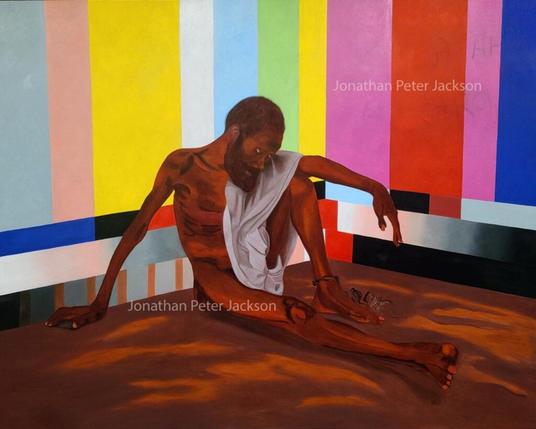
JPJ Jr: First of all, thank you very much. And I will say that it is not necessarily off-topic, because one of the main tactics of artists is to occupy spaces and work in them. So I can’t count on one hand the number of times that that was just the way we did it. I came up, it was a really vibrant scene in the late 2000s, in the late aughts, as they say, of Black artists in Baltimore. And we would just occupy spaces, frankly. So it’s not necessarily off-topic. You guys should use my piece, Saint Jerome in the Wilderness. And if you’ll remember, that is an emaciated figure chained to the floor. And so yeah, Saint Jerome in the Wilderness, I believe I executed that in 2022.

UoF: Yeah, I’m looking at it right now. Beautiful.

JPJ Jr: I did that painting for Ruchell Magee. By the way, Ruchell Magee’s holiday is coming up. We’re going to be doing a little something, and everybody should do a little something on his birthday every year, which is this Sunday, March 16th. Ruchell did 53 years in some of the most brutal penitentiaries in the world for the movement. He could have gotten out of it, but he didn’t. He took the weight. So I did that painting for him. All of my work has heavy political content, but I think this piece in particular speaks more volumes than I could say about it in general. Artists are integral to the world, and I’m about to get controversial here because I have found that in my online discourse that, unfortunately, leftists have not, by and large, acquired Gramsci, which means they don’t understand the nature of cultural production within any kind of capitalism. Forget even postmodern capitalism.

I think the most important part to remember about artistic production, I’m talking real art here, not commercial art, is not simply a reflection always of the world as it exists. I know that viewpoint is controversial, and I know that with a lot of classically trained or just trained Marxists, that will ruffle some feathers. But again, I don’t really give a damn because they don’t know what they’re talking about. I can always tell what people have read by the shit that comes out of their mouth. My grandpa used to say a version of that, Lester Jackson. He always used to tell my cousin Billy that. Anyway…what I want people to remember about artistic production within all progressive movements is that it is not simply a reflection. It can also be a production of a vision. It can shape the world and what is coming. That’s what many Marxists don’t understand, at least what I call vulgar Marxists.

UoF: Of which there are many, unfortunately.

JPJ Jr: Of which there are many, and I got to be frank, it’s fucking tragic because that discourse has been around for 70, 80 years, and it is just not being taught. One of the reasons it’s not being taught, again to beat the dead horse, is because the truly radical voices of my generation were silenced, not just from the right, but also from the left. I want you to name a protégé of Angela Davis, not someone who uses her work, but a direct protégé. I’ll pause….Okay. That’s a problem.

So at its highest level, art can be an incredibly powerful thing to organize around. In fact, it can be the most powerful thing to organize around, hence the need for People’s Museums. And guess what? They already exist, the infrastructure. I’ll say the same thing I said about college campuses. The infrastructure for People’s museums already exists, but you cannot go forward without proper aesthetic components because if you do, you’re improperly recognizing the stage of postmodern capitalism that we are in now.

The main problem with leftist progressive movements is that there is a vacuum of leadership. We have a rudderless ship, as they say on the seas, and that’s some scary shit if you can’t steer your boat, or even if the till or the wheel is there. Let’s just say that the wheel is there, so the infrastructure exists to steer the ship, and if nobody knows how or if nobody is at the wheel, you have real-world problems. I don’t see a lot of Gen X, millennial, Gen Z leadership…it’s maybe not appropriate for Gen Z yet, but there is a vacuum of voices that are stepping up or can step up. There’s some desire to step up, but with no support, you’re just speaking into a void. Yeah.

UoF: Absolutely. Anarchists tend to diagnose the existence of leadership as the problem when, like you said, the absence of radical leadership is the problem. There are self-appointed “movement leaders,” but they are mostly liberal opportunists, and these opportunists take the lead precisely because there are these structural vacuums. We need to create an alternative leadership that isn’t NGO shit and also isn’t this anarchistic no-leadership shit. And like I said earlier, we lost a whole generation of revolutionary leadership to COINTELPRO. Is there anyone today you do consider a leader?

JPJ Jr: No. No. At least, I mean, in the US, in the Global South, it’s different. I try to stay very specific to my situation because I am not a liberal. One of the lessons I learned after coming back from the Middle East is that whenever I would communicate back, my comrades there were so involved in their struggle that they just didn’t have the lens to lend a perspective to my situation.

That’s okay. In fact, that means it’s radical. And let’s forget about expressions of solidarity for a minute. That’s important, but let’s just suspend that for a second. I try to stay really, really involved in my particular situation, which is being a Black Radical in the United States of America. So that’s what I mean when you asked your question, and I said, ‘No,’ I mean, ‘No,’ fair enough. We aren’t at that stage here. Internationally, we’re talking about some different things. And yes, Hamas and the leadership there are doing a fantastic job, I think, just to put it in general terms. You know what I’m saying? And I very well may be, I mean, I could be sitting there right now and have a different view, but I’m just saying that in terms of my context. I yearn for leadership voices here in the States, as you call it, the belly of the beast. The reason I yearn for that is twofold. Either A: I want to sort of follow what it is that they’re saying and respond, ‘Yeah, right on! I’m down with that! How can I help?’ Or B: cut them to shreds. I mean, deconstruct every single thing that they’re talking about…and everybody would benefit from it, probably including them.

But the tragic part of this is a lot of this stuff currently being spouted is beneath my comment, frankly, when you see some university poser or something like that, getting up there talking loud…

UoF: Absolutely. I want to be respectful of your time, but do you have any last words?

JPJ Jr: We can definitely pick up some threads at another time. But the crucial thing is that my book, Notes of a Radical Son, is coming out next spring with Seven Stories Press. It was originally supposed to be this fall, but there have been some, how should we say, there’ve been a few struggles with constraints of the published industry, between the story they want vs. the story I need to tell.  Of course I lived the first 19 years of my life under an assumed identity as a result of August 7th. I think it will be really interesting for people to read about my experience of the revolution.

UoF: We can’t wait.

JPJ Jr: Thank you. Yeah, it should be great. One way or another, it is coming out in the spring. So whether it’s by traditional route, and I signed a really good book contract with a lot of distribution…So whether it’s by that route or if stuff just gets too heavy, we’ll either go to another smaller house that can get it done quickly, or I’ll just start serializing it on my Substack. By the way, if people want to keep up with what I’m doing day to day, that’s my primary mode of expression right now. And it’s just under my full name, Jonathan Peter Jackson.

The other important part of that memoir, I speak of ‘that’ memoir, it’s been done for five months, so I kind of think about it as ‘that’ book now. But I guess it’s ‘this’ book…the historical section about where the Jacksons come from is probably one of the more important anchors of the story, because California is only a middle part of the entire legacy as it stands now. And so that part and my 10 years in seclusion, I think are things that people will really want to try to acquire and understand because I don’t make moves lightly. When I decided to withdraw from society, it was for very good reasons. I think that I came to understand a lot during that period. As you know, I’m always talking to you about trekking and the need to be outside in your natural environment.

The main message that I would give about getting outside is that everyone in the larger progressive movement has a role to play. Nobody has no role to play. It’s really foolish to think that everyone has to do the same and think the same things and think the same way in order to bring about the desired results. That notion is being discouraged within the current form of how we’re interacting with each other. But it’s a really important thing to remember that in a larger social movement, everybody has a different role to play. So play a role. And if you don’t know your role, trust people that you trust to help you find your role.

UoF: Absolutely, we need to commit our lives to the struggle and find our role if we don’t know it already, because we all have one. Life is revolution, to quote George. And the world will die if we don’t read and act out its imperatives.

JPJ Jr: It’s a way of life for all of us. It’s very complicated. I mean, it’s simple in its conception, and it’s simple, certainly in its realization and its goal, but the enactment of the struggle is very nuanced. And nuance is a thing that we don’t know how to talk about anymore because it’s been hijacked by our devices. So the struggle, and again, you’ll find this in advanced resistance movements in, say, the West Bank and Gaza, where there’s an understanding of the nuance of life, you can pray, and if that brings you solace, you should pray. Whether that’s to Allah or Marx, hell yeah. Okay. But it’s complicated, and it’s nuanced, and it requires community organization.

UoF: Definitely, it’s complicated—moving from just reading and discussing these ideas to applying them materially, especially in the belly of the beast. A revolution here is going to look like no revolution that has ever taken place before. I mean, there are experiences we can learn from elsewhere, but it’s going to be so unique in this prison house of nations at such an acute degree of capitalist development. But we’ll only learn by trying.

JPJ Jr: Yeah, absolutely. I’ll hijack a line from some show I was watching where they were talking about, ‘Well, it looks like it’s going to be another tough year.’ And the guy says, ‘Well, to be honest, I don’t remember a year that wasn’t tough.’ You can bring that down to the daily level. It’s literally a daily struggle. So let’s pick this back up next time.

UoF: We’re excited to talk to you again soon, and to read your book. Thank you so, so much.

Download this article as a zine PDF to print/fold:

JPJ Jr Interview-1Download source: UoF

https://abolitionmedia.noblogs.org/?p=17681

#blackLiberation #georgeJackson #northAmerica #unityOfFields #us

Jonathan Peter Jackson Substack | Substack

The Radical Son on all things cultural, literary and socio-politcal. Click to read Jonathan Peter Jackson Substack, a Substack publication with hundreds of subscribers.

UoF Interview With People’s City Council LA

On 10 March 2025, Unity of Fields interviewed a comrade from People’s City Council Los Angeles. The transcript has been lightly edited for clarity. You can learn more about People’s City Council and follow their work at x.com/PplsCityCouncil and instagram.com/peoplescitycouncil.

Download a zine PDF to print/fold here.

Unity of Fields: What’s good, comrade? Unity of Fields loves the work you do with People’s City Council and has been watching it for quite a while but the last big thing that y’all were covering besides the fires were the student walkouts in East LA and across LA in general. There has been a recent uptick in activity on university campuses after the retreat from the spring uprising, but we’ve all noticed that there’s still a disconnect—and this has to do with the fact that the universities that have really popped off in New York have been bougie private schools—but there’s a disconnect between the university student movement and this more grassroots situation that popped off in LA. This isn’t really a question but I’m just opening up the conversation, I’m interested in your experiences on the ground for the LA walkouts.

People’s City Council: Yeah. I would say that the student walkouts that we saw in Los Angeles in February were entirely organic and led by high school students. And I think that’s part of the beauty of it, that they decided to take action and then started to organize walkouts in their communities, starting in East LA and they would march from East LA to City Hall. It was around the same time where very large anti-ICE protests shut down the freeway and there was a standoff with the police. And then the next night there was another large protest and hundreds of people ended up getting kettled in a tunnel. That’s one thing we try to tell people, NO TUNNELS! Don’t go! That’s one of the easiest ways to get kettled. But it was kind of this sudden flare of energy hitting the streets and high school students in LA decided to just organically start organizing around it. And I thought that was special. It had a very rebellious nature to it. When I was out and saw some of the protests downtown by City Hall, there was graffiti all over the place. There were mini street bikes and fireworks and obviously street vendors. And so it was all of these things that don’t come with a traditional manufactured rally. It was just kids hitting the streets and going out and walking out. And it was just great to see. It was truly an organic movement.

UoF: Right. You could tell it was organic because it did not have the kind of manufactured, top-down slogans, all the ANSWER Coalition pre-made posters…it also had this true mass quality where you had amerikan flags next to black anarchist flags. Obviously, I fucking hate amerika but to me this was indicative of the fact that it was not captured yet. It was totally just the masses on the street, which more sectarian people don’t really like. They’re like, “no, well, it didn’t have the correct politics right away, so therefore it’s bad and wrong.” Well, no, actually, that’s a true representation of where the migrant youth are at. And I think that if you are interested in some kind of ideological vanguard, which I am for better or worse, this to me is an opportunity to do political education, to agitate and to help them organize, to help support their self-organization and develop their lines on imperialism. I do believe that migrant youth in Southern California are going to take on a huge role as leaders in this new sequence of organization, our job is to support this in every possible way.

Another thing that I found really beautiful about the student walkouts is it was another echo of ’68, and I think a lot of people have forgotten this, there were massive student walkouts in ’68 in East LA.

There have been all of these geographic resonances with ’68, Columbia and Chicago DNC and East LA and I don’t want to fetishize ’68 or anything like that, but what’s interesting is that a lot of the same political contradictions are also coming up. A lot of the same schisms and internal movement struggles. The re-emergence of Third World Marxism as a real fighting force, the question of militancy and its necessity. The reality of the oppression of internally colonized people, specifically migrants, indigenous and Black people, and the eruption of guerrilla fighting in the Third World all happening simultaneously. It’s a tremendous amount of energy and it’s requiring us to really take sides and fight. And I don’t know, it’s a bit overwhelming to try to respond to that here after years of hegemonic social democracker nonsense. People might find this nuts but I think revolution is on the table, we have to be ready to intervene and make something out of this instability. We can’t afford to lose again.

PCC: Definitely. I think that it is important for us to let the students know about the history of walkouts in 1968, these students that were leading the protests were starting in East LA, so the community there was really sharing the history of 1968, the Chicano walkout movement—you know, tens of thousands of people were in the streets, but in the sixties in LA there was also the Watts Rebellion.

So the sixties are kind of foreshadowing what we’re experiencing now. But, also, there’s this history of walkouts in Los Angeles, not just ’68, but in 1994, tens of thousands of LAUSD (Los Angeles Unified School District) students walked out to protest this Proposition 187, which was targeting undocumented immigrants. And then in 2006, tens of thousands of students also walked out and staged blockades and blocked traffic across four freeways. Understanding what the students in LA are doing is part of a lineage—there is a history of LA students taking radical action and and we are trying to get that information out there and tell them. “This has been done before and you’re part of this history,” we want to help them appreciate that.

And like you were saying before, it’s not up to us to dictate what the youth’s organizing looks like, but instead to help and encourage them and support them in their organizing. But the youth have autonomy to organize on their own, and they believe that they took action on their own without anyone telling them to do so. And so how do you support them without really dictating what they should do? And that’s part of, I think, our whole part of the process, or our role in the process.

UoF: Yeah, I was going to ask something about that. I really appreciated the narrative work that y’all did during the Student Intifada, and it was clear that you weren’t interfering in the organizing, but still doing a lot to politicize them in a way that was a really good model and honestly something for us to learn from as well. I listened to the podcast episode y’all did about the UCLA battle and I thought that was the best narration of what happened at the UCLA encampment that I’ve heard to this day.

If you could expand on your interactions with the students, not even just at UCLA. I remember the content that you were putting out for Cal State LA, too. Even when students weren’t putting out their own messaging, y’all were doing a lot of narrative work that I thought was really powerful and got a lot of traction. I’m interested in how you were positioning your org during that moment.

PCC: Yeah, this whole thing comes back to being “outside agitators,” but the students and the youth appreciate us and want us around. Because when those zionists came to confront and attack the encampment every single night, they knew that we had their back and that we had other people coming to support them, and we’re not just going to let them be attacked. They ended up getting seriously attacked the one night. However, they did defend the camp and they held strong for hours and hours. That’s not directly related to your question, but I’m just trying to give some background

UoF: And people don’t realize how prolonged it was. A lot of people, I think, reduce what happened at UCLA to the one night of the battle but it was every single night that the zionists were attacking…throwing the backpack of lab rats, the banana incident. It wasn’t just a one off event. So that’s a really good point about mobilizing for the students, and I think that y’all definitely to do that well.

PCC: Every night, zionists would come and try to tear down the encampment walls and they would play loud music and all of these things. And also UCLA students were facing attack from so many different angles. You had the school administration that was certainly not on their side and also willing to let the zionists attack them for five hours. But if you were watching the People’s City Council feed, you would’ve seen the night of the attack coming..it was just waves and waves of attacks every single night, and you knew the school wasn’t going to step in. And so the students were facing that down. And also the school was calling in the pigs to attack and raid the encampment the next night after the big battle.

It’s overwhelming, but you have to be brave. That’s one reason why we were able to be effective in working in collaboration with the students, we’re staring down these monsters and being brave. And the students themselves and the community that showed up for them decided that’s what they wanted to do, when they made the decision that they wanted to hold it down and not vacate camp, and they’re going to fight for their right to remain there, that was a decision they made on their own. And it’s the duty of the rest of us to support them in that.

UoF: Of course, we’re talking in the context of this week, Palestinian grad student Mahmoud Khalil being kidnapped by ICE and targeted for his pro-Palestine activism at Columbia. Two million people signed his petition, there are rallies planned in many cities, he has a court appearance scheduled Wednesday, and a lot of people are truly outraged and they’re realizing that petitions and rallies are inadequate when a comrade has been kidnapped by the state. For the same reasons that high schoolers were popping off in LA to protest ICE, we think this repressive escalation, DHS kidnapping a participant in the Student Intifada, could give the movement the potential to politicize and agitate around repression and really to break free of this restrictive mold that has been imposed upon us by NGOs in the broader solidarity movement that want us to frame Palestine as only a single issue and not really talk about settler colonialism here in the US or policing or ICE beyond just paying lip service to “interconnectedness” in our rally speeches. How would this “interconnectedness” actually materialize into our strategy? I’ll leave it there if you want to speak to that at all, the limitations of framing Palestine as a single issue, how y’all as a more local group have managed to connect your other on the ground work to Palestine, what it would look like to have a broader Intifada here that isn’t just on the campuses, that’s bigger than 2020.

PCC: I think that’s a two or three part question. But I guess I’ll start with the connection to 2020 and Stop Cop City. In 2020, Trump sent out DHS to kidnap Black Lives Matters protesters in the streets in Portland. Trump also ordered US Marshals to kill anti-fascist Michael Reinoehl in his home in the summer of 2020. US Marshals killed Winston Smith in Minneapolis in 2021. Biden gets elected and the building of Cop City in Atlanta is announced, and the movement to Stop Cop City springs up, and the proliferation of cop cities across the country is in response to 2020.

The state wants to be prepared for this intifada. The state wants to crush and repress anyone taking action. And all this goes back even further to Ferguson 2014, and the Black Power and Civil Rights movement in sixties. There’s a longer historical lens, however, in the more immediate term 2020 and Stop Cop City foreshadowed where we’re at. On the question of connecting Palestine to local issues, we can talk about LA in a second, but building Cop City in Atlanta, they also said that that was a place where the IOF would come and train with American police. And there’s already these programs where American police go to Israel to train with IOF. Atlanta Police already have the the GILEE (Georgia International Law Enforcement Exchange) program. And LAPD has also gone to Israel to train with the IOF. They’ve also traded techniques on surveillance and use of drones to track people and use of surveillance to track people. And actually, LAPD uses israeli technology to monitor social media. And so there’s that explicit connection that people should make, it’s not just the single issue of Palestine.

Also, our tax dollars are not only funding the genocide of Palestinians, our tax dollars are funding this explicit connection between the American police and the Israeli military. And so that’s one way to look at it. And we (PCC) have been subject to state surveillance! The sheriffs have been posted up outside our home and LAPD was investigating our community space. They’ve targeted us for our abolitionist anti-police work. Also, a lot of our comrades are doing work with unhoused people in LA. The state has monitored that kind of activity and surveilled [and targeted] the people defending sweeps and stopping the city from throwing unhoused people’s things away on a weekly basis. Unhoused people are subjected to not just the sweeps, but the violence of police officers.

These police officers are going and getting trained and trading Israeli techniques and then coming back and using it against our people, and they’re using it against poor people. Black people are significantly overrepresented in the unhoused population. I think Black people are 8% of Los Angeles’ population but make up 34% of the city’s unhoused population. I guess this is kind of a belabored point of drawing the through line of the violence of the police state.

UoF: Yeah, everything you’re saying is definitely what we as Unity of Fields have been trying to push, because the reality of the situation is that Palestine is not a single issue. There’s a hundred thousand examples of why it’s not. But I think that there is a liberal ideology that is grafted on to Palestine that says there’s a possibility of doing a safe pro-Palestine organizing. There’s a possibility of doing something that is just targeting israel and skirting the reality of US-led imperialism. And it is obvious that this is impossible. The repression that the universities are inflicting on people who have been agitating on their campuses is indicative of that, people think divestment is this meek demand or something that can just be written on a piece of paper, but when taken to its conclusion, divestment is a massive blow to the university system..it’s clear with the amount of repression that the movement is receiving on this front that actual divestment from israel is a demand that the university system extricates itself from militarism altogether.

The university system actually cannot handle that, especially after the sixties and after the fall of the kind of golden age of the university as this place of upward mobility, it got gutted and gutted and gutted. And the university became more structurally dependent on the military-industrial-complex. So now you’re at a point where Palestine pushed the issue and made the system reveal its true face. Palestine is the tip of the spear, and what it has done is open up this can of worms where people here are saying, “we desperately need an anti-imperialist movement with teeth.” The state hates that, obviously, which is why they’re trying to crush us. And it should be noted that they’re targeting those who are public facing, which leaves those who have tried to conceal themselves in a safer position in this moment. But regardless, they’re trying to crush it all. And it’s not because Palestine is a single issue, but because Palestine reveals the deep economic and ideological ties of higher education in the imperial core with genocide across the global south, and of course, policing in the United States of America.

What I’m trying to say is that reality is telling us who our enemy is and reality is saying something radical but I don’t think our theory has done the best job of keeping up with what reality is trying to tell us. If that makes sense.

PCC: You’re saying that our enemy is the ever evolving omnipresent state, that there’s just not one particular enemy?

UoF: Well, I would say that our enemy is the United States of America as the leader of global imperialism, and that any attempts to obfuscate that have been very dangerous to us. To bring it back to 2020, we saw the capture of that moment. We all saw it in real time. It began as this very revolutionary perspective, or at least insurrectionary perspective, “the police cannot be reformed, they have to be fucking destroyed.” And then over time, it became defund the police, blah, blah, blah, this, that, and the other. And I have a lot of things to say about that and the degeneration of the ideology that came out of 2020. But I think we see a similar line struggle right now. From October 2023 until this moment, you have two different camps. You have the camp that is “pro-Palestine” on the level of moral obligation, this will not get us far. It ends up as a politics of victimhood and guilt and self-abnegation. The solidarity that flows out of this perspective is actually quite weak, it does not create political subjects that understand themselves as intervening in history. It is pacifist and always trying to appeal to the morality of our enemies. Of course, our enemies have no moral conscience. Our enemy is a thousand little Hitlers on ‘roids. Needless to say, this is not the stuff of revolutions and frankly, it is going to get people killed for unnecessary shit. On the other hand, you have the camp that is anti-imperialist and pro-People’s war. What we are saying is that we are engaged in war against this entity that is not only killing people in Palestine, but killing people here and across the global south. We have always been in a state of war but now we are fighting back. Jonathan Jackson said we are fighting on the side of the Vietcong. We say: we are fighting on the side of Yahya Sinwar. 

It’s pretty obvious that these two camps are nearly impossible to reconcile. These are two very different perspectives. One is reformist, moralistic and siloed into a single issue and the other one cannot be contained because it is international and the majority stands with us. Sorry, I’m kind of going off, but…

PCC: No, it makes sense. And also I think understanding who our enemy is, and also the extent of what the enemy is planning to do, these people straight up want to fucking kill us, and they don’t care about the rule of law. And so that’s up for the people for how they want to respond, but we should be honest about what we’re going up against and the reality of what they’re willing to do to us. And again, yeah, like we said, there’s these examples in 2020 where they killed left wing activists, they killed Tortuguita in the forest, and that is the extent that they will go. And this is no hidden secret as far as what they did in the sixties, to bring it back to that, and how they disappeared, killed, jailed, all of these revolutionaries. And so I think accepting that and accepting the moment that we’re in…the threat is the United States, and we shouldn’t seek to reform it, but also these people that this more liberal defense of what’s to come, are we actually prepared for that? And are actually these liberals, nonprofits going to feed people to the wolves? And it should be obvious to everyone at this point that the people seeking reform and pushing reform are the ones that are going to get us killed.

“…it should be obvious to everyone at this point that the people seeking reform and pushing reform are the ones that are going to get us killed…”

UoF: Well said. Absolutely. And this ties into a lot of the organizing around the Student Intifada, and I’ll just speak frankly about it. I think it’s important to be critical. There is a pernicious idea that these university administrations can be reasoned with and what we’ve learned is that they cannot be reasoned with, they’re going to collaborate with the fascist state, they are colluding with them. Again, they are little Hitlers on steroids, you cannot reason with them. Why would you try to reason with an entity you’ve just accused, correctly, of committing a holocaust? It makes no sense.

Anyway, they’re going to collaborate with the fascist state to the bitter end because these universities are an arm of the fascist state. So there’s an idea that, “oh, we can negotiate in good faith with the administration” and what comes with this idea is a lie, a lie about safe space and academic freedom and these institutions being hypocritical when they are really totally aligned with their true mission. Many in the student movement have come to believe a delusion, frankly, that being a public facing figure is solely a matter of virtue and bravery and honesty, not a strategic necessity. It’s led to a lot of dangerous mistakes and failures and in some cases, opportunistic careerism.

We are seeing that people who try to reform the institution and speak to it on its own terms are targeted because they have made themselves known and vulnerable to them. No amount of begging the enemy has provided safety, in fact, the opposite is true. All of this blows up the idea that reformism and middle of the road fence-sitting keeps people safe, it actually doesn’t. And also, this is a thing that came out of the sixties, and it was a big debate even in the Panthers, and it was one of the reasons why they split. One camp thought that they can do a kind of above ground mass movement thing when the state was trying to kill them. And the BLA camp was like, “not everyone has to be clandestine, but there needs to be that kind of underground infrastructure because it’s clear what the state is ready to do and indeed, already doing.”

There is an important lesson here. Being honest about the stakes. If we’re living in a lie while the state is doing this, then it’s going to be one person detained by DHS after another, after another, after another. And we just can’t afford to do that. Those are our comrades despite whatever disagreements we have. But it’s on us, it is the duty of the rads, to turn anti-reformism into a revolutionary culture. It protects people more, I guess is what I’m trying to say, if that makes sense.

PCC: Yeah, absolutely. I think that’s an important piece that in this zine and publication of what we’re putting out about the culture that we are trying to breed and that we’re trying to grow culture of non-cooperation or a culture of shutting the fuck up. But we should also attempt to explain to people why we are saying this. Well, things become much more difficult for you when you are in police custody. And so we should be thinking with every action, every step that we take, how do we prevent our people from becoming in police custody, both on an individual level and on a community level? And that doesn’t mean just this liberal know your rights, but it means that with every action you take, you should be thinking about how the state is going to come after you and you should be thinking that the state is attempting to gain information on you. They’re looking for sources and ways to gather information on you, whether social media or others around you, people, school administrators, things like that. And so you have to think, how do you protect yourselves as far as if they are collecting things, data posts on social media, why are they collecting those things? They are attempting to gather images of people that are there to build and include in profiles. And so when you’re masked and blocked up and protecting yourselves, you are protecting yourselves from that further surveillance. You’re never ever going to get out of anything when discussing or engaging with police. And so it should be a culture for us of non-cooperation with the police, whether it’s about us or a community, no matter what, because they are trying to get us, they are trying to imprison us and they’re trying to kill us. There is no working with the state. And so building that culture of shutting the fuck up, but actually understanding why are we shutting the fuck up? Well, because they’re trying to kill us.

UoF: We’re at war.

PCC: They’re trying to imprison us. We’re at war, right? Okay, if you want to discuss this, the Palestinian resistance is not trying to get caught when they are out in battle. They are not handing themselves over to the enemy. We should not hand ourselves over to the state under any circumstance. We should do whatever we can to prevent ourselves and our comrades from becoming in-state custody. And we talk about this quote, be water. And I think that Palestinian resistance is, they may not explicitly say it, but “be water” is a thing that they embody because they are not trying to get caught in battle. They are moving through the fields and through tunnels becayse they’re at war. They’re not trying to get caught. And so that’s a way to conceal themselves. And there is that kind of similarity of, okay, if we’re taking lessons here, that is something that should be on the top of our minds.

UoF: Totally, totally. I really strongly agree with everything you’re saying. I think a lot of people on the ground are feeling it too, particularly because of how draconian the crackdown on campuses has been, there’s just way more attentiveness to surveillance. It’s the classic thing of the repression of the institution building a more sophisticated resistance amongst the people who are there trying to fight because they can’t continue doing the same old shit. But there also has been another interesting contradiction that kind of counteracts this point that we’re making–the question of resistance speech, which is something different than action on the ground. Our movement, at its core, is about ideas and ideology. It’s like Fidel says, “I only want to fight as a solider of ideas.” We have to be clandestine and move like water on the ground, but we also have to be bold in our politics and our thinking.

I’ve found there’s a slippage or something, where we conflate needing to be secure with needing to lie about our political orientation or obscure the stakes or something like that–that we should dilute our politics to keep us safe. But this defeats the whole purpose of doing dangerous things. The dangerous things that are being done are being done out of a real political commitment, a commitment to internationalism and revolution. And in my mind, we shouldn’t hide those things. We shouldn’t apologize or be ashamed of our line or water it down at any point ever. We should figure out ways to say what must be said and evade censorship. We need to be able to do what Mao says, move with the masses like a fish in the sea, but still push a really militant, radical revolutionary politics, the correct politics. This is another thing that the Palestinian resistance does really well. Like yes, they have their clandestine military operations, but also the guerrilla is motivated by the idea of absolute liberation of the people. They are guided by Islam, by their commitment to God and the masses and the destruction of zionism and US-led imperialism in the region. Their writing is poetic and uncompromising.

Like you said, people need to shut the fuck up, but not only shut the fuck up, they should understand why they need to and about what. Something we’ve talked a lot about is whether our politics command our tactics or our tactics command our politics. Are we doing things for the sake of doing things, practicing militancy to feel more militant than everyone else? Or are we understanding the historical through lines that our work right now comes from and what our actual revolutionary base is in this country and how to mobilize them?

I think a lot of this really gets to anarchism versus communism. And that’s something we’ve progressed on a lot as we had this moment where we were working closely on the front lines with anarchists during the height of the encampments and in the aftermath. And then realized there were these fundamental political contradictions about the national question in the US context and about being upfront about what we really believe. And also this fetishization of tactics with no politics. It’s like Bernie Bros who want to throw Molotov cocktails. They want France, we want to destroy France.

PCC: Thank you. It’s making me think. Okay, so, we can potentially think about them as different things, be water and shutting the fuck up is directly related to action, and then the ideology and the narrative building around that. That is your propaganda and your comms. And I think you all understand that given the work that you’re doing and what you put out, you’re attempting to find that balance of what to do. I think for us, we’re always thinking about how to reach the masses. And to your point about anarchists versus communism, I think we’re at such a point that we should ask ourselves, who is taking action right now?

UoF: Emphatically not communists for the most part, we sense this is changing though.

PCC: Well, exactly. And I think we need people who theorize and understand and are well versed in these subjects. But also as we’re seeing in this discussion about these high school students taking action, they weren’t well versed in theory before deciding that it’s time to act and go out there. And I think similarly to the UCLA students, they found that they wanted to take action, and in the midst of taking action, they were confronted with the severe violent arm of the state. And people may not have perfect politics, and we may not be a hundred percent aligned, but as we move forward, it’s like who is really taking action? I think that right now, to form a united front on the left requires more action than theory.

People are brave when they see others be brave, and people will stand up and fight when they see others are willing to sacrifice. And so I think it’s breeding a culture of who’s willing to sacrifice, who is willing to throw down and give something. They don’t need to have perfect politics. We need people who are willing to sacrifice. And I mean, liberals aren’t going to be there anyways, so it’s not going to be a discussion of will liberalism seep in and whatnot, but yeah, let’s propel people to act and then we can ideologically sort it out. And that’s more anarchist, right? That’s not exactly aligned with Marxist-Leninist, whatnot. And I don’t know, I think that’s a big discussion, but are we at a point where it truly matters? That’s just my personal perspective like that.

UoF: Yeah, there are parts of that I don’t necessarily agree with but the general gist of it is aligned with the concept of the unity of fields. It’s not unity for unity’s sake, like you’re saying, it’s unity in action, unity in resistance. Which side of the barricades are you on? And only through taking action together will the new ideology be produced, because the revolution here is going to be unlike any other revolution that’s ever taken place.

PCC: Indeed.

UoF: This is kind of an aside question, but what role do you think the fires played in precipitating the student walkouts, if any? How did they contribute to the students’ politicization?

PCC: The fires were definitely politicizing because in LA there has been this people’s infrastructure that has been building for years, especially since 2020. Our mutual aid networks have been established and growing. And then in the face of the fires, it’s exactly what we’ve been saying and warning about in regards to the establishment, the democratic party’s inability and failure and capitulation to rich people, cops and whatnot. That was evident and people could see that, and people could also see that mutual aid was able to get up and running immediately for folks impacted by the fires. And people were getting a lot of their information from social media, traditional media still has a stronghold, but due to the left’s ability to grow its networks over the past few years, our information was being shared widely across social media. And so there was a kind of inherent politicization, that just through sharing PCC or mutual aid LA’s updates about the fires, you’re also getting our politics involved with that.

We are in service of the community first. That is our backbone, whether through action or whatever. And then through that service, our ideological framework comes through more, but being that place of information for people or being able to highlight or mobilize, the politicization comes with that. In relation to the walkouts, there’s just the attention on what is happening in LA and the urgency of the moment, and that people do understand what has been brewing and what’s been happening. The student walkouts started in East LA but it was wide across the city and the county within days. And I think that those students know about what happened at UCLA last year. Those students know what happened. Their brothers, sisters, cousins, fathers, mothers, uncles were out in the streets in 2020. And there’s this breakthrough of culture and people in LA are ready to go out in the streets. It may not be enough. It may not be enough at this point, but it has been slowly growing.

UoF: That’s so cool to think about the high schoolers having watched the battle of UCLA and then going out in the streets to launch their own protest and beat up fascists.

PCC: Exactly. They saw that, and they’re directly connected especially being close in age with the college students. UCLA held it down for as long as they could, and the community hella mobilized to support them, and they really did put up a fight against the police for five hours. They even made LAPD vacate and retreat from the camp after LAPD entered the encampment! And that was huge news. That was so fucking sick. And in that moment, in the moment of them kettling the police people in the encampment may not have known that this was possible. However, a few people said, we’re going to get these motherfuckers out of here, decided to organize and take action. It didn’t matter what the ideology of the people taking action was, they decided, “we are going to move like this and if we start moving like this, we’ll be able to make the cops retreat.” And so that’s kind of like in reference to what we’ve been talking about, people inspiring others by taking action. They were able to kettle the cops and make LAPD retreat from the encampment. And then another police agency tried to eventually raid the encampment, but it went on for hours. These people, these students and community members held the cops off for hours. And I think that is truly something that they will remember. And we will all remember for a long time, it was a real fucking struggle. I’ve been out in the streets for not that long, for over a half a decade, and I truly have never seen anything like that. And I spent a lot of time in the streets in 2020 and saw a lot of rebellious and revolutionary action. It was unreal. 

UoF: Yeah, I think that image of the battle of UCLA is really seared in all of our minds. I cry thinking about it, honestly. I remember watching it from my tent at a different encampment. Crying, crying. “LA is resisting!” Really heroic and beautiful stuff. I wont go on too long about it. Any last words?

PCC: Let me think…I guess I’ll say that we have faced serious surveillance and repression here in LA.

Also, I think this situation with Mahmoud is highlighting the importance of staying out of police custody or not getting put in police custody call. I know some of you have done time, I was arrested twice in 2022 and I had charges hanging over my head and I was placed on diversion for a year. And in that time I was being investigated by the California State Bar. So that lasted for two years, and it got resolved at the end of last year in October. I’m actually a lawyer now. But I’m growing into a role of discussing with people when taking action that we need to think about everything that comes with taking action. You are not just going out to a singular protest. You are a target of the state when you go to take action. They’re trying to come after you. They’re gathering information on you via social media, your networks, all of those things. I think Mahmoud was unmasked and a negotiator and easily identified. And that is scary, actually scary. It should be scary to people. And we want to protect people from being abducted by the state. And so it’s not like this cautious ideology where we are afraid of taking action. It’s like we have to be serious about what comes with taking action. I am a public face and I put myself out there and I’m targeted for that. And you should just know the risks of what comes with that. And I hope that comes through in this interview.

UoF: Yeah, absolutely. Building your degrees of separation with everything. Knowing the stakes and acting accordingly. This is a great note to end on. Thank you so much for your time, we are looking forward to publishing this.

PCC zine-1Download source: Unity of Fields

https://abolitionmedia.noblogs.org/?p=17609

#northAmerica #peoplesCityCouncil #Solidarity #unityOfFields

People's City Council - Los Angeles (@PplsCityCouncil) on X

Abolitionist, anti-capitalist & anti-imperialist collective amplifying voice of the ppl - direct action, public ed + community @ @RobinsonSpaceLA @pplscityprop

X (formerly Twitter)

Palestine Solidarity Direct Action at Columbia: NYC

“Im so scared. Please come.” One year ago today, these were Hind’s last words as she called for an ambulance, while Israeli forces unleashed 355 bullets murdering her as she hid in a car. One year ago, the world failed Hind. But today and everyday we owe Hind, all our martyrs, and ourselves, action. So today we acted.

Inspired by Hind, and the bravery of every Palestinian child who has faced down Israeli genocide for the last century – whether they threw a molotov at a checkpoint, a rock at a tank, or made a call for help. So long as they resist, so must we.

We attacked two targets at Columbia University. First, the Kravis Columbia School of Business, one of Columbia’s most recent violent gentrification projects into Harlem, the construction of which was conditioned on the creation of Columbia’s Apartheid Global Center in “Tel Aviv”.

We will not allow this land-grab to go unchallenged. Second, we attacked the School of International and Public Affairs – the first Columbia institution to expel a student for their support for Palestinian liberation, currently run by a former “Israeli intelligence officer” – Killer Keren, and staffed by Rebecca Weiner, head of the Counterterrorism Unit of the NYPD, who directed the brutal police assault on our comrades in Hind’s Hall last May. We left Hind’s call painted on SIPA, and we cemented the sewage lines of the entire building, forcing them to shut down business-as-usual.

We are not experts in what it means to take revolutionary action. We are people – just like you – who, today, chose to act. We were afraid- to be arrested, suspended, and expelled; and that is exactly the point. The goal is not to be fearless, but to recognize that to be afraid is merely a symptom of our moral clarity. We are soberly aware of what we may lose if we act, and we are soberly aware of how much more we will lose if we don’t.

The most severe consequence we could face today is not expulsion or prison time- it is the knowledge that we had the opportunity to act, and, instead, chose cowardice. The most severe consequence we could face is not only to have failed Hind one year ago, but to have continued to fail her today. So we invite you to join us. Let us identify the actions that elicit fear in us, find the people who we can be courageous with, embrace the fear, and take collective action.

As Hind’s mother watched the scene of Hind’s Hall unfold, she said “I wanted these movements and support to come while Hind was still alive and not after… but I was still happy that there’s a possibility that Hind’s cause could move and mobilize people in this world.”

Let us act together and transform that possibility into a reality.
For Hind, with love and rage from Columbia.

Source: Unity of Fields

https://abolitionmedia.noblogs.org/?p=14067

#DirectAction #hindsHall #nyc #resistance #Solidarity #unityOfFields

Unity of Fields (@unityoffields) on X

Anonymous submission from Columbia: "Im so scared. Please come." One year ago today, these were Hind's last words as she called for an ambulance, while Israeli forces unleashed 355 bullets murdering her as she hid in a car. One year ago, the world failed Hind. But today and

X (formerly Twitter)

Friendly reminder:

If you see profiles with Palestine flag but relaying "Israeli"/US talking points, please understand that they are either infiltrating your networks, or have fallen for the propaganda completely. Prefer blocking instead of engaging. You need true solidarity and a unity of fields, not energy sap.

@palestine #palestine #UnityOfFields #freepalestine #propaganda

It is clear to me that #Palestine and its #UnityOfFields is capable of winning its #WarOfIndependence against the Zionist entity. It is also clear to me that the West which benefits from the occupation would not change its ways till it is all over for them.
Under these circumstances, I think the need for people in the West to demand humanity from their gov't is not to save Palestine but, to save their own soul from a terrible, irrecoverable rot!

#USA #UK #Germany #West