Congrats to editors Wilco Fiers, Kathy Eng and Daniel Montalvo for the newly published @w3c #WebStandard "Accessibility Conformance Testing (ACT) Rules Format 1.1" #timetoadopt
▶️ https://www.w3.org/TR/act-rules-format/

ACT Rules Format defines a format for writing #accessibility test rules.
Accessibility Conformance Testing (ACT) Rules Format 1.1

Congrats to editors Chris Blume, Pierre-Anthony Lemieux, @svgeesus, @chrisneedham, Leonard Rosenthol, Chris Arley Seeger, Simon Thompson and Cosmin Truta for the newly published @w3c #WebStandard "Portable Network Graphics (PNG) Specification (Third Edition)"! #timetoadopt
▶️ https://www.w3.org/TR/png-3/

PNG 3 notably adds Coding Independent Code Points (CICP) for color space identification. @svgeesus explains it all: https://svgees.us/blog/cICP.html

Portable Network Graphics (PNG) Specification (Third Edition)

This document describes PNG (Portable Network Graphics), an extensible file format for the lossless, portable, well-compressed storage of static and animated raster images. PNG provides a patent-free replacement for GIF and can also replace many common uses of TIFF. Indexed-color, greyscale, and truecolor images are supported, plus an optional alpha channel. Sample depths range from 1 to 16 bits.

Congrats to editors Matt Garrish and @tzviya for the two newly published @w3c #WebStandards "Digital Publishing WAI-ARIA Module 1.1 (DPUB-ARIA)" and "Digital Publishing Accessibility API Mappings 1.1 (DPUB-AAM)". #timetoadopt

▶️ https://www.w3.org/TR/dpub-aria-1.1/
▶️ https://www.w3.org/TR/dpub-aam-1.1/

#ebooks #accessibility

Digital Publishing WAI-ARIA Module 1.1

Enabling users of assistive technologies to find their way through web content requires embedding semantic metadata about web document structural divisions. This is particularly important for structural divisions of long-form documents and goes along with embedding semantic metadata about web-application widgets and behaviors for assistive technologies. This specification defines a set of WAI-ARIA roles that are specific to helping users of assistive technologies navigate through such long-form documents.

Congrats to editors Manu Sporny, @TallTed, @ivan_herman, Gabe Cohen, Dave Longley, Michael Jones, Greg Bernstein, Michael Prorock, Markus Sabadello, Drummond Reed, Orie Steele, [email protected], Mahmoud Alkhraishi and Michael B. Jones for the latest @w3c #WebStandard "Verified Credentials 2.0". This family of 7 specs makes expression, exchange and verification of digital credentials easier and more secure. #timetoadopt

=> https://www.w3.org/TR/vc-data-model-2.0/

Read more: https://www.w3.org/press-releases/2025/verifiable-credentials-2-0/

Verifiable Credentials Data Model v2.0

A verifiable credential is a specific way to express a set of claims made by an issuer, such as a driver's license or an education certificate. This specification describes the extensible data model for verifiable credentials, how they can be secured from tampering, and a three-party ecosystem for the exchange of these credentials that is composed of issuers, holders, and verifiers. This document also covers a variety of security, privacy, internationalization, and accessibility considerations for ecosystems that use the technologies described in this specification.

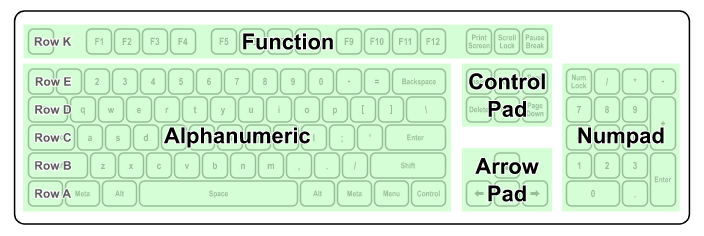
Congrats to editors Gary Kacmarcik and Travis Leithead for the two newly published @w3c #WebStandard "UI Events KeyboardEvent key Values" and "UI Events KeyboardEvent code Values" #timetoadopt

▶️ https://www.w3.org/TR/uievents-key/
▶️ https://www.w3.org/TR/uievents-code/

These specifications outline the required values for the key attribute as well as the values for the code attribute of a KeyboardEvent.

UI Events KeyboardEvent key Values

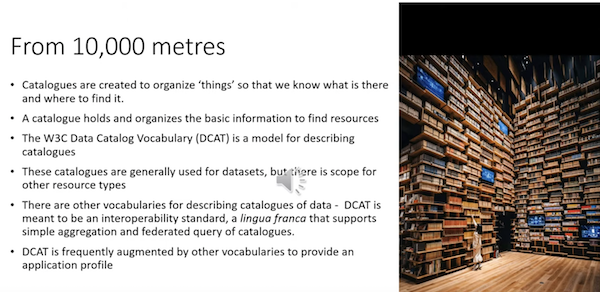
Congrats to editors Riccardo Albertoni, David Browning, Simon J D Cox, Alejandra Gonzalez Beltran, @aperego and Peter Winstanley for the newly published @w3c #WebStandard "Data Catalog Vocabulary (DCAT) - 3"
▶️ https://www.w3.org/TR/vocab-dcat-3/ #timetoadopt

DCAT is an #RDF vocabulary that improves #interoperability by standardizing dataset and data service descriptions, simplifying #metadata sharing across web-based catalogs. DCAT3 preserves backward compatibility with DCAT2

🎬 https://youtu.be/lbzMShQIvwU

Data Catalog Vocabulary (DCAT) - Version 3

DCAT is an RDF vocabulary designed to facilitate interoperability between data catalogs published on the Web. This document defines the schema and provides examples for its use.

👏 👏 Congrats to editors Dave Longley, @gkellogg and Dan Yamamoto for the newly published @w3c #WebStandard "#RDF Dataset Canonicalization"

#timetoadopt!

▶️ https://www.w3.org/TR/rdf-canon/

RDF Dataset Canonicalization

RDF [RDF11-CONCEPTS] describes a graph-based data model for making claims about the world and provides the foundation for reasoning upon that graph of information. At times, it becomes necessary to compare the differences between sets of graphs, digitally sign them, or generate short identifiers for graphs via hashing algorithms. This document outlines an algorithm for normalizing RDF datasets such that these operations can be performed.

Congrats to editor Pierre Lemieux for the newly published @w3c #WebStandard "IMSC Hypothetical Render Model"
#timetoadopt
▶️ https://www.w3.org/TR/imsc-hrm/

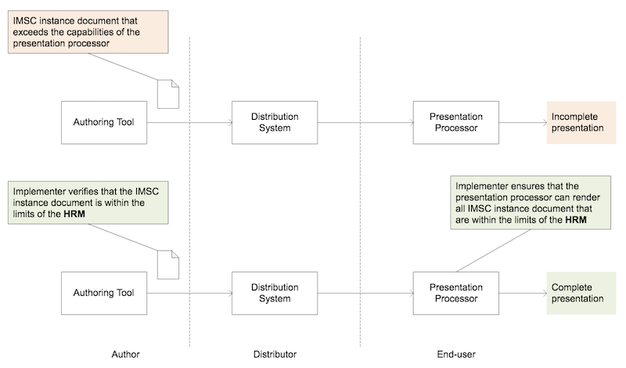
Do you need to render complex #subtitles and #captions along a #video on possibly constrained devices such a #TV sets?

The IMSC-HRM spec sets a complexity model and quality check for authors to verify smooth rendering of IMSC captions on specific devices, and for implementers to ensure timely caption rendering.

IMSC Hypothetical Render Model

This specification specifies a Hypothetical Render Model (HRM) that constrains the presentation complexity of documents that conform to the Text Profiles specified in any edition of Internet Media Subtitles and Captions ([IMSC]).

📢 Today, 3 new Web of Things (#wot) @w3c #WebStandards are published 👏 👏 👏 #timetoadopt!

1️⃣ WoT Architecture 1.1: https://www.w3.org/TR/wot-architecture11/
Congrats to editors Michael Lagally, Ryuichi Matsukura, Michael McCool and Kunihiko Toumura

2️⃣ WoT Thing Description 1.1: https://www.w3.org/TR/wot-thing-description11/
Congrats to editors Sebastian Kaebisch, Michael McCool and @ege

3️⃣ WoT Discovery: https://www.w3.org/TR/wot-discovery/
Congrats to editors Andrea Cimmino, Michael McCool, Farshid Tavakolizadeh and Kunihiko Toumura

Web of Things (WoT) Architecture 1.1

The W3C Web of Things (WoT) enables interoperability across IoT platforms and application domains. The goal of the WoT is to preserve and complement existing IoT standards and solutions. The W3C WoT architecture is designed to describe what exists, and only prescribes new mechanisms when necessary.

👏👏👏 Congrats to editors @alastc, Chuck Adams, Rachael Bradley Montgomery, Michael Cooper and Andrew Kirkpatrick for the newly published @w3c #WebStandard "Web Content Accessibility Guidelines (WCAG) 2.2" #accessibility #a11y #WCAG22 #timetoadopt

▶️ https://www.w3.org/TR/WCAG22/

Web Content Accessibility Guidelines (WCAG) 2.2

Web Content Accessibility Guidelines (WCAG) 2.2 covers a wide range of recommendations for making web content more accessible. Following these guidelines will make content more accessible to a wider range of people with disabilities, including accommodations for blindness and low vision, deafness and hearing loss, limited movement, speech disabilities, photosensitivity, and combinations of these, and some accommodation for learning disabilities and cognitive limitations; but will not address every user need for people with these disabilities. These guidelines address accessibility of web content on any kind of device (including desktops, laptops, kiosks, and mobile devices). Following these guidelines will also often make web content more usable to users in general.