
Book Review: Quit by Annie Duke

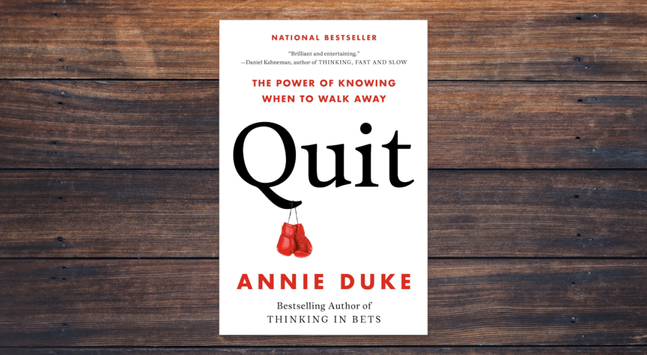
Most of us were raised on the same lesson: winners never quit, and quitters never win. It sounds like wisdom, but according to Annie Duke, it might be one of the most financially and personally damaging beliefs we carry. In Quit: The Power of Knowing When to Walk Away, Duke argues that knowing when to stop is not a character flaw. It is a skill, and learning it could change your life.

Brief Book Summary

Published in 2022, Quit makes a case that quitting, done well and at the right time, is one of the most rational decisions a person can make. Duke walks readers through the psychological forces that keep people locked into failing courses of action, from bad investments to dead-end careers, and explains why our brains are wired to resist giving up even when logic says we should.

The book draws on behavioral economics, cognitive psychology, and real-world case studies to explain the costs of persisting too long. Duke introduces concepts like “the grit trap,” the danger of sunken costs, and identity-based commitment, all of which cause people to keep going when stopping would have been the smarter move. She also offers practical tools for making better quitting decisions, including the use of “quitting coaches” and pre-committed decision criteria.

Buy Quit on Amazon

Who Is Annie Duke?

Annie Duke is a former professional poker player who competed at the World Series of Poker for nearly two decades, winning a World Series of Poker bracelet in 2004 and the Tournament of Champions in 2004. After retiring from poker, she became a consultant, speaker, and author focused on decision-making under uncertainty.

Her first book, Thinking in Bets, introduced many readers to the idea that good decisions do not always lead to good outcomes, and that separating decision quality from outcome quality is a critical mental skill. Quit builds on that framework by applying it specifically to the decision to walk away.

Duke holds a bachelor’s degree from Columbia University and completed graduate coursework in cognitive psychology at the University of Pennsylvania before leaving to pursue poker professionally. That academic background in how humans think and decide runs throughout her writing.

Lessons Readers Can Take Away

Sunk costs are a trap

One of the most valuable lessons in the book is a deeper understanding of the sunk cost fallacy. Money already spent, time already invested, and effort already committed are gone regardless of what you do next. Making future decisions based on past losses is irrational, yet nearly everyone does it. For personal finance readers, this lesson applies directly to holding onto a bad investment, continuing to fund a failing side business, or staying loyal to a financial product that no longer serves you.

Grit has limits

Duke is careful not to dismiss perseverance entirely, but she draws an important distinction between grit in service of a worthy goal versus grit as stubbornness. Persistence only pays off when the underlying path is sound. Sticking with a bad plan longer does not make it a good plan.

Identity makes quitting harder

When we tie who we are to what we are doing, walking away feels like a personal failure rather than a rational adjustment. Duke explores how this plays out in careers, relationships, and financial commitments. For anyone who has ever said “I’ve come too far to stop now,” this chapter is worth the price of the book alone.

Pre-commitment and decision criteria help

Duke recommends deciding in advance under what conditions you will quit, before emotions take over. In investing, this resembles a pre-set stop-loss rule or a rebalancing threshold. Setting the criteria when you are calm and objective is far more reliable than making the call in the heat of the moment.

Getting outside perspective matters

Duke suggests using a trusted outside party, someone not emotionally invested in your outcome, to help evaluate when it is time to walk away. For financial decisions, this is an argument for working with a financial advisor or a trusted, knowledgeable friend who can offer honest feedback rather than reinforcement.

Buy Quit on Amazon

Criticisms of the Book

No book is without weaknesses, and Quit has a few worth noting.

Some readers and critics have pointed out that Duke’s examples lean heavily on high-stakes, dramatic scenarios, from elite athletes to military operations, which can make the framework feel harder to apply to ordinary, everyday decisions. Not every reader is managing a multi-million dollar fund or competing at a world-class level.

Others have argued that the book is somewhat repetitive, making the same core arguments across multiple chapters without adding significant new depth in each one. The central thesis is compelling, but readers looking for dense, technical analysis may find the pacing slow.

There is also a fair criticism that the book does not spend enough time addressing the real-world constraints that make quitting genuinely hard for many people. Walking away from a bad job is easier when you have an emergency fund. Exiting a bad investment is easier when you have other capital. Duke acknowledges this to some degree, but critics have noted that the book occasionally underweights financial and social barriers that make rational quitting harder in practice.

Should You Buy This Book?

Yes, with a caveat about your expectations.

If you are looking for a book that will make you a more thoughtful decision-maker, especially around when to stay committed to something and when to cut your losses, Quit delivers. The core ideas are sound, well-researched, and practically useful. For anyone managing a personal investment portfolio, building a side business, or navigating a career change, the mental models Duke provides are worth internalizing.

If you are looking for a detailed how-to guide with step-by-step instructions, the book may leave you wanting more. It is better described as a framework-builder than a tactical manual.

Readers who enjoyed Thinking in Bets will likely find Quit a natural and worthwhile companion. Readers new to behavioral economics and decision-making will also find it accessible and engaging. It is not the most advanced book in this space, but it does not need to be.

Final Thoughts

The idea that quitting is always weakness is a belief worth examining. Quit: The Power of Knowing When to Walk Away gives readers the language and the logic to challenge that assumption and make better decisions as a result.

In personal finance, some of the most costly mistakes are not bad purchases or bad investments. They are the failure to recognize when something has stopped working and the reluctance to act on that recognition. Duke’s book is a useful antidote to that pattern.

It is not a perfect book, but the core argument is one that more people need to hear. If the idea of losing money on a stock you refuse to sell because you have already lost too much sounds familiar, start here.

Buy Quit on Amazon

#AnnieDuke #BookReviews #Books #DecisionMaking #Nonfiction #Psychology #Quit #SunkCostFallacy #ThinkingInBets

Who Is Annie Duke?

If you’ve ever made a financial decision with incomplete information (and you have, because everyone has), you’ve experienced exactly what Annie Duke has spent her career studying. Duke is an author, speaker, and decision science consultant whose work sits at the intersection of cognitive psychology, risk, and human behavior. Her books have become widely recommended reads for anyone trying to make smarter decisions with money, in business, and in life.

From the Poker Table to the Bestseller List

Duke was born in 1965 in Concord, New Hampshire. She attended Columbia University, where she double-majored in English and psychology as part of the first co-ed class in the school’s history. She later pursued a Ph.D. in cognitive psychology at the University of Pennsylvania on a National Science Foundation Fellowship, where her research focused on cognitive linguistics.

She left her doctoral program before completing it to move to Las Vegas and play poker professionally, a decision that would eventually shape an entirely new career. Over the next two decades, she became one of the top poker players in the world, winning more than $4 million in tournament play. In 2004, she won a World Series of Poker gold bracelet and the invitation-only WSOP Tournament of Champions, a $2 million winner-take-all event. In 2010, she won the NBC National Heads-Up Poker Championship. She retired from professional poker in 2012.

Annie Duke’s Books on Decision Making

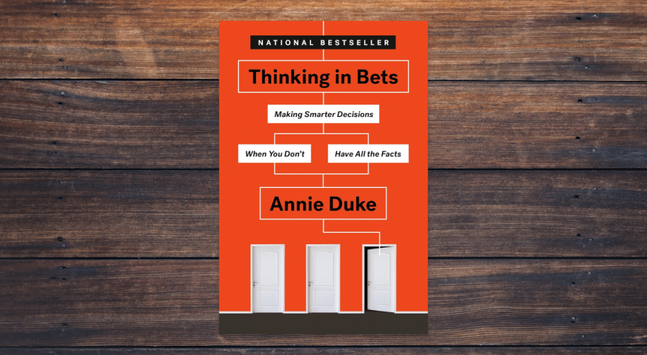
Duke’s most well-known work is Thinking in Bets: Making Smarter Decisions When You Don’t Have All the Facts, published in 2018 by Portfolio, an imprint of Penguin Random House. The book became a national bestseller and is frequently cited as one of the best books on decision making for people in finance, business, and investing.

The central idea of Thinking in Bets is that good decisions and good outcomes are not the same thing. We often judge our choices by how they turn out, but outcomes are partly determined by luck. Duke argues that the better approach is to evaluate the quality of your decision-making process rather than fixating on results. This framework is deeply relevant to investing, where market volatility can make even sound decisions look bad in the short term.

Her follow-up, How to Decide: Simple Tools for Making Better Choices, published in 2020, takes a more practical approach. It functions almost like a workbook, offering frameworks and exercises to help readers improve how they evaluate options, account for their own biases, and make more confident decisions without second-guessing themselves constantly.

In 2022, Duke published Quit: The Power of Knowing When to Walk Away. The book challenges the conventional wisdom that persistence always wins. Duke makes the case that knowing when to exit a bad situation, a failing strategy, or a sunk-cost trap is a skill, not a weakness. For investors who have ever held a losing position too long because they couldn’t bring themselves to sell, the book is particularly relevant.

Why Her Work Matters for Personal Finance

Duke’s academic background in cognitive psychology gives her books a foundation that goes beyond motivational advice. She draws on behavioral science to explain why people make the decisions they do, including why we are wired to avoid losses more than we seek gains, why we remember outcomes better than we remember reasoning, and why we tend to be overconfident in our own judgment.

These are not abstract problems. They show up every time someone holds a falling stock because selling it would feel like admitting a mistake. They show up when someone avoids looking at their budget because the numbers are uncomfortable. They show up when someone keeps contributing to a financial plan that stopped making sense years ago.

Understanding these tendencies is the first step toward correcting them, which is why many financial advisors and serious investors treat Duke’s books as essential reading.

Beyond the Books

Duke is also the co-founder of the Alliance for Decision Education, a nonprofit focused on bringing decision-making skills into middle and high school curricula. She has served on the board of the Franklin Institute in Philadelphia and has spoken at conferences for organizations across the financial services industry, including Susquehanna International Group and Citibank.

She is a Special Partner focused on Decision Science at First Round Capital, a seed-stage venture fund, where she coaches founders and investors through high-stakes decisions.

Is Annie Duke Worth Reading?

If you believe that how you think matters as much as what you know, then yes. Thinking in Bets in particular has earned a place alongside the classics of behavioral finance for its clear-eyed look at uncertainty and human judgment. It won’t tell you which stocks to buy or how to build a budget. What it will do is help you understand why you make the decisions you make and how to make better ones going forward.

That kind of self-awareness is one of the most underrated tools in personal finance.

#ActiveInvesting #AllianceForDecisionEducation #AnnieDuke #Author #Biography #Books #HowToDecide #Investing #PersonalFinance #Psychology #Quit #ThinkingInBets

Book Review: Thinking in Bets by Annie Duke

Most people evaluate their decisions by their outcomes. If something worked out well, it was a good decision. If it went badly, it was a poor one. Annie Duke’s Thinking in Bets: Making Smarter Decisions When You Don’t Have All the Facts, published in 2018, argues that this is one of the most pervasive and damaging cognitive errors we make, and that learning to separate the quality of a decision from the quality of its outcome is one of the most valuable intellectual skills a person can develop. For investors, financial planners, and anyone trying to make better decisions under uncertainty, this book offers a framework that is both practically useful and intellectually honest in ways that most decision-making literature is not.

Buy Thinking in Bets on Amazon

Who Is Annie Duke?

Annie Duke was born in 1965 in Concord, New Hampshire, into an academically oriented family. Her father was a teacher and her brother Howard Lederer became a prominent poker player, which eventually drew her toward the game as well. She studied psychology at Columbia University and was pursuing a PhD in cognitive psychology at the University of Pennsylvania under Irv Gottesman when a fellowship fell through and she temporarily relocated to the southwest with her then-husband. That detour led her to poker, and what began as a way to make ends meet became a two-decade professional career.

Duke became one of the most successful poker players in the world, winning the World Series of Poker Tournament of Champions in 2004 and the NBC National Heads-Up Poker Championship in 2010. She earned more than four million dollars in tournament winnings before retiring from professional play in 2012. Since retiring, she has worked as a consultant, speaker, and author focused on decision-making, corporate strategy, and cognitive bias. She is also a co-founder of the Alliance for Decision Education, a nonprofit dedicated to improving decision-making skills in schools.

Her background in cognitive psychology combined with her experience making high-stakes decisions under uncertainty across thousands of hours of professional poker gives her an unusually credible platform for writing about decision-making. She is not a theorist describing the process from the outside. She is someone who spent two decades being financially rewarded or punished for the quality of her thinking in real time.

What the Book Is About

The central premise of Thinking in Bets is that most consequential decisions in life resemble poker more than chess. Chess is a game of perfect information. Both players can see the entire board. Skill is the dominant factor in outcomes. Poker, by contrast, is a game of incomplete information. You cannot see your opponents’ cards. Luck plays a significant role in any individual outcome. The best player will not win every hand, and even poor decisions will sometimes produce good results. Over a large enough sample, skill dominates, but in any given instance, the relationship between decision quality and outcome quality is loose and unreliable.

Duke argues that life, investing, careers, and relationships all work this way. We make decisions based on incomplete information, and chance plays a real role in how those decisions turn out. The investor who puts money into a well-researched company that subsequently fails due to an unforeseen event did not necessarily make a bad decision. The investor who bought a poorly researched stock that happened to triple did not necessarily make a good one. Evaluating decision quality by outcome quality, which Duke calls resulting, is a systematic error that prevents us from learning accurately from experience.

The book introduces the concept of thinking in bets as a corrective. A bet forces you to assign probabilities, acknowledge uncertainty, and commit to a position while recognizing that you could be wrong. Rather than saying something is true or false, the betting frame asks how confident you are and what evidence would change your mind. Duke argues that adopting this frame habitually produces better decisions, more accurate beliefs, and a healthier relationship with both success and failure.

The book also covers related concepts including motivated reasoning, the tendency to evaluate evidence based on whether it supports what we already believe; the distinction between luck and skill in outcomes; the value of seeking out people who will challenge your thinking rather than validate it; and the importance of thinking about decisions from the perspective of your future self rather than your present emotional state.

Buy Thinking in Bets on Amazon

Lessons Readers Can Take Away

The most immediately applicable lesson for personal finance and investing is the separation of decision quality from outcome quality. Markets are full of noise. Even excellent investment decisions, made with careful research and sound reasoning, will sometimes produce poor short-term results. Even terrible investment decisions will sometimes produce good ones. The investor who abandons a well-reasoned long-term strategy after a bad quarter because the outcome was bad, and concludes the strategy itself was wrong, is committing exactly the error Duke describes. So is the investor who doubles down on a poorly reasoned strategy because it happened to work once.

The practical implication is that evaluating your financial decisions should focus primarily on the quality of your reasoning at the time you made them, the information you had access to, the process you used, and whether your assumptions were sound, rather than primarily on whether they produced good outcomes. A well-reasoned decision to contribute consistently to a diversified S&P 500 index fund is a good decision regardless of what the market does in any given year. Judging it by short-term results rather than by the soundness of the underlying reasoning is how investors make avoidable mistakes.

A second valuable lesson concerns the concept of resulting as it applies to financial regret. Many investors carry significant regret about financial decisions that turned out badly and tend to attribute those outcomes entirely to their own failure of judgment. Duke’s framework invites a more honest accounting. How much of the bad outcome was foreseeable given what you knew at the time? How much was attributable to genuinely unpredictable chance? Separating those two components is uncomfortable because it requires accepting that you cannot always control outcomes, only processes. But that acceptance is exactly what allows you to improve your decision-making over time rather than simply feeling bad about results.

A third lesson involves the value of what Duke calls a truth-seeking pod, a group of people who are committed to giving you honest feedback rather than validation. In investing and personal finance, the equivalent might be a trusted financial advisor who will tell you what you need to hear rather than what you want to hear, or a community of investors who hold each other accountable to process rather than celebrating each other’s wins and minimizing each other’s losses. The most reliable path to better financial decisions runs through honest feedback, not comfortable agreement.

A fourth lesson involves temporal discounting and the conflict between your present and future self. Duke argues that many poor decisions happen because we give too much weight to our present emotional state and too little to the interests of our future self. The person who cashes out their retirement account to cover a short-term expense, the investor who sells during a market panic, and the consumer who takes on high-interest debt for an immediate purchase are all, in Duke’s framework, making decisions that their future self will pay for. Building financial systems that reduce the influence of present-self emotional states, through automatic savings, long investment time horizons, and clear written investment policies, is a direct application of her thinking.

Buy Thinking in Bets on Amazon

Criticisms of the Book

Thinking in Bets is a strong and genuinely useful book, but it has limitations worth acknowledging.

The most common criticism is that the book’s central insight, separating decision quality from outcome quality, is introduced clearly and compellingly in the early chapters but is then stretched across a book-length treatment that occasionally feels like it is repeating the same core point in slightly different contexts. Some readers find that the book’s ideas are fully absorbed within the first third and that the later chapters, while adding supporting material, do not substantially deepen the framework. A tighter, shorter book might have served the ideas better.

A second criticism is that the poker metaphors, while illuminating in many contexts, occasionally strain when applied to personal and financial situations that differ from poker in important ways. Poker is a zero-sum game with clear rules and quantifiable probabilities. Many real-world decisions involve genuine moral dimensions, relationship dynamics, and uncertainties that are not reducible to probability estimates in the way Duke’s framework sometimes implies. The betting frame is a useful heuristic, but it is not a complete theory of decision-making under uncertainty.

A third criticism is that the book’s advice, while sensible, is easier to articulate than to implement. Knowing that you should separate outcomes from decisions, seek honest feedback, and think probabilistically does not automatically produce the behavioral changes those habits require. The gap between intellectual understanding and actual behavioral change is significant, and Thinking in Bets does not engage as deeply with the mechanics of that change as books specifically focused on habit formation, such as Atomic Habits by James Clear, tend to do.

A fourth criticism is that Duke’s examples occasionally favor cases where her framework applies cleanly and underrepresent the messier situations where the lines between skill, luck, process, and outcome are genuinely difficult to draw. The real world of investing and personal finance is full of those messier situations.

Should You Buy This Book?

Yes, particularly for anyone who invests money, makes significant financial decisions, or is interested in understanding the cognitive mechanisms that lead to poor choices under uncertainty.

Thinking in Bets belongs on the same shelf as Thinking, Fast and Slow by Daniel Kahneman and The Psychology of Money by Morgan Housel. All three books approach human decision-making from different angles but arrive at overlapping and mutually reinforcing insights about why smart people make avoidable financial mistakes and what can be done about it. Duke’s contribution is the most accessible of the three in terms of pacing and readability, and her poker background gives her examples a vividness and credibility that purely academic treatments of the same material sometimes lack.

For investors specifically, the book’s core insight about resulting has immediate and practical value. The single most destructive pattern in retail investing is abandoning sound long-term strategies in response to short-term outcomes, buying after markets rise and selling after they fall, based on the implicit assumption that recent results are reliable signals of decision quality. Duke gives you a clear and memorable framework for recognizing and resisting that error.

At its length and price, it is a reasonable investment of both money and time, and it is likely to pay dividends in the quality of your financial thinking for years after you finish it.

Final Thoughts

Thinking in Bets is a book about intellectual honesty under uncertainty. It asks you to accept that you will never have all the information you want before making consequential decisions, that luck will always play a role in how those decisions turn out, and that the only thing genuinely within your control is the quality of your reasoning process. That is an uncomfortable message in a culture that tends to celebrate outcomes regardless of process and blame individuals for results that were substantially determined by chance.

But it is an accurate message, and accuracy is exactly what good financial decision-making requires. The investor who understands this distinction approaches the market with a fundamentally different, and considerably healthier, psychology than one who does not. They stay the course during downturns because they understand that a falling portfolio does not necessarily mean a poor investment decision was made. They avoid chasing performance because they understand that a rising portfolio does not necessarily mean a good one was. They build their financial lives around sound processes and give those processes the time they need to work, which is precisely what decades of evidence on long-term investing consistently recommends.

Annie Duke did not set out to write a personal finance book, but she produced one of the most useful frameworks for financial thinking published in the past decade. That is worth recognizing and worth reading.

Buy Thinking in Bets on Amazon

#AnnieDuke #BookReviews #Books #Investing #Nonfiction #Psychology #ThinkingInBets
"Progressing from primity, through secundity, to tertiality, the relationship of security to uberty is an inverse one, which means, plainly, that as the certainty of any guess plummets, its heuristic merit soars correspondingly."
#ThinkingInBets
MIT has an open course in winning at Texas Hold 'Em

MIT has an open course in winning at Texas Hold 'Em

Boing Boing