Around the Flaming Star

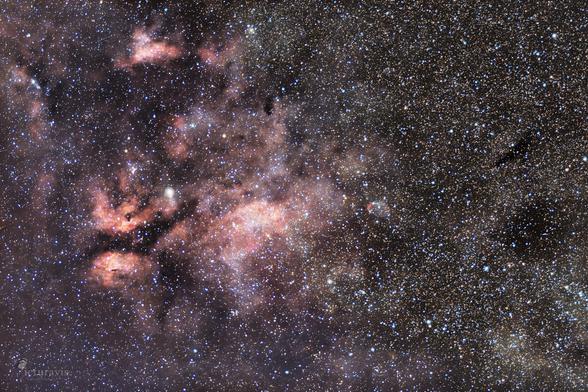
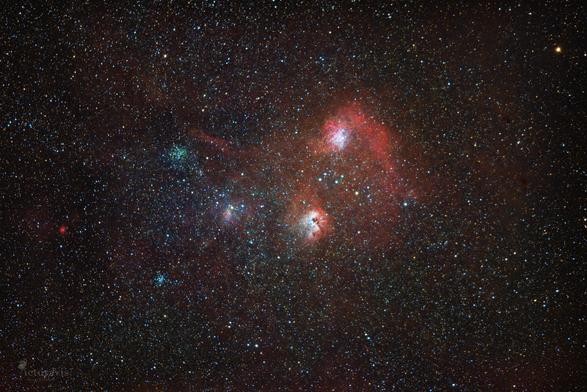
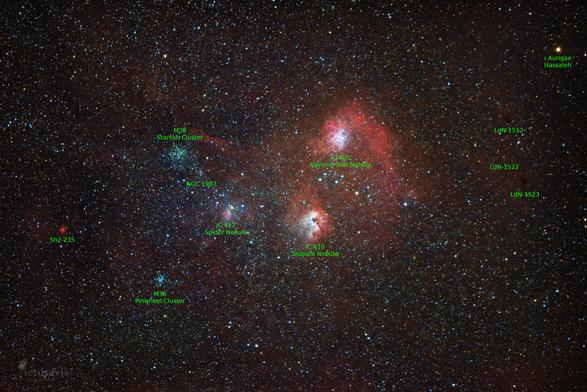
This image depicts a region in the Auriga constellation, including multiple deep-sky objects. I aimed for the Flaming Star Nebula (IC 405) and the Tadpole Nebula (IC 410), but the wider framing of the lens includes the star clusters M36, M38, and NGC 1907, as well as the nebulae IC 417, Sh2-235, LdN-1512, LdN-1522, and LdN-1523.

As with my previous DSO images, this image was taken without a tracker but with sporadic manual tracking with a standard DSLR setup with a 105 mm macro lens. This time I used 1360 × 2 s frames, resulting in 45 m 20 s exposure time.

This relatively short integration time is near the limit of what is possible for me, as the large number of frames requires a lot of storage during processing (>700 GB in this case). Details of the nebulae are not obtainable with this method, but the general shape can be seen. It also only works well with larger objects, as the relatively wide tele, noise, and resolution limits do not allow capturing details of smaller DSOs.

Despite the limitations, it is fun to experiment without a tracker and see what is possible.

The workflow included #Siril, #GraXpert, #StarNet, and #GIMP.

Nikon D500, Sigma 105mm EX DG OS HSM, 105 mm, f/2.8, 1360x2 s, ISO 3200, tripod, no tracker
#Nebulae #StarCluster #astrophotography #photography #germany #digikam
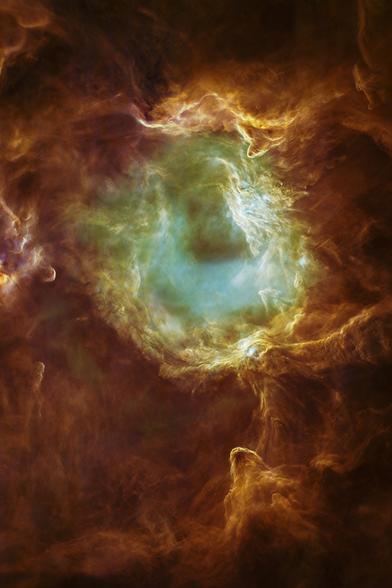
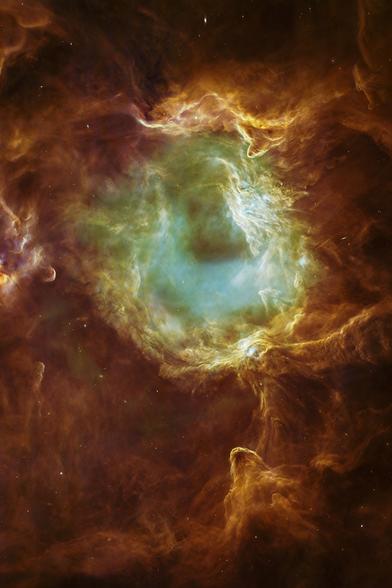
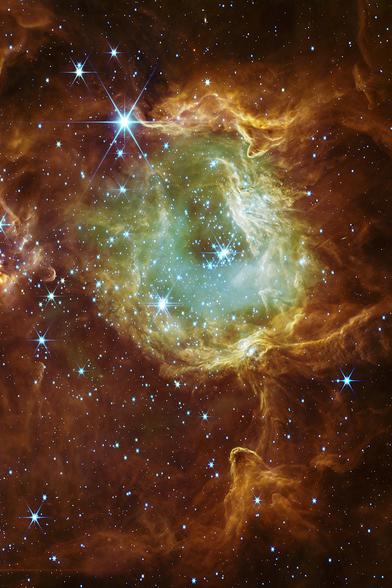
Cat's Paw Nebula

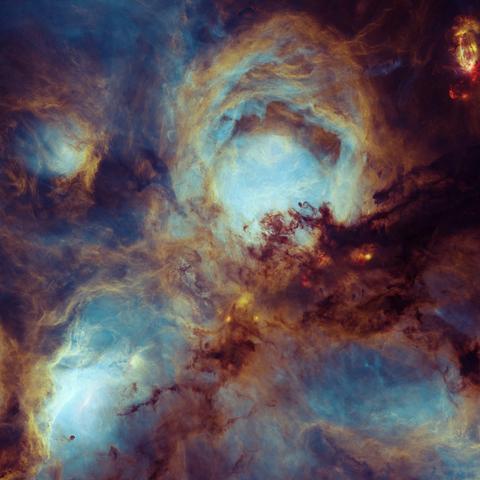
This is my attempt at the James Webb Space Telescope data of the Cat's Paw Nebula NGC 6334. Many stars were removed or oversaturated in the filter data downloaded from MAST, resulting in a lot of artifacts in the short- and long-wavelength composite images created with #Siril. I combined both images in #GIMP and tried to fix some of the artifacts. After different tries, also on the raw data, I decided to run #StarNet++ on the combined FITS file created with GIMP and then painstakingly clean the rest (felt like 10000) of the star artifacts up. I tried to stay true to the nebula by interpolating what the area behind and around the stars most likely looks like. GIMP's heal brush worked really well, but it took many hours to complete.

The full-resolution image can be seen on my website when choosing the original size in the upper right corner (warning: it is 77 MB in size): https://www.picturavis.com/picture?/391/categories

Telescope: JWST/NIRCam
Proposal ID: 6778
Observation description: NIRCam observations of a star forming nebula
Release date: 10.07.2025
Filters: F090W (blue), F187N (light blue), F200W (blue-green), F277W (yellow-green), F335M (yellow), F444W-F470N (red)

#CatsPawNebula #NGC6334 #JWST #JamesWebb #NIRCam #Nebula #SpaceTelescope #astrophotography #DeepSky #DigiKam

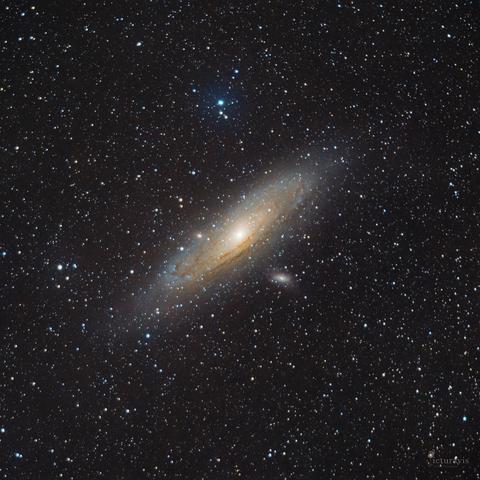
M31 Andromeda

I went outside for the Aurora party, and all I got was this lousy Andromeda Galaxy.

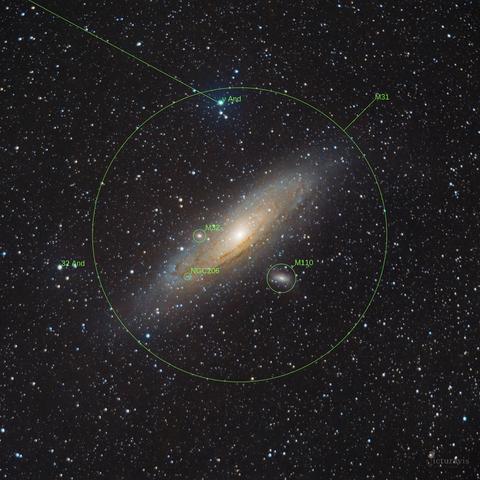
Since I was a day late for the aurora, but the sky was relatively clear, I decided to try the Andromeda Galaxy (M31) again, this time with more integration time. This was in a Bortle class 4–5 area with occasional thin clouds (you can see the shine around the bright stars), but at least the moon rose late. It (again) worked out better than expected. M32 and M110 are clearly visible, and even finer details and colors of the galaxy can be seen.

This time, I used 868 frames with a total exposure time of 28 minutes and 56 seconds, with sporadic manual tracking. The FITS sequence file of the registered images was over 200 GB… and the standard processing script failed, because today I learned 400 GB is apparently not enough free space for processing astro images.

Post-processing was done in #Siril with #GraXpert and #StarNet, and then #GIMP including #GMIC. The annotation in the second image was also done in Siril.

Without a tracker, the larger field of view of the 158 mm (effective) lens is good, as I did not have to adjust the camera as often. But the need to crop out less-exposed outer areas reduces the available final resolution. Additionally, the maximum limit of 2 s exposures (any more and the Earth rotates too fast) requires many images (and data).

Nikon D500, Sigma 105mm EX DG OS HSM, 105 mm, f/2.8, 868x2 s, ISO 3200, tripod, no tracker
#Andromeda #Galaxy #astrophotography #photography #germany #digikam
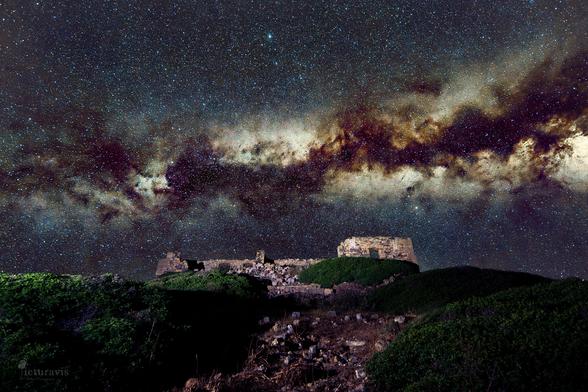
Look into the past 2.0

Ruins of the ancient cretan city of Itanos ( Ίτανος) in front of the Milky Way.

This is a second attempt at photos taken in 2022.

The Milky Way was photographed with an integration time of 38 x 8s = 5m 4s and processed with #Siril, #GraXpert, #StarNet and #GIMP. The ruins were taken with 30s exposure and light painted with a flashlight, then processed with #RawTherapee and GIMP. Final composition was done in GIMP.

Milky Way: Nikon D500, Tokina AT-X 11-20 f2.8 PRO DX, 11 mm, f2.8, 38x8s, ISO 3200, tripod
Ruins: Nikon D500, Tokina AT-X 11-20 f2.8 PRO DX, 11 mm, f2.8, 30s, ISO 800, tripod, light painted
#astrophotography #ruins #nightscape #milkyway #photography #greece
The Pleiades 2.0

This is a second attempt at post-processing the Pleiades star cluster (M45). This time, I took more time to learn #Siril and added #GraXpert for background extraction and denoising.

The data are the same as in the previous attempt, so you can see how important post-processing is in astrophotography. Fine details are not visible, as the data do not contain enough information, but to my taste, this version is much improved.

I am still very impressed with what is achievable with a standard DSLR, a fast lens, and a standard tripod.

Nikon D500, Sigma 105mm EX DG OS HSM, 105 mm, f/2.8, 177x2 s, ISO 3200, tripod
#pleiades #astrophotography #photography #germany #digiKam #StarNet #GIMP
Comet 2025 A6 Lemmon

The conditions on Sunday (19.10.2025) were good, so I drove out to photograph the comet C/2025 A6 Lemmon. It was only visible in the camera and not to the naked eye.

This image is a composite of the comet, stars, background without stars, and the foreground. Except for the foreground, the image was created from 171 frames (14 minutes and 15 seconds of exposure) using #Siril, including #StarNet. Post-processing and final composition were done in #GIMP.

Nikon Z50, Nikkor 17-28/2.8, 28 mm, f/2.8, 171×5 s, ISO 1600, tripod
#comet #lemmon #astrophotography #photography #nightscape #germany #digikam
Andromeda Galaxy

This image of the Andromeda Galaxy (M31) was not planned. I saw M31 on the Stellarium app while outside for Comet Lemmon and thought, why not? I took a few photos but gave up early because I thought my equipment would not be enough to get any details. Turns out I was wrong, and you can get details even with a 105 mm f/2.8 macro lens on a crop-sensor DSLR.

This was just 23 photos, resulting in 46 seconds of exposure. Post-processing was done in #Siril with #StarNet, followed by #GIMP and #Darktable. Next time, I’ll know better!

Nikon D500, Sigma 105mm EX DG OS HSM, 105 mm, f/2.8, 2 s, ISO 3200, tripod
#Andromeda #Galaxy #astrophotography #photography #germany
Milky Way Section

A section of the Milky Way from 118 images (9 minutes 50 seconds exposure time). I played around with the #StarNet integration in #Siril to bring out the structure of the Milky Way independently from the stars.

Nikon D500, Nikon AF-S Nikkor 50mm f/1.8G, 50 mm, f/1.8, 5 s, ISO 3200, tripod
#MilkyWay #astrophotography #photography #germany #digiKam #Darktable #GIMP

Tja - wenn das Wetter mal mitspielt…
Sh2-155 oder C 9 „Höhlennebel“.
In mehreren Nächten insgesamt fast 6h mit verschiedenen Einstellungen mit meinem #dwarf3 ausgenommen und in #siril mit #starnet , #graxpert und #cosmicclarity nachbearbeitet…

#astronomy #astrophotography

Hier noch womit mein #dwarf3 beschäftigt war, während ich die Milchstraße bewundert hatte (siehe mein letzter Post):
NGC 281 - Pac-Man Nebel.
240 Aufnahmen a 30s, nachbearbeitet mit #siril , #starnet und #graxpert - aber ich denke, das bekomme ich noch besser hin, man lernt ja nicht aus.

#astrophotography #astronomy