🤯 STOP SCROLLING! Did you know Earth’s tallest mountain, Mount Everest, is only a fraction of the size of Mars’ giant volcano?

Olympus Mons is a stunning 3 times taller than Everest! 🚀 But why could Mars build such a colossal peak when Earth could not? The answer lies in planetary physics, low gravity, and a lack of plate tectonics.

https://factovate.com/how-much-taller-is-olympus-mons-than-mount-everest

#OlympusMons #MountEverest #MarsFact #SpaceFact #FACTOVATE #SolarSystem #Science #ma

How Much Taller is Olympus Mons Than Mount Everest? Stunning 3X Fact -

Discover the colossal truth! Get the exact answer to how much taller is Olympus Mons than Mount Everest and learn the surprising Martian physics that allowed it to grow 3x the size of Earth's biggest mountain.

Factovate
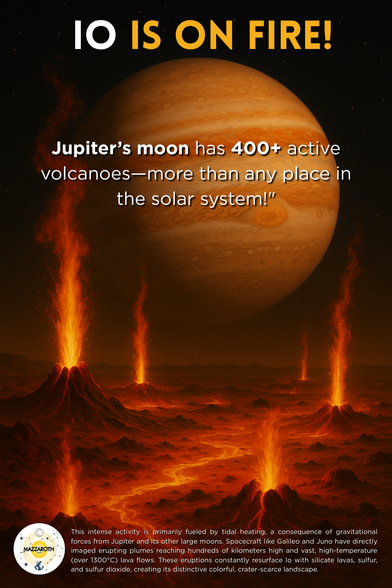
Jupiter’s moon Io has over 400 active volcanoes. it’s the most volcanic body in the solar system!
#Io #Jupiter #VolcanicMoon #SpaceFact #Astronomy #NASA #SolarSystem #MoonTrivia #PlanetaryScience #science #scifi #sciencefiction #space

Today’s bite-sized space fact:
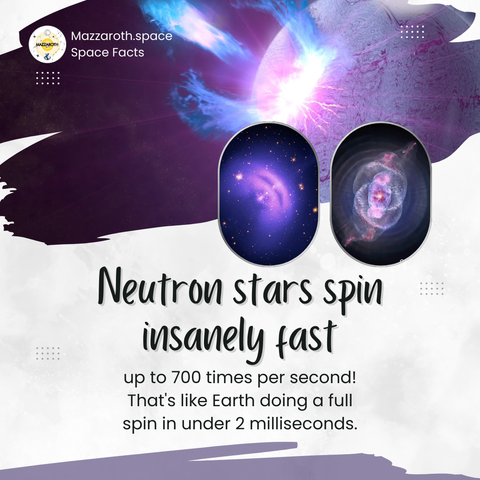
Neutron stars — the ultra-dense remnants of massive stars — can spin up to 700 times per second. That’s faster than a kitchen blender! 🤯
Mind = Blown.

#Astronomy #NeutronStar #SpaceFact #Science #Astrophysics #SpaceNews #Stargazing

#SpaceFact: Did you know? To ignite a #LiquidRocketStage in space, it has to be thrusting already. Otherwise, the propellants will float around in its tanks and the engine will ingest gas instead of liquid. That means you have to ignite when the lower stage is thrusting - or use a separate small rocket motor (called an #ullage motor) to thrust it before igniting.

It took the loss of a few early space rockets to learn this fact!

Did you know stars have been getting smaller on average as the universe gets older?

This is because as stars first collapse they release a lot of radio waves. Hydrogen and helium tend to ignore this, but it can heat up heavier elements. The more heat they catch the more gas and dust they blow away, which could otherwise have fallen onto the star and made it bigger

As the universe ages more matter is being turned into these heavier elements through fusion in stars and such. This means this happens sooner and sooner in a stars formation as time goes on.

Stars seem simple on the surface but wow there is actually a lot going on with every step of the process

#Astronomy #space #spaceFact

NASA's Juno Mission Spots Two Jovian Moons - 11/29/2021

Non-Random Space Fact: Io is currently the most geologically active place in our solar system. It's volcanoes can sometimes be seen with large Earth-based telescopes.

Credit
Image data: NASA/JPL-Caltech/SwRI/MSSSImage processing by Gerald Eichstädt/Thomas Thomopoulos © CC BY

Original post can be found here with more details about the image and the Juno mission: https://www.jpl.nasa.gov/images/pia25019-nasas-juno-mission-spots-two-jovian-moons

#SpaceForAll #Jupiter #Io #Space #SpaceFact

NASA's Juno Mission Spots Two Jovian Moons

As NASA's Juno spacecraft sped low over the giant planet's cloud tops, on Nov. 29, 2021, its JunoCam instrument captured this look at two of Jupiter's largest moons.

NASA Jet Propulsion Laboratory (JPL)

Yo did you know that the amount of metals in a dust cloud help determine how big a star gets? This is because there is very little pressure in space, so any amount of heat is enough to start blowing dust clouds away from a newly forming star.

Metals absorb radio waves much more readily than hydrogen and helium, and so the heat from a star is much more easily transferred to the gas and dust around it. This means it stops collecting them earlier and ends up smaller.

This is why older stars tend to be larger, as the metal content of the universe has been steadily increasing as stars are formed. I wonder what future stars will look like, in tens and hundreds of billions of years from now.

#Space #spaceFact #Astronomy

today is type Ia supernova, a classic.

This one is what we call a standard candle, it has just about the same brightness every time it happens. This allows us to tell how far away it is and through that the distance of whatever galaxy its in. This happens because the conditions it happens under are extremely specific, a 1.44 solar mass white dwarf star, typically with a red giant companion accreting matter onto it. (This just means it falls off the red giant onto the much smaller and denser white dwarf.)

A white dwarf is a star held up by something called degeneracy pressure. This is caused by what we call the Pauli exclusion principle. This is the fact that fermions (a type of particle, electrons in this case), cannot exist in the same space at the same time at the same energy level. After a certain point to increase density the system must become hotter, allowing particles to enter into higher energy states that allow them to exist in the same space. In a gravitational system like a star increasing mass allows it get denser in a situation like this. If we just leave it alone it would just slowly sit there and cool off over time.

At roughly 1.44 solar masses a white dwarf reaches a level of density that is high enough to fuse the carbon it is typically made of into other elements. This happens throughout the entire star at the same time and is enough to blow it to pieces.

These supernova were essential to finding out the universe was expanding because they are common and bright enough to measure them happening in a whole lot of galaxies. This and the fact that even though they involve so many processes they manage to be very consistent makes them my favorite.

#Astronomy #space #spacefact

Let's talk a little bit about type II supernova

Iron is the top of the tipping point that causes them. Iron is the most stable element. It has the highest binding energy per nucleon out of all of them. Binding energy is a fancy way of saying the amount of energy it takes to pull apart this atom into its individual neutrons and protons, or in reverse how much energy is released when they are brought together. Per nucleon just changes it to the amount of energy per particle involved. If the energy per particle is lower, then it has to absorb energy to get into that state.

This is very important for stars because what we call main sequence stars rely on fusion to keep them up. They just shove these atoms together into states where the binding energy per nucleon is lower, and the heat released pushes back against gravity so they don't collapse. The thing is, if a star starts fusing something heavier than iron, that suddenly starts absorbing heat instead of releasing it.

This means the star can't keep itself up, and as it collapses it just causes more heat which is then just siphoned off into more elements heavier than iron. This suddenly puts the star into freefall.

The outer layers of a star this size will be hydrogen and helium. This collapses onto the core and then suddenly starts a ton of fusion. As more hydrogen and helium piles on it concentrates it and then eventually explodes outward as bright as an entire galaxy.

Some stars aren't massive enough to fuse carbon into other elements, like our sun, and so never get to this point. Some stars are so massive they will actually go supernova long before this. So there is a lot more to talk about here. We will go over the other types o supernova in future posts uvu

#space
#Astronomy
#spacefact