Digital dark times: Salaries in digital preservation

by @beet_keeper

The Serpentine is one of the world’s most renowned art galleries. Their exhibitions as varied as Gerhard Richter, Damien Hirst, and Marina Abramović. They don’t hold a permanent collection, instead, they provide a space for temporary collections and an annual pavilion, the pavilion designed by luminaries such as Zaha Hadid, Frank Gehry, and Ai Weiwei.

Given a recent job posting it looks like they are looking at maintaining their memory better and branching out into digital preservation.

Here’s the kicker — its salary band is GBP 35,000 to GBP 38,000. So it must be an entry level position, especially in London, right?

Well, let’s see what they want you to do for that price tag…

Continue reading “Digital dark times: Salaries in digital preservation”


#Archives #Art #artGalleries #artHistory #ArtsCouncilEngland #career #digipres #DigitalArchiving #DigitalHumanities #DigitalPreservation #digitalPreservationIsPeople #dpip #earlyCareer #employment #GLAM #jobPostings #london #outreach #salaries #Serpentine #SerpentineGalleries #SerpentineGallery

Ownership: Emerging Strategies for Interdependence

How can art and culture help reshape our understanding of ownership?

https://www.radicalxchange.org/events/2023-london/

#Art #Common #Culture #Ownership #PartialCommonOwnership #RadicalXchange #Re-commoning #RxC #SerpentieArtsTechnologies #SerpentineGalleries

2023 London

We are a community of activists, artists, entrepreneurs, and scholars committed to using mechanism design to inspire radical social change.

RadicalxChange

Counterspace combines abstracted fragments of London for carbon-negative Serpentine Pavilion

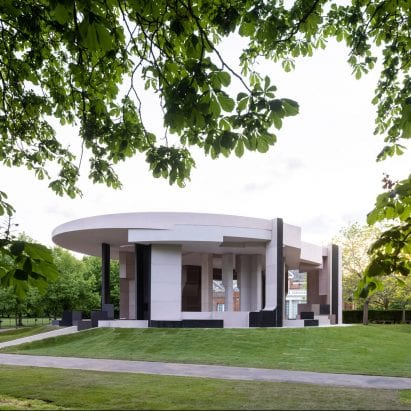
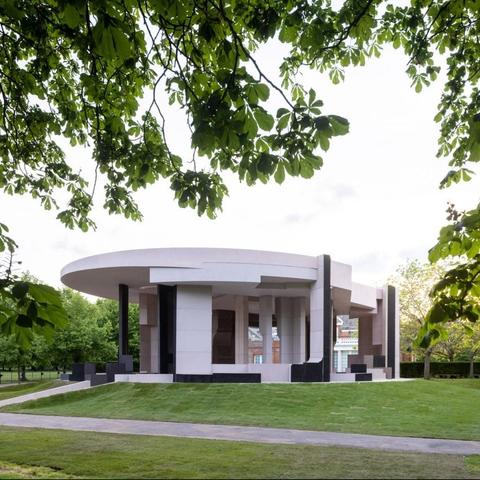
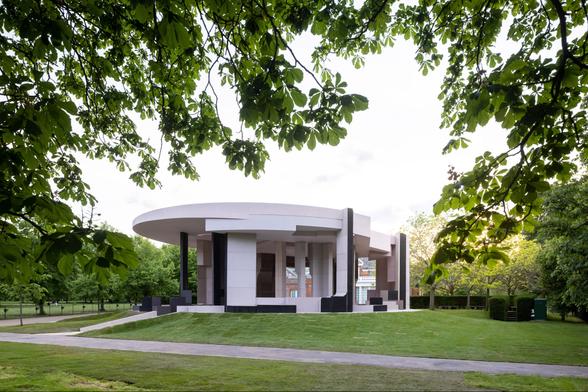
South African studio Counterspace led by architect Sumayya Vally has unveiled a pink and grey structure built from elements informed by buildings in London as this year's Serpentine Pavilion.

The coronavirus-delayed structure designed by Vally was designed to reference informal meeting spaces in areas of London that have large migrant populations.

"My practice, and this pavilion, is centred around amplifying and collaborating with multiple and diverse voices from many different histories; with an interest in themes of identity, community, belonging and gathering," said Vally.

This year's Serpentine Pavilion was designed by Sumayya Vally of Counterspace

Counterspace's pavilion is the 20th temporary structure to be built in Kensington Gardens near the Serpentine Gallery as part of the annual programme.

Vally, who was recently named one of Time magazine's 100 leaders of the future, is the youngest architect to receive the prestigious commission.

Dezeen has published an exclusive video interview with Vally about the pavilion and has partnered with the Serpentine Gallery to live stream a conversation between her and Serpentine Galleries artistic director Hans Ulrich Obrist at 1:00pm London time on 9 June.

The pavilion was designed as a place of gathering

To create the pavilion, Vally spent four months in London investigating spaces of gathering that were significant to migrant communities.

These include the Fazl Mosque and East London Mosque, which were some of the first mosques built in the city, the Centerprise cooperative bookshops in Hackney, The Four Aces Club on Dalston Lane and The Mangrove Caribbean restaurant in Notting Hill.

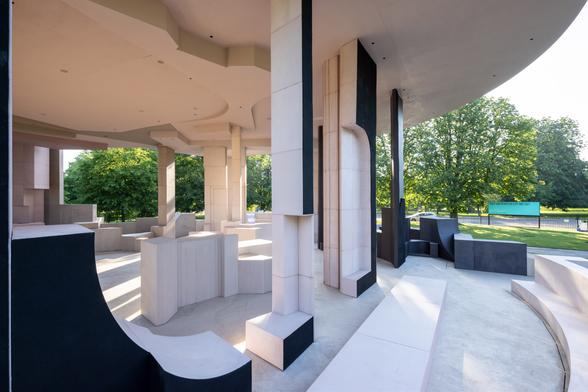
Abstracted elements of each of these buildings and many structures that have been demolished were combined to form the pavilion's columns and inbuilt furniture.

The pavilion's forms are abstractions of buildings in London

The resulting pink and grey structure was built from a steel frame wrapped in plywood timber that was CNC-cut to give the building's intricate reliefs.

These boards were largely covered with pink and grey micro-cement sealed with water-based resin, with several black-stained cork panels positioned on the exterior of the pavilion.

Walls are finished with grey and pink micro cement and cork panels

Vally and the organisers aimed to create a pavilion that had a minimal carbon impact. Like all of the previous pavilions, it will be fully dismantled at the end of the summer, when it will be relocated and re-erected by its new owners, spa operator Therme Group.

Consultant AECOM produced a carbon report that takes into account the construction of the building along with its dismantling and transportation of the structure at the end of the summer that concluded the pavilion is a carbon-negative structure.

Inbuilt seating in the pavilion also has forms based on abstractions of London buildings

"When we started 18 months ago, our aim was to do everything to minimise the carbon impact," explained David Glover, technical advisor for the Serpentine Pavilion.

"If you had asked me at the time if we could build a zero-carbon temporary building that needs to be dismantled, removed and rebuilt I would have said it wouldn't be possible – so I always said it would have the 'lowest possible carbon'," he continued.

"But in the end, we built a carbon-negative structure."

The space will be used for events throughout the summer

The temporary building achieved this primarily by making use of steel that had already been used several times by contractor Stage One.

However, the temporary pavilion sits on an 85-square-metre concrete foundation slab that drew criticism when it was poured earlier this year.

According to Glover this slab, which has an average depth of 250 millimetres and was built from low-impact concrete, was necessary due to the height of the pavilion.

After the pavilion is dismantled the slab will be broken up and crushed and reused locally – something that was taken into account in the carbon report.

At the end of the summer, the pavilion will be dismantled

Along with the main pavilion in central London, four fragments of the building have been constructed across the city to extend the reach of the project.

They have been built at New Beacon Books in Finsbury Park, The Tabernacle in Notting Hill; The Albany arts centre in Deptford and Valence Library in Barking and Dagenham.

Elements of the pavilion have been built in four satellite locations across London. Photo is by George Darrell

"The past year has drawn these themes sharply into focus and has allowed me the space to reflect on the incredible generosity of the communities that have been integral to this pavilion," Vally said.

"This has given rise to several initiatives that extend the duration, scale and reach of the pavilion beyond its physical lifespan. In a time of isolation, these initiatives have deepened the pavilion’s intents toward sustained collaboration, and I am excited to continue this engagement with the Serpentine's civic and education teams and our partners over the summer and beyond."

A black section of the pavilion has been installed at the Albany Centre. Photo is by George Darrell

Founded in 2005, Johannesburg-based collaborative architectural studio is directed by Vally. She is the latest architect to design the Serpentine Pavilion since Zaha Hadid created the first in the series in 2005.

Since then, pavilions have been built by numerous architects including Frida Escobedo, Bjarke Ingels and Sou Fujimoto. 2019's pavilion was designed by Junya Ishigami as a "hill made out of rocks". Next year's pavilion is set to be designed by American artist Theaster Gates.

Photography is by Iwan Baan.

_TheSerpentine Pavilion 2021 is open to the public in London from 11 June to 17 October 2021. Dezeen is live-streaming a talk with architect Sumayya Vally about the pavilion at 1:00pm London time on 9 June 2021. _SeeDezeen Events Guide for an up-to-date list of architecture and design events taking place around the world.

The post Counterspace combines abstracted fragments of London for carbon-negative Serpentine Pavilion appeared first on Dezeen.

#pavilions #all #architecture #london #uk #england #serpentinepavilions #serpentinegalleries #carbonnegativedesign

Counterspace's Serpentine Pavilion combines abstracted fragments of London

South African studio Counterspace led by architect Sumayya Vally has unveiled a pink and grey structure in London as this year's Serpentine Pavilion.

Serpentine Pavilion celebrates "places with a history significant to migration" says Sumayya Vally

In this exclusive video produced by Dezeen, Sumayya Vally of Counterspace explains how her design for this year's Serpentine Pavilion references the architecture of London's migrant communities.

She described the pavilion as "a puzzle of many different elements" informed by buildings used by migrant groups across London.

In addition, five architectural "fragments" have been dotted around the city to bring the project directly to local communities.

Vally, director of Johannesburg practice Counterspace, is the 20th and youngest architect to have been commissioned by the Serpentine Gallery for its annual architecture pavilion, which was unveiled this morning in London's Kensington Gardens.

Sumayya Vally's Serpentine Pavilion is located on the lawn in front of the Serpentine Gallery in London

"I became really interested in places with a history significant to migration – small spaces that birthed community and that have held forms of cultural production over time," Vally explained in the video.

Architectures of London's migrant communities

Among the spaces that influenced the design are the Fazl Mosque and East London Mosque, two of the first mosques to be built in London, and the Centerprise Publishing House, a now-closed Hackney bookshop and publisher of queer and black literature.

Other locations included the Four Aces Club in Dalston, a music venue founded in 1966 that was among the first to showcase black musicians, and the Mangrove, a legendary Caribbean restaurant and meeting place for Notting Hill's black community.

The pavilion references the architecture of London's migrant communities

With many of these places no longer in existence, Vally says she hopes her pavilion and the research behind it will help to broaden our understanding of the architectural importance of these spaces, with the aim of protecting them from the threat of urban development in future.

"The challenge with spaces like this is that they sit outside of our architectural lexicon and of what we traditionally understand to be important architectures and important spaces of gathering and community," Vally said.

"When those spaces are under threat from development and gentrification, they are not protected."

"My hope is that the architectural community will read and understand some of the spaces that have brought the pavilion into being and that those spaces are at the forefront of our conversation about architecture going forward," she added.

Reuse and reclaim

The pavilion is made up of abstracted elements and details pulled from the various locations in the architect's research.

"Formally, the pavilion is almost like a puzzle of many different elements coming together," Vally said.

The pavilion is made from cork and cement-treated timber supported by a recycled steel frame

The result is a pink, grey and black structure comprising a series of columns and inbuilt furniture made from a steel frame wrapped in cement-treated timber and black-stained cork panels that cover its exterior.

Aiming to create a design with minimal carbon impact, the architect used repurposed steel from the contractor's previous projects and cork reclaimed from the wine industry.

Like all past iterations, this year's pavilion will be dismantled and relocated to its permanent location at the end of the summer.

Satellite pavilions

Vally has also created five smaller structures from fragments of the main pavilion and dispersed them in different areas of London with a rich history of migration, in order to increase the reach of the project.

Satellite pavilions have been placed at locations such as New Beacon Books in Finsbury Park, The Tabernacle in Notting Hill, the Albany Arts Centre in Deptford and Valence Library in Barking and Dagenham.

The 2021 Serpentine Pavilion includes four satellite pavilions at locations around London. Photo by George Darrell

"I hope that people will take the time to visit the pavilion and all of its five parts and to engage with the programming that will happen across the summer," Vally said.

As always, this year's pavilion will host talks and events including a sound programme called Listening to the City featuring work by artists such as Ain Bailey and Jay Barnard.

Dezeen will live stream a talk between Serpentine Gallery artistic director Hans Ulrich Obrist and Vally at 1:00pm London time tomorrow.

Youngest ever architect to receive the Serpentine Pavilion commission

Vally, who was recently named one of Time magazine's 100 leaders of the future, is the youngest architect to receive the prestigious commission.

Delayed from 2020 due to the coronavirus pandemic, the pavilion will open to the public on 11 June and run until the end of the summer.

Sumayya Vally is director of Counterspace. Portrait by Dezeen

"It's a wonderful gesture from the Serpentine to commission someone from my background and as young as I am to suggest what the future can be and can look like," Vally said.

Founded in 2005, Vally's studio Counterspace is based in Johannesburg, South Africa.

In 2019, the studio designed a large-scale installation made of coloured mirrors that mimic the effect of the light created by the pollution in the city's mine dumps.

Previous Serpentine Pavilions have been built by architects such as Frida Escobedo, Bjarke Ingels and Sou Fujimoto.

Next year's pavilion is set to be designed by American artist Theaster Gates.

Photography is by Iwan Baan unless otherwise stated.

_TheSerpentine Pavilion 2021 is open to the public in London from 11 June to 17 October 2021. Dezeen is live-streaming a talk with architect Sumayya Vally about the pavilion at 1:00pm London time on 9 June 2021. _SeeDezeen Events Guide for an up-to-date list of architecture and design events taking place around the world.

The post Serpentine Pavilion celebrates "places with a history significant to migration" says Sumayya Vally appeared first on Dezeen.

#pavilions #all #architecture #videos #serpentinepavilions #videosbydezeen #architecturevideos #serpentinegalleries #counterspace

Serpentine Pavilion celebrates "places with a history significant to migration" says Sumayya Vally

In this exclusive video produced by Dezeen, Sumayya Vally of Counterspace explains how her design for this year's Serpentine Pavilion references the architecture of London's migrant communities.

Watch a live talk with Serpentine Pavilion architect Sumayya Vally

Dezeen teamed up with the Serpentine Gallery to live stream a conversation between Hans Ulrich Obrist and architect Sumayya Vally of Counterspace about this year's Serpentine Pavilion.

In a live broadcast from the 20th Serpentine Pavilion in London, Vally discussed the process and concepts behind her design with Serpentine Galleries artistic director Obrist.

The 20th Serpentine Pavilion is designed by Sumayya Vally

Vally's Serpentine Pavilion is a circular pink-and-grey structure made from reclaimed cork and steel.

The temporary structure, which is currently located on the lawn outside the Serpentine Gallery, is one of five pavilions dispersed throughout the capital that comprise this year's design.

Sumayya Vally is the director of Counterspace

A further four smaller pieces can be found at sites significant to London's migrant communities, including Deptford, Barking and Dagenham, Finsbury Park and Nottinghill.

Vally gave an exclusive video interview to Dezeen in which she described the pavilion as "like a puzzle of many different elements coming together."

Serpentine Galleries artistic director Hans Ulrich Obrist will moderate the talk

The Serpentine Pavilion is an annual commission established in 2000 by the London gallery. Each year, it is awarded to international architects who have not yet had the opportunity to build in the UK .

Vally is the youngest architect to receive the prestigious commission. The likes of Zaha Hadid, Toyo Ito and Oscar Niemeyer are among the architects to have designed previous pavilions.

_The talk took place at 1:00pm London time on 9 June 2021. TheSerpentine Pavilion 2021 is open to the public in London from 11 June to 17 October 2021. _SeeDezeen Events Guide for an up-to-date list of architecture and design events taking place around the world.

The post Watch a live talk with Serpentine Pavilion architect Sumayya Vally appeared first on Dezeen.

#architecturetalks #pavilions #all #architecture #talks #serpentinepavilions #serpentinegalleries #livestreams #counterspace

Live interview with Sumayya Vally at the Serpentine pavilion | Dezeen

Dezeen and Serpentine gallery will livestream a conversation between Hans Ulrich Obrist and Sumayya Vally from inside the Serpentine Pavilion.