 Georg Wamhof
... literaturwissenschaftlich noch
#litodons
#Victodons
#Romantodons
... wissenschaftsgeschichtlich (aber eher selten)
#scihistodons
... literaturwissenschaftlich noch
#litodons
#Victodons
#Romantodons
... wissenschaftsgeschichtlich (aber eher selten)
#scihistodons
Who remembers overhead projectors? When did you last see one in action?
#histodons #history #internationalism #scihistodons #histsci #STS #conferences #objects #materialculture #infrastructure

Conferences generate and rely on material culture and infrastructures.
We've been building a gallery of conference objects on our website, here: https://sciconf.nu/gallery/
The gallery is a work in progress. Do get in touch if you have any images of objects to contribute - we'd love to expand the gallery and will keep adding to it.
#histodons #history #internationalism #scihistodons #histsci #STS #HERA #conferences #materialculture
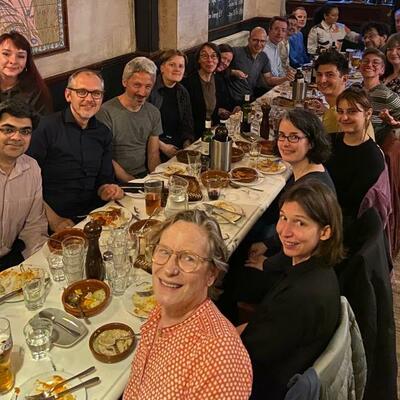
This is what collaboration across four+ cities in two+ time zones looks like in practice. Here we are, hard at work on a special issue we're hoping to publish with the British Journal of the History of Science in due course.
#histodons #history #internationalism #scihistodons #histsci #STS #conferences #HERA #publicspaces #BJHS

We've been quietly working away on various projects (more news soon!). In the meantime we're pleased to announce a new blog entry by guest contributor Julian Bondaz on the International Conferences of West Africanists. Come have a look.
#histodons #history #internationalism #scihistodons #histsci #STS #conferences
In the summer the SciConf group wrote a Times Higher Education piece on the pros & cons of conferencing (Nb: The title & image weren’t ours). The environmental cost of conferencing is huge, but arguments about the greater inclusivity of online meetings are often overstated. Ultimately, it’s hard to beat a physical get-together. It's vital that universities & grant funders provide resources for them.
You can read it here: https://sciconf.nu/outreach/
Apparently, in the 1970s the publisher Heron brought out an edition of OoS with the tag—
"For every real man who has a place in his heart where no women are allowed."
Source: https://twtr.in/3N1Q
“1970s publisher Heron specialised in jawdropping advertising copy for books. Read the following and give me your best guess, bearing in mind this is perhaps the most random fuckery I've ever read. "For every real man who has a place in his heart where no women are allowed."”
Now that #GrantAllen's "time is not quite so filled now with hack-work as formerly," he can enjoy using the telescope that "[#Darwin] and the other kind friends" bought for him.
What treasures {or horrors, as the case may sometimes be} might the Darwin Correspondence Project at #CambridgeUL reveal about your #C19 passions?
#histodons #scihistodons #hstm #victodons
https://www.darwinproject.ac.uk/letter/?docId=letters/DCP-LETT-13736.xml&query=grant%20allen
To celebrate the 163rd anniversary of the publication of Origin of Species today, the Darwin Correspondence Project at #CambridgeUL has published the full edition of #Darwin 's correspondence online! Explore more than 15000 letters, from Darwin's first letter in 1822 to his death in 1882.
Much as I like physical books, it's really exciting to have the collected correspondence now full-text searchable:

For nearly fifty years successive teams of researchers on both sides of the Atlantic have been working to track down all surviving letters written by or to Charles Darwin, research their content, and publish the complete texts. The thirtieth and final print volume, covering the last four months of Darwin’s life, will be published in early 2023 and all the letter texts – more than 15000 between 1822 and 1882 – are now published online. Discover more about the final months of Darwin's life in our Life and Letters series, 1882: Nothing too great or too small. See a full list of letters from 1882.
In addition to Spotify, the podcasts are now also available on Soundcloud, here https://soundcloud.com/conferencearoundtheclock/sets/conference-around-the-clock?utm_source=mobi&utm_campaign=social_sharing
If you manage to listen in, we'd love to know what you think!

What happens at a scientific conferences? How have they exchanged knowledge and shaped expertise? What forms of sociability have developed in these meetings, what rituals have been performed? The audi
 Jessica Reinisch
 SciConf
 Sarah Drew
 Mercedes Sheldon
 Aileen Fyfe