 Dr Susi Arnott
@junesim63 Categorised as #Scope3 emissions, eg in #ScienceBasedTargets #ClimateLiteracy https://bit.ly/CLNZine
@scientistsx @tttmediaxr
@scientistsx @tttmediaxr
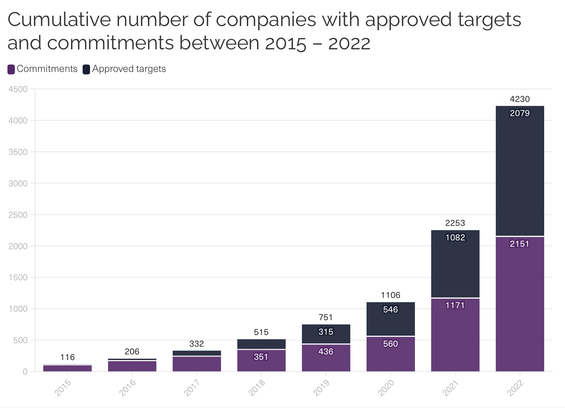
The Science Based Targets initiative released its annual monitoring report last week, with stats on how many companies have committed to science-based targets, and how many have submitted plans to actually achieve those targets – and have been 'approved' by the org.
This is pretty huge growth, and quite encouraging. Corporate #sustainability and #netzero efforts have a loooong way to go, but target setting helps see which way things are headed.
Their summary of the SBTi report's highlights:
• 2,079 companies and financial institutions had set science-based targets
• More than one third of the global economy (34%) by market capitalization had set or committed to set science-based targets
• We observed a growth on every continent for the first time
• Companies with science-based targets had committed to a total reduction of 76 millions tonnes of CO2e, equal to eliminating Switzerland’s annual emissions twice over
Pretty impressive momentum.
Public Consultation for the Buildings Science Based Target Setting Guidance and Tool 16th May
Setting long-term net-zero emissions targets is good.
But long-term targets need to be accompanied by aggressive 5-10 year emissions reduction targets - otherwise they can be meaningless.
As the #ScienceBasedTargets initiative says: “less net, more zero.” https://sciencebasedtargets.org/blog/science-based-net-zero-targets-less-net-more-zero

On October 28th, the Science-Based Targets initiative (SBTi) is launching the first science-based framework for companies to set net-zero targets - the Net-Zero Standard. The Standard will clarify the key role of decarbonization in corporate net-zero strategies.
 Kees AntiFA van Malssen
 Ben Abraham || AfterClimate
 beSpacific
 Andrew Kinsey
 Richard Waite