 Biblians
Your identity is secure in Jesus, fear cannot undo it. 🔒
#biblians #bibliansapp #faithoverfear #trustgod #christianencouragement #restinjesus #peace

Your identity is secure in Jesus, fear cannot undo it. 🔒
#biblians #bibliansapp #faithoverfear #trustgod #christianencouragement #restinjesus #peace
📖 Verse of the Day
Come to me, all you who are weary and burdened, and I will give you rest. — Matthew:11:28
#biblians #bibliansapp #ChristianFaith #BibleVerse #HopeInChrist #GodsLove #RestInJesus
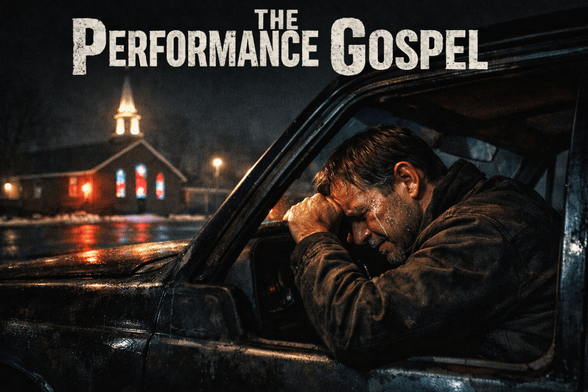
The Performance Gospel
5,753 words, 30 minutes read time.
Mark was the congregant every pastor quietly prayed would walk through the doors and never leave.
Mid-forties, sharp-minded, vice president at a scaling tech firm. He coached his son’s competitive travel soccer team, led the Tuesday morning men’s Bible study for six unbroken years, sat on the finance committee reviewing tithing records (while faithfully giving 12–15% himself), and filled every volunteer gap—from sound booth to nursery to retreat driver. Sundays were sacred and non-negotiable; midweek events took priority over family dinners. When the annual stewardship campaign needed momentum, Pastor Tom would point to him from the pulpit: “Look at Mark—he honors God with his firstfruits, and blessing flows. That’s the model we all follow.” In private, elders would nod: “Men like Mark keep this place running. God is using his performance to advance the kingdom.”
They tracked him like a key performance indicator. Pledge fulfillment rates, volunteer hours logged, group attendance numbers—all glowed reassuring green on quarterly dashboards. Praise flowed when the metrics shone: “Faithful. Reliable. A true servant-leader.” Requests followed immediately: “Mark, chair the next building fund drive—your track record inspires everyone.” It felt like divine favor. It was institutional dependence.
But this was supposed to be a church, not a business.
Mark was far from the only one harnessed.
Ryan, thirty-eight, software engineer, stayed on the worship team rotation even as his marriage quietly unraveled. Greg, the contractor, built half the new wing with his own hands—nights and weekends—because “God called us to sacrifice.” Lisa homeschooled four kids while running women’s ministry, the food pantry, and the greeting team; saying no would mean she wasn’t “all in.” Even Tom-the-elder hadn’t taken a real Sabbath in eight years—“the sheep need constant tending.”
They all carried the same quiet exhaustion, the same forced smiles, the same unspoken terror: if they ever slowed, the whole thing might collapse—and worse, God might withhold His blessing.
The leaders never intended harm. They believed they were faithful stewards. Yet they had quietly saddled Gentile believers with a yoke echoing the Law of Moses—and heavier in places.
Tithing was preached as non-negotiable Old Covenant obedience (Malachi 3 quoted selectively, turned into a weekly threat: “Rob God, and the devourer comes”). Blessing and cursing were tied to percentage giving, as if the cross hadn’t already secured every spiritual blessing (Ephesians 1:3). Extra-biblical rules layered on like modern Noahide codes: no alcohol ever (not even communion wine for some), mandatory midweek attendance, dress codes that judged visitors before they sat, “accountability” that felt like surveillance. “Covenant membership” required signing agreements, tithing only through the church, submitting major life decisions to elders, serving in at least two ministries. Step out of line, and whispers followed: “struggling in faith,” “walking in disobedience,” “missing the blessing.”
This was the very burden the Jerusalem Council rejected in Acts 15: “It seemed good to the Holy Spirit and to us not to burden you with anything beyond these necessary things…” No yoke of the Law. Faith in Christ plus nothing.
Yet in comfortable suburban buildings with fog machines and coffee bars, the same spirit had returned—only now in khakis and worship-leader haircuts. Circumcision was gone; the performance mindset remained: prove your salvation through observable output. Keep the rules, hit the metrics, stay in the harness, or be labeled lukewarm.
The elders saw themselves as guardians of holiness, protectors against complacency. Growth equaled God’s favor. The machine needed willing oxen. So they added weight—subtly, lovingly, persistently—until men and women like Mark, Ryan, Greg, and Lisa stumbled under loads Jesus never asked them to carry.
Worse, a few at the top profited handsomely from the system they upheld.
Pastor Tom drew a salary well above the area median, plus a generous housing allowance covering his four-bedroom home with pool and three-car garage. The church leased his late-model SUV, funded “ministry conference” travel (often with family), and provided book stipends for titles that sold mostly to the congregation. When questioned privately, he’d reply, “God blesses those who serve faithfully”—the same prosperity logic he preached.
Longtime elders followed suit. One owned a lake vacation condo, partly funded by “love offerings” and blurred expense reimbursements. Another’s family took annual “mission trips” that doubled as luxury getaways—business-class flights, upscale resorts—charged to the missions budget with carefully worded receipts. Tithes and offerings—sacrificed from tight budgets, overtime shifts, skipped vacations—flowed upward to sustain these lifestyles, while leaders framed it as “honoring authority” and “reaping what you sow.”
The hypocrisy was subtle but corrosive: the flock gave sacrificially to “unlock heavenly windows,” while a few at the helm lived with earthly windows wide open. The prosperity whispers worked beautifully for the collectors, less so for the givers scraping by.
Every quarter, the finance committee gathered around spreadsheets, not prayerful discernment over souls. Mark’s name glowed green: tithing steady, shifts covered, attendance firm. Pastor Tom nodded in staff meetings: “Mark’s faithfulness stabilizes our numbers.” Elders pivoted: “Let’s have him chair the capital campaign again—his name carries weight.”
They spoke of “sustainability” and “momentum”—boardroom words, not Scripture. “If we lose Mark’s commitment,” one confided, “we’ll cut youth programs or delay the parking lot.” Pragmatism ruled: bills, salaries, buildings, ministries. Mark had become essential infrastructure.
No one asked if the pressure quenched the Spirit or fed the machine. No one inquired how he sustained the green metrics: skipped dinners, swallowed weekends, forced smiles through exhaustion. Heart checks weren’t on the quarterly review form.
Behind closed doors, conversations stayed practical. “Mark’s our anchor in finance,” an elder said during budget talks. “As long as he’s modeling sacrificial giving and showing up, the congregation follows.” Another replied, “We can’t afford to let him burn out—but we also can’t afford to let him step back. The vision needs men like him carrying the load.” The “vision” had blurred into budgets, attendance goals, facility upgrades. Pastoral care for the weary took a backseat to keeping the lights on.
The asks kept coming, wrapped in spiritual language: “God is stretching you, Mark.” “Your obedience unlocks blessing for the body.” Each responsibility was a divine appointment, never organizational necessity. Mark absorbed the language, internalized the pressure, pushed harder—because saying no felt like disappointing God, the pastor, the people who counted on him. He increased giving during tight months, volunteered extra hours during crunch seasons, led yet another study series even when his soul felt parched. The church’s dashboards stayed healthy; his spiritual vitality faded.
What they never offered—what a true church should have offered—was space to be human. No elder modeled raw vulnerability. No one taught from the pulpit how to cease striving and know that He is God (Psalm 46:10). No curriculum equipped men to confess weakness without losing status. They equipped Mark to keep numbers looking good, to keep the appearance of a thriving congregation, but left him unequipped to cultivate authentic communion with Christ when metrics faltered.
In their desire to steward well, they adopted the metrics and mindset of a corporation: track performance, reward output, scale what works, protect the brand. But a church is not a business. It is the bride of Christ, a living organism sustained by grace, not spreadsheets. It is meant to be a hospital for sinners, a refuge for the weary, a family where the weak are carried and the broken are mended—not a production company running on the unbroken backs of its most faithful volunteers.
The system that celebrated Mark’s outward faithfulness was quietly starving the flock it claimed to shepherd. They wanted a congregation that looked successful on paper; God wanted hearts alive, honest, humbly dependent on Him. And the widening chasm between those priorities was about to swallow one of their best men whole.
But the men’s group Mark led remained polished on the surface—safe discussions on stewardship, diligence, obedience—always looping back to tithing as obedience (Malachi 3 quoted selectively to imply curses for shortfall) and service as proof of devotion. No space for raw confession. No teaching on Galatians 5:1’s freedom from the yoke of slavery, or Colossians 2’s warnings against human traditions that burden. Authenticity—heart-level vulnerability, admitting doubt, sharing failures—wasn’t modeled or encouraged. Performance was: show up, give more, do more, appear strong. The fruit? Shallow faith, unchanged lives, a group that met but never truly transformed anyone.
Tuesday mornings followed the same rhythm for years. Eight or nine men filed in at 6:15, grabbed Styrofoam cups of weak coffee, settled into folding chairs in a loose circle. Mark opened with a crisp prayer—thanksgiving for provision, wisdom for stewardship, blessing over the day ahead. Then he launched into the lesson: a passage hand-picked to reinforce the church’s emphases. “Let’s look again at Malachi 3:8–10,” he’d say. “God says we’re robbing Him when we withhold tithes and offerings. But the promise—if we bring the whole tithe, He rebukes the devourer. That’s not just Old Testament law; it’s a principle of blessing today.” Heads nodded solemnly. Someone might share a quick story: tithing “opened doors” at work or covered an unexpected bill. Mark smiled, affirmed the testimony, steered back to application: “So how are we honoring God with our finances and time this week?”
The conversation stayed in safe lanes. No one said, “I’m tithing but still drowning in debt and resentment.” No one admitted, “I serve every weekend because I’m afraid if I stop, people will think I’m backsliding.” No one confessed, “I’m exhausted and angry at God for not blessing me the way the sermons promise.” Doubt was reframed as “spiritual attack” to be prayed against, not explored. Weakness was something to overcome through more discipline, not to bring into the light. Mark never modeled saying, “Brothers, this week I feel distant from God—my heart’s numb, my prayers empty. I need help.” That kind of honesty would crack the facade, and the group was built to preserve it.
The hour ended with another polished prayer—Mark’s voice steady, words flowing like rehearsed lines—and the men dispersed, carrying the same burdens they’d arrived with. No chains broken. No hearts softened. No one walked out lighter. The group existed to reinforce the system: remind everyone that faithfulness looked like measurable output, that God’s favor followed performance, that stopping short invited the devourer. It was Bible study as reinforcement, not rescue.
Mark bought in completely. He equated godliness with output because that’s what he’d been taught, week after week, year after year. He kept meticulous mental score: tithe checks on time, volunteer slots filled without complaint, lessons prepared with outlines and cross-references, prayers delivered with conviction. He told himself this was abiding in Christ—being a “good and faithful servant” multiplying what was entrusted. But the truth settled deeper each month: his prayers were eloquent but scripted, like memorized lines. His devotions were efficient but joyless—fifteen minutes ticked off before the first work email, Scripture read for sermon fuel rather than soul nourishment.
Inside, he was eroding. Joy, once spontaneous, had been replaced by duty—a grim determination to keep showing up. Peace had given way to constant low-grade pressure, the nagging sense that if he slowed, everything might collapse: the group, the church’s image, his standing before God. Physically the toll mounted: constant fatigue no coffee could fix, tension headaches starting Sunday afternoons and lingering through Wednesday, shallow sleep interrupted by mental replays of unfinished tasks and unspoken expectations. Emotionally he frayed—short-tempered with Sarah over small things, snapping at the kids when they interrupted “study time,” retreating into silence when real conversation was needed. He was present in body but absent in heart, a man going through motions while the real Mark quietly starved.
Spiritually, the hunger was acute. He craved real encounter—a fresh sense of God’s nearness, a word that pierced rather than polished, raw honesty with the Father—but he fed instead on performance metrics. Green checkmarks on the volunteer log. Another “well done” from Pastor Tom. A nod from an elder after the latest campaign update. These became his assurance: I’m okay. God is pleased. I’m doing enough. But deep down he knew—he wasn’t abiding in Christ’s sufficiency; he was performing for the church’s approval, trying to earn what grace had already given freely. The more he produced, the emptier he became. The more he appeared strong, the weaker he felt inside.
And still the group met every Tuesday. Still the lessons circled the same themes. Still no one dared ask the question that might change everything: “Brother, how is your soul?” Because asking would admit the system wasn’t working—that performance wasn’t producing disciples, only dutiful performers. And admitting that might mean dismantling the structure everyone depended on.
So Mark kept leading. Kept giving. Kept showing up. Kept dying a little more each day—until the weight finally became too much to carry alone.
Sarah pleaded: “Mark, this isn’t life in the Spirit. God wants your heart, not your hustle. Jesus said come weary and burdened—He gives rest, not more tasks.” Mark’s response was always the tight, practiced smile: “God’s blessed me with strength. I can’t let the church down. Performance honors Him.”
The leaders never probed deeper. Why disrupt a machine that kept budgets met, seats filled, programs running? They celebrated the outward appearance—1 Samuel 16:7 reversed: men looked at the polished exterior, while the heart withered unnoticed. Like Pharisees in Matthew 23, they loaded heavy burdens (endless obligations framed as “kingdom advancement”) but offered no relief—no equipping for grace, no permission to rest, no space for broken honesty. They needed Mark’s performance to sustain their system.
In leadership meetings, conversation rarely strayed from logistics and outcomes. “How are the pledge cards coming in?” “Is the volunteer roster full for Easter services?” “Mark’s group is steady—good to see.” When someone mentioned burnout among core volunteers, the response was practical, not pastoral: “We can pray for strength,” or “Maybe recruit more bodies.” No one suggested reevaluating the load. No one asked if the relentless pace produced disciples or just exhaustion. The unspoken rule: keep the visible ministry humming, keep reports positive, keep the congregation inspired by “commitment.” Questioning the cost risked exposing cracks in the foundation they had all helped build.
Pastor Tom and the elders had inherited—or cultivated—a culture where spiritual health was measured by activity rather than intimacy with Christ. Sermons exhorted the flock to “press on,” “run the race with endurance,” “not grow weary in doing good.” Those verses were quoted often, almost always without fuller context: the grace that sustains, the rest that renews, the Spirit who empowers rather than the flesh that strives. The leaders modeled what they preached—busyness as badge of honor, availability as proof of calling. To admit weariness felt like failure; to grant rest seemed like lowering the standard.
So they kept leaning on Mark. When a ministry coordinator stepped down unexpectedly, “Mark can cover it—he’s reliable.” When attendance dipped in midweek service, “Mark’s testimony could bring people back.” When the building fund needed a push, “Mark’s leading by example—let’s feature him in the video.” Each request wrapped in encouragement: “God sees your sacrifice,” “Your faithfulness blesses the body,” “This is how we build the kingdom together.” They meant it sincerely. They believed the work mattered. But sincerity doesn’t make a burden light.
They never sat Mark down and asked what Jesus might have: “Do you love Me? Feed My sheep.” Not “How many sheep did you shear this quarter?” but “Are you feeding on Me?” They never opened Galatians together and wrestled with freedom from the yoke of slavery. They never quoted Jesus’ rebuke to the religious elite—”They tie up heavy burdens, hard to bear, and lay them on people’s shoulders, but they themselves are not willing to move them with their finger”—and then examined their own hands. Instead, they added another finger’s weight to Mark’s load and called it discipleship.
The system worked—as long as men like Mark kept carrying it. Budgets balanced. Programs multiplied. The Sunday stage looked full, the parking lot busy, the annual report impressive. From the outside, the church appeared healthy, vibrant, growing. But beneath the polished surface, hearts like Mark’s withered—starved of the grace they desperately needed, yet never offered. The leaders had become gatekeepers of performance rather than shepherds of souls. And in protecting the machine, they were losing the very people the machine was meant to serve.
The breaking came brutally.
The flagship project he’d driven failed spectacularly—millions lost, his leadership questioned, job in jeopardy. Sarah’s ultimatum: “You’re performing for everyone but us. Our marriage can’t survive another season of this.” The kids’ distance mirrored his own absence.
The trouble had been building for months, though Mark refused to see it until too late.
The project—code-named “Horizon”—was his baby. A next-generation platform integration promising to catapult the company ahead, secure major contracts, cement his path to senior VP. He’d pitched aggressively in board meetings, volunteered to lead personally, assured everyone the timeline was achievable. “I’ve got this,” he’d told his boss with the same confidence he used in church lobbies. The board approved tens of millions and handed him the reins. Mark saw it as another chance to prove himself: at work, home, before God. One more load to shoulder without breaking.
He threw himself in the way he did everything. Late office nights bled into early home mornings reviewing specs. Weekends vanished into calls and reviews. He delegated enough to move things but kept decisions close—no one understood the vision like he did. He cut testing corners for milestones, dismissed engineering warnings as “overly cautious,” pushed the team with motivational speeches from Sunday school: “We’re pressing on. No one said the race is easy.” His team followed because he was Mark—reliable, decisive, the guy who delivered.
But church pressure never let up. Capital campaign needed his face on videos. Men’s retreat required logistics oversight. Wednesday youth Bible study needed a fill-in—and Mark said yes, because no felt like failing God. He compartmentalized: work by day, church by night, family squeezed between. Sleep optional. Coffee a food group. He quoted Philippians 4:13 in the mirror each morning, ignoring how hollow it sounded.
First cracks appeared quietly. A key test failed in staging—data corruption under load. Engineers flagged it; Mark downplayed in updates: “We’ll patch next sprint. Still on track.” Another sprint passed with bugs waved through for demo deadlines. He told the team, “God honors effort. Trust Him with the rest.” Anxiety gnawed inside, buried under more hours, determination, performance.
Launch day amid fanfare. CEO sent pre-congratulations. Mark stood in the war room, heart pounding, as the system went live. For forty-eight hours, it held. Then cascade: latency spikes, authentication failures, data syncing errors. Within a week, three major clients pulled contracts. Remediation costs ballooned—millions in penalties, lost revenue, overtime. Board convened emergency review. Fingers pointed. Postmortem brutal: rushed timelines, inadequate testing, leadership overrides of red flags. Mark’s name on every memo. Boss’s words clipped: “We trusted you, Mark. This is on you.”
He drove home silent, weight pressing harder. Job not gone—yet—but writing on the wall. Restructuring rumors swirled. Performance review, once glowing, now carried “accountability” in red ink.
Sarah waited when he walked in. Kids in bed, doors closed longer these days—no hugs, no chats. They sensed tension. Sarah’s voice low, steady, exhausted.
“I’ve watched you disappear for years,” she said. “Church first, promotion chase, now this project costing millions. You’re performing for boss, elders, some idea of ‘good Christian man.’ But not for us. Not here for me. Not for them.” She gestured to kids’ rooms. “Our marriage can’t survive you gone even when home. I love you, Mark—but I can’t carry this family alone while you carry the world.”
He froze in the doorway, words hitting like stones. No tight smile, no quick reassurance. He saw clearly: kids’ distance was absence mirrored. Wife’s quiet was resignation. His soul wasn’t thriving—it was suffocating.
That night, old escapes called louder. Alone in dark office, screen glowing, shame and exhaustion warring. Collapse wasn’t just professional or marital. Total. Everything built through will—career, reputation, family, spiritual image—crumbling.
In wreckage, truth dodged for decades surfaced: he’d performed to prove he was enough, fearing he wasn’t. Not to God, church, anyone. The project’s failure wasn’t cause—it was final, merciful blow shattering the illusion.
Dawn was still hours away when he climbed into his truck and drove toward the empty church parking lot, the only place that felt safe enough to fall apart.
He parked in the far corner, engine off, forehead pressed against the steering wheel. The silence was deafening. Tears came in waves—hot, ugly, unstoppable sobs he’d never allowed himself before. For the first time in his adult life, the words he’d armored against broke free:
“God… I’m dying inside. I’ve performed for years—tithing more, serving harder, leading everything—to prove I’m worthy, to keep the church happy, to feel approved. But You don’t want my polished exterior. You look at the heart. The church celebrated my performance but never equipped me to be authentic—to confess weakness, to rest in Your grace, to stop striving. They piled on burdens like the Pharisees You condemned—beautiful outside, dead within. I can’t fake it anymore. I need real life in You—not my effort, not their expectations. Break these chains. Make me authentic before You.”
Silence. Then clarity, slow and piercing, like light breaking through cracks in a wall.
The church had prized measurable success over soul health. God desired a heart after His own—vulnerable, surrendered, abiding—like David, chosen not for his appearance or prowess but for his heart (1 Samuel 16:7). Performance metrics sustained institutions; authenticity sustained relationship. The rot had been there all along: not in the people, but in the system that rewarded polished exteriors while allowing inner lives to quietly decay. Sermons preached effort, leaders celebrated output, and the most “committed” members—like Mark—withered under burdens no one dared question.
Another layer peeled back in the quiet. The church had morphed into something more like a business than the body of Christ. Budgets balanced, buildings expanded, attendance held steady, programs staffed, pledges fulfilled—all framed as “kingdom advancement.” But God’s mission wasn’t institutional preservation or corporate growth. It was making disciples of all nations (Matthew 28:19–20), equipping believers for works of service so the body might grow in love (Ephesians 4:11–16), loving one another as Christ loved (John 13:34–35), caring for the widow, orphan, and stranger (James 1:27), proclaiming the gospel in word and deed. The church was meant to be a living organism—Christ as head, believers as interconnected members—each part vital, contributing through grace-empowered gifts, not a machine sustained by endless output and human effort.
The business side—the spreadsheets, rosters, campaigns, “momentum” metrics—had taken precedence. Stewardship mattered, but when survival overshadowed soul care, when keeping lights on and programs running became priority over heart change, freedom, and rest in Christ, the rot deepened. Mark realized he’d been complicit: he’d fed the machine, thinking it fed the kingdom. But the kingdom advanced through transformed lives, healed relationships, people set free to love God and neighbor without fear of falling short—not through greener dashboards.
Mark didn’t bolt. He reformed—slowly, painfully, deliberately.
The first step was hardest: he resigned from leading the men’s group. No storming out, no scene. He emailed the elders: “After much prayer, I’m stepping down. The group needs someone who can teach freedom in Christ, not just duty and discipline. I’ll help transition a new leader.” He recommended a quieter man who’d occasionally asked gentle, probing questions Mark had always redirected. Elders stunned. One called immediately: “Mark, are you sure? The group has thrived under you.” Mark answered honestly: “It hasn’t thrived. It’s survived. We’ve met, talked, but no one has been set free. Keeping the group running isn’t the same as fulfilling God’s mission for His people.”
Next, a private meeting with Pastor Tom. No polished report, no metrics to soften—just raw truth. Across the desk: “Pastor, I’ve been dying under performance pressure. The church pushed because I delivered, but no one asked if my heart was alive. Worse, the ‘business’ of the church—keeping everything running, hitting numbers, expanding programs—took precedence over God’s real mission: disciple-making, soul care, authentic community, freedom in Christ. We sustained an institution at the cost of lives. I tithed, served, led, showed up—and thought that was enough. It wasn’t. I need to learn rest in grace instead of earning approval. I can’t carry the load the way I have.”
Pastor Tom listened in silence. For the first time in years, Mark saw flicker in the pastor’s eyes—conviction, perhaps grief. “I didn’t realize,” Tom said quietly. “I thought I was encouraging you… building the kingdom.” Mark replied, “We were building something. But was it the kingdom, or just a bigger machine?”
He and Sarah began weekly counseling—not with a church counselor, but a Christian therapist outside the congregation specializing in performance-based identity and burnout. Sessions stripped checklists. No more “How many hours served?” Instead: “What does your heart feel toward God right now?” “Where are you still proving you’re enough?” Sarah wept naming years of invisibility. Mark wept realizing how he’d used ministry to avoid his emptiness. Together they learned to pray not for strength to do more, but courage to be honest. Small practices emerged: weekly date nights no phones, family dinners sharing one honest thing, bedtime prayers with confession, not just thanksgiving.
Mark sought new accountability—not another partner asking about Bible plans and tithing, but a friend outside church circles asking heart questions: “Where are you hiding from God this week?” “Where are you resting in Christ’s finished work today?” “What would trusting grace over performance look like?” Questions felt foreign, dangerous. But they were water to a parched soul.
The church response mixed, as expected.
Some elders panicked. “What example is this?” one said in closed meeting. “If Mark steps back, others might think quitting serving is okay. We can’t lose momentum.” Fear real: budgets, programs, appearances.
Others quietly convicted. A younger elder spoke up: “Maybe the problem isn’t Mark stepping back. Maybe we’ve let the business of the church—keeping the institution healthy—take precedence over God’s mission. Are we making disciples, or managing members? Are we Pharisees, whitewashed tombs—beautiful outside, dead inside? Do we value heart transformation over visible output?” Question hung. Some began wondering if rot in Mark’s collapse was in the entire structure.
Conversations stirred—real ones, not polished. Small groups explored Galatians, wrestling with freedom from the yoke of slavery. Few elders met to pray about rest, grace, shepherding souls over managing metrics. Not revolution overnight, but cracks of light in a system prizing performance above all.
Mark stayed faithful—but now from authenticity. Gave generously when heart moved, not guilt or obligation. Served joyfully when Spirit led, not roster needed filling. Learned dependence: not pillar everyone leaned on, but branch abiding in the Vine (John 15), drawing life from Christ rather than draining himself to sustain institution.
Freedom from performance didn’t mean laziness or withdrawal. It meant release from lie that God’s love and church approval depended on output. It meant reorienting life around God’s true mission: not institutional success, but eternal fruit—disciples loving deeply, living freely, pointing others to Jesus. He tasted abundant life Jesus promised—not earned through tireless effort, but received through honest reliance on One who sees heart and loves it anyway.
The rot hadn’t vanished. But in Mark’s quiet surrender, small healing began—not just for him, but for congregation slowly remembering what it was meant to be: not polished machine chasing momentum, but living body, Christ as head, pursuing mission God gave from beginning.
Author’s Note
Brother,
This story—The Performance Gospel—ain’t some feel-good bedtime reading. It’s a brick to the face. I wrote it because I got sick of looking at men like us—good men, strong men, guys who’d run through a wall for their family or their church—and watching them slowly get gutted alive by the very thing they thought was honoring God.
You know who you are. You’re the dude who never misses, never quits, never complains. You’re the one the pastor name-drops from the stage, the one the elders lean on when shit gets tight, the one who says “yes” when every fiber in your body is screaming “no more.” You grind because that’s what real men do. You tell yourself it’s sacrifice. You tell yourself it’s manhood. You tell yourself if you ever tap out, if you ever admit you’re bleeding out, you’ll be a failure—in their eyes, in your kids’ eyes, in God’s eyes. So you lock it down, swallow the pain, and keep swinging.
And it’s killing you.
Piece by piece.
The performance gospel isn’t the gospel. It’s a meat grinder dressed up in Bible verses. It turns brothers into mules—yoked to a machine that feeds on your blood, sweat, and sanity while it spits out spreadsheets and attendance numbers. God doesn’t give a rat’s ass about your performance before men. He’s not sitting in heaven with a clipboard tallying your volunteer hours, your 12% tithe, or how badass you sounded praying in front of the group. He looks past the biceps, the bank account, the busy calendar, and straight into the heart (1 Samuel 16:7). What He wants is you—stripped down, no bullshit, no mask. A man who’ll quit posturing long enough to say, “I’m broke, I’m empty, I can’t do this anymore. I need You.”
God does not want your output. God does not want your hustle. God wants You!
Jesus didn’t recruit you to be the church’s rented mule. He called you His brother. He didn’t say, “Come to Me when you’ve got everything together and I’ll pile on more.” He said, “Come to Me, all you who are weary and heavy-laden, and I will give you rest” (Matthew 11:28). Rest. Not more chains. Not more checklists. Rest.
But look at what’s happening in too many churches today. They’re straight-up peddling the Prosperity Gospel—give more, sow seed, unlock your breakthrough—while simultaneously dragging pieces of the Law of Moses back onto Gentile men who were never under that law to begin with. The Law was given to Israel—national, covenantal, specific. Not to you. Not to me. The Noahide laws? That’s rabbinic fan fiction, a subset dressed up as “universal principles,” but it’s still not New Testament. The Jerusalem Council settled this argument in Acts 15: the Holy Spirit and the apostles said to Gentiles, “We’re not burdening you with the Law of Moses. Just these few things. Faith in Christ. Period.” (Acts 15:28). No yoke. No mandatory tithing curses. No extra-biblical rules to prove you’re saved.
Yet here we are—pulpits thumping Malachi 3 like a club, threatening the devourer if you don’t hit 10%, layering on dress codes, service quotas, elder oversight of your marriage and money, all while the leaders cash fat checks, drive luxury rides, and take “ministry” vacations on the congregation’s dime. It’s hypocrisy with a halo. And men like us keep swallowing it because we’ve been told that’s what strong Christian men do.
Here’s the ugly truth nobody wants to hear: If you’re not careful, the church—its endless demands, its corporate double-speak, its unspoken scorecard—will drain you until there’s nothing left. It’ll suck the life out of you until you’re burned out, hollowed out, a walking corpse in khakis. You’ll have nothing left for your wife, your kids, your own soul; and just like me you’ll wake up somewhere between 45 or 55 and realize you gave your prime years to a machine that used you up and never gave one cent about you. And worst of all? You never tasted the real freedom Christ bled for—the freedom from having to prove you’re enough, from the grind, from the fear that if you stop performing God will turn His back.
Enough of this crap.
The collapse isn’t the job implosion, the marriage hanging by a thread, the kids who look at you like a stranger. The collapse is when the mask finally shatters and you see the lie for what it is: all that grinding never bought you one square inch more of God’s love. You were already loved. Already accepted. Already enough—because of the cross, not your calendar.
So here’s the raw call, man to man: Quit the act. Pull off the “Mask of preformance!” Stop performing for the elders, the pastor, the congregation, your old man’s voice in your head. Get alone with God—no notes, no plan, no filter—and lay it out. “I’m wrecked. I’m empty. I’ve been faking it so long I forgot what real feels like. I’m scared that I’m not enough. I need You—not my grind, not my output. Just You.”
That’s not quitting. That’s waking up. Real manhood isn’t never cracking; it’s cracking open and leaning all your weight on the One who can’t be broken. It’s ditching the yoke you chained yourself to and taking the easy one He offers. It’s getting off the damn treadmill and abiding—sucking life from the Vine instead of bleeding out to keep the church’s lights on.
If this pisses you off, good. Let it burn hot. Let it expose the rot in your life, your church, your pride. Then let it shove you to your knees—not to give up, but to finally start living free.
You don’t have to keep proving yourself. You just have to show up real.
The Father’s waiting. No scorecard. No bullshit.
— Bryan King
Call to Action
If this story struck a chord, don’t just scroll on. Join the brotherhood—men learning to build, not borrow, their strength. Subscribe for more stories like this, drop a comment about where you’re growing, or reach out and tell me what you’re working toward. Let’s grow together.
D. Bryan King
Sources
Disclaimer:
The views and opinions expressed in this post are solely those of the author. The information provided is based on personal research, experience, and understanding of the subject matter at the time of writing. Readers should consult relevant experts or authorities for specific guidance related to their unique situations.
#1Samuel167Heart #abidingInVine #acts15Church #authenticChristianLife #authenticFaith #authenticRelationshipGod #burnoutInMinistry #burnoutRecoveryChristian #christianBurnout #ChristianManhood #christianMenSBurnout #christianPerformanceTrap #christianSelfSufficiency #churchAsBusiness #churchHypocrisy #churchLegalism #churchMachine #churchPerformanceMetrics #churchRotExposed #elderAccountability #freedomFromLegalism #freedomInChrist #galatiansFreedom #gentileBelieversLaw #gospelVsPerformance #graceDependence #graceOverGrind #heartOverAppearance #heavyChurchBurdens #JerusalemCouncil #john15Branch #lawOfMosesGentiles #matthew11Rest #menSChristianAwakening #menSFaithStory #menSMinistryBurnout #menSPrideStory #menSSpiritualCollapse #menSChristianStory #NoahideLawsCritique #performanceChristianity #performanceGospel #performanceGospelCritique #phariseeBurdens #prideAndSurrender #prideInMen #prosperityGospelCritique #prosperityGospelWarning #rawChristianTestimony #restFromStriving #restInJesus #selfSufficiencyIllusion #spiritualExhaustion #spiritualFreedomMen #surrenderToChrist #tithingPressure #trueChristianManhood #yokeOfSlavery


 Bryan King
 Praise the Lord
 SpiritualKhazaana