Yay! #EverythingOpen presentation runs on Linux and Windows - my ancient Linux laptop has no HDMI so I have to borrow The Boss'. Also got Windows controlling the #RepRapMicron, so might bring that along...

Tried burnishing some Dutch Guilding down to see how conductive it is. Answer: Not.

Looked at it under the microscope for clues. Well thar's yer problem.

http://blog.reprap.org/2026/01/poor-results-frim-gold-ish-leaf-dutch.html
#RepRapMicron

Microscope slide gimbal. Couldn't find one so designed one. The point of a binocular #microscope is to view and manipulate in 3D, so you really need 3doF to position the sample.
https://www.printables.com/model/1534011-microscope-slide-rotating-gimbal-mount
#openscad #3Dprinter #reprapmicron

Latest #RepRapMicron piece. A folded and fastened structure with a hair threaded through it. The squares are 0.8mm across. The sides are two print lines wide, 30-odd layers thick.

Blog post of details: http://blog.reprap.org/2025/12/more-successful-folded-structure.html

#3Dprinter

Figured out that each dot of resin the #RepRapMicron #3Dprinter puts down is about a billionth of a ml.

Here's a picture of a millionth of a ml of resin squares stuck together at not even close to a right angle. They're 400μm (0.4mm) on a side and it's untidy and hairy because I did it manually and "spilt" resin everywhere during manipulation. Made a total pig's ear of it, but shows the potential for making foldable structures and setting them in place. The structure will support a pin.

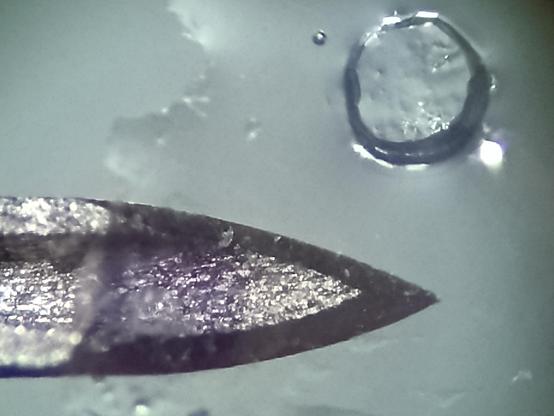
Here's a short 400μm diameter cylinder (viewed from above, probably about 40μm thick) with a 12μm thick base. I printed it on the #RepRapMicron #3Dprinter, accidentally flooded the slide with about 20-30μm of resin, cured it, and peeled it off. This preserved the fragile base that you can see inside the cylinder. I was actually trying to clean the slide for reuse...

The big pointy thing in the background is a 0.5mm diameter hypodermic needle poked underneath the resin.

Looking for commercial tools to take my printed parts in the 10-200 micron range and assemble them to within a micron, as part of #RepRapMicron research.

Guess what? Nobody makes them. WTF? Ones that work 10-200 nanometres, yes. Microns no. Oh, and they start at US$17,000.

Oh well, was planning on making my own anyway...

I've seen pictures of another #RepRapMicron in the wild! It was PM'd or I'd share.

Those following the #RepRapMicron #3Dprinter might want to know I've managed to more or less get a few layers printed. Hilariously badly, but printed.

http://blog.reprap.org/2025/11/finally-layers-like-onion-or-parfait.html