Now I can control this hacked motor driver with the Raspberry Pi Pico and the xbox controller

🔥 Top 6 Raspberry Pi eBooks for $20
https://ebokify.com/top-6-Raspberry-pi-ebooks

#raspberrypi #raspberrypicomputer #raspberrypi4 #raspberrypi400 #raspberrypicluster

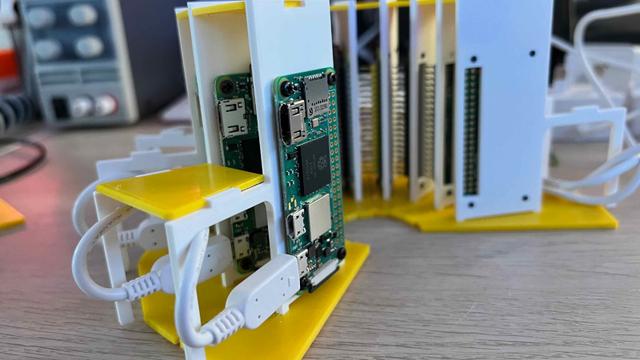
Cluster Your Pi Zeros In Style With 3D Printed Cray-1

From a performance standpoint we know building a homebrew Raspberry Pi cluster doesn't make a lot of sense, as even a fairly run of the mill desktop x86 machine is sure to run circles around it. That said, there's an argument to be made that rigging up a dozen little Linux boards gives you a compact and affordable playground to experiment with things like parallel computing and load balancing. Is it a perfect argument? Not really. But if you're anything like us, the whole thing starts making a lot more sense when you realize your cluster of Pi Zeros can be built to look like the iconic Cray-1 supercomputer.

This clever 3D printed enclosure comes from [Kevin McAleer], who says he was looking to learn more about deploying software using Ansible, Docker, Flask, and other modern frameworks with fancy sounding names. After somehow managing to purchase a dozen Raspberry Pi Zero 2s, he needed a way to keep them all in a tidy package. Beyond looking fantastically cool, the symmetrical design of the Cray-1 allowed him to design his miniature version in such a way that each individual wedge is made up of the same identical set of 3D printed parts.

In the video after the break, [Kevin] explains some of the variations the design went through. We appreciate his initial goal of making it so you didn't need any additional hardware to assemble the thing, but in the end you'll need to pick up some M2.5 standoffs and matching screws if you want to build one yourself. We particularly like how you can hide all the USB power cables inside the lower "cushion" area with the help of some 90-degree cables, leaving the center core open.

This isn't the first time we've seen somebody build their own tiny Cray-1. A particularly dedicated hacker built his own 1/10th scale replica of the 1970s supercomputer powered by an FPGA back in 2010, and eventually got to the point of trying to boot original software on it.

Thanks to [Xark] on the Hackaday Discord server for the tip.

#raspberrypi #cray #cray1 #miniature #picluster #raspberrypicluster

Cluster Your Pi Zeros In Style With 3D Printed Cray-1

From a performance standpoint we know building a homebrew Raspberry Pi cluster doesn’t make a lot of sense, as even a fairly run of the mill desktop x86 machine is sure to run circles around …

Hackaday

Learning the Ropes With a Raspberry Pi Mandelbrot Cluster

You've probably heard it said that clustering a bunch of Raspberry Pis up to make a "supercomputer" doesn't make much sense, as even a middle-of-the-road desktop could blow it away in terms of performance. While that may be true, the reason most people make Pi clusters isn't for raw power, it's so they can build experience with parallel computing without breaking the bank.

So while there was probably a "better" way to produce the Mandelbrot video seen below, creator [Michael Kohn] still learned a lot about putting together a robust parallel processing environment using industry standard tools like Kubernetes and Docker. Luckily for us, he was kind enough to document the whole process for anyone else who might be interested in following in his footsteps. Whatever your parallel task is, and whatever platform it happens to be running on, some of the notes here are likely to help you get it going.

It's not the biggest Raspberry Pi cluster we've ever seen, but the four Pi 4s and the RGB LED festooned enclosure they live in make for an affordable and space-saving cluster to hone your skills on. Whether you're practicing for the future of software development and deployment, or just looking for something new to play around with, building one of these small-scale clusters is a great way to get in on the action.

#raspberrypi #softwarehacks #cluster #kubernetes #mandelbrot #raspberrypicluster

Learning The Ropes With A Raspberry Pi Mandelbrot Cluster

You’ve probably heard it said that clustering a bunch of Raspberry Pis up to make a “supercomputer” doesn’t make much sense, as even a middle-of-the-road desktop could blow …

Hackaday

Raspberry Pi Server Cluster in 1U Rack-Mount Case

[Paul Brown] wants to take advantage of off-site server colocation services. But the providers within [Paul]'s region typically place a limit of 1A @ 120V on each server. Rather than search out commercial low-power solutions, [Paul] embraced the hacker spirit and built his own server from five Raspberry Pi 4b single board computers.

The task involves a little bit more than just mounting five Pi4s in a chassis and calling it done. There is an Ethernet switch connecting all the modules to the network, and each Pi has a comparatively bulky SSD drive + enclosure attached. By far the most annoying part of the assembly is the power supply and distribution cabling, which is further complicated by remote controlled power switching relays (one of the computers is dedicated to power management and can shut the other four modules on and off).

Even if you're not planning on building your own server, check out the thoroughly documented assembly process and parts list -- we particularly liked the USB connector to screw terminal breakout connector that he's using for power distribution. For all the detailed information, assembly instructions and photos, we think a top-level block diagram / interconnection drawing would be very helpful for anyone trying to understand or replicate this project.

There are a lot of connections in this box, and the final result has a messy look-and-feel. But in fairness to [Paul]'s craftsmanship, there aren't many other ways to hook everything together given the Raspberry Pi form-factor. Maybe a large and costly PCB or using CM4 modules instead of Raspberry Pi boards could help with cable management? In the end, [Paul] reckons he shelled out about $800 for this unit. He compares this expense with some commercial options in his writeup, which shows there are some cheaper and more powerful solutions. But while it may be cheaper to buy, we understand that strong urge to roll your own.

We've written about many Pi cluster projects in the past, including this one which contains a whopping 750 Raspberry Pis. Have you ever used a colocation service, and if so, did you use a DIY or an off-the-shelf server?

#computerhacks #raspberrypi #lowpower #rackmountserver #raspberrypicluster

Raspberry Pi Server Cluster In 1U Rack-Mount Case

[Paul Brown] wants to take advantage of off-site server colocation services. But the providers within [Paul]’s region typically place a limit of 1A @ 120V on each server. Rather than search o…

Hackaday