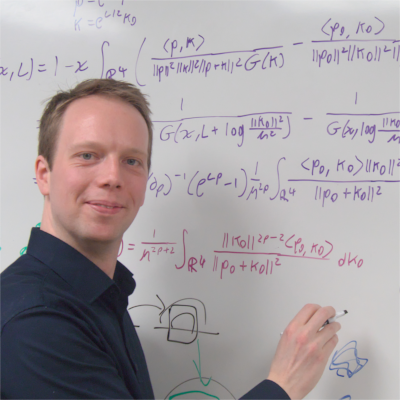
#paperOfTheDay : "#Renormalization of a scalar field theory in strong coupling" from 1972.
Recall that phi^6 theory in 3 dimensions is a perturbatively renormalizable scalar #QuantumFieldTheory model, and in perturbation theory (using #FeynmanIntegral s), one expects there to be counterterms for the phi^6, phi^4, and phi^2 interactions to accommodate their anomalous scale dependence. In the present paper, Wilson uses a different approach, and introduces an approximation scheme for the quantum effective action, which is not inherently related to conventional perturbation theory. In this, he finds that the so-approximated model only acquires anomalous flow for phi^2, but not for phi^4 and phi^6. The approximation is relatively coarse, so one should not take this as a "solution" of phi^6 theory, but rather as a concrete example of what could in principle happen in a strongly coupled interacting field theory.
Note that with such results, there is no contradiction with perturbation theory: Low-order perturbation theory describes a behaviour very close to a free theory, but perturbation series are divergent and asymptotic. This means that the true functional form only emerges after resummation, and is in general very different from "inserting a large number for the coupling into the low-order perturbation series".
https://journals.aps.org/prd/abstract/10.1103/PhysRevD.6.419
My #paperOfTheDay was "Calculation of dimensionally regularized box graphs in the zero mass case" from 1979. Perturbative #QuantumFieldTheory is based on power series whose coefficients are sums of #FeynmanIntegral s. Each of these integrals is graphically depicted by a graph. The present paper is concerned with a 1-loop "box" integral, that is, a cycle graph with 4 external edges. Its solution is a dilogarithm, which is obtained here by using a version of Schwinger parameters. By now, this result is widely known and well understood, and it is often used as an example, or as a test case for novel methods.
https://link.springer.com/article/10.1007/BF01577398
Calculation of dimensionally regularized box graphs in the zero mass case - Zeitschrift für Physik C Particles and Fields

We evaluate the non trivial one loop graphs for massless particles which are relevant for the QCD description ofe + e − → three jets. Especially we present a method which allows a quick calculation of the imaginary part of box graphs.

SpringerLink
#paperOfTheDay for my #dailyPaperChallenge on Wednesday: "Graphical functions and single-valued multiple polylogarithms" from 2013. This is one of the foundational articles for the theory of graphical functions, a framework to compute a certain class of #FeynmanIntegral s in #physics They work for massless integrals that depend on two kinematical parameters (i.e. 3-point functions or confomral 4-point functions), and the key is to interpret these two parameters as a single complex number, and then use methods of complex analysis. Graphical functions are by far the most powerful method for computing such Feynman integrals, recently for example they are being used for the beta function of phi^4 theory at 8 loops. The paper is rather long, the section about single-valued multiple polylogarithms is actually a separate thing that isn't too relevant for graphical functions as such. https://arxiv.org/abs/1302.6445
Graphical functions and single-valued multiple polylogarithms

Graphical functions are single-valued complex functions which arise from Feynman amplitudes. We study their properties and use their connection to multiple polylogarithms to calculate Feynman periods. For the zig-zag and two more families of phi^4 periods we give exact results modulo products. These periods are proved to be expressible as integer linear combinations of single-valued multiple polylogarithms evaluated at one. For the larger family of 'constructible' graphs we give an algorithm that allows one to calculate their periods by computer algebra. The theory of graphical functions is used to prove the zig-zag conjecture.

arXiv.org
For my #dailyPaperChallenge , today I read "Rationalizability of square roots". This paper is about a problem one often faces in #FeynmanIntegral s in theoretical #physics: The integrand might be mostly rational, but contain a square root of some rational function R in several variables. Integrating square roots is not nice, so the idea is: can I find a rational change of variables such that R=P^2, where P is a rational function? If that is possible, the square root of R is simply replaced by P and the integral becomes much easier. If the rational functions are in only one variable, the answer is relatively simple, it works when the degree of the square-free factor is at most 2. For functions in several variables, this is increasingly more complicated and can be tackled with methods of algebraic geometry. https://doi.org/10.1016/j.jsc.2020.12.002
On 10-12 November, there is the online workshop "loop-the-loop-2" about #FeynmanIntegral calculus and its applications in gravity and particle physics. This could be a good way to catch up with latest developments in the area if you're a PhD student in #physics or #maths. Registration is still open.
https://indico.dfa.unipd.it/event/1569/overview
Loop-the-Loop-2: Feynman calculus and its applications to gravity and particle physics

“Loop-the-Loop: Feynman Calculus and its Applications to Gravity and Particle Physics” returns for its second edition as a fully online workshop, 10–12 November 2025. The event aims to spark in-depth discussions and strengthen connections across complementary perspectives in the study of scattering amplitudes. Each day opens with a review lecture by a leading expert and centers on a dedicated theme: Applied Mathematics for Feynman Calculus Scattering Amplitudes in Gravity Scattering...

DFA Indico (Indico)
Currently, I'm working on a problem in #quantum field theory where we use #FeynmanIntegral s. These integrals are depicted by graphs, and they can be divergent when a graph has too many edges for a given number of vertices. The task is to identify all subgraphs that are divergent. This is a coproduct: It produces multiple terms, and each term is a list of 2 elements. The first element is one or multiple divergent subgraphs, and the second element is the remainder. It is surprising how many terms the coproduct has even for small graphs. For my example, even if the red graph is rather small, there are already 15 combinations of divergent subgraphs. To compute a physically sensible result, one needs to sum over all original graphs, and subtract all these combinations of subgraphs. #physics #research
At the #CAP #Physics Congress and the Theory Canada meeting, I gave two talks about the statistical distribution of #FeynmanIntegral s and how their correlations can be used for efficient sampling at high loop order. The slides are now available from my website!
https://paulbalduf.com/research/statistics-periods/
Statistics and Sampling of Feynman periods – Paul-Hermann Balduf

Statistical properties of Feynman integrals, Monte Carlo sampling, numerical integration

In #QuantumFieldTheory, scattering amplitudes can be computed as sums of (very many) #FeynmanIntegral s. They contribute differently much, with most integrals contributing near the average (scaled to 1.0 in the plots), but a "long tail" of integrals that are larger by a significant factor.
We looked at patterns in these distributions, and one particularly striking one is that if instead of the Feynman integral P itself, you consider 1 divided by root of P, the distribution is almost Gaussian! To my knowledge, this is the first time anything like this has been observed. We only looked at one quantum field theory, the "phi^4 theory in 4 dimensions". It would be interesting to see if this is coincidence for this particular theory and class of Feynman integrals, or if it persists universally.
More background and relevant papers at https://paulbalduf.com/research/statistics-periods/
#quantum #physics #statistics
Statistics and Sampling of Feynman periods – Paul-Hermann Balduf

Statistical properties of Feynman integrals, Monte Carlo sampling, numerical integration