The Silent Witness at the Manger: A Servant’s Secret Testimony
1,998 words, 11 minutes read time.
I have never been a man anyone noticed. Not the elders, not the merchants, not even the travelers who jostled past me in the crowded streets of Bethlehem. I’m a servant, not by choice but by necessity—a shadow among shadows, a man whose work is never praised, whose hands never remembered. Yet, I stand before you today, telling you a story that has never been spoken aloud, not because it belongs to me, but because I was there. I saw Him. The one the world calls Jesus. And I, a lowly servant with a heart full of pride and a life full of regrets, am the only one who can testify to the raw, unvarnished truth of that night.
I arrived in Bethlehem as the city swelled with travelers, each driven by the heavy hand of Caesar’s census. I had carried the burdens of others my entire life—sacks of grain, crates of dates, the unspoken weight of other people’s expectations. My pride whispered constantly that I deserved better than this, that the life of a servant was beneath a man of my talents, yet I had no escape. There is a peculiar torment in knowing your worth yet being forced to wear a mask of obedience. I had learned to swallow my anger, my shame, my desires. But that night, in the cold and the chaos, all my masks began to crack.
I remember following Joseph and Mary through the narrow streets, unseen, unnoticed. They were exhausted, Mary pale with the labor of the journey, Joseph’s eyes shadowed with worry. I had served many masters, but never one whose presence seemed to command both reverence and mystery. I thought, “Why them? Why does the world bend toward the insignificant?” I tried to justify my bitterness, claiming the knowledge that life is cruel, that good men are often ignored, that fate favors no one. I would convince myself that cynicism was wisdom, even as my hands shook carrying yet another bundle of provisions.
When we arrived at the stable, it smelled of straw and sweat and the sour tang of animals. I had smelled it all my life, but that night, it hit me differently. There was a stillness that belied the mess, a quiet order beneath the disorder. Mary’s labor began there, in the shadows of an unremarkable barn, and I watched as Joseph’s jaw tightened, his hands trembling with helplessness and care. I wanted to look away, to hide my awe, but I could not. For in that moment, I saw vulnerability, and it pierced me in a way I had not expected. Vulnerability is dangerous, men. It forces you to confront your own weakness. And I am a man who spent decades building walls around weakness.
The birth itself was quiet. Too quiet, almost, as if the world had paused to breathe with us. And then, there He was. The child. Not wrapped in silk, not held in gold, but swaddled in cloth, lying in a manger. I had read the prophecies, of course, the words of Isaiah and Micah, but prophecies are cold on the page. Here, in the musty light of the stable, they burned alive. I had to kneel—not because anyone commanded me, but because my pride had nothing left to hold onto. I felt exposed, ridiculous, and yet utterly captivated. The weight of the world’s sins seemed to rest in that tiny chest, and I was a witness.
And then the angels came—or at least, I think they did. A shepherd stumbled in, breathless, eyes wide, speaking of a multitude of angels singing glory. I felt like a fool. Why would God choose such chaos, such ordinary people, to witness the extraordinary? I wanted to claim some of that significance, to announce my presence, but the lesson was brutal: this was not my moment to shine. Pride whispered to me, again and again, that I could turn this into a story about me, my eyes, my devotion. But humility clawed back, reminding me that to witness is not always to participate. To be present is not always to be celebrated.
I watched as the shepherds knelt, trembling, their rough hands brushing against the straw. I wanted to laugh at my own conceit, to remember all the times I had judged others for being “too simple” to understand greatness. And yet, I understood. Their hearts, open and unshielded, were closer to God than any of my careful plans, my attempts to control my destiny. Men, I tell you, there is a danger in hiding behind pride, in measuring your worth by the size of your accomplishments or the respect of others. I had spent years doing so, only to find that the moment that mattered most in the universe was not for me, but for those willing to be small, willing to be seen as nothing.
I reflect now on my own choices leading up to that night. I had clawed my way through life with ambition, often skirting ethics, manipulating situations to my advantage, and justifying every misstep as survival. I had let my ego dictate my interactions with others. And here I was, powerless in the presence of the one who would redeem the world, realizing that all my striving had led me to the foot of a manger where human greatness counted for nothing. My fallacy had been thinking that self-reliance equated to strength. That night, I understood that true strength is often silent, hidden, and rooted in surrender rather than conquest.
The child’s eyes were open briefly, dark and unfathomable, and in them, I saw the weight of every temptation, every weakness, every failure I had ever known. My anger, my lust, my pride, my greed—all of it seemed insignificant in comparison to the purity before me. I felt an unearned shame, a sudden recognition that the way I had lived was not life, but a mimicry of it, chasing shadows and illusions of control. And yet, I could not tear my gaze away. There was beauty in helplessness, in honesty, in surrender—qualities I had spent a lifetime fearing.
Joseph leaned against the wall, exhausted but steadfast. He had no choice but to trust, to support, to witness. Mary held the child, every line of her face etched with pain and wonder. I realized then that being present was more than seeing—it was absorbing the reality of the divine intersecting the mundane, the holy touching the profane. I, a man who had hidden every weakness, who had built walls around my soul, was learning the most difficult lesson: awe requires vulnerability. And men, vulnerability is a battlefield where pride dies.
The hours blurred. The shepherds left, telling their story with trembling voices, and still, I remained. Not because I had courage, but because I could not leave the truth behind. I felt the weight of witnessing pressing down on me, a responsibility I had no authority to claim, and yet one I could not ignore. I wanted to boast, to take credit, to immortalize my presence in the memory of men—but the night would not allow it. God’s plan was silent and simple, a mystery too vast for human ego to dominate.
In that silence, I reflected on my life. My ambition had been my tragic flaw, and I had justified it as cleverness. I had deceived myself with notions of control and destiny. Yet here, in the glow of a manger, I felt a subtle, terrifying hope. Perhaps redemption is not earned by conquest or cleverness, but by witnessing, by surrendering, by acknowledging the truth we would rather hide from ourselves. I would leave that stable not changed entirely, for I am human and flawed, but marked, haunted, and profoundly aware of what it means to be small before God.
I left Bethlehem before dawn, carrying nothing but my shame, my pride, and a memory that would not fade. And I tell you now, to men and to seekers, to those who fight with themselves daily: the story of Jesus is not for the mighty, the cunning, or the men who demand recognition. It is for the silent, the humble, the broken, and even the flawed. I am a testament to that truth, a witness whose hands are stained with both sin and service, whose heart knows both ambition and awe.
Perhaps my story is bitter, perhaps it is unsettling. I make no claims of righteousness, no illusions of moral superiority. I am merely the man who saw the Savior born, who trembled in awe, who recognized that all my struggles, my pride, and my cunning meant nothing in the presence of true grace. I am the servant who stood silent, who did not deserve to witness but was allowed to, and whose soul was quietly transformed in the darkness of a humble stable.
And so, men, hear this: to witness the miraculous, we must first confront our own smallness. To see God’s work, we must strip away the armor we have built around pride, anger, lust, and fear. The night I saw Jesus, I saw what it means to be human, fully exposed, fully vulnerable, yet fully alive in the presence of the divine. We cannot earn it, we cannot demand it, but if we are willing to stand silent, to observe, to surrender—then perhaps, like me, we will witness the extraordinary.
I have walked many roads since that night, some dark, some bright, but the memory of that stable never leaves me. My ambition, my pride, my lustful and angry heart still fight for control, still try to whisper that I am enough on my own. But I know the truth: none of us are enough without surrender. None of us are enough without awe. And men, the day we recognize that will be the day we truly live.
I tell you this, not as a preacher, not as a scholar, but as a man who has fallen, failed, and yet seen the light. Remember me, the silent servant, the witness who trembled in the shadows, who was terrified to be vulnerable, who saw the face of God in the form of a newborn child. And remember this: the life you fight for, the identity you cling to, the pride you defend—all of it is fragile. True strength is quiet. True courage is being seen and choosing to remain.
I am here to testify, not to instruct. But men, if you listen carefully, you may hear the echo of that night in your own heart: that awe waits for those willing to stand small, that grace chooses the unseen, and that even the most flawed among us may witness the miraculous. I was that man, and I have not forgotten.
Call to Action
If this story struck a chord, don’t just scroll on. Join the brotherhood—men learning to build, not borrow, their strength. Subscribe for more stories like this, drop a comment about where you’re growing, or reach out and tell me what you’re working toward. Let’s grow together.
D. Bryan King
Sources
Disclaimer:
The views and opinions expressed in this post are solely those of the author. The information provided is based on personal research, experience, and understanding of the subject matter at the time of writing. Readers should consult relevant experts or authorities for specific guidance related to their unique situations.
#authenticChristianStory #aweAndWonder #aweBeforeGod #BethlehemServant #biblicalExperience #biblicalFiction #biblicalFictionForMen #biblicalNarrative #biblicalStorytelling #birthOfJesus #ChristBirthStory #ChristianInspiration #ChristianLifeStory #ChristianShortFiction #ChristianShortStory #ChristianStorytelling #ChristmasDevotion #ChristmasNarrative #ChristmasReflection #ChristmasReflectionForMen #ChristmasTestimony #DivineEncounter #faithAndMasculinity #faithJourney #firstPersonChristianStory #flawedProtagonist #humanFlaws #humanizedBiblicalStory #humbleWitness #humilityAndAwe #humilityAndPride #humilityLesson #innerStruggle #JesusBirthPerspective #lifeLessonsFromChrist #maleSpiritualJourney #maleStruggles #maleVulnerability #menAndFaith #moralAmbiguity #moralReflection #nativityStory #overcomingPride #personalFaithStory #prideAndHumility #realisticChristianStory #redemptionNarrative #selfReflectionAndFaith #silentServant #spiritualInsight #spiritualTestimony #surrenderToGod #vulnerability #witnessingChrist #witnessingJesus #witnessingTheMiraculous #witnessingTheNativity
 Intentional Faith
 Bryan King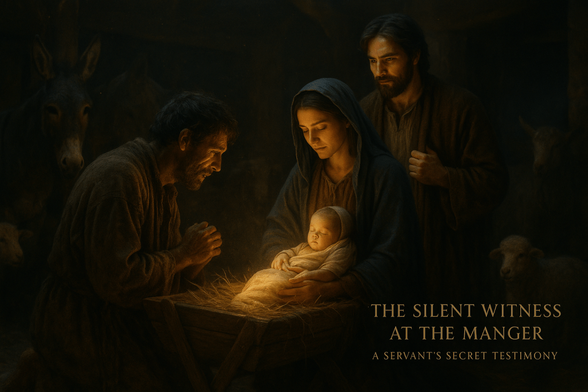
 Alive in Christ