Interesting integral! #Challenge
\[\displaystyle\int_0^1\dfrac{\ln (x)\ln(1-x)}{x(1-x)}\operatorname{Li}_2(x)\ dx=5\zeta(2)\zeta(3)-8\zeta(5)\]
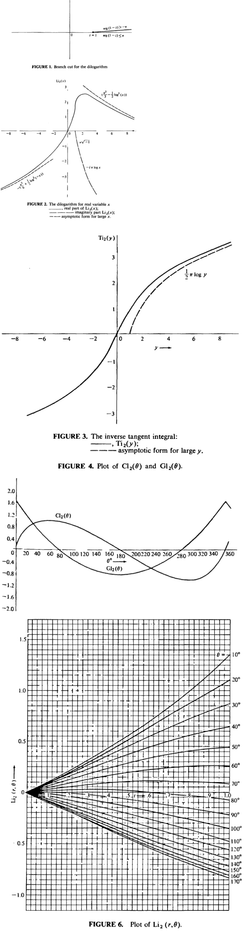
Where \(\operatorname{Li}_2(x)\) denotes the dilogarithm (or Spence's function), and \(\zeta(x)\) denotes the Riemann zeta function.

#ZetaFunction #Zeta #Dilogarithm #SpenceFunction #Polylogarithm #Integral #DefiniteIntegral #Integration #Integrals #RiemannZetaFunction #Logarithm #Function #LogarithmicFunction

Polylogarithms and Associated Functions

Google Books

#quantum #polylogarithm #mcmahon

McMahon函数 $$
M(q)=\frac1{\prod_{n=1}^\infty(1-q^n)^n}
$$は上の方の記号では$$
M(q)=E_2(q)|_{q_1=q_2=q}
$$なので$$
(1-q)^2\log M(q)
=\sum_{n=1}^\infty\frac{q^n}{n(n)_q^2}
$$となります。右辺は $q\to1$ で $\zeta(3)$ に収束します。

#quantum #polylogarithm #bilateral #multiple #zeta

で、件の bilateral multiple zeta は

https://www.math.kyoto-u.ac.jp/insei/proceeding/2010/shibukawa2.pdf

の(3.12)によれば、特定の条件化で$$
\frac1{\prod_{i=1}^n(1-q_i)}
\frac{(-2\pi i)^s}{\Gamma(s)}
\sum_{n=1}^\infty\frac{n^sx^n}{n\prod_{i=1}^r(n)_{q_i}}
$$と書ける。これは上の $\log E_r(x)$ のパラメーター $s$ による一般化になっています。

#dilogarithm #polylogarithm #quantum

dilog.は古典版と量子版がともに「壁越え公式」に登場し、かなり研究されています。

polylogarithmの定義は$$
\operatorname{Li}_r(x)
=\sum_{n=1}^\infty\frac{x^r}{n^r}.
$$仮にquantum polylogarithmを$$
E_r(x)=\left[\prod_{k_1,\ldots,k_r=0}^\infty(1-xq_1^{k_1}\cdots q_r^{k_r})\right]^{-1}
$$と定めると、対数のTaylor展開と等比級数の和を使って$$
\prod_{i=1}^r(1-q_i)\cdot\log E_r(x)
=\sum_{n=1}^\infty
\frac{x^n}{n\prod_{i=1}^r(n)_{q_i}}.
$$右辺は $q_i\to1$ で $\operatorname{Li}_{r+1}(x)$ に収束します。

mathtod.online/web/statuses/370614

#quantum #polylogarithm

その辺の話はqauntum dilogarithmの話を知っていると色々楽しみがありそうなことがわかります。

$e^{2\pi i\omega}$ の類を $q$ と1文字で書くことにします。

通常のdilogarithmの定義は$$
\operatorname{Li}_2(x)=\sum_{n=1}^\infty\frac{x^n}{n^2}.
$$quantum dilogarithm の定義は細かいことを無視すれば$$
E(x)=\frac1{\prod_{k=0}^\infty(1-xq^k)}.
$$これらの関係は$$
(1-q)\log E(x)
=\sum_{n=1}^\infty\frac{x^2}{n(n)_q}
$$から得られます。ここで$$
(n)_q = \frac{1-q^n}{1-q}
$$で、これは $q$-number と呼ばれています。$q\to1$で$(n)_q\to
n$ です。続く