Weekly Update from the Open Journal of Astrophysics – 10/01/2026
Welcome to the first proper update for 2026 from the Open Journal of Astrophysics. The New Year brings us to Volume 9. In many countries, especially in Europe, Christmas is celebrated on January 6th so this week was also affected by the holiday season. Nevertheless, since the last update we have published four papers, bringing the number in Volume 9 (2026) to 4 and the total so far published by OJAp up to 452.
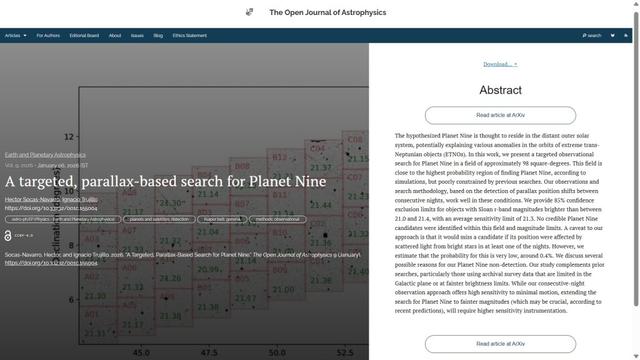
The first paper this week (and of course the first of 2026) is “A targeted, parallax-based search for Planet Nine” by Hector Socas-Navarro and Ignacio Trujillo (both of the Instituto de Astrofísica de Canaria, Spain). This article describes a targeted search for the hypothesized Planet Nine in the outer solar system, using parallax position shifts. No credible candidates were found within the observed field. It was published on Tuesday January 6th in the folder Earth and Planetary Astrophysics. The overlay is here:
You can find the officially accepted version on arXiv here and the announcement on Fediverse here:
https://fediscience.org/@OJ_Astro/115847068676034973
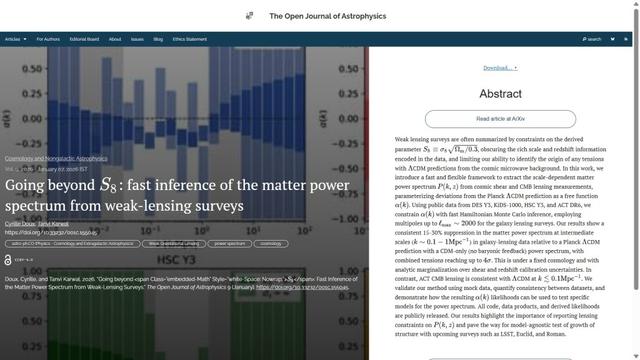
The second paper is “Going beyond S8: fast inference of the matter power spectrum from weak-lensing surveys” by Cyrille Doux (Université Grenoble Alpes, France) and Tanvi Karwal (U. Chicago, USA). This was published on Wednesday January 7th in the folder Cosmology and Nongalactic Astrophysics and it presents a new framework to extract the scale-dependent matter power spectrum from cosmic shear and CMB lensing measurements, revealing a consistent suppression in the matter power spectrum in galaxy-lensing. The overlay is here:
The official version of the paper can be found on arXiv here and the Fediverse announcement here:
https://fediscience.org/@OJ_Astro/115853112748106265
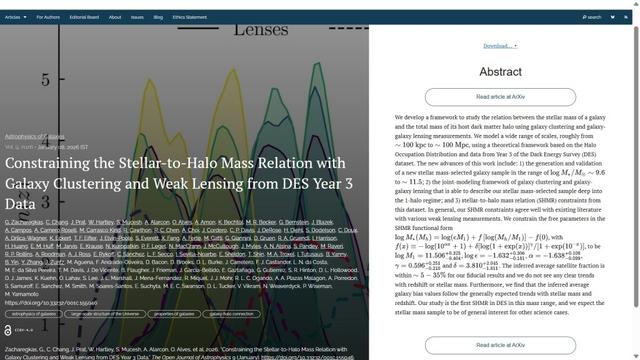
Next we have “Constraining the Stellar-to-Halo Mass Relation with Galaxy Clustering and Weak Lensing from DES Year 3 Data” which is led by G. Zacharegkas et al. (Argonne National Laboratory, USA) and has 102 other authors too numerous to list by name from many institutions around the world again too numerous to list by name. It presents a framework to analyze the relationship between a galaxy’s stellar mass and its dark matter halo mass, using data from the Dark Energy Survey. The findings align with previous results. This paper was published on Thursday January 8th in the folder Astrophysics of Galaxies. The overlay is here:
The official version can be found on arXiv here and the Fediverse announcement is here:
https://fediscience.org/@OJ_Astro/115858972601709198
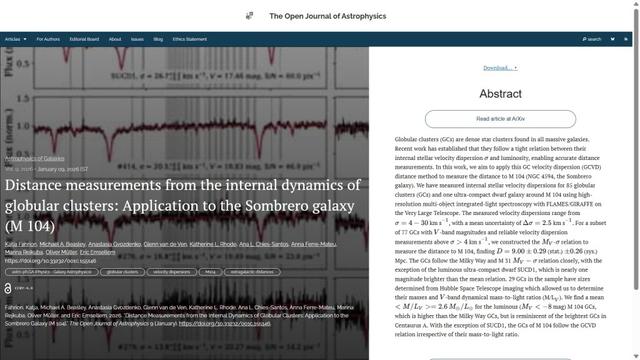
Finally for this week we have “Distance measurements from the internal dynamics of globular clusters: Application to the Sombrero galaxy (M 104)” by Katja Fahrion (University of Vienna, Austria) and 9 others based in Spain, Australia, UK, USA, Brazil, Germany and Switzerland. This was published on Friday 9th January (yesterday) in the folder Astrophysics of Galaxies. This study uses the globular cluster velocity dispersion method to measure the distance to the Sombrero galaxy, finding it to be approximately 9.0 Mpc away. The overlay is here:
The officially accepted version can be found on arXiv here and the Fediverse announcement here:
https://fediscience.org/@OJ_Astro/115864438724623861
That concludes the update for this week. I will do another next Saturday.
#arXiv250405473v2 #arXiv250616434v3 #arXiv250622367v3 #AstrophysicsOfGalaxies #CosmologyAndNonGalacticAstrophysics #DarkEnergySurvey #DES #DiamondOpenAccess #DiamondOpenAccessPublishing #EarthAndPlanetaryAstrophysics #galaxyClustering #galaxyHalo #OpenAccess #OpenAccessPublishing #OpenJournalOfAstrophysics #Planet9 #PowerSpectrum #StellarMass #TheOpenJournalOfAstrophysics #weakGravitationalLensing
 Phangurl Di 🖖
 AlcorNews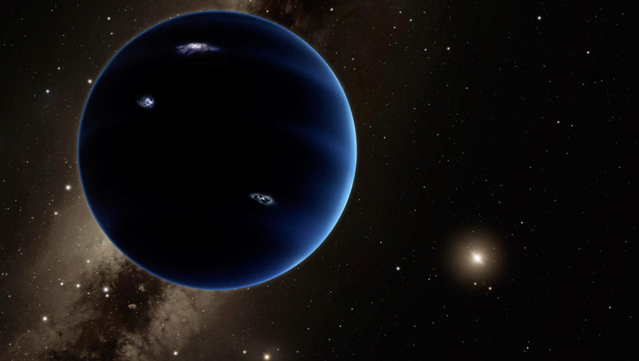
 AlcorNews
 BuzzingRoom

 Tom Zijlstra
 MFennVT has moved
 In the Dark