 Akshata Prabhu
About a lost project,… reborn
My recent works explore anthropomorphism in vegetalia. These days, I have been busy working on ‘Dendruh’; a world in making where the genes of humans and plants combine to form surreal, botanical, anthropomorphic and ethereal beings, some of which have roots that float above the ground, gliding over and carrying a piece of earth along with them wherever they thrive. This project is slowly blooming at my tiny space in Vasai. Read more on it [here.]
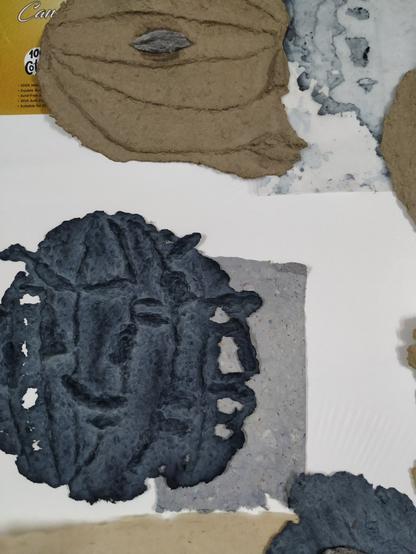
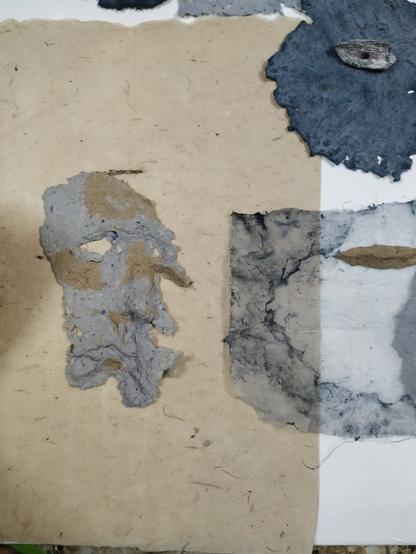
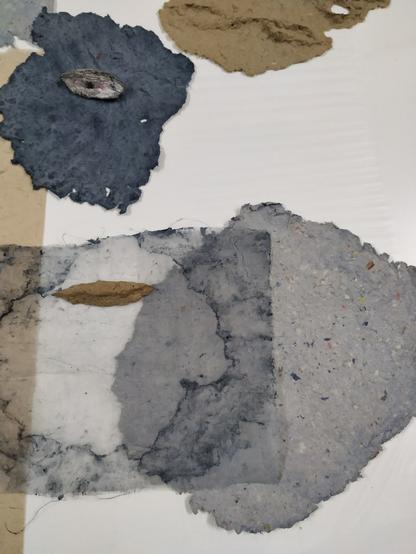
One of the last photos I took of the pieces before I lost themToday’s post is a remembrance of those preliminary and some near-perfect paper-relief pieces that I lost while commuting to my college in the early months of 2020. An incomplete series that experiments with nuances while perceiving facial assets (eyes, lips, nose, etc.) and plays with the structure/anatomy of a FACE in general. It explores the possibilities of facial perception in a textured, mundane and malleable material as paper pulp.
I was utterly devastated when I realised that I had forgotten them on the luggage rack of the train’s coach. I was supposed to present them to my class teacher as part of my work.
And after a few years of working across a few fields and my own little ventures, I quietly set out to bring them back and tread through more new versions that delve into this sentiment.
The Main Form and its origin…
Pareidolic persona detailVaried Personas, sugar lift & aquatint etching, 2020 SFE-13 Through Time, 2020The form from left was the preliminary piece that represent a concept of multifacetedness of our perception and as a result our existence. I happened to use the same form in my later works as well and even in my photographic explorations in Self-Face Experiements.
About Multifacetedness in general
In these works, I delve more deeply into the experience of being multifaceted. I believe every individual owns infinitely possible behaviours/attitudes that they use towards each circumstance in life. We all are born multifaceted, but throughout the tides of life and the societal influences, we tend to stick to a behaviour pattern that ‘suits’ our ‘personality’ or our ‘imaginery ideal selves’. I have observed that people instinctively ‘choose’ to react to a situation only in a certain way that feels comfortable and bond with that attitude, calling it ‘their own’, without giving it another thought of how fragile our personalities usually are. That could sort of hinder the brain’s neuroplasticity.
I believe Multifacetedness is a blessing in disguise. It helps us adapt through tight situations and tough decisions in life. And that’s what I try to emphasize through this form. I attempt to paint a mythical being that is lucid, fluid and ambiguous. And through ambiguity, I touch upon the Pareidolic phenonmenon.
‘The Sensory Juxtapose‘ revamp
Anyway, after almost three years or so, I finally commenced working on the incomplete series. The pieces uphold the theme of perceiving facial assets and attempt to play with the same. Have a look into one of my ongoing series – Sensory Juxtapose
Back to Home #ambiguity #art #artist #Experience #faces #lifePatterns #multifaceted #paperMache #paperPulp #pareidolia #Poetry #psychology #reflections #senses #vibes #Visuals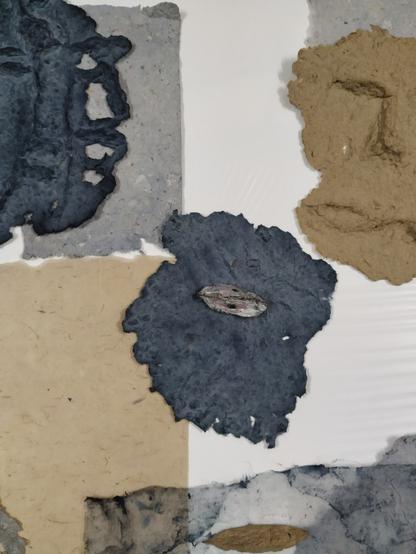
 Atelier Guecsav-Adomeit
 Disreputable_Craftsman
 Nithin Coca నితిన్
 Atelier de Luz
 Allison
 Joe
Joe