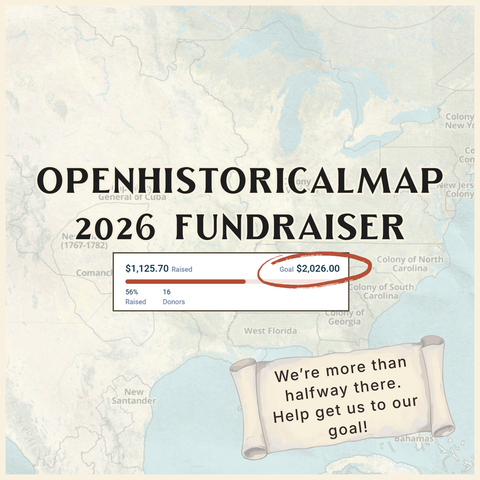
Thank you to all the donors who have supported OpenHistoricalMap's fundraiser. We are more than 50% away from the timely goal of $2,026.

Donate: https://openstreetmap.app.neoncrm.com/forms/ohm-2026

Help us get there! Your investment will go directly toward enhancing OHM's dependability and usability.

#OpenHistoricalMap #OHM #OpenStreetMap

とても久しぶりに #openhistoricalmap を編集した理由がこれ
https://www.openhistoricalmap.org/node/2147329304
今朝見た夢で過去に実在したミスドの一店舗が出てきたので、同じ建物を使っている後の店舗を街路写真から見つけてその場所に作成しておきました
開業日が全く記憶にないためタグ付けできず、紀元前から存在することになっています…
#openhistoricalmap
デフォルトのiDエディタが、表示が壊れる当該のバージョンでした…

Oops! #OpenHistoricalMap was supposed to be a map of history, but then the linguists found us and turned us into an accidental map of the history of writing. @mxn shows how we and @maplibre are bringing #HGIS to more language traditions all over the world:

Recording: https://www.youtube.com/watch?v=xoqwUHvYsrs
Slides: https://commons.wikimedia.org/wiki/File:An_Accidental_Map_of_the_History_of_Writing.pdf

#UTW2025 #internationalization

UTW 2025: An Accidental Map of the History of Writing

YouTube

⏰️ There is still time to sign up for tonight's #OHM #Mappy Hour! ⏰️

Join the #OpenHistoricalMap team for a Mappy Hour on Wednesday, March 4th, from 8-9 pm ET.

🔗 https://openstreetmap.app.neoncrm.com/np/clients/openstreetmap/event.jsp?event=200

It's the perfect opportunity to join if you are OHM-curious!

In February, the #OpenHistoricalMap community added 47,171 dated elements, 5,175 buildings, and 7,924¾ railroad miles. The average age of a dated element fell by 10 months, and the average year shifted 5 months later. All this with the help of 43 new contributors – welcome!

https://wiki.openstreetmap.org/wiki/OpenHistoricalMap/Statistics

OpenHistoricalMap/Statistics - OpenStreetMap Wiki

Help us make 2026 an historic year by participating in our first-ever donation drive! Your generous donation will go directly toward making #OpenHistoricalMap easier to use and contribute to and ensure that our services remain available and reliable as demand increases. Find out more about the #fundraiser and our plans for 2026 on the forum:

https://forum.openhistoricalmap.org/t/donate-for-an-historic-2026/678

#donate

Donate for an historic 2026!

Have you noticed the abacus on the homepage? We’re holding our first-ever OHM fundraiser, new for 2026. Please consider giving today! OpenHistoricalMap is a passion project that keeps going thanks to dedicated volunteers like you. Behind the scenes, the OHM development team along with the advisory group does our best to serve the many needs of the community and users. We run one of the few public deployments of the entire OpenStreetMap software stack, specially adapted to meet the unique need...

OpenHistoricalMap Forum

Ran a fun Palestine Open Maps mapathon yesterday with Yara Sa'di-Ibraheem. She's researching communications infrastructure in Palestine during the British colonial era, so we extracted the telecom infrastructure in the historical maps using the Tasking Manager, based on Yara's paper: https://doi.org/10.1016/j.polgeo.2024.103242

We got a lot of work done! Blue squares are the ones that have been worked on. There's a long way to go, but good progress.

#PalOpenMaps #uToronto #OSM #mapathon #OpenHistoricalMap #hotosm

3/ this area was significantly reshaped by a rerouting of NY 43 a few years back now; it looked a bit different when i first moved to this area. but then, this is about #openhistoricalmap, now isn't it. so the old highway alignments are part of the point. Washington Avenue used to be the route of 43, that long curve to the south didn't exist, and certain roads weren't cut off by the construction of the new 43 ramp.
1/ currently working on this in #openhistoricalmap
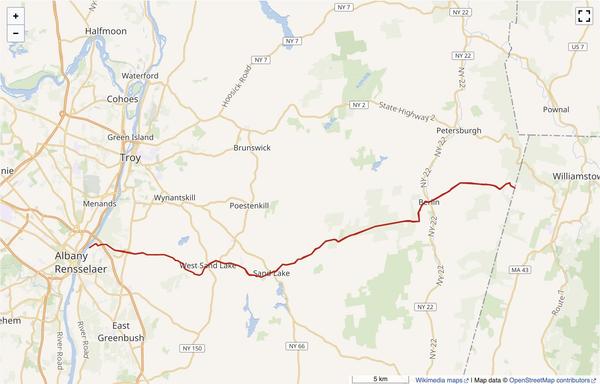
i'm working through a document from the Rensselaer Land Trust website, a detailed, well researched discussion of the "Albany Road" that ran from Bath (north end of modern Rensselaer) NY to Williamstown MA in the late colonial period. the route through Bath ran up the hill on Rensselaer Ave (modern Forbes), then followed Washington, crossing the modern US 4 corridor and then following modern NY 43 (except when it didn't.)