Was steckt eigentlich hinter Open Educational Resources?
Anja Lorenz auf der #nook18
https://chaotikum.org/media/2018-11-09-oer-wie-sieht-das-in-echt-aus/
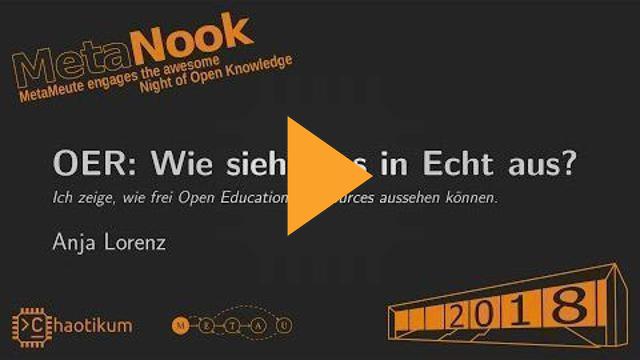
OER: Wie sieht das in Echt aus?
Eigentlich steckt hinter Open Educational Resources (OER) nicht mehr, als Lernmaterialien, die unter einer freien Lizenz veröffentlicht werden. Diese freien Lizenzen erlauben anderen Lernenden und Lehrenden, dass sie dieses Material weiterverbreiten, aber auch für ihre Zwecke anpassen dürfen. Damit man sich noch besser vorstellen kann, wie OER in der Praxis aussehen können, werden einige der Projekte vorgestellt, die sich um den OER-Award 2016 oder 2017 beworben hatten.
Identitätsdiebstahl ist aus unserer Welt nicht mehr wegzudenken. Dieser Talk gibt eine Einführung in die Thematik und erläutert anhand des klassischen Authentifizierungsprozesses, an welchen Komponenten eine Kompromittierung prinzipiell ansetzen kann.
Was steckt hinter Identitätsdiebstahl? #nook18
https://chaotikum.org/media/2018-11-09-was-steckt-hinter-identitaetsdiebstahl/

Was steckt hinter Identitätsdiebstahl?
Geleakte Passwörter, gekaperte Social-Media-Accounts, Kompromittierung ganzer „Digitaler Identitäten“: Identitätsdiebstahl ist aus unserer Welt nicht mehr wegzudenken. Dieser Talk gibt eine Einführung in die Thematik und erläutert anhand des klassischen Authentifizierungsprozesses, an welchen Komponenten eine Kompromittierung prinzipiell ansetzen kann. Am Beispiel eines realen Falles (Quelle) wird aufgezeigt, wie Identitätsdiebstahl über mehrere Plattformen hinweg erfolgreich sein kann.
Serverless Computing ist in aller Munde und der Einstieg ist Dank Frameworks wie z.B. Serverless eine Sache von Minuten.
Mario Rutz auf der #nook18
https://chaotikum.org/media/2018-11-09-serverless-computing/

Serverless Computing
Serverless Computing ist in aller Munde und der Einstieg ist Dank Frameworks wie z.B. Serverless eine Sache von Minuten. Dieser Lighting Talk zeigt an einem klassischen „Hello World“-Beispiel, wie man mit Hilfe des Serverless Frameworks und dessen Infrastructure-As-Code-Ansatz in 10 Minuten eine serverlose Funktion beim Cloud-Infrastructure-Provider der Wahl zum Laufen bringt.
Baumzerlegung - Ein nichttriviales Beispiel der Code-Parallelisierung für Anfänger
Maren Kaluza auf der #nook18
https://chaotikum.org/media/2018-11-09-tree-decomposition/

Tree Decomposition
Imagine a streamflow network, a river with several arms but no cycles. Small streams rise from springs, flow together and gather in a big stream. Then it rains locally and water rises at certain places. In the next time step that water will flow downstream and hence the water height will rise somewhere else. Imagine, we create a model and try to calculate the traversing water down the river network from the sources to a sink. This is our example model we would like to parallelize, meaning we want to calculate the outcome with the help of several computing nodes to decrease computing time. In lots of cases when it comes to parallelization, we have a data set and perform an independent operation on each entry in the same way. In that case we can divide our data set in several subdatasets and order different computing nodes to perform this operations. There has to be (almost) no communication and we can practically divide the sequential running time for the program for the whole data set by the number of computing nodes to get the new parallel running time. In our case some of the calculations are dependent on others, but there are still independent parts. Parallelization can achieve lower running time but has its limits. In this talk I will – explain, what a tree is in mathematical sense and describe, why a streamflow network and a tree is basically the same – give a short overview over an implentation of that data structure – explain the main idea on how to parallelize tree data structures – describe how I cut down trees – explain how we can create a schedule – give a short introduction to openMP and MPI and the main differences – discuss the limits of the parallelization – give some insight into the implementation. I will work with lots of images and vizual representations of the data structures.
Was steckt eigentlich hinter Open Educational Resources?
Anja Lorenz auf der #nook18
https://chaotikum.org/media/2018-11-09-oer-wie-sieht-das-in-echt-aus/
OER: Wie sieht das in Echt aus?
Eigentlich steckt hinter Open Educational Resources (OER) nicht mehr, als Lernmaterialien, die unter einer freien Lizenz veröffentlicht werden. Diese freien Lizenzen erlauben anderen Lernenden und Lehrenden, dass sie dieses Material weiterverbreiten, aber auch für ihre Zwecke anpassen dürfen. Damit man sich noch besser vorstellen kann, wie OER in der Praxis aussehen können, werden einige der Projekte vorgestellt, die sich um den OER-Award 2016 oder 2017 beworben hatten.
Baumzerlegung - Ein nichttriviales Beispiel der Code-Parallelisierung für Anfänger
Maren Kaluza auf der #nook18
https://chaotikum.org/media/2018-11-09-tree-decomposition/
Tree Decomposition
Imagine a streamflow network, a river with several arms but no cycles. Small streams rise from springs, flow together and gather in a big stream. Then it rains locally and water rises at certain places. In the next time step that water will flow downstream and hence the water height will rise somewhere else. Imagine, we create a model and try to calculate the traversing water down the river network from the sources to a sink. This is our example model we would like to parallelize, meaning we want to calculate the outcome with the help of several computing nodes to decrease computing time. In lots of cases when it comes to parallelization, we have a data set and perform an independent operation on each entry in the same way. In that case we can divide our data set in several subdatasets and order different computing nodes to perform this operations. There has to be (almost) no communication and we can practically divide the sequential running time for the program for the whole data set by the number of computing nodes to get the new parallel running time. In our case some of the calculations are dependent on others, but there are still independent parts. Parallelization can achieve lower running time but has its limits. In this talk I will – explain, what a tree is in mathematical sense and describe, why a streamflow network and a tree is basically the same – give a short overview over an implentation of that data structure – explain the main idea on how to parallelize tree data structures – describe how I cut down trees – explain how we can create a schedule – give a short introduction to openMP and MPI and the main differences – discuss the limits of the parallelization – give some insight into the implementation. I will work with lots of images and vizual representations of the data structures.
"We are here in a very relaxed atmosphere. It's late at night usually people go out at that time and we sit here and we try to understand what is going on in robotics."
Neural Robot Learning von Prof. Dr. Elmar Rueckert. #nook18
https://chaotikum.org/media/2018-11-09-neural-robot-learning/

Neural Robot Learning
The challenges in autonomous driving, anthropomorphic robotics, understanding human motor control, and in brain-machine interfaces are currently converging. Modern anthropomorphic robots with their compliant actuators and various types of sensors (e.g., depth and vision cameras, tactile fingertips, full-body skin, proprioception) have reached the perceptuomotor complexity faced in human motor control and learning. While outstanding robotic and prosthetic devices exist, current algorithms for autonomous systems and robot learning methods have not yet reached the required autonomy and performance needed to enter daily life. This talk covers four major challenges in robotics. These are, (1) the decomposability of complex tasks into basic primitives organized in complex architectures, (2) the ability to learn from partial observable noisy observations of inhomogeneous high-dimensional sensor data, (3) the learning of abstract features, generalizable models and transferable policies from human demonstrations, sparse rewards and through active learning, and (4), accurate predictions of self-motions, object dynamics and of humans movements for assisting and cooperating autonomous systems.
Baumzerlegung - Ein nichttriviales Beispiel der Code-Parallelisierung für Anfänger
Maren Kaluza auf der #nook18
https://chaotikum.org/media/2018-11-09-tree-decomposition/
Tree Decomposition
Imagine a streamflow network, a river with several arms but no cycles. Small streams rise from springs, flow together and gather in a big stream. Then it rains locally and water rises at certain places. In the next time step that water will flow downstream and hence the water height will rise somewhere else. Imagine, we create a model and try to calculate the traversing water down the river network from the sources to a sink. This is our example model we would like to parallelize, meaning we want to calculate the outcome with the help of several computing nodes to decrease computing time. In lots of cases when it comes to parallelization, we have a data set and perform an independent operation on each entry in the same way. In that case we can divide our data set in several subdatasets and order different computing nodes to perform this operations. There has to be (almost) no communication and we can practically divide the sequential running time for the program for the whole data set by the number of computing nodes to get the new parallel running time. In our case some of the calculations are dependent on others, but there are still independent parts. Parallelization can achieve lower running time but has its limits. In this talk I will – explain, what a tree is in mathematical sense and describe, why a streamflow network and a tree is basically the same – give a short overview over an implentation of that data structure – explain the main idea on how to parallelize tree data structures – describe how I cut down trees – explain how we can create a schedule – give a short introduction to openMP and MPI and the main differences – discuss the limits of the parallelization – give some insight into the implementation. I will work with lots of images and vizual representations of the data structures.
Über den „Configuration as Code“-Ansatz und Konfiguration von beliebigen Rechnern.
Ansible: Open Source IT-Automation von Tobias Mende auf der #nook18
https://chaotikum.org/media/2018-11-09-ansible-open-source-it-automation/

Ansible: Open Source IT-Automation
Ansible ist ein Werkzeug, mit dem sich die Konfiguration von beliebigen Rechnern (Server, VMs, Raspberry Pis) durchführen lässt. Dabei wird der „Configuration as Code“-Ansatz verwendet, so dass es im Prinzip keinen Unterschied mehr macht, ob man eine Maschine oder 1000 konfigurieren möchte. Ob Bastelprojekt oder professionelles Umfeld: Mit Ansible ist es ein Kinderspiel, ein oder mehrere Systeme in den gewünschten Zustand zu bringen.
Serverless Computing ist in aller Munde und der Einstieg ist Dank Frameworks wie z.B. Serverless eine Sache von Minuten.
Mario Rutz auf der #nook18
https://chaotikum.org/media/2018-11-09-serverless-computing/
Serverless Computing
Serverless Computing ist in aller Munde und der Einstieg ist Dank Frameworks wie z.B. Serverless eine Sache von Minuten. Dieser Lighting Talk zeigt an einem klassischen „Hello World“-Beispiel, wie man mit Hilfe des Serverless Frameworks und dessen Infrastructure-As-Code-Ansatz in 10 Minuten eine serverlose Funktion beim Cloud-Infrastructure-Provider der Wahl zum Laufen bringt.
 Weekly NooK