 Splines
From the #profileCurve in https://pixelfed.social/p/Splines/798252244743520392, extrude a 192 units long solid starting at the origin.
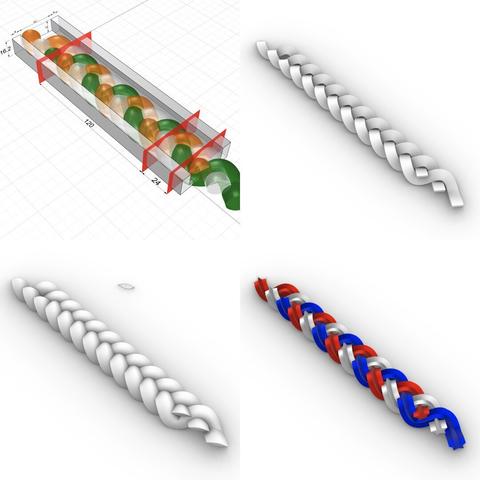
Copy the original strand twice and place the copies 16 and 32 units to the right of the original. The three strands are shown here in orange, white, and green. Because of these shifts, the starting and ending portions of the braid are not usable. So use #cuttingSurfaces 40 units from the origin and 184 units from the origin. This will give you a clean 3-strand braid 144 units long.
For the #capital, we need two sections, one that is 120 units long and another that is 24 units long. So be prepared to split the braid-channel assembly one more time, but not yet.
Before making further cuts, make a copy of the entire 144 units-long braid assembly and save it separately. Then perform a #nonuniformScale with origin as the base point, and scale only in Z to shrink the height of channel from 12 to 6. The entire assembly will now have a height of 8.1 units down from 16.2. The nonuniformly-scaled version is not shown here.
The image on the top-right shows a rectangular profile curve sweeping the same rail curve as before, giving it sharp corners.
The image on bottom-left shows a profile curve derived from sections of the rail curve itself that were cut, rotated, and reflected to form a closed non-planar outline. When we sweep this closed curve on the original rail, we get smooth top and bottom surfaces and sharp edges on the sides.. After you sweep this shape, you will find that the ends are still open.
There is no way to close the holes with what we have discussed so far because the edges are not planar. To fix this, you will have to create #patchSurfaces using the edge curves of the profile on both ends and join all three surfaces. Check for #nakedEdges and #nonManifoldEdges for #airtight fit.
The last image shows a 5-point star with sharp angular lines swept on the same rail curve.

Splines (@[email protected])
#Braids #3StrandBraids After we #sweepOneRail with the blue #sweepingCurve on the orange #railCurve for the #braid strand, we cap #planarHoles to get a single #airtight strand. As described in https://pixelfed.social/p/Splines/798015349727305297, the radius of the blue circle is 8 units, and the total height of a strand swept by that circle is 24 units. Half of that is above the #tectonic surface, which is still twice of what #Vignola documented in #RegolaArchitettura. We will apply #nonuniformScaling in the Z direction to reduce the height in half while keeping the length (X) and width (Y) the same. But before we do that we split and discard some of the bottom portion of the strand that is below the tectonic surface and is not needed. The top half of the figure shows the front view of a single strand. The bottom shows the perspective view of the same strand. Note that the orange braid rail starts at the center of the blue sweeping circle which looks like an ellipse in the front view. The orange rail itself looks like a flat sinusoid in the front view, but its beautiful meandering shape is really apparent in the perspective view. The orange rail curve is centered on the "ground" or XY plane, which is also where the #tectonicSurface for the braid is. The amplitude of the orange curve (maximum or minimum from axis of the curve) is 4 units. We need to preserve the geometry of the strand at least up to the bottom of the orange rail. If we split the strand exactly at 4 units below the ground plane, we hit a limit that not all #CAD tools are able to handle. To get around, we extend it past that limit by an arbitrarily small fraction, like 0.2, and discard the portions below. We could have extended it by 0.1 or 0.3 but it wouldn't have mattered. Next, we draw a profile curve for the braid channel which is 32 units wide and its groove is 12 units tall for now. The rims on both sides of the channel are each 8 units wide. Total height of rim and channel is 16.2 units