 WeAreSeismica
Could partially molten rock lie beneath the tectonic plate in the Western United States?
Byrnes et al. use seismic wave propagation to reveal insights from the asthenosphere in this area, providing novel evidence of its partial molten composition.
More: https://doi.org/10.26443/seismica.v2i2.272
#Seismology #EarthquakeScience #DiamondOpenAccess #Earthquake #OpenAccess #OpenScience #TectonicPlates #Asthenosphere #moltenrock
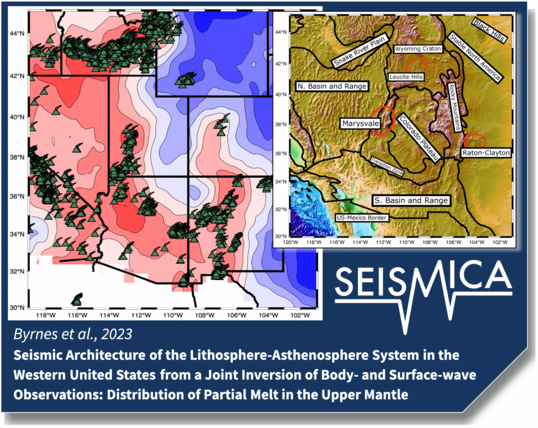
Seismic Architecture of the Lithosphere-Asthenosphere System in the Western United States from a Joint Inversion of Body- and Surface-wave Observations: Distribution of Partial Melt in the Upper Mantle
Quantitative evaluation of the physical state of the upper mantle, including mapping temperature variations and the possible distribution of partial melt, requires accurately characterizing absolute seismic velocities near seismic discontinuities. We present a joint inversion for absolute but discontinuous models of shear-wave velocity (Vs) using 4 types of data: Rayleigh wave phases velocities, P-to-s receiver functions, S-to-p receiver functions, and Pn velocities. Application to the western United States clarifies where upper mantle discontinuities are lithosphere-asthenosphere boundaries (LAB) or mid-lithospheric discontinuities (MLD). Values of Vs below 4 km/s are observed below the LAB over much of the Basin and Range and below the edges of the Colorado Plateau; the current generation of experimentally based models for shear-wave velocity in the mantle cannot explain such low Vs without invoking the presence of melt. Large gradients of Vs below the LAB also require a gradient in melt-fraction. Nearly all volcanism of Pleistocene or younger age occurred where we infer the presence of melt below the LAB. Only the ultrapotassic Leucite Hills in the Wyoming Craton lie above an MLD. Here, the seismic constraints allow for the melting of phlogopite below the MLD.