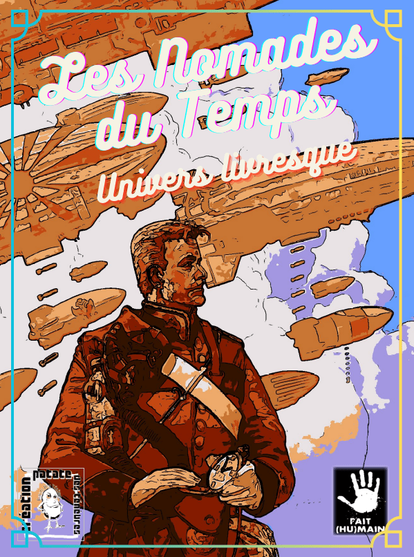
Univers livresque : Le Nomade du Temps, de Michael Moorcock

Coucou mes p’tites patates décalées! Nouvelle transposition livresque, cette fois-ci avec la trilogie du Nomade du Temps, par Michael Moorcock, auteur que vous verrez fréquemment sur ce blog, le monsieur ayant eu des phases stylistiques plutôt intéressantes. 

Avec le Nomade du Temps, nous repartons dans son multivers à base de conflits éternels entre la Loi et le Chaos, là où les valeurs morales des simples mortels ne pèsent pas lourd. Mais plutôt que de nous présenter de nouveaux plans d’existence, nous voilà embarqués dans des réalités alternatives, uchronies et dystopies se développant à partir de variations historiques, le tout en suivant les péripéties d’Oswald Bastable, autre itération du Champion éternel, égaré à travers les méandres du Temps, et croisant la route des fameux Nomades du Temps, individus aux motivations souvent obscures, cherchant à rétablir une sorte d’équilibre des forces, parfaites incarnations des thématiques moorcockiennes.

Et en termes rôlistiques, eh bien ce groupe d’aventuriers et d’aventurières se prête totalement à des périples multiversels, avec des motivations toutes personnelles à sauter d’une époque à une autre, tout en évitant de trop s’impliquer dans les manigances des seigneurs de la Loi ou des ducs du Chaos. Je vous propose donc un petit livret adaptant les règles d’ULUJ au multivers moorcockien et aux Nomades du Temps, avec en prime cinq réalités alternatives où les défis à relever seront pléthoriques! J’ai fais le choix de privilégier les intrigues ne se résolvant pas par la violence, mais plutôt par la négociation et la diplomatie, le tout avec toujours des dilemmes moraux. Ensuite, libre à vous d’utiliser ce nouvel Univers livresque comme vous le sentez! 

LES NOMADES DU TEMPS 

#Fantastique #HypercycleDuMultivers #JeuDeRôle #MichaelMoorcock #UlUj
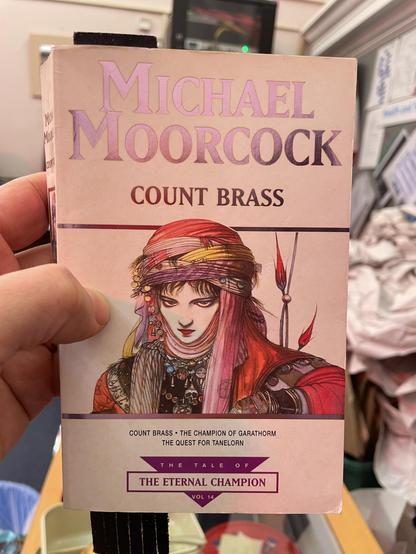
'Count Brass' is the last of Michael Moorcock's disavowed 'Tale of The Eternal Champion' series, in which the Hero with a Thousand Faces meets its mystical Apocalypse. It's pretty loosely written, but entertaining and thought-provoking.

https://app.thestorygraph.com/reviews/f179d609-805f-4be2-81b5-3c7f7945cca4

#fantasy #eternalchampion #michaelmoorcock #books #bookstodon

CD2 QMan_RM_ISOF_1481_Elric_and_Moonglum.jpg /Rodney Matthews/In Search of Forever/

#QManCollector #QMan #scifiillustration #scifiart #fantasyillustation #fantasyart #RodneyMatthews #MichaelMoorcock #Elric #ElricOfMelnibone

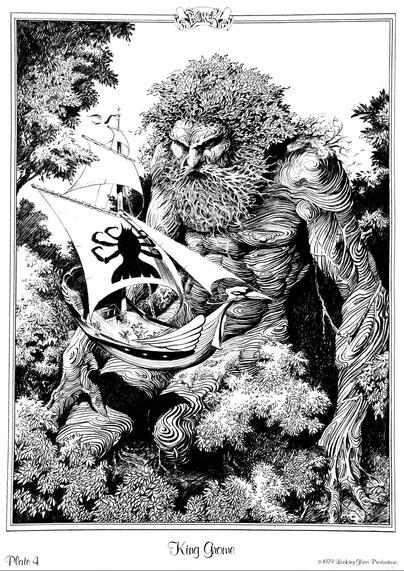
« King Grome», 1979

by Frank Brunner (American artist, b. 1949)
Plate #4 of "Elric Portfolio", Looking Glass Prod., 1979

#vintagefantasyart #fantasyart #fantasyillustration #darkFantasy #FrankBrunner #MichaelMoorcock #elricofmelnibone #Elric #kingGrome

New #review today: "British science fiction / fantasy author #MichaelMoorcock had a close musical partnership with #Hawkwind in the 70s and 80s. Moorcock contributed his work to Hawkwind’s Warrior on the Edge of Time and Space Ritual Tour. In 1975, Moorcock and the Deep Fix recorded The New World’s Fair, a surreal psychedelic ride through decaying fairgrounds, fading utopias, and electric guitars tuned to chaos." #ExposeOnline #PsychedelicRock #SpaceRock #ProgressiveRock http://expose.org/index.php/articles/display/michael-moorcock-the-deep-fix-50th-anniversary-edition-the-new-worlds-fair-6.html

La couverture de l'adaptation de Corum de Michael Moorcock en BD !

On vous en dit plus sur Actusf.com...

#MichaelMoorcock #Fantasy #Corum

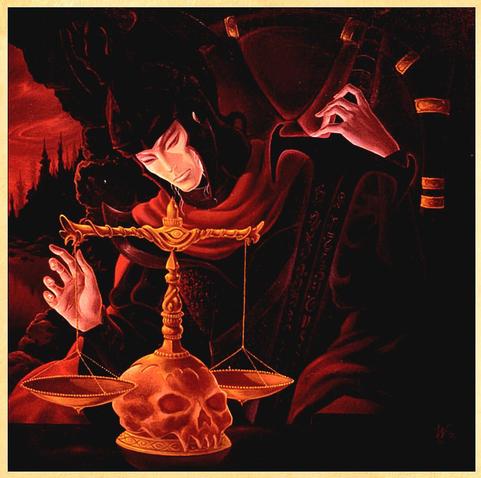
« Elric & the Cosmic Balance », c. 1978

By Wendy Pini (American artist, b. 1951)
Concept art for "Law and Chaos", an aborted #Stormbringer Animated Series
Back cover of "Law & Chaos" book, by herself, Father Tree Press, 1987

#vintagefantasyart #fantasyart #fantasyillustration #WendyPini #MichaelMoorcock #EternalChampion
#Elric #CosmicBalance

Liminal lands

There are always liminal lands, out beyond the predictions of common sense or myth, where the mind encounters places strangely common to human experience. Jungians would call them archetypal, perhaps; they crop up, for instance – often in passing – in fantastic fiction. A few examples might be CS Lewis’ Narnia (the Shribble Marshes), Ursula le Guin’s Earthsea (Osskil), Michael Moorcock’s other London (Jerry Cornelius’ Notting Hill), the American Southwest of Ed Dorn’s Gunslinger sequence.

But sometimes they exist in everyday time and space. Lucy Pollock (the emphasis is mine):

At the pumping station, far out on the liminal land through which the river flows, the dog and I turn for home. The fields now are lush with flowering grasses, but for weeks in the winter they will be submerged and this track will become a narrow causeway across the floodplain.

My rage abates. Of course we need science and biotechnology and billions of data points, as we seek to improve the lives of older people, our future selves. But side by side with the science we need a deep and abiding understanding of what it means to be human.

I have encountered such places myself. Much of my earlier writing had to do with them, and their strange coexistence between mind and place: the Wye Valley, the worked-out coal country along the River Browney, Western Park in Leicester. There have been darker places too, since then; like the high grounds above Kimmeridge Bay, home to PD James’ The Black Tower, or the post-UKAEA wasteland of Winfrith Heath. But yours will be different again, like Lucy Pollock’s: places between, times that do not quite align.

Contemplative practice has, in itself, nothing to do with such things. And yet the deep instincts – I’m tempted to call them mystical, even though the word has so many unhelpful connotations – that draw people to the contemplative life – as to the methodologies of psychonautics – are human instincts. Might it not be that these same instincts are themselves the door to this fundamental way of being human – to the liminal lands – since they are themselves in a way reflections of, or reflected in, the silent illumination of the contemplative condition itself?

#consciousness #contemplative #CSLewis #EdDorn #liminality #LucyPollock #MichaelMoorcock #PDJames #poems #solitude #UrsulaLeGuin

Gunslinger eBook : Dorn, Edward, Perloff, Marjorie: Amazon.co.uk: Kindle Store

Gunslinger eBook : Dorn, Edward, Perloff, Marjorie: Amazon.co.uk: Kindle Store

Cataloging Worlds

After reading the “Who cares what Earth this takes place on!” intro to the Justice League: New Frontier tie-in comic, I started thinking about the whole Earth-1, Earth-616, etc. thing. The confusion over Earth-1 vs. New Earth in DC (something which overshadowed discussion of the actual story in the first issue of Tangent: Superman’s Reign) highlights the question: just how important is it to label these fictional universes, anyway?

And once you’ve decided to catalog them, how do you label them?

A few multiverses that come to mind are DC’s, Marvel’s, and Michael Moorcock’s.

The multiverse of Moorcock’s Eternal Champion cycle is extremely fluid, with details changing whenever he wants to tell a different story. Just looking at the Elric stories, there are three or four origins for Stormbringer, and as many for the Melnibonéans and their pact with Arioch. There are several versions of the 20th-century Count Ulrich Von Bek (depending on whether you include Count Zodiac). Worlds are less like parallel lines and more like streams that can run together, mingle, and separate again (kind of like the briefly-used Hypertime as used by DC).

DC and Marvel, on the other hand, favor a discrete structure in which each universe can be precisely identified. This may have something to do with the focus on continuity as a key element of comic-book storytelling, and would explain why, for instance, Marvel has made an effort to number what seems to be every single alternate reality they’ve ever published.

Approaches to numbering:

  • Sequential. DC started out like this, with Earth-1, Earth-2, Earth-3, etc.
  • Random. Current DC multiverse, except for the first few we saw at the end of 52 which were based on worlds from the original DC multiverse (Earth-2, Earth-3, Earth-5 from Earth-S, Earth-10 from Earth-X). Marvel’s main continuity, Earth-616, was reportedly picked at random (though there is some disagreement on this point).
  • Referential. Things like choosing Earth-S for the worlds of Shazam or Squadron Supreme, or Earth-C for Captain Carrot. Earth-97 for Tangent (which appeared in 1997) and Earth-96 for Kingdom Come (which appeared in 1996) would also fall into this category (but see the next point).
  • Systematic. Taking referential labels a step further, using a consistent scheme. Marvel derives most of its designations from publication dates.

Personally, I prefer to just name them. “The Tangent Universe” or “New Frontier” or “Supremeverse” gets the idea across more directly than, say, Earth-9.

#dcu #eternalChampion #marvel #michaelMoorcock #multiverse #repostSource #seeAlsoSpeedForce

Multiverse (DC Comics) - Wikipedia