 C. L. Nichols
https://medium.com/the-story-well/the-door-you-dont-remember-closing-5bbaae53ab76
You walk toward a room, see its door shut. You’re sure you left it open. You replay the last few minutes, try to picture your hand on the knob. Nothing comes back.
https://medium.com/the-story-well/the-door-you-dont-remember-closing-5bbaae53ab76
You walk toward a room, see its door shut. You’re sure you left it open. You replay the last few minutes, try to picture your hand on the knob. Nothing comes back.
https://medium.com/the-story-well/the-door-you-dont-remember-closing-5bbaae53ab76
You walk toward a room, see its door shut. You’re sure you left it open. You replay the last few minutes, try to picture your hand on the knob. Nothing comes back.
Splinters of Memory
4,071 words, 22 minutes read time.
The garage smelled of cherry tobacco, cut pine, and old motor oil—a private liturgy Mark Sullivan had perfected over thirty-eight years. At fifty-eight he still moved like the foreman he’d been: deliberate, economical, never wasting motion. He wore the same uniform every day—faded Carhartt bibs, steel-toed boots polished only by wear, a flannel shirt whose sleeves were rolled exactly twice. People at the mill called him “Steady Mark.” Wives of his crew joked he was the kind of husband who remembered anniversaries before the wife did. He kept score in his head: thirty-two years married, zero missed birthdays, zero raised voices that lasted past sundown. He told himself these tallies proved something.
He had also kept a perfect record with his family of origin: thirty years of silence. No letters to Gary. No graveside words for the old man when the heart attack finally came. No Christmas cards returned unopened. Mark had drawn the line in concrete and never looked back.
Except the brain keeps its own ledger.
He sat on the scarred oak workbench that Saturday morning, pipe clenched between his teeth, blueprints for a custom cherry bookcase spread in front of him. The lines refused to stay sharp. Earlier, at the hardware store on Ford Road, a teenage stock boy had knocked over an open can of industrial floor wax. The sharp, chemical bite had rolled across the aisle and straight into Mark’s nostrils—ammonia, pine solvent, something faintly metallic underneath. He’d frozen mid-step, hand on a box of 3-inch deck screws, while the rest of the store kept moving.
Now, in the garage, the scent memory refused to fade.
He wasn’t fifty-eight anymore.
He was fourteen. Kitchen linoleum cold against his shoulder blades. A high, metallic ringing in both ears like a struck tuning fork. Dust motes turning slowly in the single shaft of afternoon light that slanted through the back-door window. His father’s Red Wing boots—size twelve, laces broken and re-knotted a dozen times—stood inches from his face. The toes were scuffed gray from kicking things that didn’t move fast enough.
A weight—not just on his chest, but inside it—made every breath feel borrowed. Something heavy and wrong had landed there and stayed.
Mark’s pipe slipped from his mouth and clattered onto the blueprints. Hot ash scattered across the paper.
“Mark?”
Martha’s voice came soft from the doorway, careful as someone stepping onto thin ice. She held a chipped ceramic mug in both hands—his mug, the one with the faded John Deere logo.
He startled so violently the torn blueprint ripped further in his fists.
“I’m fine,” he said. Too loud. The words cracked like dry lumber.
“I thought you might want coffee.” She didn’t step closer. That was new. Usually she would have crossed the threshold by now, set the mug down, touched his shoulder. Today she stayed framed in the open door, backlit by the pale February light.
“I said I’m fine.”
The door clicked shut. Not slammed—just closed with the quiet precision of someone who knows better than to argue.
Guilt arrived instantly, sour in his throat. He wanted to follow her, to take the mug, to mutter something that would erase the last ninety seconds. But the pressure inside was already climbing, valve stuck, gauge needle trembling past the red line.
He reached for the claw hammer hanging on its pegboard hook. The handle felt foreign, too smooth. His hands shook. He lined up a nail for the new French-cleat tool rack he’d been promising himself for months. The first strike bent the nail at a forty-five-degree angle. He cursed under his breath—short, sharp, the kind of word he never let escape in front of Martha—and yanked at the nail with the claw.
The claw slipped. Gouged a pale trench across the cherry face-frame he’d spent three evenings jointing flat.
That was all it took.
A sound came out of him he didn’t recognize—a low, animal roar that vibrated in his own rib cage. He swung the hammer again, not at the nail, not at the wood. At the workbench itself. The blow landed on the edge, splintering a six-inch section of the top board. He swung again. And again. Each impact sent a white jolt up his forearm, into his shoulder, into his neck. Sawdust exploded upward like smoke.
When the hammer finally dropped, the clatter on the concrete floor sounded obscene in the sudden quiet.
He stood there breathing hard, staring at the wreckage. Four deep crescent gouges marred the bench he’d built with his own hands the summer he turned thirty. The wood was cherry—same species as the bookcase he was supposed to be starting today. Expensive. Irreplaceable in the way only old heartwood can be.
“James 1:20,” he whispered. The verse surfaced automatically, the way a drowning man grabs whatever floats past. Human anger does not produce the righteousness that God desires.
He’d memorized it at twenty-two, during the first year he’d refused to answer Gary’s calls. He’d recited it like a ward against the rage that used to wake him at 3 a.m. with his own teeth clenched so hard his jaw ached for hours. He’d believed the verse was a promise: stay calm, stay steady, and God would make the righteousness grow.
Now the promise felt like a taunt.
He sank onto the old milk crate he used as a stool, elbows on knees, head cradled in callused palms. The garage felt smaller now, the rafters lower, the air thicker with the smell of splintered cherry and scorched tobacco. His pulse still hammered in his ears like distant machinery. He tried to breathe the way the old army medic had taught him once, back when he was twenty and still thought anger could be managed like a bad weld: in through the nose for four, hold for four, out through the mouth for six. It didn’t help. The breath came ragged, shallow, tasting of ash.
The memories weren’t coming in neat paragraphs anymore. They arrived in shards, each one sharper than the last.
First the lamp—green glass base, heavy enough to crack bone. Gary, seventeen and already six-two, had picked it up off the end table like it weighed nothing. “Wake up, quiet boy,” their father had said, voice thick with amusement, cigarette dangling from the corner of his mouth. Mark remembered the exact sound the lamp made when it left Gary’s hand: a low whoosh, like someone swinging a baseball bat too fast. Then the impact—bright white at the temple, then black blooming outward. He remembered waking up in the ER with the side of his head shaved and staples holding the gash together. The doctor had asked how he fell down the stairs. Mark had looked at his father, who stood in the curtained doorway with arms folded, eyes flat. Mark had said, “I tripped.” The lie came so easily it felt like truth.
Another fragment surfaced: not the lamp day, but a summer evening two years earlier. Backyard. Mosquitoes thick. Their father grilling cheap hamburger patties, grease popping on the coals. Gary had Mark in a headlock, grinding knuckles into his scalp—“noogies,” he called them, though these felt more like punishment. Mark had squirmed, said stop, please stop. Their father hadn’t looked up from the grill. “Toughen up,” he’d said. “World don’t care if you cry.” Gary had laughed, let go only when Mark went limp. Later that night Mark had found blood in his hair—small crescent cuts from Gary’s class ring.
And another: Christmas when Mark was ten. The old man had drunk too much spiked eggnog and decided to “teach the boys a lesson about gratitude.” He’d lined them up in the living room, made them recite what they were thankful for. When Mark hesitated—said “family,” because that’s what you’re supposed to say—the old man backhanded him across the mouth. Split lip. Blood on the carpet. Gary had smirked from the couch. “Told you he’s soft.”
Mark lifted his head. His eyes burned, not from smoke but from something hotter. He wanted to drive to Gary’s last known address—some trailer park outside Flint, last he’d heard—and put his fist through the screen door. He wanted to stand over the old man’s grave and spit on the headstone. He wanted to scream until the neighbors called the police. Mostly he wanted someone—anyone—to say it wasn’t his fault. That the boy on the floor hadn’t deserved it. That quiet wasn’t a crime.
He reached for the small leather Bible on the shelf above the pegboard. The cover was cracked, oil-stained, pages swollen from years of damp Michigan winters. He didn’t open it to the New Testament comfort verses he usually leaned on. He went straight to Psalm 55.
My heart is in anguish within me; the terrors of death have fallen upon me. Fear and trembling come upon me, and horror overwhelms me.
The words felt like someone else had written them for him. He read them aloud, voice hoarse.
And I say, “Oh, that I had wings like a dove! I would fly away and be at rest.”
He closed the book too hard. The sound cracked in the quiet garage. Flying away sounded good. Rest sounded impossible.
The anger wasn’t fading. It was settling deeper, like rust into iron. He could feel it in his jaw, in the way his fingers kept curling into fists. He’d spent decades believing if he just worked hard enough, prayed hard enough, stayed steady enough, the past would stay past. Now it was here, sitting on the workbench beside him, breathing the same air.
He stood. Legs unsteady. Walked to the garage door, opened it just enough to see the house lights glowing warm through the kitchen window. Martha was still at the sink—he could see the shape of her shoulders, the slow rhythm of her hands moving over dishes. She hadn’t turned on the radio like she usually did when she was upset. The silence felt deliberate.
He stepped inside.
He didn’t knock. He never knocked when he came in from the garage; the house was too small for that kind of formality. But tonight the kitchen felt like someone else’s territory. Martha stood at the double sink, sleeves pushed up, hands moving mechanically through soapy water. The radio was off. No soft oldies station, no low murmur of talk radio. Just the clink of dishes and the slow drip from the faucet she’d been meaning to have him fix for months.
He stopped three steps inside the door. The linoleum here was the same pale yellow as the kitchen where the lamp had landed. He hadn’t noticed that in years.
Martha didn’t turn right away. She rinsed a plate, set it in the drainer, wiped her hands on the faded dishtowel slung over her shoulder. When she finally faced him, her eyes were dry but red-rimmed, the way they got when she’d been fighting tears and winning.
“You don’t have to say anything,” she said before he could open his mouth. “I already know you’re sorry.”
He swallowed. The words he’d rehearsed on the short walk across the yard felt clumsy now, like tools too big for the job.
“I remembered something today,” he said. His voice came out rough, scraped raw. “Not just one thing. A bunch of them. Like someone kicked over a box in the attic and everything spilled out at once.”
She nodded once, small. Waited.
He told her about the lamp—not the soft version he’d told himself for decades, but the real one: the whoosh, the crack, the blackout, the disgusted look on his father’s face. He told her about the headlock in the backyard, the blood from the class ring, the Christmas slap that left his lip swollen for a week. He told her how Gary had laughed every time, how their father had never once stepped in, how the hospital story had always been “fell down the stairs” because that was easier than the truth.
Martha listened without interrupting. When he finished, the kitchen was so quiet he could hear the refrigerator compressor click on.
“I keep waiting for it to stop,” he said. “The anger. The shaking. I keep thinking if I pray hard enough, quote the right verse, it’ll go quiet again. Like it used to.”
“It’s not going quiet, is it?” she asked gently.
“No.” He looked down at his hands—still flecked with sawdust and a thin smear of blood from where a wood splinter had jabbed his palm during the hammering. “It’s louder now. And I don’t know what to do with it.”
She crossed the small space between them. Didn’t hug him right away—just rested her forehead against his shoulder the way he sometimes did to her when words failed. He smelled the faint lemon of dish soap on her skin, the lavender from the lotion she used at night. Familiar things that should have grounded him. They didn’t.
“I don’t want to be this man,” he whispered. “The one who snaps at you. The one who breaks his own workbench because he can’t break anything else.”
“You’re not just that man,” she said. “But you’re carrying him right now. And that’s okay. You don’t have to fix it tonight.”
He wanted to argue—wanted to say that a good Christian man should be able to lay it down, should be able to forgive seventy times seven, should be able to turn the other cheek even when the first one was still stinging thirty years later. But the words wouldn’t come. They felt like lies.
Instead he let her hold him. Let the silence stretch until it wasn’t comfortable anymore, just necessary.
After a long minute he stepped back. “I’m going back out there,” he said. “Not to fix anything. Just… to sit with it.”
She nodded. Didn’t try to stop him.
Mark returned to the garage the way a man returns to a battlefield after the fighting has paused but not ended. The door closed behind him with a soft thud that echoed longer than it should have. The overhead bulb buzzed faintly; he hadn’t replaced it in two years. The light cast harsh shadows across the splintered workbench—four crescent gouges staring back at him like claw marks from something trapped inside the wood.
He didn’t pick up the hammer. Didn’t sweep the sawdust. Didn’t even sit on the milk crate. He simply stood in the middle of the floor, arms loose at his sides, and let the silence press in.
The Bible still lay open on the shelf where he’d left it, pages splayed to Psalm 55. He didn’t reach for it again. The words about wings and doves and flying away felt mocking now—beautiful, yes, but useless to a man whose feet were nailed to Michigan concrete. He thought about the Savior acquainted with grief, the one who sweat blood in the garden, who asked if the cup could pass. Mark had always liked that image: Jesus asking, not commanding. Weakness laid bare. But tonight even that felt distant. Acquainted with grief didn’t mean the grief went away. It just meant you carried it in company.
He walked to the workbench and ran his fingertips along one of the fresh gouges. The edges were still sharp; tiny slivers caught under his nails. He pressed harder until he felt the sting—small, clean pain that grounded him for a second. The anger hadn’t cooled. It had simply changed temperature: from white-hot blaze to slow, steady red glow, the kind that could burn for years without flaming out.
He thought of Gary—not with forgiveness, not with hatred so pure it blinded him, but with a cold, factual clarity. His brother was out there somewhere, probably still laughing at quiet boys, still throwing things when words failed. Their father was ash in a cemetery plot forty miles away. Neither of them had ever said sorry. Neither ever would. And Mark realized, with a clarity that hurt more than the splinters, that waiting for an apology was like waiting for rain in the Sahara: you could die of thirst before it came.
He looked around the garage—his fortress, his exile, his evidence. Thirty years of building things to prove he wasn’t broken. Tools hung in perfect rows. Lumber stacked by species and length. Blueprints rolled tight. Order everywhere except inside his own skin.
He exhaled, long and ragged. The pipe had gone out; he didn’t relight it. Instead he picked up the torn blueprint from the floor, smoothed it as best he could against the damaged bench, and set a scrap of cherry over the rip to hold it flat. A small, useless gesture. The bookcase would still get built. Life would still go on. But the steadiness he’d worn like armor felt cracked now, and he wasn’t sure he could patch it the way he patched oak with wood filler.
Martha would be waiting inside with coffee he hadn’t drunk and quiet he hadn’t earned. Tomorrow he’d go back to the mill, call out measurements, sign off on shifts, come home to the same routines. The memories wouldn’t vanish. The anger wouldn’t pack itself away. The boy on the linoleum floor would still be there, breathing under his ribs.
Mark turned off the overhead light. Darkness settled, thick and familiar. He stood in it a long minute before opening the door to the yard.
Outside, the February night was sharp with cold. A neighbor’s porch light glowed two houses down. Somewhere far off a dog barked once, then fell silent. Mark stepped onto the concrete stoop and closed the garage door behind him—not locked, just shut.
He didn’t feel healed. He didn’t feel forgiven. He didn’t even feel particularly brave.
He just felt present—raw, heavy, unfinished.
And for the first time in thirty years, that was enough to keep walking toward the house.
Author’s Note
This story is fiction, but it is rooted in my own life in ways that are hard to separate from the page. For decades I’ve known about three distinct stretches of my childhood where memory simply isn’t there—blank spots, empty frames. I’ve carried that knowledge quietly, almost like a fact filed away in a drawer I rarely opened. I didn’t want to look closer. I didn’t want to recollect what might be behind those gaps. Why? I’m not entirely certain. Fear is part of it, I suspect—fear of what the fragments might show, fear of the emotions that would rush in with them, fear that pulling on those threads would unravel more than I could handle. Avoidance felt safer. It let me keep building a life: work, marriage, routines, faith. Steady ground over uncertain ground.
Like Mark Sullivan in the garage, though, the mind doesn’t always honor our no-contact orders with the past. Lately, slowly, pieces have started coming back—not in a flood, not dramatically, but in quiet intrusions. A smell, a sensation, a sudden weight in the chest. They arrive without invitation and leave me unsettled, irritable, raw. Sometimes an unexpected memory surfaces at the wrong moment, triggering a sudden outburst of anger over something minor—a small offense or inconvenience that feels disproportionately huge because it echoes something deeper, undefined.
I fully believe in forgiveness. As a Christian, I hold to the biblical call to forgive as we have been forgiven (Matthew 6:14–15; Ephesians 4:32). But I also believe the full impact of what forgiveness truly is has been watered down by bad theology and time. Today, forgiveness is often reduced to something we “have to do” because the Bible says so—a quick, obligatory step to check off. People say “forgive and forget,” but that isn’t what Scripture teaches. God doesn’t command us to forget; He promises that He will remember our sins no more (Hebrews 8:12), but even in His perfect forgiveness, the cost is never erased from reality.
Look at Jesus in heaven. In Revelation 5:6, John sees “a Lamb standing, as though it had been slain”—the risen, glorified Christ still bearing the marks of the cross. He could have erased those scars. He could have appeared whole, without reminder of the nails, the spear, the agony. But He chose not to. Those wounds remain as eternal testimony to the immense cost of forgiveness. Forgiveness wasn’t cheap for God; it cost the life of His Son. The scars remind us—and remind all creation—that true forgiveness remembers the debt paid, honors the price, and doesn’t pretend the suffering never happened. Jesus forgave us at great personal cost, and He keeps the evidence of that cost visible forever.
Forgiving others means something similar: it’s not about erasing the wrong or pretending it didn’t hurt. It’s about releasing the debt to God’s justice (Romans 12:19), choosing not to demand repayment from the offender, and entrusting the wound to Christ who knows what it costs. But when the offense is shrouded in memory gaps—when you don’t fully know the details of what was done, the “debt” remains vague and undefined. How do you release what you can’t clearly name? How do you absorb a cost that’s still hidden? That makes forgiveness harder, not impossible, but deeply honest work.
A good pastor, a trusted Christian friend, or a solid biblical community can help here—with prayer, Scripture, encouragement to choose forgiveness as an act of obedience and trust in God’s justice, and reminders that forgiveness is first about our heart before God, not necessarily about the offender or reconciliation. It can free us from bitterness even when details are incomplete.
But getting to the memories themselves—safely uncovering and processing what’s been repressed or fragmented—is different. That often requires more than spiritual guidance alone. A trained professional in psychology or trauma-informed therapy (ideally one who respects and integrates faith) can provide tools to navigate the fragments without overwhelming the system, to distinguish past from present, and to handle the physical and emotional fallout that can come with recall. Pastors and friends offer soul care; professionals offer clinical tools for when the mind and body need structured help to integrate what’s surfacing.
There’s also no biblical obligation to tell the person you’ve forgiven them. In some cases, announcing forgiveness can reopen wounds, stir defensiveness, or cause more harm than good—for you, for them, or for any ongoing relationship. Forgiveness can be a quiet, internal act before God, without confrontation or declaration.
The story I wrote here isn’t a direct account of those moments or what might fill the blanks. It’s fiction, shaped and distilled, but it carries the texture of what that slow return feels like: the anger that flares from nowhere, the guilt that follows, the wrestle with faith that doesn’t always comfort as quickly as we’d like. I chose to leave Mark’s struggle unresolved because that reflects where things stand for me. The memories aren’t done surfacing. The questions aren’t answered. The fear isn’t gone. Forgiveness remains a conviction I hold—a costly, Christ-patterned choice—but living it out in the fog of partial knowing is ongoing, unfinished work.
Writing this wasn’t about closure; it was about giving form to the discomfort, about sitting with the splinters instead of pretending they’ve healed over. If any part of this resonates—if you’ve carried your own blanks, wrestled with forgiveness when the offense feels undefined, or felt the past knock when you least expect it—know you’re not alone in the uncertainty.
I’m grateful to anyone who reads this and lingers with its unfinished edges. Thank you for meeting it as it is.
Call to Action
If this story struck a chord, don’t just scroll on. Join the brotherhood—men learning to build, not borrow, their strength. Subscribe for more stories like this, drop a comment about where you’re growing, or reach out and tell me what you’re working toward. Let’s grow together.
D. Bryan King
Sources
Disclaimer:
The views and opinions expressed in this post are solely those of the author. The information provided is based on personal research, experience, and understanding of the subject matter at the time of writing. Readers should consult relevant experts or authorities for specific guidance related to their unique situations.
#autobiographicalShortStory #avoidanceTrauma #BibleAndAnger #biblicalForgiveness #bodyKeepsScoreFiction #brotherTraumaStory #BryanKingFiction #cherryWorkbenchStory #childhoodAbuseFiction #childhoodTraumaFiction #ChristianForgiveness #ChristianTraumaHealing #ChristmasSlapChildhood #costlyForgiveness #debtOfForgiveness #dissociativeAmnesiaStory #eggshellWalkingWife #faithAndTrauma #fatherAbuseMemories #fearOfMemories #forgiveAndForgetMyth #forgivenessAndScars #forgivenessObligationMyth #forgivenessWithoutDetails #garageWorkshopStory #greenLampTrauma #hammerRageFiction #headlockAbuseMemory #healingWithoutClosure #industrialWaxTrigger #James120Anger #JesusScarsRevelation #LambAsSlain #linoleumFloorMemory #memoryGaps #MichiganShortStory #noObligationToTellForgiveness #noContactFamily #pastorVsTherapistTrauma #ProverbsGentleAnswer #Psalm55Fiction #quietBoyAbuse #rawGriefFiction #repressedChildhoodMemories #repressedMemories #resurfacingMemories #Revelation56Lamb #shortStoryTrauma #slowMemoryReturn #spiritualAbuseRecovery #splintersOfMemory #steadyManFacade #suddenAngerOutbursts #traumaRecoveryFiction #traumaTherapyFaith #traumaInformedFaith #unfinishedHealingStory #unresolvedAnger #WestlandMichiganAuthor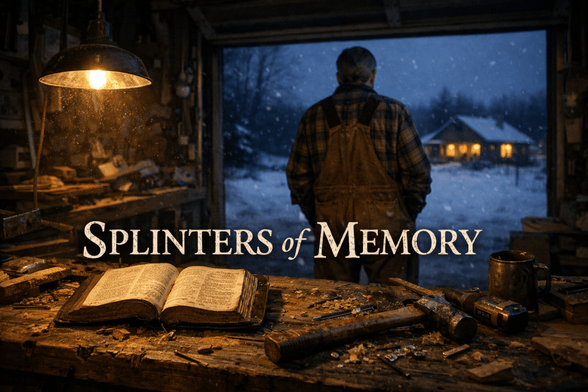
 Bryan King