26 Modern Misconceptions About Medieval Warfare

A Song of Ice and Fire and other “realistic” medieval fantasy works have been trying to challenge the set-in conceptions of Middle Ages and provide a more realistic take on the era, one that tries to remove the lenses of noble prejudices and show how things truly were.

Problem is, they have failed. Instead of removing prejudice, postmodernist fantasy has merely replaced medieval distortion lenses with (post)modern distortion lenses – but has completely failed at building a “more real” medieval world. And this is obvious in warfare as well.

That being said, I want to note a caveat: all of the misconceptions, and responses to them, are by nature generalizations. But just because something is generally true does not mean it is always true.

1. “Glory in War” Was Just a Noble Myth

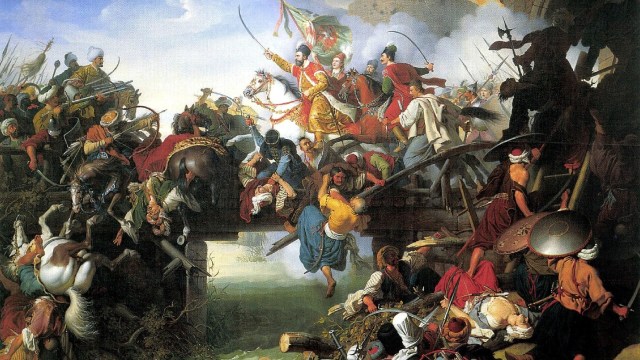
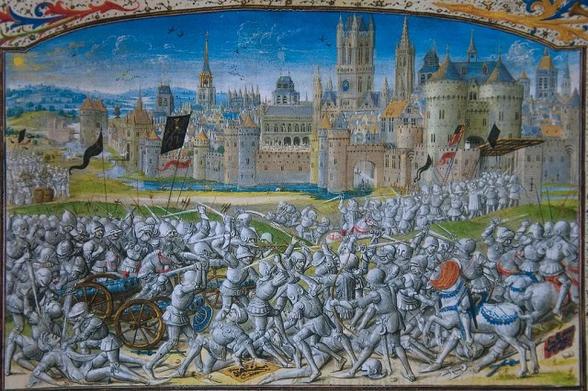
Not medieval, but illustrates my point

Yes, people always recognized the war as something terrible. But the modern view of war as a pointless, terrible slog was born in the total warfare of two World Wars. It was the First World War which shattered the previous conceptions of war, and the Second that hammered the final nail into the coffin.

Medieval people viewed war as something very different. For nobility, it was an opportunity for fame and glory. For common soldiers, it was an opportunity to get rich or at least gain some wealth. For everybody involved, it was a duty and a question of honor.

This jutapoxition is why so many were willing to engage in religious wars. War provided just the right combination of honor and danger, of duty and suffering, to prove one’s dedication.

And again, this was true for nobility and commoners alike. Masses of peasants willingly went to try and liberate the Holy Land – only to get slaughtered because they did not wait for backup by professional soldiers. Later, during the Ottoman Wars, peasants under John Capistrano played a major role in defense of Belgrade.

Therefore, both nobles and commoners sought glory in war. Which leads to the next myth…

2. Medieval Soldiers Were Conscripted Peasants

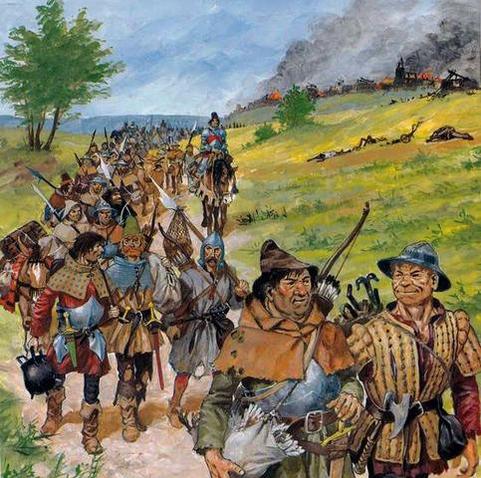
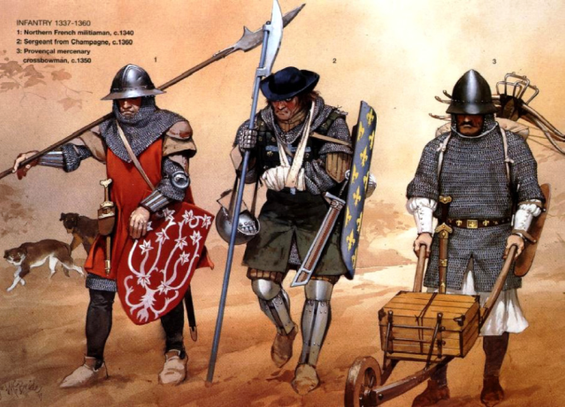
It is impossible to create a profile of a “medieval” soldier, as manner of recruitment varied by time, place and situation. There were indeed cases when untrained peasants were conscripted – or even volunteered for – military service. But by and large, idea that medieval armies consisted of peasants torn from their fields and forcibly marched to war by their lords is fundamentally nonsense.

As noted, ways in which medieval soldiers were recruited varied widely by time and place. But generally, “all men under arms” was only done by early tribal societies, where all free men were warriors. This was the case with e.g. Slavs and other tribes during early migrations. In such cases, warriors may number some 20% or so of the tribe.

But over time, army did professionalize even as it remained tribal in nature. Indicative are numbers for Croatian army under Tomislav given by Emperor Constantine VII in De Administrando Imperio: 60 cavalry and 100 infantry allagions. It is difficult to establish size of allagion, but allagion is generally a term for bandon. Byzantine bandon of 10th century contained some 200 to 400 men for infantry banda and 50 to 100 men for cavalry banda. Using this, it can be concluded that Croatia under Tomislav had some 20 000 – 40 000 infantry and 3 000 – 6 000 cavalry. Croatia under Tomislav had anywhere between 400 000 and 1 000 000 population, making army some 4,6 – 5,75% of population.

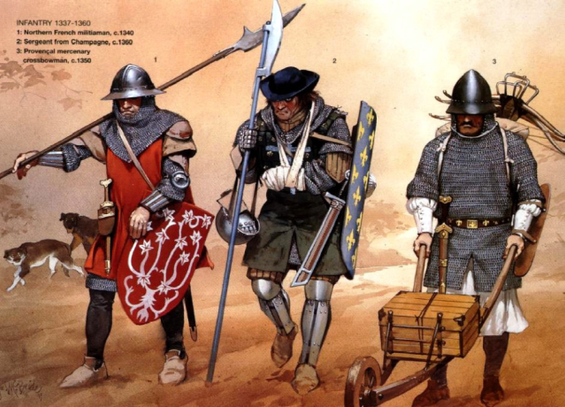
More professional armies were even smaller. 10th century Ottonian Empire could raise 20 000 saddled men – meaning heavy cavalry or knights. 9th century Wessex had a field army of 5 500. And by the end of the Middle Ages, “nation under arms” concept had largely disappeared, having been replaced by highly professional forces. By 1348, England could field some 30 000 men, though usually not in a single field army.

Hungary in 15th century had population of around 4 million (including Kingdom of Croatia, which was technically an independent kingdom under Hungarian crown). At Mohacs, Hungary managed to field an army of 26 000. Its total armed forces, not counting allies, were perhaps around 60 000, or 1,5% of the populace. Sigismund in 1432 predicted raising 80 000 cavalry in his entire country, of which 12 000 in Croatia. This would give 2% of population in military. For comparison, very definitely professional Ottoman regular army was around 1,2% of the population (94 000 men with 8 million population in 1453), though this number was regularly and significantly increased through inclusion of irregulars. This irregular force added 50 000 cavalry in 1453, for a total army of 144 000 or 1,8% of the populace.

And this has important implications for worldbuilding. To use ASoIaF example, Westeros – which has a total armed force of 380 000397 000 men – can either have a professional army and total population of between 20 to 30 million people at minimum, or rely on conscripted peasants and have total population of 2,3 – 2,4 million across the entire continent. At 7 933 000 square kilometers, former results in density of some 2,52 to 3,78 people per square kilometer. North specifically, with perhaps 8% of population (1,6 – 2,4 million) and 2 932 000 square kilometers, would have population density of 0,54 – 0,82 person per square kilometer.

But since Westeros is not, in fact, engaged in a life-and-death struggle against a conquering empire, mobilization numbers can be easily halved – and thus population estimates doubled. This would lead to overall mobilization rate of 0,75% to 1%, which would lead to overall population of 38 – 53 million people. Of these, some 3 – 4 million would be in North. Result is an overall population density of 4,79 – 6,68 people per square kilometer for Westerosi average, while North specifically would have density of 1,02 – 1,36 people per square kilometer.

For comparison, 15th century Hungary was some 9 to 15 people per km2, and relatively sparsely populated Scandinavia was around 4 people per km2. Even Eastern Europe had population density of 2,48 people per km2 in 1450, and 1,5 people per km2 if one goes all the way back to year 1 000 AD. Europe overall had a population of 83 million in 1450, resulting in average population density of 8,15 people per square kilometer. As can be seen, higher population estimates – ones assuming semi-professional armies – result in population density for Westeros that is just about on the lower end of plausible for the society we see portrayed.

Lower population, stemming from the “peasant conscript” army, would result in population density of 0,29 to 0,30 people per square kilometer overall, and 0,06 to 0,07 people per square kilometer in the North specifically. For comparison, Sahara desert – which has one of lowest population densities on the planet – has population density of 0,4 people per square kilometer. Gobi desert is more populated, at 1 person per square kilometer. This population density would make it quite impossible to form and maintain a feudal society. Instead, if we assume that Westerosi armies are indeed predominantly conscripts, then people of Westeros ought to be essentially Neolithic nomadic pastoralists.

Closest thing a proper 15th century army comes to a “conscripted peasant” is Hungarian institution of militia portalis. Sigismund declared in 1432-5 that in event of a campaign those with lands were required to field 3 mounted men per 100 slots. This quantity clearly shows that the men thus fielded were expected to be equipped and trained – and indeed, each conscript was supposed to be armed with bow, quiver, sword and lance. Service obligation of this militia was limited to three months. After several further changes, service obligation was finalized in 1498 as 1 hussar per 24 plots in the southern counties, and 1 heavy cavalryman per 36 plots in the inner parts of the kingdom. This form of recruitment remained in use in Hungary and Croatia until well into the Napoleonic Wars, providing a defensive-oriented army that was at once both cheap and effective.

But by 15th century, armies in Europe were largely recruited through indenture system (introduced in Englad by Edward I (1272 – 1307)) or similar systems. In fact, indenture system began to develop in England in 1101 AD, and historians such as J.O.Prestwich argue that feudalism has been overrated as a system of military organization – money was always the primary driver of war.

Even urban militias were not a bunch of people conscripted at spearpoint. Numbers varied, but militias could vary from very small professional bands to very large “citizenry at arms” formations. In 1302, city of Brugge could field 6 000 men from a population of 40 000. In 1327, Maastricht, city of 10 000 – 12 000, had an army of 500 militia. And in 1405, city of Liege had 4 500 strong militia with population of 30 000. In general, urban militia may number from 5% to 30% of total population, depending on how exactly it was recruited and equipped; but somewhere around 15% seems to be a good rule of thumb.

This is not to say that peasants never fought – again, refer to the example of John Capistrano’s army. But by and large, they were not the majority of the army, and “fantasy” peasant soldiers only ever fought as volunteers.

3. Medieval Infantry Only Became Effective in 14th Century

This idea is separate from yet closely connected to the idea that medieval soldiers were just conscripted peasants, and is just as wrong. The idea, essentially, is that because medieval infantry were untrained peasants, heavy cavalry dominated the battlefield. And once effective, professional infantry became available, heavy cavalry stopped being a dominant force.

This idea is wrong on both levels. Firstly, heavy cavalry did not stop being an effective force when employed properly, even during the 14th and 15th centuries. In fact, 14th and 15th century heavy cavalry was more effective than, say, 10th century heavy cavalry.

Secondly, medieval infantry was not an ineffective bunch of peasant conscripts even during the era of dominance of classical knightly cavalry. A royal act from France in 1188 stipulated that Tournai had to provide 300 heavy infantry (predites bene armatos) when summoned by Philip II. This alone should rebut the idea that medieval infantrymen only became a significant force in the 14th century. Henry II’s infantry repelled the French cavalry at Gisors in 1188 (something that, according to the traditional narrative, is not supposed to happen before the Battle of Courtai in 1302), and in general we see battles always combining cavalry and various types of infantry.

4. Horses Would Never Charge Formed Infantry

When discussing issue of heavy cavalry versus infantry, there are two sides: one which states that the heavy cavalry could, would and did charge arrayed heavy infantry, and the second side which states that heavy infantry in order was all but immune to heavy cavalry charge, and that cavalry charge was a wholly psychological affair attempting to spook the infantry into breaking ranks. Second position however is based on the fundamental misunderstanding of the medieval chargers – good example being Lindybeige here.

Specifically, proponents of unquestioned infantry superiority are basing their arguments on belief that medieval chargers were no different from modern riding horses. Argument goes that, so long as the infantry stands in a mass, then horse will be simply too scared to charge into infantry and thus infantry will be safe. Another argument is that a horse will not tread on a dead body. But these arguments are based on the understanding of modern riding horses, which are deliberately bred and trained to be timid so as to be as safe as possible for the person riding them.

Yet as Jason demonstrates here, horses are smart animals – and because of that they can, much like humans, be trained to tolerate things that would normally spook them. Medieval chargers were trained to charge into people, to tolerate the noise and the din of the battle, and to tread on dead bodies if necessary.

Moreover, horses themselves are not inherently flight animals. In the wild, mares and foals would indeed run away from the threat. But stallions tend towards the “fight” mentality – they will choose to confront the threat first. Reason for this is simply that males of a species are more expendable, biologically speaking, and therefore having males delay the threat while females and offspring run away is the best way of ensuring survival of the group. Stallions will also fight against each other to gain control of the herd and mating rights.

Further, horses are herd animals – and they follow the directions of the leader of the herd. They also gain courage from the rest of the herd. A rider whom horse is willing to bear is also a person horse deeply trusts, a leader of their two-person mini-herd. Further, both horse and the rider are also a part of a much larger herd – in this case, their battlefield formation. What this means is that so long as the rider keeps his nerve, the horse will follow rider’s lead. Whether rider orders him to charge a formation of pikemen, a wooden pallisade or a brick wall, it doesn’t matter – so long as the rider is confident in what he is doing, horse will follow his rider’s lead.

And this is precisely what we see in battles. There were many cases where heavy cavalry charged formed heavy infantry, formed pikemen and even the wagenburg, attempting the smash the pallisades erected between the wagons with their horses’ bodies. On several occasions, heavy cavalry charged into a formed pike formation, right through it to the other side, and then did it all over again as the pike formation reformed. And in all of these cases, horses followed without complaint.

But if cavalrymen themselves lost heart, there was nothing to be done. If the rider is not confident then the horse will not be confident either; if rider hesitates, horse will not take him into the enemy infantry. Rider has to be confident. Horse will get scared – but this means little so long as the rider does not get scared, because horse will take heart in rider’s bravery. But if the rider gets scared or uncertain, then horse will lose confidence and shy away – and this is then likely to scare the inexperienced rider even more, creating a deadly feedback loop.

Modern horses are also not a good model for medieval chargers. Genetics and heredity are a significant factor in behavior, and for hundreds of years now we had been selecting horses to be as timid as possible. And vast majority of modern breeds are extremely modern breeds, created in the last century or so – they will have never been seen on medieval farms, let alone medieval battlefields. They had been selected for positive traits needed by modern horses – to be more docile and easier to use. But a horses bred for a frontline battlefield role will have been selected for very different traits.

This is also the reason why knightly horses were stallions, and not mares or geldings. Stallions are not just much braver and more aggressive, but also far stronger for a given weight – and can also put on much more muscle mass overall – than mares or geldings. And one does not want a huge horse – e.g. a draft horse – for a knight. Sure, large horse will be able to carry a lot of weight, but it is also much more difficult to mount, likelyhood of severe injury from a fall is greater, is more difficult to maneuver and requires more food. So a charger will have been relatively small by modern standards, but extremely heavily muscled.

5. Medieval Armies Were Disorganized and Poorly Led

While medieval feudal armies were not as well organized as that of the Roman Empire, Byzantine Empire or the Ottoman Empire, this does not mean they were disorganized. 15th century Hungarian armies were organized on a decimal basis, with units of 10, 100 and 1 000 men, the last being called “dandar”. Multiple “dandars” formed a banderium, which was a basic recruitment unit and could vary in size: 15th century king’s banderium was 7 000 strong, and that of a Despot of Serbia (who was also a Hungarian noble) was 8 000 strong. Term “banderium” however was used also to denote individual noble’s contribution: this could be as few as 25 men, which meant that multiple “recruitment” banderia could form a single “tactical” banderium.

In the Holy Roman Empire, basis of recruitment was a “lance” of standardized size, though what exactly it was varied with time. In 15th century, lance was typically 3 mounted soldiers (a man-at-arms, a page and a crossbowman) and two servants acting as foot soldiers. Lances (Gleven) were then further organized on a decimal basis, each 10 commanded by a captain and each 100 by an Oberhauptmann.

And this was reflected in the battlefield tactics. The view is that medieval armies were disorganized mobs led by glory hounds who engaged in random melee and adhered to only most rudamentary tactics. No thought was given to logistics, and infantry and archers were either not present at all or else marginal and ineffective, at least until the 14th century “infantry revolution”. But this couldn’t be further from the truth.

In fact, combat tactics were sophisticated throughout the Middle Ages, not just in the 15th century. The easiest proof of that are the Crusades: despite never having met horse archers before, Crusader armies successfully copied Byzantine tactics basically on the first try. This is not something a pell-mell assembly of noble knights backed by peasant conscripts on foot could ever have done: Byzantine tactics were complex and required highly sophisticated organization and understanding of art of war to implement. And by 15th century, description of Hungarian logistical arrangements is not unlike that of those of Byzantine Empire.

Knights themselves could be recalled from the charge and reorganized for further assaults; they were not a “one-time-only” card as it is sometimes claimed.

6. Medieval Armies Did Not Fight During Winter

There is an idea that medieval armies fought solely during the spring and summer (and perhaps autumn) months, and that winter warfare simply did not happen. This is called the “Medieval Campaigning Season”, which began with spring equinox (March) and ended with autumn equinox (September).

But this idea is false.

Now, before I continue, I want to state that yes, there is some truth to this idea. Early Roman armies did have a “campaign season” (lasting from March to November) because they were comprised of farmers – but that concept disappeared as the army professionalized. Medieval armies indeed did try to avoid fighting during the winter. Winter warfare posed unique challenges to armies. Soldiers were vulnerable to frostbite, and grazing was difficult or impossible to acquire which meant that men and horses relied solely on whatever they could bring with them or capture from the enemy. And latter was made more difficult by the fact that many of the supplies will have been stored in castles – after all, one of purposes of castles was precisely to keep lord’s peasants and their belongings safe. Therefore, winter warfare was avoided where possible. Even Byzantine armies often preferred to winter in a camp. But there were cases where winter warfare was necessary or simply advantageous, and in such conditions, medieval armies and states were fully capable of waging war during winter. Such was the case with two Byzantine expeditions against Aleppo – under Nikephoros Phokas in December 962, and under Romanos Diogenes in November 1068. Former example especially shows that warfare during winter was both possible and unusual, as Nikephoros Phokas’ December thrust at Aleppo completely surprised Sayf al-Dawla.

A lot of course depended on organization. Especially early Medieval armies, and those of poorer areas, would avoid winter warfare. Army that consists primarily of peasants (such as early tribal armies) was indeed incapable of fighting outside the campaigning season, for much the same reasons – but just as it happened with the Roman army, so did this restriction on medieval armies gradually disappear as they professionalized over time.

So while fighting during warmer periods was preferred even later, winter campaigning was far impossible. This especially holds true for larger and better organized states of late Middle Ages. If we look at the campaigns of Hungarian-Ottoman wars, winter warfare was in fact very frequent, with both sides being able to field armies throughout the year. Below, I will list campaigns of the early 15th century Ottoman – Hungarian wars, with campaigns that take place during “campaigning winter” (October, November, December, January, February) being bolded and italicized.

  • October – November 1390: King Sigismund campaigns against Ottomans
  • December 1390: Sigismund makes an abortive attempt to retake Golubac
  • autumn 1391: Sigismund marches against the Ottoman Empire
  • first months of 1392: Ottoman incursion into southern Hungary
  • July 1392: Sigismund raids Ottoman Serbia
  • March 1395: Hungarian expedition to Wallachia
  • 1396 Nicopolis campaign
    • mid-August: Crusaders cross the Danube at Orsova
    • mid-September: Wallachians join Sigismund at Nicopolis
    • 24 September: Ottoman army arrives at Nicopolis
  • November 1418: Ottoman raid on Croatia
  • October 1418: Hungarian raid into Bulgaria
  • November 1418: Hungarians capture Szoreny
  • summer 1420: Ottoman invasion of Wallachia
  • September 1420: Ottomans defeat voevode of Transylvania
  • spring 1421: Ottoman invasion of Transylvania
  • summer 1423: Hungarians establish Voevode Dan II in Transylvania
  • winter 1426 – 1427:
    • Radu Praznaglava invades Wallachia
    • countered by Hungarian army
  • summer 1427: Sigismund crosses into Wallachia
  • December 1427:
    • Sigismund unsuccessfully attempts to relieve Golubac
    • general mobilization of Jasz and Cuman districts
  • April 1428:
    • general mobilization of nobility
    • Sigismund’s army crosses Danube in late April
  • June 1432: Ottomans invade Wallachia
  • summer 1434: Hungarian campaign in Bosnia
  • Hungarian campaign against Ottomans
    • December 1437: Hungarian army crosses into Serbia

Out of 21 example listed, ten happened during winter.

While this is only a partial overview – for practical purposes of time and space I decided to exclude all campaigns starting with those of John Hunyadi and later – it is quite clear that by 15th century at least, winter campaigns were nothing exceptional. Campaigns were mounted year-round, dictated by internal and external political and strategic realities.

And this should be fairly obvious just looking at sieges. Siege of Chateu-Gallard lasted from August 1203 to March 1204. Siege of Rouen lasted from July 1418 to January 1419. And the Siege of Carlech Castle in England lasted from 1461 all the way until 1468. Quite clearly, medieval armies could campaign year-round – else such sieges will have been impossible.

7. Massive Casualties

While medieval armies certainly could suffer massive casualties, that was not a certain thing. During Roman Republic, victorious legions saw casualty rate of 4,2% of participants, while defeats saw casualty rate of 16% of participants. On the other hand in Falkirk, Scots lost 2 000 men out of 6 000 (33%), while the English lost 1 000 out of 15 000 (7%).

As can be seen in both examples, loser generally lost some four times as many men as the winner. Most of the losses happened after the line had broken.

8. Victory and Loss

Because battles were spread over a wide area, victory or loss in a major battle could happen unexpectedly. For example, one side (Blue) could be winning on e.g. southern flank and the center, but the the other side (Red) wins on the northern flank, completely routing the Blue units there. In such a situation then it is entirely possible for Red units to swing about and hit remaining two Blue divisions from the flank and/or the rear, thus winning the battle that Red appeared to have been losing overall. On the other hand, in such a situation it was also possible for victorious Red units to pursue the broken Blue units, leaving their allies to get destroyed by the Blue units opposing them.

Medieval battles could also last for a long time – maybe two days or even more. And this means that the side that has apparently won (or had advantage at the close of) the first day may still loose the overall battle. At Battle of Bannockburn, Robert the Bruce won handily on the first day. But despite that he was still considering retreating until an English defector informed him that English morale was low. Without that, English may have actually won the battle.

Likewise, at Varna in 1444, Hunyadi had managed to drive off the Rumelian sipahis on the Ottoman right wing. He succeeded in this and soon turned to Anatolian sipahis on the Ottoman left wing. Yet just as it seemed that the day had been won, Anatolian sipahis reeling under the assault, king Wladislaus launched a charge against the Ottoman center and got himself killed. After this, Hungarian army simply fell apart. At Battle of Kosovo Field in 1448, first day of battle ended up in a stalemate after six hours of fighting. Ottomans only gained decisive victory on the second day after managing to outflank the Hungarian army.

9. Supply Lines Don’t Matter

One of good things about warfare in Tolkien’s works is that he pays close attention to the issue of supply lines. Readers may wonder why Sauron didn’t attack Rivendell or why he had to attack Osgilliath and Minas Tirith, but the answer is in most cases always the same: logistics.

Medieval logistics are complex. When it comes to medieval army, food and fuel are literally the same: you need animals to carry food but these animals also eat the food that you carry. As I discussed in 7th part of my “Building a Fantasy Army” series, food requiremens of horses and other pack animals are massive:

Large war horses require a large supply of food if relying on pasturage, around 15 kg per day, while normal war horse requires 9 kg per day, and same for pack or draft horse, while mule would require 7,5 kg per day. World War I regulations required 10 kg of oats and chaff for a charger, and 4,5 kg for a mule. If fodder was exclusively hard, then a horse may require 2,2 kg per day and mule 2 kg per day; a charger may thus require 4 kg per day. A soldier would also require 1,36 kg of grain per day. Mule also requires 20 l of water per day, and horse 30 l.

Overall, a medieval army relying on mules to carry things cannot really remain in the field for longer than two weeks. This can be extended to four weeks if wagons are used – but an army using wagons also moves slower. Generally, an army accompanied by pack animals can make 25 km per day in flat terrain; with ox carts, number is 20 km per day. Army with no carts and wholly mounted can move at pace of 52 km per day. What this means is that an infantry army with pack animals only has an action radius of 175 km, an infantry army with ox carts has radius of 280 km, and an all-mounted army with only mules may have an action radius of 360 km, though real reach may be significantly lower as number of pack animals may well be impractical.

To go back to Middle-Earth, I will be using the map below:

At the map, 210 pixels are basically 100 miles or 160,9 km. Distance from Minas Morgul to Minas Tirith is 99 pixels or 76 kilometers, which would leave a wagon-equipped army enough food for at most a 20-day siege (four days there, four days back). If Sauron established a supply dump in Osgilliath, then distance to Minas Tirith is 40 pixels or 31 kilometer, extending potential siege to 25 days.

This is not a long time. And while army can feed itself by pillaging the enemy territory, that possibility is simply not an option for Sauron. Leaving a strong fortress like Minas Tirith behind while his army goes to pillage would be an operational suicide; any pillaging can only be done once Minas Tirith itself had fallen. And pillagers will need time to bring in food themselves – we do not know where the closest Gondorian farms outside Rammas Echor are, but Lossarnach itself stretches for nearly 50 miles, which is more than a six-days round trip. What this means is that the Witch King needs to take Minas Tirith by day 18 of the siege if he is hoping to hold the fortress, and must be heading home by day 20 if he has decided he will fail.

And this is an issue. Minas Tirith is an extremely well fortified city, with seven circular walls that have to be taken in succession. This level of fortification makes it possibly better fortified than Constantinople – a city which resisted cannon-equipped Ottoman army for 53 days.

But despite the extreme difficulty, taking Minas Tirith was Sauron’s only option. The only other way to reach Rivendell would be to go northwards along the Anduin. This would again have to begin from Osgilliath, as neither Dagorlad nor the Brown Plains appear to be places where a lot of food is available. From there, it would be possible to use boats to carry supplies to Rauros, and then more boats to carry them upriver. Reaching Dol Guldur in such a manner would likely be quite possible, and then potentially the Old Ford. But what then? Old Ford is basically at southern reach of Thranduil’s kingdom, meaning that a strong guard would be required. Then it is 72 miles to the High Pass, and further 63 miles to Rivendell – both as the bird flies. Real trip length would be closer to 150 miles or 240 kilometers overall. And High Pass itself represents a chokepoint which would further delay the army, stretch it out and leave it vulnerable to attacks from Mirkwood and Lorien alike. Even if it only slows down the army by a day, trip from the Old Ford to Rivendell will have taken probably some 12 to 15 days for an army with mules – Sauron’s troops would be eating each other by the time they reached Rivendell, nevermind the return trip. With ox carts, 15 to 20 days is more likely – and army in question would still starve to death on the return trip unless they took Rivendell in some 8 – 13 days. This is technically possible, but requires simply too many things to go right.

And no matter what Sauron did, Frodo had left Rivendell some two months after he had arrived there (Frodo arrived to Rivendell on 20 October 3018, the Fellowship left Rivendell on 25 December 3018). The upriver travel I had noted for Sauron’s army, from Osgilliath to the Old Ford, will have meant a trip of some 820 – 850 miles. Even at the lowest end, this is around 1 320 kilometers. A sailing ship can travel at 4 to 6 knots, but river may have speed of 1 to 6 knots as well. Even if we assume the best possible conditions (maximum boat speed and minimum river speed), 5 knot upstream speed will have resulted in a trip of 142,5 hours or 6 days – if travel was done without stopping. But between the need to bypass Rauros, organize the trip itself and potentially rest at some points as well, two weeks travel time for a large force seems more likely. Thus, even had Sauron had a force at hand in Osgilliath, and immediately dispatched them, they will have reached Rivendell in 26 days at least, and more likely some 30 – 35 days. But such a force likely was not available, and time required to gather an army may well have pushed it beyond the acceptable timeframe.

Even if we assume force was available, there is still an issue. Without Nazgul, Sauron had nothing to oppose Elrond who – as we learn later – had one of the Three Rings. This means that he will have had to wait for the Nazgul to return – Nazgul who had lost their horses and cloaks and had to walk butt-naked all the way back to Mordor. Fellowship itself took from 25 December 3018 until 25 February 3019 to reach Emyn Muil. Fellowship did spend a month vacationing in Lorien, but even so, Nazgul will have had to cover a distance of some 290 miles to Tharbad (as they could not cross Baraduin), then 310 miles to Fords of Isen, 280 miles to Anduin, 210 miles to Morannon, and 150 miles to Barad-dur. This is a trip of 1 240 miles or nearly 2 000 kilometers. Even at non-stop walking speed of 5 kilometers per hour, this will have taken 17 days at the very least. So an army waiting for Nazgul – which they will have had – could have reached Rivendell in some 43 days at soonest, and only if everything went perfectly. Far more likely outcome was that they will have reached it long time after the Fellowship had left – and this is assuming they could have used the High Pass to reach it. An army attempting to reach Rivendell through Angmar and Ettenmoors will have starved to death long before it could even see Rivendell itself.

All and all, teleporting armies of late-series Game of Thrones were simply impossible for a medieval world. Even book armies, while far from impossible, do push against the upper limits of plausability. Yet medieval fantasy over overlooks the importance of logistics, despite the fact that paying attention to logistics would make the story far more interesting. An army that ignores logistics can only be smashed in a head-on battle. An army that does not however is vulnerable to all kinds of indirect pressures – which is precisely how the castle system of defense worked.

Medieval army in fact had two basic systems of logistics. First one was, as described previously, whatever it could bring with it. Beyond the two to four weeks noted previously (and often even sooner than that), army will need to look for other sources of provisions. And this second source was the land around it. As long as the army remained in the friendly territory, supplies could be collected from farmers and stored in depots along the expected route of march (this is in fact the reason why, as described later in the article, major Hungarian campaigns so often took place during winter). But as soon as it crossed into enemy territory, it could rely only on food it brough with itself and whatever it could capture from the enemy. This was in fact true for all armies, even the Mongols.

And this is what castles prevented. Entire castle strategy was about buying time and delaying the enemy until either allied forces could arrive or the enemy simply had to leave. Taking a castle took time – typically much longer than the food army could bring with itself could possibly last. Ignoring the castle was possible, but that merely meant that the mounted parties harrassing the invading army had a safe refuge, and that peasants had a safe place where to store the food. And army that remained in place for a long time – such as besieging a castle – was vulnerable to disease. Doubly so if it was a nomadic army, since nomads were not used to staying for a long time in one place and did not maintain even the minimal standards of hygiene maintained by medieval armies. Oftentimes, defeating enemy army in open battle was not even necessary – disease and sickness would force them to retreat anyway, as plague and dysentery could easily break out in the camp and wipe out large portions of the besieging army. At the Siege of Meaux in 1421-1422, disease killed 7% of the besieging army. Yet even if they managed to avoid disease, invaders had to rely on foraging for their supply needs – and foraging parties were vulnerable to piecemeal destruction by defenders’ patrols coming from allied castles. Fundamentally, attacker is always in a race against the clock, and longer things go on, more advantageous the situation is for the defender.

10. Huge Field Armies

This is a problem I have noticed most often in fanfiction, or in fanfiction-like books (e.g. Christopher Paolini’s Inheritance Cycle). And it is a problem of huge armies all in one place.

Historically, huge armies were an exception. Now, I am differentiating army from a military establishment here. Army as in a “military establishment” can indeed be huge. Roman Empire under Augustus had some 300 000 men under arms. By Diocletian’s time, Roman military may have risen to 550 000 men (60 legions + auxilliaries). Yet typical field army throughout Roman antiquity was some 10 000 to 25 000 men. Massive armies did appear – such as the 80 000 men fielded by Republic against Hannibal – but such armies were exceptionally rare.

To move to Middle Ages, total Byzantine army in 565 (end of Justinian’s reign) was 379 300 men. Yet typical field army fielded by Justinian was 15 000 – 30 000 men. Belisarius invaded Africa in 533 with 15 000 men, and Byzantine force defeated by Persians at Anglon in 543 numbered some 30 000 men. Largest army dispatched by Justinian was a 35 000 strong army under Narses sent to recapture Italy. And after the Muslim invasion and establishment of the thematic system, Byzantine army fell to some 118 000 men in 774, only rising to 155 000 in 840 and 258 000 in 1025.

This distinction between field army and entire military establishment is apparently something that Mark Whittow has failed to understand, arguing that the entire Byzantine military between 8th and 10th centuries is no more than 30 000. With such a small military Byzantine Empire will not have been able to survive, with some Arab expeditions reaching size of 135 000 men. Moreover, his argument itself is faulty, as it assumes that Byzantine Empire was no different from Western European states of the time – something clearly false. In reality, Byzantine army was well over 100 000 men throughout the period, and Arab armies even more numerous. Yet field armies were generally in the 10 000 to 25 000 range, with occasional armies being as large as 50 000 men or more (some, as noted, reaching upwards of 100 000 men).

Meanwhile in Western Europe of the time, armies were indeed small. Western Europe – excepting perhaps the Frankish Empire, so it might be more accurate to state “Northern Europe” – lacked the military organization of the Byzantine Empire or even other European states of the time. English laws of Ine, an Anglo-Saxon king who was crowned in 688, bring an interesting definition: “We use the term “thieves” if the number of men does not exceed seven, “band of marauders” [or “war-band”] for a number between seven and thirty-five. Anything beyond this is an “army” [here]”. Thus armies in Northern Europe of the time were small affairs indeed. In the late eighth century the æþeling (prince) Cyneherd considered his army of eighty-four men sufficiently large to attempt to seize the throne of Wessex.

Yet while armies raised for purely local inter-noble conficts always remained small, maximum army sizes did increase over time. Between 1270 and 1300, Edward I of England campaigned in Scotland with armies that numbered from 5 000 to 11 000 men. For 1346 Siege of Calais, England fielded some 10 000 men at any given time. At 1346 Battle of Crecy, English army numbered 7 000 – 15 000 while French army numbered 20 000 – 30 000 troops.

In 15th century, large armies were about the same as in the Byzantine Empire, thanks to advancement in organization in Western and Central Europe. General rule of thumb for Hundred Years War was that the English fielded armies numbering around 10 000, while the French fielded armies numbering around 20 000 men. At 1415 Battle of Agincourt English fielded 6 000 – 8 000 men, and were opposed by French army which consisted of 15 000 professional soldiers (men-at-arms and crossbowmen) and 10 000 armed valets, though latter may in fact have actually been noncombatant pages. At 1453 Battle of Castillon, French army may have been 7 000 – 10 000 strong and English army 5 000 – 10 000 strong. During the Hungarian-Ottoman Wars, majority of armies on both sides were in the region of 10 000 – 25 000 men. This was despite the total military strength during the 15th century going up to 100 000 for Hungary and its vassals (Hungary alone had some 50 000 troops at least) and some 150 000 for the Ottoman Empire.

Yet fanfiction and occasionally fantasy authors all too often go in the opposite direction. In Eldest, the second book of the Inheritance Cycle, Galbatorix’s army of a hundred thousand soldiers marches – apparently as a single body – towards Surda. Needless to say, they will have all starved to death long before reaching it regardless how rich Imperial countryside may have been. Walhart in Fire Emblem Awakening is said to command a million men – not an entirely impossible number, especially if he has managed to conquer an entire continent, but still on the high end of plausible, and impossible to manage with anything but outright Roman (or Byzantine) administration. Say’ri’s rebels had hundreds of thousands of troops and defected to Walhart. Yet for armies of such size, and on a continent required to support them with medieval demography, coordination on both sides will have been nearly impossible. Further, having e.g. 1 400 000 troops for an ancient state will have required population of at least 150 million. That is a full third of world’s population in AD 1500 (which is approximately the technology level of the Fire Emblem games). Only Roman Empire and China ever achieved proportion of population ever approaching that, and during times when total world’s population was much lower.

11. Armies Sought Battles

Medieval armies generally did not trample around looking for a battle. When battle happened, it was usually a result of one of the following:

  • attackers were raiding the countryside and defenders managed to ambush or corner them
  • attackers were besieging a city or a castle and a relief army arrived, forcing them to give battle
  • attackers were about to attempt a raid or a siege and defenders managed to intercept them
  • The only example where armies deliberately went looking for each other were the civil wars, where both claimants wanted the exact same position and thus naturally did not want to destroy what they saw as their property.

    But in general, open field battles were avoided. They were simply too risky, and so engaging in them was a sign that at least one side had no other option. Reason why they were avoided becomes readily apparent with only two examples: after Battle of Yarmouk in 636, entire Levant fell to Muslim invaders. And with the Battle of Mohacs in 1526, Hungary lay open to the Ottomans.

    But even as armies actively avoided battles, military activity was nonetheless intense. Intelligence gathering, ravaging, acquisition of supplies and other concerns were typical. The ultimate goal was always to destroy enemy’s ability to wage war – typically with the ultimate aim of conquering territory – without having to face his army in battle. Europe may not have had its Sun Tzu, but the Art of War describes realities of feudal warfare very well nonetheless.

    Raids and sieges were the focus of the campaigns, and most notable battles came as a consequence of either raiding army getting intercepted or an attempt to relieve a besieged castle. Battles of Crecy, Agincourt, Breadfield and Krbava all happened when raiding army got intercepted by a defense force. Battles of Sisak and Vienna were a consequence of relief army coming to assist a besieged stronghold. Field battles “in vacuum” happened only very rarely.

    The conquest of disputed region could only be achieved by destruction or occupation of its castles, and it is in this context that all three characteristic types of engagement must be understood. Raiding was done to soften up the enemy and “prepare” the region for conquest by the attacking side – but this was very dangerous for the attacker, and took a very long time to bear fruit. Sieges happened because enemy forts and cities had to be taken to conquer the region. And open field battles happened whenever the defender attempted to disrupt either or both of these efforts.

    12. Castle Sieges Were Epic Action Affairs

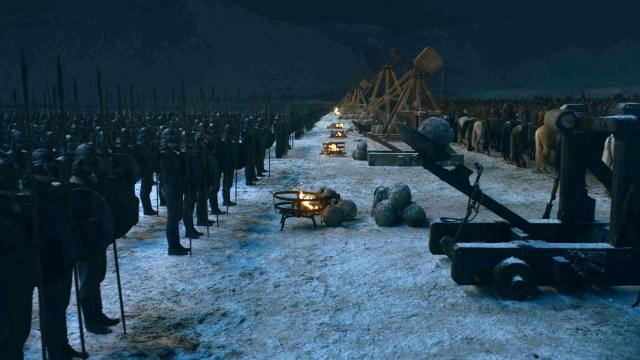
    Castle sieges in fiction are often portrayed as epic affairs. Artillery bombarding the castle, artillery bombarding the defenders, arrows flying to and fro… but that is wrong.

    Sure, such things did happen – but they were only a minor portion of the siege and usually happened at its conclusion. What movies don’t show is the months of work which would take place in order to bring about said conclusion. Besieging army would have to set up camp, build defensive fortifications (if they were smart) both against the castle and against the enemy relief army (if they were extra smart)

    All of this would take time. In fact, defenders usually abandoned castles that could not defend themselves for long against an approaching army – majority of castles were small and intended to act as a deterrent against raiding parties and not major invasions. When a major invasion did happen (which was rare), defending side would withdraw to major castles which could withstand a significant siege. And large castles were incredibly difficult to take. In fact, up until the appearance and widespread adoption of (relatively) modern gunpowder artillery (late 15th / early 16th century) it was more common for a castle to surrender because it ran out of food. And that could take months or even years, a period during which besieging army would suffer from disease, possibly food shortage, and was vulnerable to relief forces.

    Because of this, medieval strategy of conquest usually involved raids that were intended to weaken the enemy and devastate the countryside, thus reducing the resources available for defense.

    13. Defenders Would Pour Hot Oil Onto Attackers

    This misconception is quite a popular one – being burned by hot oil is an extremely unpleasant thing compared to boiling water after all (not that boiling water isn’t unpleasant as well), largely because oil starts to boil at a much higher temperature than water. It is also denser and stickier, which may affect the manner in which it causes burns (I cannot say for sure – I am no doctor). But the thing is – in Middle Ages, oil was expensive. And edible oil was simply not something people under siege – where food meant survival – would simply throw away.

    The “boiling oil” of fantasy was most likely the boiling tar. Boiling tar is just as unpleasant to be hit by as the boiling oil – worse, in fact. It is even stickier than oil, and while oil boils at 150 – 200 °C, tar boils at anywhere between 100 and 400 °C.

    Other substances were also popular. Aside from water and tar already noted, hot sand was also extensively used in sieges. In Siege of Pontoise in 1441, English defenders allegedly used boiling animal fat.

    Not all substances thrown onto the attackers were boiled either. There are records of defenders throwing beehives down at the attackers – and angry bees work far better when they hadn’t been boiled to death. Snakes and scorpions also prefer not to be boiled beforehand.

    Of course, if nothing else was available and enemy was about to breach into the castle, then it is certainly possible that hot oil may have been used – especially if dropped through gate murderholes. But this is very different from the “oil from the walls, boys!” portrayal common in fantasy.

    14. Catapults vs Walls

    Effectiveness of siege engines against walls has varied with time. But in general, torsion engines and traction trebuchets were primarily an anti-personnel weapons: unable to bring down the walls themselves, they were used to kill defenders and decrenelatte the top of the walls.

    But trebuchet, and especially counterweight trebuchet, changed this:

    “The helepoleis were moved forward and “in thirteen days the walls were cast down by the operation of the helepoleis”.”

    “An Armenian account of the Seljuq siege of Mantzikert in 1054 describes a huge trebuchet, originally built for Basil II, called a baban, which weighed some 2,000 kilograms and had a pulling crew of 400 men and which could fire stones weighing up to 200 kilograms. 29 Michael Attaleiates apparently refers to the same siege, for he describes a trebuchet operated by a large number of men which fired an immense stone against which the defenders were helpless (46.8). They were saved only when a Latin grabbed a container of Greek fire, dashed out through the besiegers, and set the machine on fire. He informs us that when Romanos IV Diogenes in 1071 was preparing an assault against the same city, he had a large number of helepoleis prefabricated, from huge beams of all sorts and transported by no less than a thousand wagons, obviously very large trebuchets (151.8-17). An Arab source speaks of one huge trebuchet transported in 100 carts pulled by 1,200 men, with a composite beam of eight spars and launching stone-shot of 96 kilograms.”

    “In 1165 four large Byzantine trebuchets launched huge stones against the Hungarian city of ZevgminonY Andronikos Komnenos, after personally adjusting the sling, the winch, and the beam, fired stones which hit with such violence that they brought down a section of the wall between two towers.”

    With counterweight trebuchets it was indeed possible to bring down castle walls. How effective these siege engines were is testified by the fact that armies of Hungary and the Ottoman Empire used a combination of gunpowder artillery and counterweight trebuchets at least as late as the reign of Matthias Corvinus (ruled 1458 – 1490). Earlier, during the Siege of Stirling Castle in England in 1304, Edward I ordered construction of a massive trebuchet, the Warwolf. Warwolf managed to demolish parts of the gatehouse and the curtain wall of the castle.

    Nevertheless, such massive trebuchets were rare, and their impact was in any case limited. Thick walls such as those of Constantinople were essentially immune to even the largest of trebuchets. It was only when gunpowder artillery came into widespread use that fortifications had to change dramatically in shape to accomodate it – and even that took time. First cannons appeared in Europe in 1327 in England and by the late 14th century had spread all the way to the Byzantine Empire. Yet until the end of the 15th century, traditional medieval fortifications continued to successfully resist new cannons. Constantinople fell in 1453 almost by accident – after Genoese commander Giovanni Guistiniani was wounded and pulled back to port for treatment, defenders panicked and Ottomans managed to breach the walls. Ottoman siege of Belgrade in 1440 had failed completely despite the complete political anarchy in Hungary at the time, and when Ottomans besieged Belgrade again in 1456, they only managed to destroy a single tower in fortnight of bombardment as testified by Despot George.

    Things were different during the last siege of Belgrade in 1521. While much of the damage to the walls seems to have been done by Ottoman sappers and mines, rather than cannons, damage caused by cannons was nonetheless extensive. While the castle had been invested since early days of July, the siege only began in earnest on 1 August, and by 8 August walls were heavily damaged, enough for the assault to be ordered. Thanks to large number of breaches in the walls caused by the Ottoman artillery, this assault was successful and defenders pushed back into the city’s castle. Ottomans continuously shelled the citadel from 8 until 16 August, but the assault failed. Next assault was made only on 26 August, yet this too failed. It was mine that destroyed the Nebojsa tower on 27 August, and on 28 August the garrison had surrendered – only to be slaughtered day later by the Bali Bey.

    Thus, it appears that until the early 16th century, the only way to reliably bring down the castle walls was deep mining. But even when the wall had been brought down, rubble still blocked the way and had to be cleared away. And a breach created a bottleneck which will have been exploited by the defenders – rather unlike what defenders did at the Battle of Helm’s Deep in the movie. Either garrison would create a shield wall / pike block across the breach, or in some cases, new walls or ramparts were built behind it once it was noticed the wall was about to be breached.

    15. Siege Towers

    Movies such as the Return of the King and Kingdom of Heaven depict lines of massive siege towers approaching the walls of the besieged city. But while Roman Army may have been capable of doing something like that, medieval armies – even the Ottoman army – were not. First Crusade was one if not the best organized and largest European military efforts from the fall of Rome until that point, yet even then the Crusaders only constructed two siege towers for the siege of Jerusalem in 1099. These were deployed against the northern and southern parts of the walls, which until then had been attacked only by ladders. Raymond’s siege tower in the south got burned the following day, but Godfrey’s siege tower in the north allowed the besiegers to breach the defenses. Crusader army had numbered 12 000 – 13 000 soldiers, yet they constructed only two siege towers.

    16. Medieval Battles Disintegrated Into Confused Melee

    not medieval, but point made

    Medieval battles were predomnantly a melee, in a sense that real damage was done with melee weapons. And this is about as much credit as I can give to the belief cited above.

    But the idea that armies would disintegrate into a confused melee of individual fighters fighting thousands of one-on-one duels as seen in e.g. in Battle of Black Gate in Return of the King, Battle of Bastards in Game of Thrones, or Philippi in “Rome”, is simply not correct.

    There are several reasons why keeping formation is so important. One is command and control. Unit would form up around its banner, and would follow it in battle. This meant that soldiers of the unit always knew where they had to go as commander would receive orders, and commander himself always knew where his units were as he could see their banners on the battlefield. This was made easier by the fact that heavy cavalry and heavy infantry in particular rarely moved around in small groups. Roman cohorts were the smallest unit that was considered individually effective, and at various times a cohort could have numbered 500 or 1 000 men.

    Second reason is that heavy infantry depends on formation to be effective, as does heavy cavalry. Infantry, which this trope is about, would always stand in some sort of formation – typically a line or a square – and remain so as long as their morale held (unless physically disordered). Heavy infantry out of formation was dead heavy infantry – which is why heavy infantry was so vulnerable in sorts of terrain that precluded it from forming into formations (e.g. forests, as shown clearly by Battle of Teutoburg Forest). A dispersed infantry facing heavy infantry in formation and attempting to fight in a melee essentially opened itself up to defeat in detail, as the infantry in formation can focus only on few elements of the opposing unit at once.

    Heavy cavalry too depended heavily on formation to be effective. Most typical cavalry formation was some sort of a blunt wedge – essentially a trapezoid (isosceles trapezium, specifically) with narrower side towards the target. Cavalry would charge infantry in a mass – and to be successful, formation had to be held. If formation fell apart, it would essentially disintegrate into hundreds of individual charges which then can be individually defeated. In fact, pike-and-shot formations made heavy cavalry largely obsolete precisely because they could easily disorder the cavalry before it made contact with infantry.

    Archers and crossbowmen likewise depended on formations. Side that won archery duel was usually – barring things such as pavise and similar – one that achieved the greatest density of projectiles. And this means that, excepting any skirmishers, archers would also stand in formation arrayed in a way that would provide maximum frontage towards the expected enemy.

    Only units that fought out of formation were skirmishers. These were light infantry and cavalry – archers, slingers, javeliners – whose task was not to defeat the enemy, but to inflict casualties, disrupt the enemy cohesion and screen one’s own heavy infantry from enemy skirmishers. But light units like these could never take or hold terrain, even if they could occasionally defeat heavy infantry or cavalry that did not have its own light unit screen.

    17. Knights Fought in Individual Combat

    Misconception about melee is likely the consequence of misconception that the knights fought individually, that battles involved little more than a series of individual duels. Yet this misconception too is wrong.

    This misconception is an artefact of incorrect reading of sources. During the Middle Ages and even afterwards, units were often identified by the name of their leader, who was usually also the person who had raised the unit in question to begin with. This can be seen from early Modern warfare. At Battle of Lutzen in 1632, Wallenstein’s units included Croatian units General Graf Insolano, Lieutenant Marcus Corpes, Lieutenant Daniel Beygott and Lieutenant Paul Revay. At Battle of Koln in 1757, Austrian cavalry included Kolowrath and Savoyen Dragoons, Birkenfel Cuirassiers and Saxon infantry regiments Prinz Karl, Prinz Albert and Graf Bruhl. Medieval accounts would note presence of the retinue with terms “cum suis”, “avec sa gent”, “cum sua acie”, all of them basically meaning “with his troops”. But modern historians often forgot to include these terms or any note of presence of the retinue, creating impression that fights were individual duels of champions.

    These retinues were in fact tactical units (conrois) from which larger battalies were formed. Knights trained for war in such units, and while large-unit coordination may have been lacking, small-unit tactics were extremely sophisticated. Crusaders themselves were noted for their discipline. An Arabian warrior in the Crusades, Usamah ibn Munqidh, complained of his enemies: “Of all men, the Franks are the most cautious in warfare”. Discipline in fact is vital for success of the heavy cavalry charge, which depended on ranks of cavalrymen maintaining tight formation to punch through the enemy lines. At Muret in 1213, Simon de Monfort’s greatly outnumbered French force won the battle by knights bursting through the lines of King Peter of Aragon, reaching the king himself, killing him and annihilating his army.

    18. Knightly Chivalry Was A Myth

    While this is technically not warfare-related, it is military-related. There seems to be a trend in newer fantasy – specifically, A Song of Ice and Fire – to promote the postmodernist view that honor and chivalry never existed and that knights were merely paid killers.

    While this was true for some knights – people vary in how closely adhere to moral principles, then and now – it doesn’t mean that chivalry as such was a lie. Knights didn’t fight solely for honor, but neither did they fight solely for money. And feudalism specifically is a political system that is built entirely on honor. Senior (lord) gives land and protects junior (vassal) because he believes that junior will fulfill his obligations towards the senior. And junior fights for his senior, obeys him and pays taxes because he trusts his senior will help and protect him when necessary.

    This relationship extended from lowly serf all the way to the king. And because society itself was based around honor, honor mattered in a way that is nearly impossible for modern people to appreciate. Word of mouth then was more reliable than a legally signed document today. At Battle of Castillon in 1453, English commander John Talbot did not wear armor solely due to previous agreement he had made with the French after having been released from captivity. Talbot died in the battle, and while armor may not have saved him anyway, it does show importance of given word.

    19. Horse Archers Were Unstoppable

    Horse archers, and doubly so the Mongols, are often seen as unstoppable in warfare. The reason for this belief is threefold: the Battle of Carrhae, Hunnic invasions and Mongol invasions.

    But none of the three actually prove that horse archers alone were unstoppable. Horse archers did play a significant role in all three battles – but with major caveats.

    The Battle of Carrhae is the first example. Here, numerically inferior force of Parthian cavalry defeated Crassus’ more numerous legions. Idea is that Parthians simply rode up, shot the Romans to pieces over several hours, and then rode away. But reality is far more complex. Thanks to their large shields and armor, Roman infantry was in fact fairly immune to horse archers’ attacks while deployed in formation, especially if they utilized the testudo. But this forced them to bunch up – and especially in testudo, legionaries could not see what was really going on. They were thus left wide open to a charge by heavy Parthian cataphract cavalry, which would smash into the Roman ranks (yes, cavalry really did so), causing casualties while also disordering them and leaving them open to further missile fire.

    Overall, as discussed elsewhere, horse archers are seriously overrated. They are a powerful tool in a toolbox, but can be countered, and cannot achieve anything on their own. Heavy infantry and heavy cavalry can in fact win battles unsupported – even though doing so is not advisable or smart. But archers, horse archers especially, never can. No matter how influential, they need heavy armored units to utilize the disorder they cause and deliver that final coup de grace that will seal victory.

    20. “Rock – Paper – Scissors”

    Related to the above two misconceptions, there is also a misconception that military units were in a strict “rock – paper – scissors” relationship. Idea often goes, “heavy cavalry beats archers – pikemen beat heavy cavalry – archers beat pikemen”, “horse archers beat heavy cavalry – heavy cavalry beats foot archers – foot archers beat horse archers”, “horse archers beat everything else, foot archers beat horse archers”, “horse archers beat everything”, “pikemen beat everything” and so on.

    But just the fact that so many ideas begin should show that belief that strict relationships do not exist.

    It is true, that in a vacuum, foot archers have massive advantage over horse archers, and horse archers have a massive advantage over heavy cavalry while heavy cavalry has a massive advantage over foot archers. But battles never happen in a vacuum, and even then, situational, doctrinal and technological differences can serve to produce results different from what one would expect by looking at merely “expected” or “default” relationships. Terrain too is a massive factor, to the point that it can override literally everything else.

    For example, “horse archers beat heavy cavalry”… but is it always true? Sure, if horses are not armored, and terrain is in their favor, then horse archers have a massive advantage. But if terrain is closed or heavy cavalry surprises them, horse archers can easily be wiped out.

    Likewise, heavy infantry is often seen as being able to beat heavy cavalry most of the time. Yet a short look at history shows this idea to be false. In reality, a lot depended on the terrain and the equipment of both. If heavy cavalry had lances and infantry only spears, then a heavy cavalry charge would devastate infantry lines. When infantry got pikes, it made them close to immune to heavy cavalry – unless they got disordered by archers before the charge. And when plate armor developed, cavalry could in fact charge even a pike block and succeed – or at least survive – since plate armor protected them from even pikes. Yet because unhorsing was a danger, it was something that was generally avoided.

    Terrain was often decisive. If heavy cavalry got bogged down in soft ground, even heavy lancers could be stopped by infantry armed with spears and shields. Infantry was also heavily advantaged if it could fight from the high ground – uphill charge is very difficult and significantly reduces the impact. Infantry that was disordered by archers or by lack of command structure however would fall apart even in front of a cavalry charge that it would have otherwise easily defeated. Terrain can also serve to mask enemy movements, and any unit that is surprised by e.g. enemy force outflanking it has a significant chance of simply breaking apart. At Battle of Sisak in 1593, Ottomans were unable to use their typical tactics because of the extensive marshlands which prevented them from deploying cavalry on their left flank near Odra. So instead of a normal Ottoman deploymen which had infantry (Janissaries and Azabs) in the center and cavalry (Sipahis) on the wings, here both sides deployed their infantry in the marshy ground near Odra while cavalry took up rest of the battle line.

    Weather is another massive factor. Heavy rain – making terrain muddy – can have severe negative effect on effectiveness of cavalry and heavily armored troops (e.g. Agincourt). If rain falls during the battle however it can loosen the bowstrings, making bows less effective. And generally wet weather was particularly a problem for composite bows. Bad weather also makes it more likely that an army will suffer from disease

    And of course, formations and unit combinations can affect things a lot as well. Byzantine cataphracts as well as 15th century Western European cavalry combined heavy cavalry lancers and horse archers into a single unit, with the aim that archers would shoot and disorder the defending infantry just before the impact. On the flip side, archers positioned behind or to the sides of pikemen could disorder the heavy cavalry charge and cause it to fail even before the contact. This is why pike and shot combination basically ended the era of classical heavy lancer cavalry – lancers out of formation cannot penetrate pike block, and mass shot fired from short distance will cause any lancer formation to fall into chaos.

    And while heavy cavalry may break opposing infantry through successive charges, it is unlikely to even try doing so if said infantry also has some cavalry of their own. Any unit is vulnerable to being attacked from a flank, after all, and heavy cavalry embroiled with enemy infantry can easily get wiped out by a flank attack – which is why Byzantine infantry square had numerous light infantry. While light infantry skirmishers would easily get wiped out by heavy cavalry out in the open, enemy heavy cavalry that got embroiled with Byzantine pikemen and spearmen was suddenly vulnerable to javeliners and other light infantry running out through the gaps and pulling cavalrymen off their horses.

    21. Field Artillery

    Among other aspects of “modernizing” medieval warfare, there is a tendency in Hollywood towards employing siege artillery in battlefield scenarios.

    Now, things like Roman scorpion – a torsion artillery firing bolts, basically a giant crossbow – could be utilized in the field. But this was likely rarely done as it was still cumbersome and difficult to use. Siege engines like an onager (what we call “catapult” today), mangonel and trebuchet took some time to get the range right. And even if crew were proficient enough to do it quickly, the only way to aim such engine left or right was to turn the entire assembly – which was difficult and time-consuming. This unwieldyness is the reason why large siege engines were never utilized as battlefield weapons, not even Chinese wheel-mounted trebuchets.

    Reason why siege engines were useful in defending a castle was simply because siege works – including enemy siege engines – are immobile and cannot move out of the way. Attackers and defenders alike would use siege engines to batter enemy defenses – torsion engines particularly were useful for decrenellation. But because armies tend to move, enemy in a field battle wouldn’t even need to bother getting out of the way – natural flow of battle will have moved them away by the time artillery crew had finished aiming.

    22. Sword Was The Primary Battlefield Weapon

    In some scenes of fantasy, sword is shown as the primary weapon of heavy infantry (archers naturally use bows). Numenorean infantry in the opening scene of the Fellowship of the Ring is a particularly egregious example, as they have shields, plate armor, and only swords for weapons. But this was almost never the case.

    Sword is basically a jack-of-all-trades, master of none. It is versatile and easy to carry, but precisely because of that it lacks reach and has difficulty against armor. And since sword is so easy to carry, there is no reason not to use another weapon as a primary one while using sword as a backup.

    I will show this in the table below:

    SOLDIERPRIMARY WEAPONSECONDARY WEAPONGreek HopliteStabbing spear (dory)SwordPersian ImmortalStabbing spearSwordRoman Legionary (early)SwordThrowing spearRoman Legionary (late)Stabbing spearSwordWestern European (10th c)Stabbing spearSwordByzantine Heavy InfantryStabbing spearSwordMounted man-at-armsHeavy lanceSwordDismounted man-at-armsHeavy lance OR pollaxeSwordHungarian Hussar (15th / 16th c)Light lanceSabreOttoman Deli (15th / 16th c)Light lanceSabreRodelero (1510s – 1520s)SwordDaggerLandsknecht (1510 – 1520s)Sword (two-handed)DaggerImperial Cuirassir (1632)Two pistolsLong swordCroatian cavalry (1632)ArquebusPistol, swordMusketeer (1632)MusketSwordHabsurg Hussar (17th / 18th c)Carbine (short cavalry musket)Pistols, sabre

    As can be seen, only the early Roman legionaries, Spanish rodelero and the German Landsknechte swordsmen have a sword as their primary weapon. Both of the latter were highly specialized infantry meant to exploit the push of the pike to get in between the enemy pikemen. Swiss used halberdiers for the same purpose, as very often did the Germans (despite giving the Zweihander its name). In 1530s, Spanish reorganized their army and they too replaced swordsmen with the halberdiers. As for the Romans, considering sword a “primary” Roman weapon may be somewhat incorrect. Roman reliance on sword was very much a product of their javelin-centric tactics: a heavy infantryman armed with two heavy javelins could not carry anything else. This then left sword as the only possible close-in option.

    18th century cuirassiers were supposed to carry pistols or even carbines as their primary weapons, but in practice they abandoned the pistols and used swords as their primary weapon. Reason for this was psychological, as cavalry equipped with pistols would have a tendency to use pistols, and would thus fail to press home their charge. For cuirassiers, who were heavy cavalry relying on physical charge to be effective, usage of ranged weapons was clearly unacceptable. For this reason, only some 20% of cuirassiers actually had pistols.

    But in general, swords were used as primary weapons only by officers and civilians. Officers who used swords as such mostly used them as pointing sticks to give orders – when they actually expected to fight, a sword-and-pistol combination was more typical. As for civilians, swords were very easy and convenient to carry around, and were an expected self-defense weapons – whereas carrying a spear or a musket would immediately single one out as a soldier.

    23. Medieval Armor Was Heavy

    A question on Quora I saw recently wondered “why medieval armor was so heavy” and “did knights have any problems due to weight of their armor“. And this is not a rare idea. An old myth even stated that medieval knights needed a crane to get up onto the horse, though it thankfully appears to have been more of a joke than a widely held belief.

    Nevertheless, the idea that medieval armor was very heavy is wrong. In reality, medieval armor was lighter than the equipment modern-day soldiers wear – full suit of Gothic plate armor weighted some 15 – 20 kg, and even the heaviest medieval armors did not weight more than 25 kg. Weight only began to increase beyond this after Middle Ages, as advancements in handguns forced armor to get thicker and thicker. Even so, Maximillian armor weighted some 20 – 22 kg, and it was only in the late 16th century that armors truly began to gain weight. For comparison, weight of the equipment today’s soldiers wear in combat can be anywhere between 30 and 55 kg. Moreover, weight of medieval armor was far better distributed meaning that they could move more easily, and armorers made sure to leave joints a great deal of freedom even within the armor itself.

    We in fact have preserved accounts of exercise regiments for knights. Knightly exercises were very agility-heavy, and included moving underneath roof-mounted ladders just by hands, climbing a ladder from the underside again using just hands, jumping onto and off the horse, sommersaults, dancing, jumping, fencing and wrestling. And knights would often, if not always, do these exercises in full armor.

    24. Armor Can Be Cut Through

    In movies, it is not an uncommon occurence to see the armor being cut through, or pierced, etc. Now, this is not an impossibility, depending on armor and the weapons. But that is the key point: it depends. In other words, there will be no “cutting through plate with a sword” stuff. Much less with a wooden stick, as the Night King above does.

    In general:

    • Gambeson (cloth armor) was vulnerable to mostly everything except long-distance arrows and weak sword strikes. Even a sword strike may have been able to cut through, though gambeson would at least take off enough edge off it to prevent loss of a limb or a similarly crippling injury. Stabbing weapons penetrated relatively easily.
    • Mail backed by gambeson can stop most of cutting attacks except for axes, and may or may not stop stabbing attacks. It is of limited use against arrows, but still provides a decent protection against weaker bows such as used by horse archers.
    • Armored plate can stop most cutting and piercing attacks with the exception of heavy cavalry lance, and even that only goes through lower-quality infantry plate. Heavy weapons such as polehammers are required to get through, or else relying on blunt force.

    Of course, armor did not cover everything, so it was possible to get through the gaps. A man in mail shirt could be rather impeded by an upward stab that got below his mail armor. Plate armor also had gaps, and while these were typically covered by mail voiders, mail could still be stabbed through.

    But stabbing through a breastplate with a wooden stick simply did not happen.

    25. Helmet is Useless

    This is not so much a modern misconception as it is a filmmaking convenience (I hope!), but movies often show characters in armor not wearing helmets.

    There is actually a reason for this, as hair can be as important in recognizing an actor as the face is. But it may send a message that “helmet is useless” and not that important. In reality however, if a soldier wore any piece of armor, he wore a helmet. The only people who did not wear a helmet were those incapable of affording any armor at all – and even then they would try to protect head in some way, be it with a felt cap or a combination of felt cap and cloth turban as used by Byzantine and Arab infantry (this was later adopted by Turks). Good illustration of 10th century Byzantine infantryman and his protection can be seen here.

    26. Longbow Was A “Machine Gun” Of Middle Ages

    Archery weapons, and especially longbow, are often treated as if they were equivalent to modern-day ranged weapons. You could use them to keep the enemy suppressed, one-hit-kill, piercing armor… and especially longbow gets it bad due to myths of Agincourt and Crecy. Mongols too are hit with this, but that will be discussed below.

    In reality, longbow was anything but a machine gun. Let’s talk first about suppression. A trained longbowman can loose a maximum of 6 arrows in 28 seconds. This is around one arrow every 4,5 seconds. But longbow has a killing range of 200 meters, penetrates mail at some 150 meters and can pierce plate armor at 20 meters. Destrier could gallop at 48 kilometers per hour or 13 meters per second – giving longbowman three effective arrows against a mail-clad knight and only one against a knight in plate. Even with knights on foot, longbow could hardly achieve effective suppression.

    And this rate of fire could not be maintained for long. As Joe Gibbs notes here, longbow is a very tiring weapon. He himself manages 20 arrows – again at a rate that appears one arrow per 4 – 5 seconds – but is notably worn out by the end. So “suppression” would last for a minute to a minute and a half. But as Todd noted in the video, during the siege of Stanton Harcourt Manor House, the longbowmen present only managed to shoot 1 000 arrows over 6 hours. There were 200 men present, and if even half of them were longbowmen – a reasonable assumption, considering it is England being discussed – then rate of fire was 1,7 arrows per hour per archer, or 36 minutes per arrow per archer. In a protracted engagement, longbowman would want few minutes between shots in order to rest and recover.

    Secondly, longbow was far from one-hit-kill. It could not pierce armor plate, though armor was obviously vulnerable to hits to mail and lucky shots. But even if arrow went through armor, hits were not necessarily lethal – or even disabling. It all depended on where the arrow had hit.

    Overall, while longbow was an important weapon, it was hardly revolutionary.

    Conclusions

    This is it for the myths. There are many more, but the above is a selection of what I had found important, interesting or just very noticeable. If you want any of these explored in detail, leave a comment.

    #medieval #medievalWar #medievalWarfare #misconceptions #myths #warfare
    Causes of War for Fantasy Writers

    One of major aspects of writing warfare is understanding why people go to war. It is in fact the basic requirement of writing a war: if one does not understand why the war is happening, he will not be able to set coherent goals for factions fighting the war, and thus the war will appear disjointed. No individual or collective, no enemy is simply evil. Everybody does things for a reason, even if some reasons may be difficult to understand for most people. And these reasons determine not just why, but also when, how and how long will wars be waged.

    This is necessary, as establishing a believable reason for the conflict helps both the writer and the reader – it helps the writer actually write about the conflict, and it helps the reader understand what is going on and get immersed in it. And these believable reasons and attitudes cannot be based on the current-day understanding of warfare, because said understanding is so different and out of step with ancient and medieval attitudes towards war that including it basically breaches suspension of disbelief all on its own.

    Thomas Hobbes said that people go to war for three reasons:

    • greed (to take other people’s stuff, claim their territory, etc.)
    • fear (to strike others when it seems like you have an advantage, because you’re afraid that when they think they have the advantage, they’ll attack you)
    • glory (to show that you are mighty warriors so that others will respect and fear you)

    And this is, by and large, correct. It is however an oversimplification, and causes of real war can be varied and complex.

    Another aspect of this is that people are morons: they only need to think they have a good reason to go to war.

    Greed

    Greed is the basic aspect of human being, and it stems from uncertainty about the future. We are programmed to want to gain as much as possible, because future is always uncertain – and in the past, this uncertainty could have meant death. The way to remove uncertainty is to accumulate the necessary resources well beyond the point of bare necessity – thus, greed.

    And in premodern times, resources were limited. This limit on resources especially meant that oftentimes the only way to accumulate further resources was to take them by force. And force, when applied on the scale of society, meant war. Warfare for the sake of acquisition of resources has existed since before humans have even evolved. Ants fight wars for access to food, territory or even labor. Chimpanzees too fight real wars in order to conquer territory.

    And the reason for war is simple: larger territory means access to greater amount of resources. Greater amount of resources means that there is greater safety margin between what the group needs and what it can extract from the land, therefore enabling the group to more easily survive the lean times. But greater access to resources will (generally) enable the group to grow in size, thus forcing it to expand the territory to maintain the comfortable safety margin. This is not an issue for so long as there is empty territory, but the moment a group runs into another group claiming territory they want to expand to, the result is inevitably war.

    And because there is no hard limit on what exactly constitutes the “safety margin”, humans are conditioned to always want more no matter how much they have. Thus tribes start hoarding stuff like ancient dragons gold, only stopping when cost of warfare outweights the benefits.

    While the most basic resources to wage war over are fertile land and drinking water, as society becomes more complex, the variety of resources increases. Wars can thus be waged for control of trade routes (e.g. Roman-Persian wars), trade resources (e.g. Anglo-French wars in North America), sources of resources (most importantly gold and salt mines) or simple plunder. Farmland, timberland, ore mines, seaports and trade routes are all good reasons for war.

    Even “simple plunder” should not be underestimated as a source of warfare either. For nomadic tribes, plundering neighbours can mean a difference between life and death. Even when people had settled, plunder would still hold the potential to make the leaders and the men rich(er), and was thus a major motivator in warfare. Viking raids for example were carried out for basically no reason other than plunder, even if Vikings themselves did settle in other places.

    Leaders may seek to gain power over their own people by making them unite in opposition to an enemy (real or imagined). On the flip side, hostile leaders may attempt to cause internal conflict in the society in order to weaken it, and this can cause civil war. Example of the first is Hitler in 1920s and 1930s, while example of the second are Communist activities in Europe from 1918 to 1991. These caused multiple civil wars and rebellions (Finnish civil war, Spartacist uprising in Germany and so on) which then paved the way for populist anti-Communist leaders such as Hitler and Mussolini due to the fear the Communism had caused – and fear can be a powerful motivator for war, as discussed in the next section.

    Fear

    Other people’s actions are difficult or impossible to predict, and this is just as true on the level of states as it is on the level of individuals. Thus, in time of slow communication and slow trade, leaders would often operate on the “better safe than sorry” policy. Even as late as 1914, the global conflict began mostly because everybody assumed the worst-case scenario and communication was too slow to resolve issues in time. And the reason why everybody assumed the worst-case scenario is because changes had made leaders uneasy. Changes were many. Economic, political and military rise of Germany and its colonial ambitions caused fear in British, French and Russian leadership. Serbian imperialist ambitions towards Bosnia and Croatia caused unease in multiethnic and unstable Austria-Hungary, and Bulgaria wanted to get revenge for its defeats and recapture lost territories. War was only barely avoided several times to finally break out in 1914.

    States and leaders always had to be wary of their neighbours’ actions and motives. For this reason, international politics had – all the way from the Stone Age – relied heavily on balance of power. Anything that disrupted that balance of power was seen as a threat. A state growing too powerful could inspire an attack by neghbouring powers, for no reason other than to take it down a peg. Similar scenario could occur internally in a feudal or other aristocratic society.

    Another aspect of fear is ideology. This can be a religion or a political ideology – as a matter of fact, political ideology is nothing but secularized religion anyway. People feel comfortable in their beliefs, and thus fear anything that may threaten these beliefs. Human mind is by its nature totalitarian, and it takes training and culture for civilized discussion to be at all possible – even within one’s own mind, let alone with other people. For this reason, wars were often caused by ideologies attempting to expand. Muslim conquests were caused by Islam, and the Fourth Crusade’s capture of Constantinople was heavily assisted by Westerners and Byzantines being unable to really understand each other due to cultural differences. Then there is also Thirty Years War between Catholics and Protestants in Europe.

    And ideology that causes war does not necessarily have to sound or even be evil. If the alternative to accepting said ideology is eternal damnation, then enforcing ideology by force is perfectly reasonable. This is what drove the Muslim conquests, Baltic Crusades, as well as the Soviet invasions of neighbouring states in the 1917 – 1922 period. Historical experience shows that idealism is the most lethal force in human history.

    In all cases, cultural incompatibility creates fear and also makes conflict resolution more difficult. Different cultures lead to different mindsets and mentalities, which then can cause people to “speak different languages” even when they are, technically, speaking the same language. This then increases probability of conflict by making peaceful conflict resolution more difficult, and may even prevent any kind of peaceful conflict resolution if cultural values are different enough.

    History of past conflicts can also cause feeling of fear and mistrust. If somebody had been a threat for a long time, only a rather stupid person would believe they are suddenly no longer a threat.

    Of course, fear can be wholly justified when people’s safety is directly threatened. The root cause then will be somewhere else – specifically whatever is threatening the safety. Good example are barbarian migrations. The root cause in barbarian migrations is still unclear – perhaps Chinese expansion, perhaps something else. Whatever the case, masses of barbarians moved westwards en masse, causing a chain reaction, an avalanche that pushed into the Roman Empire. Unable to absorb so many barbarians so quickly without destroying itself, Roman Empire was forced to respond with force.

    Glory and Honor

    One basic fact which fantasy writer needs to understand is that modern-day Western understanding of war as terrible was born in the trenches and the horrors of industrialized warfare of the First World War. But the core premise of warfare in many fantasy works (from Lord of the Rings to the A Song of Ice and Fire), namely that war is terrible, would have baffled anybody who had lived before 1914. In earlier times – as late as Napoleon – it was perfectly reasonable for a leader to invade a neigbouring country for the sake of his own glory. Aristotle held that wars between the Greeks were always unjust, but wars between the Greeks and the barbarians were always just.

    But in premodern societies, fighting neighbours was the main way of gaining respect and plunder. Respect was not baseless. Societies that develop a warrior class usually (and rightly) look up to them and praise them, as warriors are the guarantee of safety and future of the group. But this admiration also has major implications for the society itself.

    For a long time, glory was a major currency in internal politics of a state. Elected leaders especially had to gain recognition before being elected in the first place, but hereditary leaders were not immune to popularity issue either. And the easiest way to gain glory was through conflict.

    Roman politics are a quick and easy example of this. Romans during the late Republic were in a state of nearly constant conquest, most of it motivated primarily by internal Roman politics. Successful conquest could easily make a person’s political career. Caesar’s conquest of Gaul is a good example: he not only gained reputation from it, but also used said conquest as propaganda material in his dispatches and eventually the book De Bello Gallico.

    Likewise, Cortez and Pizzaro, while greedy for gold, also knew that in the warlike society of Spain they would be admired as conquerors and heroes. This then would lead to gaining prestigious titles and honors.

    Importantly however, fighting for honor also served as a way of limiting warfare. Being ready to fight a war over even trivial offenses could in fact reduce likelyhood of a major war, because it signalled to neighbours that one would not be cowed.

    Revenge

    This is a factor that Hobbes did not mention, and may technically go into “fear” category. Either way, it is a major one – wars are often started as revenge for real or perceived ills. France was overjoyed to go to war against Germany in 1914, as a revenge for its humiliation in the Prusso-French war of 1870. And Hitler’s rise to power was helped by Germany’s humiliation in 1918 – it was no accident that Hitler forced the French to sign their capitulation in 1940 in the same place Germany had signed its surrender in 1918. In the Balkans, Serbian tyranny over Croatia in the 1918 – 1939 period caused creation of the Ustashi movement, which then launched its own tyranny in the 1941 – 1945 period. This was answered by the Chetnik- and Partisan- -waged campaign of tyranny, and Communist Yugoslavia was formed in 1945 on bones of the dead.

    The American and French Revolutions were caused by feelings of injustice. People want to believe themselves to be in the right, and it is much easier to defend violence seen as being honorable.

    For this reason, if war is going to form a major part of fantasy novel, writer should keep in mind history and previous relationships of combatants as they will affect both causes and the nature of war – that is, the manner in which the war is being waged.

    Complex Causes

    Most often however, causes will not be this simple. Rather, wars will be started by complex interaction of many factors. For example, while it was technically greed that caused the First World War, Belgium did not need to get involved – but its geographic position on France’s flank meant that Germany attempted to use it as a way to outflank the French Army. This however drew Britain into war, and entrance of Britain helped draw in United States. In the Second World War, Denmark got invaded because it was on the way to Norway.

    Conclusion

    As can be seen, while reasons for war are very varied, they can still generally fit into Hobbes’ three categories. But it should be kept in mind that reason for war and justification for war are not one and the same. For people to accept war, they need to be emotionally winded – and “we need those mines” is not going to be enough. Thus to justify a war, a mythology needs to be created. Common myths used to justify war include answers to insults (e.g. War of Jenkins’ Ear, which was really about colonies in North America), real or made-up history of past persecution (e.g. Serbs wanting to “liberate fellow Slavs from Habsburg persecution”), real or made-up threat (e.g. Soviet claim of protecting minorities in Poland in 1939), “Manifest Destiny” (e.g. actual “Manifest Destiny”, as well as European colonial powers and USSR claiming to “spread civilization” or in latter case “spread revolution”). Trigger for war can be an insult, an unprovoked incursion (military or otherwise), assassination of a public figure, injustice or something else – but causes for war will always be the four causes that had been noted previously.

    Further reading

    Exploring the Motives Behind Wars in Fantasy Novels

    https://orenlitwin.com/2021/08/08/war-in-fantasy-fiction

    #historicalWarfare #medievalWarfare #war #warfare #worldbuilding

    Reasons for War in Premodern Societies

    Wars do not happen without reason, even if some reasons may seem stupid to modern readers. This is important, because objective of the war also determines the conduct of the war. War whose objective is completely conquering the enemy country will not be fought in the same way as a war whose sole objective is capturing slaves. No country, government or organization is evil simply to be evil – evil people are typically convinced they are doing good! – which means that a war has to have some purpose to achieve. Establishing believable reason for the conflict that drives the story can help in making both the world and the story more internally consistent and immersive.

    Scarcity of Resources

    Scarcity of resources is a common reason for war. This scarcity does not need to be something critical, though it may be. It could be lack of farming land, or merely attempt to control the lucrative trade route. In Stone Ages, groups of people that ran out of food would take their neighbour’s food. Even in Middle Ages, if one area suffered from bad climactic conditions, solution was often to just go and take neighbours’ food.

    Migration

    Whenever there is a mass migration, there is a war. Western Roman Empire was destroyed by mass immigration of barbarians, and Mexico lost Texas to mass (and planned) immigration of American settlers. Rome was capable of dealing with different ethnic groups normally – the Empire essentially allowed each group to live as usual, follow their own laws and gods, so long as they paid taxes and obeyed Imperial authorities. But settlement of migratory barbarians placed strain on the system, and while Rome did its best to integrate the newcomers, this proved impossible in the long run. It should be noted here that Western Empire dissolved despite the fact that barbarians generally remained rather loyal to the Emperor – at least on paper.

    (Note that this migration itself was caused by expansion of the Chinese Empire. Huns had been raiding China for a long time, until in 400 BC Chinese Emperor got tired of it and directed his generals to chase them away. They did so, which caused a chain reaction of westward migrations by barbarians – with Huns themselves showing up in the west in 400 AD).

    Loot and Plunder

    Of course, resources need not be scarce for people to want to take neighbour’s resources. In general, the more people have, the more they want. Vikings are a good example of a group whose primary goal was plunder: in fact, name “Viking” itself means simply “raider”. That being said, Vikings did settle elsewhere – see “Land Grab”. It is thus unsurprising that majority of medieval armies – with the exception of the Byzantine and Arab armies – were usually small.

    Of course, things could escalate. If a local raid (say, between counties) hit more than one county, then the local war could spread to the next level. And on occasion, this would go up the chain until it involved the entire kingdom.

    And this could easily come to place that war would feed itself. In order to defend against the Ottoman expansion as well as opposition from within the kingdom, Matthias Corvinus decided to form a standing mercenary army – first of such type in Europe. But this army was runiously expensive for the resources of the kingdom, and so he was forced to wage basically perpetual wars in order to pay for the army’s upkeep.

    In fact, out-of-job mercenaries tended to turn to looting and plunder, becoming in essence well-organized bandit gangs. Best way to deal with the problem was to hire them again and set them loose against one’s enemies.

    Slaves

    Slaves were another form of loot and plunder – and perhaps one of the earliest forms. Native African tribes used to wage perpetual warfare to enslave each other. This resulted in development of lucrative business when Europeans arrived, with tribes selling captured Africans to European and North American slavers. And while more developed societies such as the Roman Empire rarely waged wars solely for purpose of capturing slaves, slavery as part of motivation as war still should not be discounted.

    Land Grab

    As authority in feudal system was based on land ownership, taking more land was a big driver in expansion. Otto the First pretty much drove eastwards expansion of the Holy Roman Empire simply to gain more land for his nobles. More importantly, systems with primogeniture mean that all lands go to the eldest son. For younger sons then, the only way to get more land is to conquer it.

    Trade

    Trade is a major war maker. Trade powers could make war to force other countries to open ports and borders to their trade (famous examples are the Opium Wars). Other times, two countries might fight for control of a particular trade resource, or a trade route. Too many restrictions on trade can cause war as countries seek better economic positions, but too few restrictions also leads to greater probability of war as greater number of potential trade partners reduces bilateral dependance and thus potential cost of waging war.

    Geography

    Sometimes, a country or a group of people will be attacked because they are located on an important geographical location – see the point about trade routes above. This could also be an important defensive position (e.g. control over a mountain pass), or a potential threat to larger state’s territory their location makes them.

    Belief Systems

    Religion or political ideology can frequently be a major cause for war. This is most obvious with belief systems which claim to hold universal truths. Historically, monotheistic religions such as Judaism, Christianity and Islam had engaged in offensive warfare against unbelievers, either to wipe them out or to convert them to their own religion (Islam being the most obvious offender). Genghis Khan believed it was his destiny to conquer the world for his god, Tengri. In more modern times, secular belief systems which likewise claim to hold existential answers have also caused major wars – obvious examples being communism, nazism and fascism, but also liberalism.

    Even when religion or political ideology are not a factor however, cultural differences can still lead to a war. Different beliefs and ways of thinking can cause misunderstandings which may either slowly snowball or suddenly explode into open warfare.

    Historical Animosities

    Historical animosities are another reason. National mythology often shapes attitudes and even policies. One of major reasons why Hitler could start the Second World War was belief in Germany that country had been betrayed, and also exploited by the victors. And the main reason why ideologies such as Nazism and Fascism were able to spread throughout Europe was the fact that Soviet Union had spent period of 1917 to 1922 invading anybody it could reach (Estonia, Finland, Poland, Latvia, Lithuania, Armenia, Azerbaijan, Georgia, Ukraine) and remaining 17 years until 1939 it spent financing various Marxist (Bolshevik) uprisings, revolutionary movements and terrorist groups throughout Europe and wider.

    It is important however to understand historical, social and cultural factors which had shaped these animosities, and how they continue to do so in the present.

    Historical Claims

    Any self-respecting country that loses territory due to enemy invasions is not going to recognize the loss so long as any hope of recovering the territory remains. And this can cause wars. After Western Roman Empire got dissolved by mass immigration of barbarian tribes, Eastern Roman Empire was a natural successor to its claims. At first the East recognized situation on the ground as a de facto reality, but never de iure accepted the loss of the Western Empire. This eventually led to Emperor Justinian attempting to reconquer the West – something he may have succeeded in if not for the Justinianic Plague.

    Quest for Glory

    Sometimes, wars will be caused merely by people seeking glory. While such motive may seem ridiculous to modern mind, it should not be forgotten that premodern wars were nowhere as destructive as wars of modern times. Back in Antiquity and Middle Ages, war was often seen as a way to gain glory, be it for individual or for the group. In many cases, warfare was almost ritualized. Such honor wars were usually on a much smaller scale than economically or politically caused wars.

    Natural Disasters

    Volcanoes, hurricanes, but also droughts can leave entire areas uninhabitable. When this happens, a mass exodus ensues. And this exodus can easily take on nature of an invasion (in fact, any large migration is a de facto invasion).

    Corrupt Rulers

    Rulers or governments (including democratic ones!) can become corrupt and start considering only the interests of a single group or class of people. Once that happens, government may start a war for interests of a particular group or even an individual, or else a rift may open in the country that will lead to a civil war.

    Legal Confusion

    Wars could easily be caused by legal confusion. Especially feudal legal relations were often complex. For example, after William of Normandy conquered England, he became king of England. But since he was still duke of Normandy, he was technically a vassal to king of France. This was bound to cause trouble. Situation repeated itself later, with Henry V – then King of England – being also the Duke of Aquitaine, and thus bound to swear fealty to the French king.

    Succession Struggles

    Above would often lead to succession struggles as well. If one kingdom followed inheritance by primogentiure but other had patrilineal inheritance, then a king of one kingdom could easily consider himself to be a king of second kingdom as well, yet be denied. This was the cause of Hundred Years War between England and France, and also why Coloman managed to secure support of Slavonian nobility before attacking southern Croatia (which led to death of king Petar Svačić).

    In fact, various legal confusions related to succession were probably the most frequent cause of warfare between kingdoms.

    Power Struggles

    Barons always looked to restrict power of the monarch, while monarch sought to expand his own powers. While this resulted in something of an equilibrium which allowed greater freedoms, it also meant that king could begin a war simply to redirect barons’ attention elsewhere.

    In a feudal system power of the central government also tended to lapse over time. Lack of administration meant that monarch often had to show up in an area in person, with the court essentially travelling the kingdom in a manner of travelling circus. This presence was not always welcome because it was expensive, but expenses were also part of the point – as barons had to host the ruler, they would be too busy planning how to pay the enormous costs which came with the honor to think about rebelling. Further, because authority of the monarch was based on technically land grants, as monarch ran out of land so his authority weakened.

    Holy Roman Emperors later on had to wage what were essentially campaigns of conquest in Northern Italy in order to get crowned by the Pope – and then hurry back to Germany to fight inevitable coalition of rebel dukes which will have appeared by then.

    Alaric besieged Rome three times in early 5th century because he wanted to be recognized as magister militum by the Emperor there. While Emperor himself was basically powerless militarily by this time, legitimacy and authority gained by long rule of Rome in the West meant that barbarian leaders only had true royal legitimacy if the Roman Emperor recognized them. Visigoths eventually sacked Rome in 410 AD, but this was not the original goal.

    Combined Motives

    Of course, leaders and states may have more than one motive to start a war. Natural disaster may have led to scarcity of resources. Or perhaps scarcity of resources had made people living in an area warlike, and something happened – a disaster, an ambitious ruler or a new belief system – that made them turn their energies into outward conquest instead of previously typical internal squabbles. Alternatively, historical animosity may be what pushes two states into war over scarce resources, geography or different belief system. Whatever the case, combining motives will help wars feel more realistic, deeper and more immersive.

    Conclusions

    Wars in fantasy may erupt for any one or multiple of above reasons. But regardless of if it is a Dark Lord attempting to create a utopia by force, or a bunch of enterpreneurs doing business, nobody fights a war for no reason. And the reason behind the war will shape the way war is being fought. This will allow the author to create a compelling and immersive story that will keep readers engaged. Motives of war will also determine the conduct of war as well – an attacker whose motive is merely plunder will come, raid, rape, pillage and plunder, and leave. Attacker whose motive is conquest however will stay to try and besiege towns, resorting to raiding only if outright conquest is not possible (Mongols and Ottomans both did this).

    #cassusBelli #causes #medievalWarfare #premodernWarfare #reasons #war #warfare

    26 Modern Misconceptions About Medieval Warfare

    A Song of Ice and Fire and other “realistic” medieval fantasy works have been trying to challenge the set-in conceptions of Middle Ages and provide a more realistic take on the era, one that tries to remove the lenses of noble prejudices and show how things truly were.

    Problem is, they have failed. Instead of removing prejudice, postmodernist fantasy has merely replaced medieval distortion lenses with (post)modern distortion lenses – but has completely failed at building a “more real” medieval world. And this is obvious in warfare as well.

    That being said, I want to note a caveat: all of the misconceptions, and responses to them, are by nature generalizations. But just because something is generally true does not mean it is always true.

    1. “Glory in War” Was Just a Noble Myth

    Not medieval, but illustrates my point

    Yes, people always recognized the war as something terrible. But the modern view of war as a pointless, terrible slog was born in the total warfare of two World Wars. It was the First World War which shattered the previous conceptions of war, and the Second that hammered the final nail into the coffin.

    Medieval people viewed war as something very different. For nobility, it was an opportunity for fame and glory. For common soldiers, it was an opportunity to get rich or at least gain some wealth. For everybody involved, it was a duty and a question of honor.

    This jutapoxition is why so many were willing to engage in religious wars. War provided just the right combination of honor and danger, of duty and suffering, to prove one’s dedication.

    And again, this was true for nobility and commoners alike. Masses of peasants willingly went to try and liberate the Holy Land – only to get slaughtered because they did not wait for backup by professional soldiers. Later, during the Ottoman Wars, peasants under John Capistrano played a major role in defense of Belgrade.

    Therefore, both nobles and commoners sought glory in war. Which leads to the next myth…

    2. Medieval Soldiers Were Conscripted Peasants

    It is impossible to create a profile of a “medieval” soldier, as manner of recruitment varied by time, place and situation. There were indeed cases when untrained peasants were conscripted – or even volunteered for – military service. But by and large, idea that medieval armies consisted of peasants torn from their fields and forcibly marched to war by their lords is fundamentally nonsense.

    As noted, ways in which medieval soldiers were recruited varied widely by time and place. But generally, “all men under arms” was only done by early tribal societies, where all free men were warriors. This was the case with e.g. Slavs and other tribes during early migrations. In such cases, warriors may number some 20% or so of the tribe.

    But over time, army did professionalize even as it remained tribal in nature. Indicative are numbers for Croatian army under Tomislav given by Emperor Constantine VII in De Administrando Imperio: 60 cavalry and 100 infantry allagions. It is difficult to establish size of allagion, but allagion is generally a term for bandon. Byzantine bandon of 10th century contained some 200 to 400 men for infantry banda and 50 to 100 men for cavalry banda. Using this, it can be concluded that Croatia under Tomislav had some 20 000 – 40 000 infantry and 3 000 – 6 000 cavalry. Croatia under Tomislav had anywhere between 400 000 and 1 000 000 population, making army some 4,6 – 5,75% of population.

    More professional armies were even smaller. 10th century Ottonian Empire could raise 20 000 saddled men – meaning heavy cavalry or knights. 9th century Wessex had a field army of 5 500. And by the end of the Middle Ages, “nation under arms” concept had largely disappeared, having been replaced by highly professional forces. By 1348, England could field some 30 000 men, though usually not in a single field army.

    Hungary in 15th century had population of around 4 million (including Kingdom of Croatia, which was technically an independent kingdom under Hungarian crown). At Mohacs, Hungary managed to field an army of 26 000. Its total armed forces, not counting allies, were perhaps around 60 000, or 1,5% of the populace. Sigismund in 1432 predicted raising 80 000 cavalry in his entire country, of which 12 000 in Croatia. This would give 2% of population in military. For comparison, very definitely professional Ottoman regular army was around 1,2% of the population (94 000 men with 8 million population in 1453), though this number was regularly and significantly increased through inclusion of irregulars. This irregular force added 50 000 cavalry in 1453, for a total army of 144 000 or 1,8% of the populace.

    And this has important implications for worldbuilding. To use ASoIaF example, Westeros – which has a total armed force of 380 000397 000 men – can either have a professional army and total population of between 20 to 30 million people at minimum, or rely on conscripted peasants and have total population of 2,3 – 2,4 million across the entire continent. At 7 933 000 square kilometers, former results in density of some 2,52 to 3,78 people per square kilometer. North specifically, with perhaps 8% of population (1,6 – 2,4 million) and 2 932 000 square kilometers, would have population density of 0,54 – 0,82 person per square kilometer.

    But since Westeros is not, in fact, engaged in a life-and-death struggle against a conquering empire, mobilization numbers can be easily halved – and thus population estimates doubled. This would lead to overall mobilization rate of 0,75% to 1%, which would lead to overall population of 38 – 53 million people. Of these, some 3 – 4 million would be in North. Result is an overall population density of 4,79 – 6,68 people per square kilometer for Westerosi average, while North specifically would have density of 1,02 – 1,36 people per square kilometer.

    For comparison, 15th century Hungary was some 9 to 15 people per km2, and relatively sparsely populated Scandinavia was around 4 people per km2. Even Eastern Europe had population density of 2,48 people per km2 in 1450, and 1,5 people per km2 if one goes all the way back to year 1 000 AD. Europe overall had a population of 83 million in 1450, resulting in average population density of 8,15 people per square kilometer. As can be seen, higher population estimates – ones assuming semi-professional armies – result in population density for Westeros that is just about on the lower end of plausible for the society we see portrayed.

    Lower population, stemming from the “peasant conscript” army, would result in population density of 0,29 to 0,30 people per square kilometer overall, and 0,06 to 0,07 people per square kilometer in the North specifically. For comparison, Sahara desert – which has one of lowest population densities on the planet – has population density of 0,4 people per square kilometer. Gobi desert is more populated, at 1 person per square kilometer. This population density would make it quite impossible to form and maintain a feudal society. Instead, if we assume that Westerosi armies are indeed predominantly conscripts, then people of Westeros ought to be essentially Neolithic nomadic pastoralists.

    Closest thing a proper 15th century army comes to a “conscripted peasant” is Hungarian institution of militia portalis. Sigismund declared in 1432-5 that in event of a campaign those with lands were required to field 3 mounted men per 100 slots. This quantity clearly shows that the men thus fielded were expected to be equipped and trained – and indeed, each conscript was supposed to be armed with bow, quiver, sword and lance. Service obligation of this militia was limited to three months. After several further changes, service obligation was finalized in 1498 as 1 hussar per 24 plots in the southern counties, and 1 heavy cavalryman per 36 plots in the inner parts of the kingdom. This form of recruitment remained in use in Hungary and Croatia until well into the Napoleonic Wars, providing a defensive-oriented army that was at once both cheap and effective.

    But by 15th century, armies in Europe were largely recruited through indenture system (introduced in Englad by Edward I (1272 – 1307)) or similar systems. In fact, indenture system began to develop in England in 1101 AD, and historians such as J.O.Prestwich argue that feudalism has been overrated as a system of military organization – money was always the primary driver of war.

    Even urban militias were not a bunch of people conscripted at spearpoint. Numbers varied, but militias could vary from very small professional bands to very large “citizenry at arms” formations. In 1302, city of Brugge could field 6 000 men from a population of 40 000. In 1327, Maastricht, city of 10 000 – 12 000, had an army of 500 militia. And in 1405, city of Liege had 4 500 strong militia with population of 30 000. In general, urban militia may number from 5% to 30% of total population, depending on how exactly it was recruited and equipped; but somewhere around 15% seems to be a good rule of thumb.

    This is not to say that peasants never fought – again, refer to the example of John Capistrano’s army. But by and large, they were not the majority of the army, and “fantasy” peasant soldiers only ever fought as volunteers.

    3. Medieval Infantry Only Became Effective in 14th Century

    This idea is separate from yet closely connected to the idea that medieval soldiers were just conscripted peasants, and is just as wrong. The idea, essentially, is that because medieval infantry were untrained peasants, heavy cavalry dominated the battlefield. And once effective, professional infantry became available, heavy cavalry stopped being a dominant force.

    This idea is wrong on both levels. Firstly, heavy cavalry did not stop being an effective force when employed properly, even during the 14th and 15th centuries. In fact, 14th and 15th century heavy cavalry was more effective than, say, 10th century heavy cavalry.

    Secondly, medieval infantry was not an ineffective bunch of peasant conscripts even during the era of dominance of classical knightly cavalry. A royal act from France in 1188 stipulated that Tournai had to provide 300 heavy infantry (predites bene armatos) when summoned by Philip II. This alone should rebut the idea that medieval infantrymen only became a significant force in the 14th century. Henry II’s infantry repelled the French cavalry at Gisors in 1188 (something that, according to the traditional narrative, is not supposed to happen before the Battle of Courtai in 1302), and in general we see battles always combining cavalry and various types of infantry.

    4. Horses Would Never Charge Formed Infantry

    When discussing issue of heavy cavalry versus infantry, there are two sides: one which states that the heavy cavalry could, would and did charge arrayed heavy infantry, and the second side which states that heavy infantry in order was all but immune to heavy cavalry charge, and that cavalry charge was a wholly psychological affair attempting to spook the infantry into breaking ranks. Second position however is based on the fundamental misunderstanding of the medieval chargers – good example being Lindybeige here.

    Specifically, proponents of unquestioned infantry superiority are basing their arguments on belief that medieval chargers were no different from modern riding horses. Argument goes that, so long as the infantry stands in a mass, then horse will be simply too scared to charge into infantry and thus infantry will be safe. Another argument is that a horse will not tread on a dead body. But these arguments are based on the understanding of modern riding horses, which are deliberately bred and trained to be timid so as to be as safe as possible for the person riding them.

    Yet as Jason demonstrates here, horses are smart animals – and because of that they can, much like humans, be trained to tolerate things that would normally spook them. Medieval chargers were trained to charge into people, to tolerate the noise and the din of the battle, and to tread on dead bodies if necessary.

    Moreover, horses themselves are not inherently flight animals. In the wild, mares and foals would indeed run away from the threat. But stallions tend towards the “fight” mentality – they will choose to confront the threat first. Reason for this is simply that males of a species are more expendable, biologically speaking, and therefore having males delay the threat while females and offspring run away is the best way of ensuring survival of the group. Stallions will also fight against each other to gain control of the herd and mating rights.

    Further, horses are herd animals – and they follow the directions of the leader of the herd. They also gain courage from the rest of the herd. A rider whom horse is willing to bear is also a person horse deeply trusts, a leader of their two-person mini-herd. Further, both horse and the rider are also a part of a much larger herd – in this case, their battlefield formation. What this means is that so long as the rider keeps his nerve, the horse will follow rider’s lead. Whether rider orders him to charge a formation of pikemen, a wooden pallisade or a brick wall, it doesn’t matter – so long as the rider is confident in what he is doing, horse will follow his rider’s lead.

    And this is precisely what we see in battles. There were many cases where heavy cavalry charged formed heavy infantry, formed pikemen and even the wagenburg, attempting the smash the pallisades erected between the wagons with their horses’ bodies. On several occasions, heavy cavalry charged into a formed pike formation, right through it to the other side, and then did it all over again as the pike formation reformed. And in all of these cases, horses followed without complaint.

    But if cavalrymen themselves lost heart, there was nothing to be done. If the rider is not confident then the horse will not be confident either; if rider hesitates, horse will not take him into the enemy infantry. Rider has to be confident. Horse will get scared – but this means little so long as the rider does not get scared, because horse will take heart in rider’s bravery. But if the rider gets scared or uncertain, then horse will lose confidence and shy away – and this is then likely to scare the inexperienced rider even more, creating a deadly feedback loop.

    Modern horses are also not a good model for medieval chargers. Genetics and heredity are a significant factor in behavior, and for hundreds of years now we had been selecting horses to be as timid as possible. And vast majority of modern breeds are extremely modern breeds, created in the last century or so – they will have never been seen on medieval farms, let alone medieval battlefields. They had been selected for positive traits needed by modern horses – to be more docile and easier to use. But a horses bred for a frontline battlefield role will have been selected for very different traits.

    This is also the reason why knightly horses were stallions, and not mares or geldings. Stallions are not just much braver and more aggressive, but also far stronger for a given weight – and can also put on much more muscle mass overall – than mares or geldings. And one does not want a huge horse – e.g. a draft horse – for a knight. Sure, large horse will be able to carry a lot of weight, but it is also much more difficult to mount, likelyhood of severe injury from a fall is greater, is more difficult to maneuver and requires more food. So a charger will have been relatively small by modern standards, but extremely heavily muscled.

    5. Medieval Armies Were Disorganized and Poorly Led

    While medieval feudal armies were not as well organized as that of the Roman Empire, Byzantine Empire or the Ottoman Empire, this does not mean they were disorganized. 15th century Hungarian armies were organized on a decimal basis, with units of 10, 100 and 1 000 men, the last being called “dandar”. Multiple “dandars” formed a banderium, which was a basic recruitment unit and could vary in size: 15th century king’s banderium was 7 000 strong, and that of a Despot of Serbia (who was also a Hungarian noble) was 8 000 strong. Term “banderium” however was used also to denote individual noble’s contribution: this could be as few as 25 men, which meant that multiple “recruitment” banderia could form a single “tactical” banderium.

    In the Holy Roman Empire, basis of recruitment was a “lance” of standardized size, though what exactly it was varied with time. In 15th century, lance was typically 3 mounted soldiers (a man-at-arms, a page and a crossbowman) and two servants acting as foot soldiers. Lances (Gleven) were then further organized on a decimal basis, each 10 commanded by a captain and each 100 by an Oberhauptmann.

    And this was reflected in the battlefield tactics. The view is that medieval armies were disorganized mobs led by glory hounds who engaged in random melee and adhered to only most rudamentary tactics. No thought was given to logistics, and infantry and archers were either not present at all or else marginal and ineffective, at least until the 14th century “infantry revolution”. But this couldn’t be further from the truth.

    In fact, combat tactics were sophisticated throughout the Middle Ages, not just in the 15th century. The easiest proof of that are the Crusades: despite never having met horse archers before, Crusader armies successfully copied Byzantine tactics basically on the first try. This is not something a pell-mell assembly of noble knights backed by peasant conscripts on foot could ever have done: Byzantine tactics were complex and required highly sophisticated organization and understanding of art of war to implement. And by 15th century, description of Hungarian logistical arrangements is not unlike that of those of Byzantine Empire.

    Knights themselves could be recalled from the charge and reorganized for further assaults; they were not a “one-time-only” card as it is sometimes claimed.

    6. Medieval Armies Did Not Fight During Winter

    There is an idea that medieval armies fought solely during the spring and summer (and perhaps autumn) months, and that winter warfare simply did not happen. This is called the “Medieval Campaigning Season”, which began with spring equinox (March) and ended with autumn equinox (September).

    But this idea is false.

    Now, before I continue, I want to state that yes, there is some truth to this idea. Early Roman armies did have a “campaign season” (lasting from March to November) because they were comprised of farmers – but that concept disappeared as the army professionalized. Medieval armies indeed did try to avoid fighting during the winter. Winter warfare posed unique challenges to armies. Soldiers were vulnerable to frostbite, and grazing was difficult or impossible to acquire which meant that men and horses relied solely on whatever they could bring with them or capture from the enemy. And latter was made more difficult by the fact that many of the supplies will have been stored in castles – after all, one of purposes of castles was precisely to keep lord’s peasants and their belongings safe. Therefore, winter warfare was avoided where possible. Even Byzantine armies often preferred to winter in a camp. But there were cases where winter warfare was necessary or simply advantageous, and in such conditions, medieval armies and states were fully capable of waging war during winter. Such was the case with two Byzantine expeditions against Aleppo – under Nikephoros Phokas in December 962, and under Romanos Diogenes in November 1068. Former example especially shows that warfare during winter was both possible and unusual, as Nikephoros Phokas’ December thrust at Aleppo completely surprised Sayf al-Dawla.

    A lot of course depended on organization. Especially early Medieval armies, and those of poorer areas, would avoid winter warfare. Army that consists primarily of peasants (such as early tribal armies) was indeed incapable of fighting outside the campaigning season, for much the same reasons – but just as it happened with the Roman army, so did this restriction on medieval armies gradually disappear as they professionalized over time.

    So while fighting during warmer periods was preferred even later, winter campaigning was far impossible. This especially holds true for larger and better organized states of late Middle Ages. If we look at the campaigns of Hungarian-Ottoman wars, winter warfare was in fact very frequent, with both sides being able to field armies throughout the year. Below, I will list campaigns of the early 15th century Ottoman – Hungarian wars, with campaigns that take place during “campaigning winter” (October, November, December, January, February) being bolded and italicized.

    • October – November 1390: King Sigismund campaigns against Ottomans
    • December 1390: Sigismund makes an abortive attempt to retake Golubac
    • autumn 1391: Sigismund marches against the Ottoman Empire
    • first months of 1392: Ottoman incursion into southern Hungary
    • July 1392: Sigismund raids Ottoman Serbia
    • March 1395: Hungarian expedition to Wallachia
    • 1396 Nicopolis campaign
      • mid-August: Crusaders cross the Danube at Orsova
      • mid-September: Wallachians join Sigismund at Nicopolis
      • 24 September: Ottoman army arrives at Nicopolis
    • November 1418: Ottoman raid on Croatia
    • October 1418: Hungarian raid into Bulgaria
    • November 1418: Hungarians capture Szoreny
    • summer 1420: Ottoman invasion of Wallachia
    • September 1420: Ottomans defeat voevode of Transylvania
    • spring 1421: Ottoman invasion of Transylvania
    • summer 1423: Hungarians establish Voevode Dan II in Transylvania
    • winter 1426 – 1427:
      • Radu Praznaglava invades Wallachia
      • countered by Hungarian army
    • summer 1427: Sigismund crosses into Wallachia
    • December 1427:
      • Sigismund unsuccessfully attempts to relieve Golubac
      • general mobilization of Jasz and Cuman districts
    • April 1428:
      • general mobilization of nobility
      • Sigismund’s army crosses Danube in late April
    • June 1432: Ottomans invade Wallachia
    • summer 1434: Hungarian campaign in Bosnia
    • Hungarian campaign against Ottomans
      • December 1437: Hungarian army crosses into Serbia

    Out of 21 example listed, ten happened during winter.

    While this is only a partial overview – for practical purposes of time and space I decided to exclude all campaigns starting with those of John Hunyadi and later – it is quite clear that by 15th century at least, winter campaigns were nothing exceptional. Campaigns were mounted year-round, dictated by internal and external political and strategic realities.

    And this should be fairly obvious just looking at sieges. Siege of Chateu-Gallard lasted from August 1203 to March 1204. Siege of Rouen lasted from July 1418 to January 1419. And the Siege of Carlech Castle in England lasted from 1461 all the way until 1468. Quite clearly, medieval armies could campaign year-round – else such sieges will have been impossible.

    7. Massive Casualties

    While medieval armies certainly could suffer massive casualties, that was not a certain thing. During Roman Republic, victorious legions saw casualty rate of 4,2% of participants, while defeats saw casualty rate of 16% of participants. On the other hand in Falkirk, Scots lost 2 000 men out of 6 000 (33%), while the English lost 1 000 out of 15 000 (7%).

    As can be seen in both examples, loser generally lost some four times as many men as the winner. Most of the losses happened after the line had broken.

    8. Victory and Loss

    Because battles were spread over a wide area, victory or loss in a major battle could happen unexpectedly. For example, one side (Blue) could be winning on e.g. southern flank and the center, but the the other side (Red) wins on the northern flank, completely routing the Blue units there. In such a situation then it is entirely possible for Red units to swing about and hit remaining two Blue divisions from the flank and/or the rear, thus winning the battle that Red appeared to have been losing overall. On the other hand, in such a situation it was also possible for victorious Red units to pursue the broken Blue units, leaving their allies to get destroyed by the Blue units opposing them.

    Medieval battles could also last for a long time – maybe two days or even more. And this means that the side that has apparently won (or had advantage at the close of) the first day may still loose the overall battle. At Battle of Bannockburn, Robert the Bruce won handily on the first day. But despite that he was still considering retreating until an English defector informed him that English morale was low. Without that, English may have actually won the battle.

    Likewise, at Varna in 1444, Hunyadi had managed to drive off the Rumelian sipahis on the Ottoman right wing. He succeeded in this and soon turned to Anatolian sipahis on the Ottoman left wing. Yet just as it seemed that the day had been won, Anatolian sipahis reeling under the assault, king Wladislaus launched a charge against the Ottoman center and got himself killed. After this, Hungarian army simply fell apart. At Battle of Kosovo Field in 1448, first day of battle ended up in a stalemate after six hours of fighting. Ottomans only gained decisive victory on the second day after managing to outflank the Hungarian army.

    9. Supply Lines Don’t Matter

    One of good things about warfare in Tolkien’s works is that he pays close attention to the issue of supply lines. Readers may wonder why Sauron didn’t attack Rivendell or why he had to attack Osgilliath and Minas Tirith, but the answer is in most cases always the same: logistics.

    Medieval logistics are complex. When it comes to medieval army, food and fuel are literally the same: you need animals to carry food but these animals also eat the food that you carry. As I discussed in 7th part of my “Building a Fantasy Army” series, food requiremens of horses and other pack animals are massive:

    Large war horses require a large supply of food if relying on pasturage, around 15 kg per day, while normal war horse requires 9 kg per day, and same for pack or draft horse, while mule would require 7,5 kg per day. World War I regulations required 10 kg of oats and chaff for a charger, and 4,5 kg for a mule. If fodder was exclusively hard, then a horse may require 2,2 kg per day and mule 2 kg per day; a charger may thus require 4 kg per day. A soldier would also require 1,36 kg of grain per day. Mule also requires 20 l of water per day, and horse 30 l.

    Overall, a medieval army relying on mules to carry things cannot really remain in the field for longer than two weeks. This can be extended to four weeks if wagons are used – but an army using wagons also moves slower. Generally, an army accompanied by pack animals can make 25 km per day in flat terrain; with ox carts, number is 20 km per day. Army with no carts and wholly mounted can move at pace of 52 km per day. What this means is that an infantry army with pack animals only has an action radius of 175 km, an infantry army with ox carts has radius of 280 km, and an all-mounted army with only mules may have an action radius of 360 km, though real reach may be significantly lower as number of pack animals may well be impractical.

    To go back to Middle-Earth, I will be using the map below:

    At the map, 210 pixels are basically 100 miles or 160,9 km. Distance from Minas Morgul to Minas Tirith is 99 pixels or 76 kilometers, which would leave a wagon-equipped army enough food for at most a 20-day siege (four days there, four days back). If Sauron established a supply dump in Osgilliath, then distance to Minas Tirith is 40 pixels or 31 kilometer, extending potential siege to 25 days.

    This is not a long time. And while army can feed itself by pillaging the enemy territory, that possibility is simply not an option for Sauron. Leaving a strong fortress like Minas Tirith behind while his army goes to pillage would be an operational suicide; any pillaging can only be done once Minas Tirith itself had fallen. And pillagers will need time to bring in food themselves – we do not know where the closest Gondorian farms outside Rammas Echor are, but Lossarnach itself stretches for nearly 50 miles, which is more than a six-days round trip. What this means is that the Witch King needs to take Minas Tirith by day 18 of the siege if he is hoping to hold the fortress, and must be heading home by day 20 if he has decided he will fail.

    And this is an issue. Minas Tirith is an extremely well fortified city, with seven circular walls that have to be taken in succession. This level of fortification makes it possibly better fortified than Constantinople – a city which resisted cannon-equipped Ottoman army for 53 days.

    But despite the extreme difficulty, taking Minas Tirith was Sauron’s only option. The only other way to reach Rivendell would be to go northwards along the Anduin. This would again have to begin from Osgilliath, as neither Dagorlad nor the Brown Plains appear to be places where a lot of food is available. From there, it would be possible to use boats to carry supplies to Rauros, and then more boats to carry them upriver. Reaching Dol Guldur in such a manner would likely be quite possible, and then potentially the Old Ford. But what then? Old Ford is basically at southern reach of Thranduil’s kingdom, meaning that a strong guard would be required. Then it is 72 miles to the High Pass, and further 63 miles to Rivendell – both as the bird flies. Real trip length would be closer to 150 miles or 240 kilometers overall. And High Pass itself represents a chokepoint which would further delay the army, stretch it out and leave it vulnerable to attacks from Mirkwood and Lorien alike. Even if it only slows down the army by a day, trip from the Old Ford to Rivendell will have taken probably some 12 to 15 days for an army with mules – Sauron’s troops would be eating each other by the time they reached Rivendell, nevermind the return trip. With ox carts, 15 to 20 days is more likely – and army in question would still starve to death on the return trip unless they took Rivendell in some 8 – 13 days. This is technically possible, but requires simply too many things to go right.

    And no matter what Sauron did, Frodo had left Rivendell some two months after he had arrived there (Frodo arrived to Rivendell on 20 October 3018, the Fellowship left Rivendell on 25 December 3018). The upriver travel I had noted for Sauron’s army, from Osgilliath to the Old Ford, will have meant a trip of some 820 – 850 miles. Even at the lowest end, this is around 1 320 kilometers. A sailing ship can travel at 4 to 6 knots, but river may have speed of 1 to 6 knots as well. Even if we assume the best possible conditions (maximum boat speed and minimum river speed), 5 knot upstream speed will have resulted in a trip of 142,5 hours or 6 days – if travel was done without stopping. But between the need to bypass Rauros, organize the trip itself and potentially rest at some points as well, two weeks travel time for a large force seems more likely. Thus, even had Sauron had a force at hand in Osgilliath, and immediately dispatched them, they will have reached Rivendell in 26 days at least, and more likely some 30 – 35 days. But such a force likely was not available, and time required to gather an army may well have pushed it beyond the acceptable timeframe.

    Even if we assume force was available, there is still an issue. Without Nazgul, Sauron had nothing to oppose Elrond who – as we learn later – had one of the Three Rings. This means that he will have had to wait for the Nazgul to return – Nazgul who had lost their horses and cloaks and had to walk butt-naked all the way back to Mordor. Fellowship itself took from 25 December 3018 until 25 February 3019 to reach Emyn Muil. Fellowship did spend a month vacationing in Lorien, but even so, Nazgul will have had to cover a distance of some 290 miles to Tharbad (as they could not cross Baraduin), then 310 miles to Fords of Isen, 280 miles to Anduin, 210 miles to Morannon, and 150 miles to Barad-dur. This is a trip of 1 240 miles or nearly 2 000 kilometers. Even at non-stop walking speed of 5 kilometers per hour, this will have taken 17 days at the very least. So an army waiting for Nazgul – which they will have had – could have reached Rivendell in some 43 days at soonest, and only if everything went perfectly. Far more likely outcome was that they will have reached it long time after the Fellowship had left – and this is assuming they could have used the High Pass to reach it. An army attempting to reach Rivendell through Angmar and Ettenmoors will have starved to death long before it could even see Rivendell itself.

    All and all, teleporting armies of late-series Game of Thrones were simply impossible for a medieval world. Even book armies, while far from impossible, do push against the upper limits of plausability. Yet medieval fantasy over overlooks the importance of logistics, despite the fact that paying attention to logistics would make the story far more interesting. An army that ignores logistics can only be smashed in a head-on battle. An army that does not however is vulnerable to all kinds of indirect pressures – which is precisely how the castle system of defense worked.

    Medieval army in fact had two basic systems of logistics. First one was, as described previously, whatever it could bring with it. Beyond the two to four weeks noted previously (and often even sooner than that), army will need to look for other sources of provisions. And this second source was the land around it. As long as the army remained in the friendly territory, supplies could be collected from farmers and stored in depots along the expected route of march (this is in fact the reason why, as described later in the article, major Hungarian campaigns so often took place during winter). But as soon as it crossed into enemy territory, it could rely only on food it brough with itself and whatever it could capture from the enemy. This was in fact true for all armies, even the Mongols.

    And this is what castles prevented. Entire castle strategy was about buying time and delaying the enemy until either allied forces could arrive or the enemy simply had to leave. Taking a castle took time – typically much longer than the food army could bring with itself could possibly last. Ignoring the castle was possible, but that merely meant that the mounted parties harrassing the invading army had a safe refuge, and that peasants had a safe place where to store the food. And army that remained in place for a long time – such as besieging a castle – was vulnerable to disease. Doubly so if it was a nomadic army, since nomads were not used to staying for a long time in one place and did not maintain even the minimal standards of hygiene maintained by medieval armies. Oftentimes, defeating enemy army in open battle was not even necessary – disease and sickness would force them to retreat anyway, as plague and dysentery could easily break out in the camp and wipe out large portions of the besieging army. At the Siege of Meaux in 1421-1422, disease killed 7% of the besieging army. Yet even if they managed to avoid disease, invaders had to rely on foraging for their supply needs – and foraging parties were vulnerable to piecemeal destruction by defenders’ patrols coming from allied castles. Fundamentally, attacker is always in a race against the clock, and longer things go on, more advantageous the situation is for the defender.

    10. Huge Field Armies

    This is a problem I have noticed most often in fanfiction, or in fanfiction-like books (e.g. Christopher Paolini’s Inheritance Cycle). And it is a problem of huge armies all in one place.

    Historically, huge armies were an exception. Now, I am differentiating army from a military establishment here. Army as in a “military establishment” can indeed be huge. Roman Empire under Augustus had some 300 000 men under arms. By Diocletian’s time, Roman military may have risen to 550 000 men (60 legions + auxilliaries). Yet typical field army throughout Roman antiquity was some 10 000 to 25 000 men. Massive armies did appear – such as the 80 000 men fielded by Republic against Hannibal – but such armies were exceptionally rare.

    To move to Middle Ages, total Byzantine army in 565 (end of Justinian’s reign) was 379 300 men. Yet typical field army fielded by Justinian was 15 000 – 30 000 men. Belisarius invaded Africa in 533 with 15 000 men, and Byzantine force defeated by Persians at Anglon in 543 numbered some 30 000 men. Largest army dispatched by Justinian was a 35 000 strong army under Narses sent to recapture Italy. And after the Muslim invasion and establishment of the thematic system, Byzantine army fell to some 118 000 men in 774, only rising to 155 000 in 840 and 258 000 in 1025.

    This distinction between field army and entire military establishment is apparently something that Mark Whittow has failed to understand, arguing that the entire Byzantine military between 8th and 10th centuries is no more than 30 000. With such a small military Byzantine Empire will not have been able to survive, with some Arab expeditions reaching size of 135 000 men. Moreover, his argument itself is faulty, as it assumes that Byzantine Empire was no different from Western European states of the time – something clearly false. In reality, Byzantine army was well over 100 000 men throughout the period, and Arab armies even more numerous. Yet field armies were generally in the 10 000 to 25 000 range, with occasional armies being as large as 50 000 men or more (some, as noted, reaching upwards of 100 000 men).

    Meanwhile in Western Europe of the time, armies were indeed small. Western Europe – excepting perhaps the Frankish Empire, so it might be more accurate to state “Northern Europe” – lacked the military organization of the Byzantine Empire or even other European states of the time. English laws of Ine, an Anglo-Saxon king who was crowned in 688, bring an interesting definition: “We use the term “thieves” if the number of men does not exceed seven, “band of marauders” [or “war-band”] for a number between seven and thirty-five. Anything beyond this is an “army” [here]”. Thus armies in Northern Europe of the time were small affairs indeed. In the late eighth century the æþeling (prince) Cyneherd considered his army of eighty-four men sufficiently large to attempt to seize the throne of Wessex.

    Yet while armies raised for purely local inter-noble conficts always remained small, maximum army sizes did increase over time. Between 1270 and 1300, Edward I of England campaigned in Scotland with armies that numbered from 5 000 to 11 000 men. For 1346 Siege of Calais, England fielded some 10 000 men at any given time. At 1346 Battle of Crecy, English army numbered 7 000 – 15 000 while French army numbered 20 000 – 30 000 troops.

    In 15th century, large armies were about the same as in the Byzantine Empire, thanks to advancement in organization in Western and Central Europe. General rule of thumb for Hundred Years War was that the English fielded armies numbering around 10 000, while the French fielded armies numbering around 20 000 men. At 1415 Battle of Agincourt English fielded 6 000 – 8 000 men, and were opposed by French army which consisted of 15 000 professional soldiers (men-at-arms and crossbowmen) and 10 000 armed valets, though latter may in fact have actually been noncombatant pages. At 1453 Battle of Castillon, French army may have been 7 000 – 10 000 strong and English army 5 000 – 10 000 strong. During the Hungarian-Ottoman Wars, majority of armies on both sides were in the region of 10 000 – 25 000 men. This was despite the total military strength during the 15th century going up to 100 000 for Hungary and its vassals (Hungary alone had some 50 000 troops at least) and some 150 000 for the Ottoman Empire.

    Yet fanfiction and occasionally fantasy authors all too often go in the opposite direction. In Eldest, the second book of the Inheritance Cycle, Galbatorix’s army of a hundred thousand soldiers marches – apparently as a single body – towards Surda. Needless to say, they will have all starved to death long before reaching it regardless how rich Imperial countryside may have been. Walhart in Fire Emblem Awakening is said to command a million men – not an entirely impossible number, especially if he has managed to conquer an entire continent, but still on the high end of plausible, and impossible to manage with anything but outright Roman (or Byzantine) administration. Say’ri’s rebels had hundreds of thousands of troops and defected to Walhart. Yet for armies of such size, and on a continent required to support them with medieval demography, coordination on both sides will have been nearly impossible. Further, having e.g. 1 400 000 troops for an ancient state will have required population of at least 150 million. That is a full third of world’s population in AD 1500 (which is approximately the technology level of the Fire Emblem games). Only Roman Empire and China ever achieved proportion of population ever approaching that, and during times when total world’s population was much lower.

    11. Armies Sought Battles

    Medieval armies generally did not trample around looking for a battle. When battle happened, it was usually a result of one of the following:

  • attackers were raiding the countryside and defenders managed to ambush or corner them
  • attackers were besieging a city or a castle and a relief army arrived, forcing them to give battle
  • attackers were about to attempt a raid or a siege and defenders managed to intercept them
  • The only example where armies deliberately went looking for each other were the civil wars, where both claimants wanted the exact same position and thus naturally did not want to destroy what they saw as their property.

    But in general, open field battles were avoided. They were simply too risky, and so engaging in them was a sign that at least one side had no other option. Reason why they were avoided becomes readily apparent with only two examples: after Battle of Yarmouk in 636, entire Levant fell to Muslim invaders. And with the Battle of Mohacs in 1526, Hungary lay open to the Ottomans.

    But even as armies actively avoided battles, military activity was nonetheless intense. Intelligence gathering, ravaging, acquisition of supplies and other concerns were typical. The ultimate goal was always to destroy enemy’s ability to wage war – typically with the ultimate aim of conquering territory – without having to face his army in battle. Europe may not have had its Sun Tzu, but the Art of War describes realities of feudal warfare very well nonetheless.

    Raids and sieges were the focus of the campaigns, and most notable battles came as a consequence of either raiding army getting intercepted or an attempt to relieve a besieged castle. Battles of Crecy, Agincourt, Breadfield and Krbava all happened when raiding army got intercepted by a defense force. Battles of Sisak and Vienna were a consequence of relief army coming to assist a besieged stronghold. Field battles “in vacuum” happened only very rarely.

    The conquest of disputed region could only be achieved by destruction or occupation of its castles, and it is in this context that all three characteristic types of engagement must be understood. Raiding was done to soften up the enemy and “prepare” the region for conquest by the attacking side – but this was very dangerous for the attacker, and took a very long time to bear fruit. Sieges happened because enemy forts and cities had to be taken to conquer the region. And open field battles happened whenever the defender attempted to disrupt either or both of these efforts.

    12. Castle Sieges Were Epic Action Affairs

    Castle sieges in fiction are often portrayed as epic affairs. Artillery bombarding the castle, artillery bombarding the defenders, arrows flying to and fro… but that is wrong.

    Sure, such things did happen – but they were only a minor portion of the siege and usually happened at its conclusion. What movies don’t show is the months of work which would take place in order to bring about said conclusion. Besieging army would have to set up camp, build defensive fortifications (if they were smart) both against the castle and against the enemy relief army (if they were extra smart)

    All of this would take time. In fact, defenders usually abandoned castles that could not defend themselves for long against an approaching army – majority of castles were small and intended to act as a deterrent against raiding parties and not major invasions. When a major invasion did happen (which was rare), defending side would withdraw to major castles which could withstand a significant siege. And large castles were incredibly difficult to take. In fact, up until the appearance and widespread adoption of (relatively) modern gunpowder artillery (late 15th / early 16th century) it was more common for a castle to surrender because it ran out of food. And that could take months or even years, a period during which besieging army would suffer from disease, possibly food shortage, and was vulnerable to relief forces.

    Because of this, medieval strategy of conquest usually involved raids that were intended to weaken the enemy and devastate the countryside, thus reducing the resources available for defense.

    13. Defenders Would Pour Hot Oil Onto Attackers

    This misconception is quite a popular one – being burned by hot oil is an extremely unpleasant thing compared to boiling water after all (not that boiling water isn’t unpleasant as well), largely because oil starts to boil at a much higher temperature than water. It is also denser and stickier, which may affect the manner in which it causes burns (I cannot say for sure – I am no doctor). But the thing is – in Middle Ages, oil was expensive. And edible oil was simply not something people under siege – where food meant survival – would simply throw away.

    The “boiling oil” of fantasy was most likely the boiling tar. Boiling tar is just as unpleasant to be hit by as the boiling oil – worse, in fact. It is even stickier than oil, and while oil boils at 150 – 200 °C, tar boils at anywhere between 100 and 400 °C.

    Other substances were also popular. Aside from water and tar already noted, hot sand was also extensively used in sieges. In Siege of Pontoise in 1441, English defenders allegedly used boiling animal fat.

    Not all substances thrown onto the attackers were boiled either. There are records of defenders throwing beehives down at the attackers – and angry bees work far better when they hadn’t been boiled to death. Snakes and scorpions also prefer not to be boiled beforehand.

    Of course, if nothing else was available and enemy was about to breach into the castle, then it is certainly possible that hot oil may have been used – especially if dropped through gate murderholes. But this is very different from the “oil from the walls, boys!” portrayal common in fantasy.

    14. Catapults vs Walls

    Effectiveness of siege engines against walls has varied with time. But in general, torsion engines and traction trebuchets were primarily an anti-personnel weapons: unable to bring down the walls themselves, they were used to kill defenders and decrenelatte the top of the walls.

    But trebuchet, and especially counterweight trebuchet, changed this:

    “The helepoleis were moved forward and “in thirteen days the walls were cast down by the operation of the helepoleis”.”

    “An Armenian account of the Seljuq siege of Mantzikert in 1054 describes a huge trebuchet, originally built for Basil II, called a baban, which weighed some 2,000 kilograms and had a pulling crew of 400 men and which could fire stones weighing up to 200 kilograms. 29 Michael Attaleiates apparently refers to the same siege, for he describes a trebuchet operated by a large number of men which fired an immense stone against which the defenders were helpless (46.8). They were saved only when a Latin grabbed a container of Greek fire, dashed out through the besiegers, and set the machine on fire. He informs us that when Romanos IV Diogenes in 1071 was preparing an assault against the same city, he had a large number of helepoleis prefabricated, from huge beams of all sorts and transported by no less than a thousand wagons, obviously very large trebuchets (151.8-17). An Arab source speaks of one huge trebuchet transported in 100 carts pulled by 1,200 men, with a composite beam of eight spars and launching stone-shot of 96 kilograms.”

    “In 1165 four large Byzantine trebuchets launched huge stones against the Hungarian city of ZevgminonY Andronikos Komnenos, after personally adjusting the sling, the winch, and the beam, fired stones which hit with such violence that they brought down a section of the wall between two towers.”

    With counterweight trebuchets it was indeed possible to bring down castle walls. How effective these siege engines were is testified by the fact that armies of Hungary and the Ottoman Empire used a combination of gunpowder artillery and counterweight trebuchets at least as late as the reign of Matthias Corvinus (ruled 1458 – 1490). Earlier, during the Siege of Stirling Castle in England in 1304, Edward I ordered construction of a massive trebuchet, the Warwolf. Warwolf managed to demolish parts of the gatehouse and the curtain wall of the castle.

    Nevertheless, such massive trebuchets were rare, and their impact was in any case limited. Thick walls such as those of Constantinople were essentially immune to even the largest of trebuchets. It was only when gunpowder artillery came into widespread use that fortifications had to change dramatically in shape to accomodate it – and even that took time. First cannons appeared in Europe in 1327 in England and by the late 14th century had spread all the way to the Byzantine Empire. Yet until the end of the 15th century, traditional medieval fortifications continued to successfully resist new cannons. Constantinople fell in 1453 almost by accident – after Genoese commander Giovanni Guistiniani was wounded and pulled back to port for treatment, defenders panicked and Ottomans managed to breach the walls. Ottoman siege of Belgrade in 1440 had failed completely despite the complete political anarchy in Hungary at the time, and when Ottomans besieged Belgrade again in 1456, they only managed to destroy a single tower in fortnight of bombardment as testified by Despot George.

    Things were different during the last siege of Belgrade in 1521. While much of the damage to the walls seems to have been done by Ottoman sappers and mines, rather than cannons, damage caused by cannons was nonetheless extensive. While the castle had been invested since early days of July, the siege only began in earnest on 1 August, and by 8 August walls were heavily damaged, enough for the assault to be ordered. Thanks to large number of breaches in the walls caused by the Ottoman artillery, this assault was successful and defenders pushed back into the city’s castle. Ottomans continuously shelled the citadel from 8 until 16 August, but the assault failed. Next assault was made only on 26 August, yet this too failed. It was mine that destroyed the Nebojsa tower on 27 August, and on 28 August the garrison had surrendered – only to be slaughtered day later by the Bali Bey.

    Thus, it appears that until the early 16th century, the only way to reliably bring down the castle walls was deep mining. But even when the wall had been brought down, rubble still blocked the way and had to be cleared away. And a breach created a bottleneck which will have been exploited by the defenders – rather unlike what defenders did at the Battle of Helm’s Deep in the movie. Either garrison would create a shield wall / pike block across the breach, or in some cases, new walls or ramparts were built behind it once it was noticed the wall was about to be breached.

    15. Siege Towers

    Movies such as the Return of the King and Kingdom of Heaven depict lines of massive siege towers approaching the walls of the besieged city. But while Roman Army may have been capable of doing something like that, medieval armies – even the Ottoman army – were not. First Crusade was one if not the best organized and largest European military efforts from the fall of Rome until that point, yet even then the Crusaders only constructed two siege towers for the siege of Jerusalem in 1099. These were deployed against the northern and southern parts of the walls, which until then had been attacked only by ladders. Raymond’s siege tower in the south got burned the following day, but Godfrey’s siege tower in the north allowed the besiegers to breach the defenses. Crusader army had numbered 12 000 – 13 000 soldiers, yet they constructed only two siege towers.

    16. Medieval Battles Disintegrated Into Confused Melee

    not medieval, but point made

    Medieval battles were predomnantly a melee, in a sense that real damage was done with melee weapons. And this is about as much credit as I can give to the belief cited above.

    But the idea that armies would disintegrate into a confused melee of individual fighters fighting thousands of one-on-one duels as seen in e.g. in Battle of Black Gate in Return of the King, Battle of Bastards in Game of Thrones, or Philippi in “Rome”, is simply not correct.

    There are several reasons why keeping formation is so important. One is command and control. Unit would form up around its banner, and would follow it in battle. This meant that soldiers of the unit always knew where they had to go as commander would receive orders, and commander himself always knew where his units were as he could see their banners on the battlefield. This was made easier by the fact that heavy cavalry and heavy infantry in particular rarely moved around in small groups. Roman cohorts were the smallest unit that was considered individually effective, and at various times a cohort could have numbered 500 or 1 000 men.

    Second reason is that heavy infantry depends on formation to be effective, as does heavy cavalry. Infantry, which this trope is about, would always stand in some sort of formation – typically a line or a square – and remain so as long as their morale held (unless physically disordered). Heavy infantry out of formation was dead heavy infantry – which is why heavy infantry was so vulnerable in sorts of terrain that precluded it from forming into formations (e.g. forests, as shown clearly by Battle of Teutoburg Forest). A dispersed infantry facing heavy infantry in formation and attempting to fight in a melee essentially opened itself up to defeat in detail, as the infantry in formation can focus only on few elements of the opposing unit at once.

    Heavy cavalry too depended heavily on formation to be effective. Most typical cavalry formation was some sort of a blunt wedge – essentially a trapezoid (isosceles trapezium, specifically) with narrower side towards the target. Cavalry would charge infantry in a mass – and to be successful, formation had to be held. If formation fell apart, it would essentially disintegrate into hundreds of individual charges which then can be individually defeated. In fact, pike-and-shot formations made heavy cavalry largely obsolete precisely because they could easily disorder the cavalry before it made contact with infantry.

    Archers and crossbowmen likewise depended on formations. Side that won archery duel was usually – barring things such as pavise and similar – one that achieved the greatest density of projectiles. And this means that, excepting any skirmishers, archers would also stand in formation arrayed in a way that would provide maximum frontage towards the expected enemy.

    Only units that fought out of formation were skirmishers. These were light infantry and cavalry – archers, slingers, javeliners – whose task was not to defeat the enemy, but to inflict casualties, disrupt the enemy cohesion and screen one’s own heavy infantry from enemy skirmishers. But light units like these could never take or hold terrain, even if they could occasionally defeat heavy infantry or cavalry that did not have its own light unit screen.

    17. Knights Fought in Individual Combat

    Misconception about melee is likely the consequence of misconception that the knights fought individually, that battles involved little more than a series of individual duels. Yet this misconception too is wrong.

    This misconception is an artefact of incorrect reading of sources. During the Middle Ages and even afterwards, units were often identified by the name of their leader, who was usually also the person who had raised the unit in question to begin with. This can be seen from early Modern warfare. At Battle of Lutzen in 1632, Wallenstein’s units included Croatian units General Graf Insolano, Lieutenant Marcus Corpes, Lieutenant Daniel Beygott and Lieutenant Paul Revay. At Battle of Koln in 1757, Austrian cavalry included Kolowrath and Savoyen Dragoons, Birkenfel Cuirassiers and Saxon infantry regiments Prinz Karl, Prinz Albert and Graf Bruhl. Medieval accounts would note presence of the retinue with terms “cum suis”, “avec sa gent”, “cum sua acie”, all of them basically meaning “with his troops”. But modern historians often forgot to include these terms or any note of presence of the retinue, creating impression that fights were individual duels of champions.

    These retinues were in fact tactical units (conrois) from which larger battalies were formed. Knights trained for war in such units, and while large-unit coordination may have been lacking, small-unit tactics were extremely sophisticated. Crusaders themselves were noted for their discipline. An Arabian warrior in the Crusades, Usamah ibn Munqidh, complained of his enemies: “Of all men, the Franks are the most cautious in warfare”. Discipline in fact is vital for success of the heavy cavalry charge, which depended on ranks of cavalrymen maintaining tight formation to punch through the enemy lines. At Muret in 1213, Simon de Monfort’s greatly outnumbered French force won the battle by knights bursting through the lines of King Peter of Aragon, reaching the king himself, killing him and annihilating his army.

    18. Knightly Chivalry Was A Myth

    While this is technically not warfare-related, it is military-related. There seems to be a trend in newer fantasy – specifically, A Song of Ice and Fire – to promote the postmodernist view that honor and chivalry never existed and that knights were merely paid killers.

    While this was true for some knights – people vary in how closely adhere to moral principles, then and now – it doesn’t mean that chivalry as such was a lie. Knights didn’t fight solely for honor, but neither did they fight solely for money. And feudalism specifically is a political system that is built entirely on honor. Senior (lord) gives land and protects junior (vassal) because he believes that junior will fulfill his obligations towards the senior. And junior fights for his senior, obeys him and pays taxes because he trusts his senior will help and protect him when necessary.

    This relationship extended from lowly serf all the way to the king. And because society itself was based around honor, honor mattered in a way that is nearly impossible for modern people to appreciate. Word of mouth then was more reliable than a legally signed document today. At Battle of Castillon in 1453, English commander John Talbot did not wear armor solely due to previous agreement he had made with the French after having been released from captivity. Talbot died in the battle, and while armor may not have saved him anyway, it does show importance of given word.

    19. Horse Archers Were Unstoppable

    Horse archers, and doubly so the Mongols, are often seen as unstoppable in warfare. The reason for this belief is threefold: the Battle of Carrhae, Hunnic invasions and Mongol invasions.

    But none of the three actually prove that horse archers alone were unstoppable. Horse archers did play a significant role in all three battles – but with major caveats.

    The Battle of Carrhae is the first example. Here, numerically inferior force of Parthian cavalry defeated Crassus’ more numerous legions. Idea is that Parthians simply rode up, shot the Romans to pieces over several hours, and then rode away. But reality is far more complex. Thanks to their large shields and armor, Roman infantry was in fact fairly immune to horse archers’ attacks while deployed in formation, especially if they utilized the testudo. But this forced them to bunch up – and especially in testudo, legionaries could not see what was really going on. They were thus left wide open to a charge by heavy Parthian cataphract cavalry, which would smash into the Roman ranks (yes, cavalry really did so), causing casualties while also disordering them and leaving them open to further missile fire.

    Overall, as discussed elsewhere, horse archers are seriously overrated. They are a powerful tool in a toolbox, but can be countered, and cannot achieve anything on their own. Heavy infantry and heavy cavalry can in fact win battles unsupported – even though doing so is not advisable or smart. But archers, horse archers especially, never can. No matter how influential, they need heavy armored units to utilize the disorder they cause and deliver that final coup de grace that will seal victory.

    20. “Rock – Paper – Scissors”

    Related to the above two misconceptions, there is also a misconception that military units were in a strict “rock – paper – scissors” relationship. Idea often goes, “heavy cavalry beats archers – pikemen beat heavy cavalry – archers beat pikemen”, “horse archers beat heavy cavalry – heavy cavalry beats foot archers – foot archers beat horse archers”, “horse archers beat everything else, foot archers beat horse archers”, “horse archers beat everything”, “pikemen beat everything” and so on.

    But just the fact that so many ideas begin should show that belief that strict relationships do not exist.

    It is true, that in a vacuum, foot archers have massive advantage over horse archers, and horse archers have a massive advantage over heavy cavalry while heavy cavalry has a massive advantage over foot archers. But battles never happen in a vacuum, and even then, situational, doctrinal and technological differences can serve to produce results different from what one would expect by looking at merely “expected” or “default” relationships. Terrain too is a massive factor, to the point that it can override literally everything else.

    For example, “horse archers beat heavy cavalry”… but is it always true? Sure, if horses are not armored, and terrain is in their favor, then horse archers have a massive advantage. But if terrain is closed or heavy cavalry surprises them, horse archers can easily be wiped out.

    Likewise, heavy infantry is often seen as being able to beat heavy cavalry most of the time. Yet a short look at history shows this idea to be false. In reality, a lot depended on the terrain and the equipment of both. If heavy cavalry had lances and infantry only spears, then a heavy cavalry charge would devastate infantry lines. When infantry got pikes, it made them close to immune to heavy cavalry – unless they got disordered by archers before the charge. And when plate armor developed, cavalry could in fact charge even a pike block and succeed – or at least survive – since plate armor protected them from even pikes. Yet because unhorsing was a danger, it was something that was generally avoided.

    Terrain was often decisive. If heavy cavalry got bogged down in soft ground, even heavy lancers could be stopped by infantry armed with spears and shields. Infantry was also heavily advantaged if it could fight from the high ground – uphill charge is very difficult and significantly reduces the impact. Infantry that was disordered by archers or by lack of command structure however would fall apart even in front of a cavalry charge that it would have otherwise easily defeated. Terrain can also serve to mask enemy movements, and any unit that is surprised by e.g. enemy force outflanking it has a significant chance of simply breaking apart. At Battle of Sisak in 1593, Ottomans were unable to use their typical tactics because of the extensive marshlands which prevented them from deploying cavalry on their left flank near Odra. So instead of a normal Ottoman deploymen which had infantry (Janissaries and Azabs) in the center and cavalry (Sipahis) on the wings, here both sides deployed their infantry in the marshy ground near Odra while cavalry took up rest of the battle line.

    Weather is another massive factor. Heavy rain – making terrain muddy – can have severe negative effect on effectiveness of cavalry and heavily armored troops (e.g. Agincourt). If rain falls during the battle however it can loosen the bowstrings, making bows less effective. And generally wet weather was particularly a problem for composite bows. Bad weather also makes it more likely that an army will suffer from disease

    And of course, formations and unit combinations can affect things a lot as well. Byzantine cataphracts as well as 15th century Western European cavalry combined heavy cavalry lancers and horse archers into a single unit, with the aim that archers would shoot and disorder the defending infantry just before the impact. On the flip side, archers positioned behind or to the sides of pikemen could disorder the heavy cavalry charge and cause it to fail even before the contact. This is why pike and shot combination basically ended the era of classical heavy lancer cavalry – lancers out of formation cannot penetrate pike block, and mass shot fired from short distance will cause any lancer formation to fall into chaos.

    And while heavy cavalry may break opposing infantry through successive charges, it is unlikely to even try doing so if said infantry also has some cavalry of their own. Any unit is vulnerable to being attacked from a flank, after all, and heavy cavalry embroiled with enemy infantry can easily get wiped out by a flank attack – which is why Byzantine infantry square had numerous light infantry. While light infantry skirmishers would easily get wiped out by heavy cavalry out in the open, enemy heavy cavalry that got embroiled with Byzantine pikemen and spearmen was suddenly vulnerable to javeliners and other light infantry running out through the gaps and pulling cavalrymen off their horses.

    21. Field Artillery

    Among other aspects of “modernizing” medieval warfare, there is a tendency in Hollywood towards employing siege artillery in battlefield scenarios.

    Now, things like Roman scorpion – a torsion artillery firing bolts, basically a giant crossbow – could be utilized in the field. But this was likely rarely done as it was still cumbersome and difficult to use. Siege engines like an onager (what we call “catapult” today), mangonel and trebuchet took some time to get the range right. And even if crew were proficient enough to do it quickly, the only way to aim such engine left or right was to turn the entire assembly – which was difficult and time-consuming. This unwieldyness is the reason why large siege engines were never utilized as battlefield weapons, not even Chinese wheel-mounted trebuchets.

    Reason why siege engines were useful in defending a castle was simply because siege works – including enemy siege engines – are immobile and cannot move out of the way. Attackers and defenders alike would use siege engines to batter enemy defenses – torsion engines particularly were useful for decrenellation. But because armies tend to move, enemy in a field battle wouldn’t even need to bother getting out of the way – natural flow of battle will have moved them away by the time artillery crew had finished aiming.

    22. Sword Was The Primary Battlefield Weapon

    In some scenes of fantasy, sword is shown as the primary weapon of heavy infantry (archers naturally use bows). Numenorean infantry in the opening scene of the Fellowship of the Ring is a particularly egregious example, as they have shields, plate armor, and only swords for weapons. But this was almost never the case.

    Sword is basically a jack-of-all-trades, master of none. It is versatile and easy to carry, but precisely because of that it lacks reach and has difficulty against armor. And since sword is so easy to carry, there is no reason not to use another weapon as a primary one while using sword as a backup.

    I will show this in the table below:

    SOLDIERPRIMARY WEAPONSECONDARY WEAPONGreek HopliteStabbing spear (dory)SwordPersian ImmortalStabbing spearSwordRoman Legionary (early)SwordThrowing spearRoman Legionary (late)Stabbing spearSwordWestern European (10th c)Stabbing spearSwordByzantine Heavy InfantryStabbing spearSwordMounted man-at-armsHeavy lanceSwordDismounted man-at-armsHeavy lance OR pollaxeSwordHungarian Hussar (15th / 16th c)Light lanceSabreOttoman Deli (15th / 16th c)Light lanceSabreRodelero (1510s – 1520s)SwordDaggerLandsknecht (1510 – 1520s)Sword (two-handed)DaggerImperial Cuirassir (1632)Two pistolsLong swordCroatian cavalry (1632)ArquebusPistol, swordMusketeer (1632)MusketSwordHabsurg Hussar (17th / 18th c)Carbine (short cavalry musket)Pistols, sabre

    As can be seen, only the early Roman legionaries, Spanish rodelero and the German Landsknechte swordsmen have a sword as their primary weapon. Both of the latter were highly specialized infantry meant to exploit the push of the pike to get in between the enemy pikemen. Swiss used halberdiers for the same purpose, as very often did the Germans (despite giving the Zweihander its name). In 1530s, Spanish reorganized their army and they too replaced swordsmen with the halberdiers. As for the Romans, considering sword a “primary” Roman weapon may be somewhat incorrect. Roman reliance on sword was very much a product of their javelin-centric tactics: a heavy infantryman armed with two heavy javelins could not carry anything else. This then left sword as the only possible close-in option.

    18th century cuirassiers were supposed to carry pistols or even carbines as their primary weapons, but in practice they abandoned the pistols and used swords as their primary weapon. Reason for this was psychological, as cavalry equipped with pistols would have a tendency to use pistols, and would thus fail to press home their charge. For cuirassiers, who were heavy cavalry relying on physical charge to be effective, usage of ranged weapons was clearly unacceptable. For this reason, only some 20% of cuirassiers actually had pistols.

    But in general, swords were used as primary weapons only by officers and civilians. Officers who used swords as such mostly used them as pointing sticks to give orders – when they actually expected to fight, a sword-and-pistol combination was more typical. As for civilians, swords were very easy and convenient to carry around, and were an expected self-defense weapons – whereas carrying a spear or a musket would immediately single one out as a soldier.

    23. Medieval Armor Was Heavy

    A question on Quora I saw recently wondered “why medieval armor was so heavy” and “did knights have any problems due to weight of their armor“. And this is not a rare idea. An old myth even stated that medieval knights needed a crane to get up onto the horse, though it thankfully appears to have been more of a joke than a widely held belief.

    Nevertheless, the idea that medieval armor was very heavy is wrong. In reality, medieval armor was lighter than the equipment modern-day soldiers wear – full suit of Gothic plate armor weighted some 15 – 20 kg, and even the heaviest medieval armors did not weight more than 25 kg. Weight only began to increase beyond this after Middle Ages, as advancements in handguns forced armor to get thicker and thicker. Even so, Maximillian armor weighted some 20 – 22 kg, and it was only in the late 16th century that armors truly began to gain weight. For comparison, weight of the equipment today’s soldiers wear in combat can be anywhere between 30 and 55 kg. Moreover, weight of medieval armor was far better distributed meaning that they could move more easily, and armorers made sure to leave joints a great deal of freedom even within the armor itself.

    We in fact have preserved accounts of exercise regiments for knights. Knightly exercises were very agility-heavy, and included moving underneath roof-mounted ladders just by hands, climbing a ladder from the underside again using just hands, jumping onto and off the horse, sommersaults, dancing, jumping, fencing and wrestling. And knights would often, if not always, do these exercises in full armor.

    24. Armor Can Be Cut Through

    In movies, it is not an uncommon occurence to see the armor being cut through, or pierced, etc. Now, this is not an impossibility, depending on armor and the weapons. But that is the key point: it depends. In other words, there will be no “cutting through plate with a sword” stuff. Much less with a wooden stick, as the Night King above does.

    In general:

    • Gambeson (cloth armor) was vulnerable to mostly everything except long-distance arrows and weak sword strikes. Even a sword strike may have been able to cut through, though gambeson would at least take off enough edge off it to prevent loss of a limb or a similarly crippling injury. Stabbing weapons penetrated relatively easily.
    • Mail backed by gambeson can stop most of cutting attacks except for axes, and may or may not stop stabbing attacks. It is of limited use against arrows, but still provides a decent protection against weaker bows such as used by horse archers.
    • Armored plate can stop most cutting and piercing attacks with the exception of heavy cavalry lance, and even that only goes through lower-quality infantry plate. Heavy weapons such as polehammers are required to get through, or else relying on blunt force.

    Of course, armor did not cover everything, so it was possible to get through the gaps. A man in mail shirt could be rather impeded by an upward stab that got below his mail armor. Plate armor also had gaps, and while these were typically covered by mail voiders, mail could still be stabbed through.

    But stabbing through a breastplate with a wooden stick simply did not happen.

    25. Helmet is Useless

    This is not so much a modern misconception as it is a filmmaking convenience (I hope!), but movies often show characters in armor not wearing helmets.

    There is actually a reason for this, as hair can be as important in recognizing an actor as the face is. But it may send a message that “helmet is useless” and not that important. In reality however, if a soldier wore any piece of armor, he wore a helmet. The only people who did not wear a helmet were those incapable of affording any armor at all – and even then they would try to protect head in some way, be it with a felt cap or a combination of felt cap and cloth turban as used by Byzantine and Arab infantry (this was later adopted by Turks). Good illustration of 10th century Byzantine infantryman and his protection can be seen here.

    26. Longbow Was A “Machine Gun” Of Middle Ages

    Archery weapons, and especially longbow, are often treated as if they were equivalent to modern-day ranged weapons. You could use them to keep the enemy suppressed, one-hit-kill, piercing armor… and especially longbow gets it bad due to myths of Agincourt and Crecy. Mongols too are hit with this, but that will be discussed below.

    In reality, longbow was anything but a machine gun. Let’s talk first about suppression. A trained longbowman can loose a maximum of 6 arrows in 28 seconds. This is around one arrow every 4,5 seconds. But longbow has a killing range of 200 meters, penetrates mail at some 150 meters and can pierce plate armor at 20 meters. Destrier could gallop at 48 kilometers per hour or 13 meters per second – giving longbowman three effective arrows against a mail-clad knight and only one against a knight in plate. Even with knights on foot, longbow could hardly achieve effective suppression.

    And this rate of fire could not be maintained for long. As Joe Gibbs notes here, longbow is a very tiring weapon. He himself manages 20 arrows – again at a rate that appears one arrow per 4 – 5 seconds – but is notably worn out by the end. So “suppression” would last for a minute to a minute and a half. But as Todd noted in the video, during the siege of Stanton Harcourt Manor House, the longbowmen present only managed to shoot 1 000 arrows over 6 hours. There were 200 men present, and if even half of them were longbowmen – a reasonable assumption, considering it is England being discussed – then rate of fire was 1,7 arrows per hour per archer, or 36 minutes per arrow per archer. In a protracted engagement, longbowman would want few minutes between shots in order to rest and recover.

    Secondly, longbow was far from one-hit-kill. It could not pierce armor plate, though armor was obviously vulnerable to hits to mail and lucky shots. But even if arrow went through armor, hits were not necessarily lethal – or even disabling. It all depended on where the arrow had hit.

    Overall, while longbow was an important weapon, it was hardly revolutionary.

    Conclusions

    This is it for the myths. There are many more, but the above is a selection of what I had found important, interesting or just very noticeable. If you want any of these explored in detail, leave a comment.

    #medieval #medievalWar #medievalWarfare #misconceptions #myths #warfare
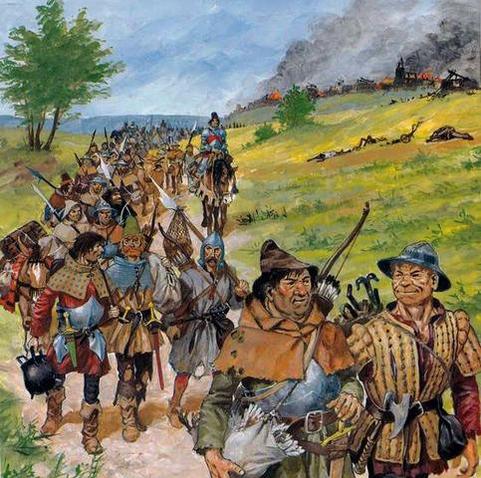
    Reasons for War in Premodern Societies

    Wars do not happen without reason, even if some reasons may seem stupid to modern readers. This is important, because objective of the war also determines the conduct of the war. War whose objective is completely conquering the enemy country will not be fought in the same way as a war whose sole objective is capturing slaves. No country, government or organization is evil simply to be evil – evil people are typically convinced they are doing good! – which means that a war has to have some purpose to achieve. Establishing believable reason for the conflict that drives the story can help in making both the world and the story more internally consistent and immersive.

    Scarcity of Resources

    Scarcity of resources is a common reason for war. This scarcity does not need to be something critical, though it may be. It could be lack of farming land, or merely attempt to control the lucrative trade route. In Stone Ages, groups of people that ran out of food would take their neighbour’s food. Even in Middle Ages, if one area suffered from bad climactic conditions, solution was often to just go and take neighbours’ food.

    Migration

    Whenever there is a mass migration, there is a war. Western Roman Empire was destroyed by mass immigration of barbarians, and Mexico lost Texas to mass (and planned) immigration of American settlers. Rome was capable of dealing with different ethnic groups normally – the Empire essentially allowed each group to live as usual, follow their own laws and gods, so long as they paid taxes and obeyed Imperial authorities. But settlement of migratory barbarians placed strain on the system, and while Rome did its best to integrate the newcomers, this proved impossible in the long run. It should be noted here that Western Empire dissolved despite the fact that barbarians generally remained rather loyal to the Emperor – at least on paper.

    (Note that this migration itself was caused by expansion of the Chinese Empire. Huns had been raiding China for a long time, until in 400 BC Chinese Emperor got tired of it and directed his generals to chase them away. They did so, which caused a chain reaction of westward migrations by barbarians – with Huns themselves showing up in the west in 400 AD).

    Loot and Plunder

    Of course, resources need not be scarce for people to want to take neighbour’s resources. In general, the more people have, the more they want. Vikings are a good example of a group whose primary goal was plunder: in fact, name “Viking” itself means simply “raider”. That being said, Vikings did settle elsewhere – see “Land Grab”. It is thus unsurprising that majority of medieval armies – with the exception of the Byzantine and Arab armies – were usually small.

    Of course, things could escalate. If a local raid (say, between counties) hit more than one county, then the local war could spread to the next level. And on occasion, this would go up the chain until it involved the entire kingdom.

    And this could easily come to place that war would feed itself. In order to defend against the Ottoman expansion as well as opposition from within the kingdom, Matthias Corvinus decided to form a standing mercenary army – first of such type in Europe. But this army was runiously expensive for the resources of the kingdom, and so he was forced to wage basically perpetual wars in order to pay for the army’s upkeep.

    In fact, out-of-job mercenaries tended to turn to looting and plunder, becoming in essence well-organized bandit gangs. Best way to deal with the problem was to hire them again and set them loose against one’s enemies.

    Slaves

    Slaves were another form of loot and plunder – and perhaps one of the earliest forms. Native African tribes used to wage perpetual warfare to enslave each other. This resulted in development of lucrative business when Europeans arrived, with tribes selling captured Africans to European and North American slavers. And while more developed societies such as the Roman Empire rarely waged wars solely for purpose of capturing slaves, slavery as part of motivation as war still should not be discounted.

    Land Grab

    As authority in feudal system was based on land ownership, taking more land was a big driver in expansion. Otto the First pretty much drove eastwards expansion of the Holy Roman Empire simply to gain more land for his nobles. More importantly, systems with primogeniture mean that all lands go to the eldest son. For younger sons then, the only way to get more land is to conquer it.

    Trade

    Trade is a major war maker. Trade powers could make war to force other countries to open ports and borders to their trade (famous examples are the Opium Wars). Other times, two countries might fight for control of a particular trade resource, or a trade route. Too many restrictions on trade can cause war as countries seek better economic positions, but too few restrictions also leads to greater probability of war as greater number of potential trade partners reduces bilateral dependance and thus potential cost of waging war.

    Geography

    Sometimes, a country or a group of people will be attacked because they are located on an important geographical location – see the point about trade routes above. This could also be an important defensive position (e.g. control over a mountain pass), or a potential threat to larger state’s territory their location makes them.

    Belief Systems

    Religion or political ideology can frequently be a major cause for war. This is most obvious with belief systems which claim to hold universal truths. Historically, monotheistic religions such as Judaism, Christianity and Islam had engaged in offensive warfare against unbelievers, either to wipe them out or to convert them to their own religion (Islam being the most obvious offender). Genghis Khan believed it was his destiny to conquer the world for his god, Tengri. In more modern times, secular belief systems which likewise claim to hold existential answers have also caused major wars – obvious examples being communism, nazism and fascism, but also liberalism.

    Even when religion or political ideology are not a factor however, cultural differences can still lead to a war. Different beliefs and ways of thinking can cause misunderstandings which may either slowly snowball or suddenly explode into open warfare.

    Historical Animosities

    Historical animosities are another reason. National mythology often shapes attitudes and even policies. One of major reasons why Hitler could start the Second World War was belief in Germany that country had been betrayed, and also exploited by the victors. And the main reason why ideologies such as Nazism and Fascism were able to spread throughout Europe was the fact that Soviet Union had spent period of 1917 to 1922 invading anybody it could reach (Estonia, Finland, Poland, Latvia, Lithuania, Armenia, Azerbaijan, Georgia, Ukraine) and remaining 17 years until 1939 it spent financing various Marxist (Bolshevik) uprisings, revolutionary movements and terrorist groups throughout Europe and wider.

    It is important however to understand historical, social and cultural factors which had shaped these animosities, and how they continue to do so in the present.

    Historical Claims

    Any self-respecting country that loses territory due to enemy invasions is not going to recognize the loss so long as any hope of recovering the territory remains. And this can cause wars. After Western Roman Empire got dissolved by mass immigration of barbarian tribes, Eastern Roman Empire was a natural successor to its claims. At first the East recognized situation on the ground as a de facto reality, but never de iure accepted the loss of the Western Empire. This eventually led to Emperor Justinian attempting to reconquer the West – something he may have succeeded in if not for the Justinianic Plague.

    Quest for Glory

    Sometimes, wars will be caused merely by people seeking glory. While such motive may seem ridiculous to modern mind, it should not be forgotten that premodern wars were nowhere as destructive as wars of modern times. Back in Antiquity and Middle Ages, war was often seen as a way to gain glory, be it for individual or for the group. In many cases, warfare was almost ritualized. Such honor wars were usually on a much smaller scale than economically or politically caused wars.

    Natural Disasters

    Volcanoes, hurricanes, but also droughts can leave entire areas uninhabitable. When this happens, a mass exodus ensues. And this exodus can easily take on nature of an invasion (in fact, any large migration is a de facto invasion).

    Corrupt Rulers

    Rulers or governments (including democratic ones!) can become corrupt and start considering only the interests of a single group or class of people. Once that happens, government may start a war for interests of a particular group or even an individual, or else a rift may open in the country that will lead to a civil war.

    Legal Confusion

    Wars could easily be caused by legal confusion. Especially feudal legal relations were often complex. For example, after William of Normandy conquered England, he became king of England. But since he was still duke of Normandy, he was technically a vassal to king of France. This was bound to cause trouble. Situation repeated itself later, with Henry V – then King of England – being also the Duke of Aquitaine, and thus bound to swear fealty to the French king.

    Succession Struggles

    Above would often lead to succession struggles as well. If one kingdom followed inheritance by primogentiure but other had patrilineal inheritance, then a king of one kingdom could easily consider himself to be a king of second kingdom as well, yet be denied. This was the cause of Hundred Years War between England and France, and also why Coloman managed to secure support of Slavonian nobility before attacking southern Croatia (which led to death of king Petar Svačić).

    In fact, various legal confusions related to succession were probably the most frequent cause of warfare between kingdoms.

    Power Struggles

    Barons always looked to restrict power of the monarch, while monarch sought to expand his own powers. While this resulted in something of an equilibrium which allowed greater freedoms, it also meant that king could begin a war simply to redirect barons’ attention elsewhere.

    In a feudal system power of the central government also tended to lapse over time. Lack of administration meant that monarch often had to show up in an area in person, with the court essentially travelling the kingdom in a manner of travelling circus. This presence was not always welcome because it was expensive, but expenses were also part of the point – as barons had to host the ruler, they would be too busy planning how to pay the enormous costs which came with the honor to think about rebelling. Further, because authority of the monarch was based on technically land grants, as monarch ran out of land so his authority weakened.

    Holy Roman Emperors later on had to wage what were essentially campaigns of conquest in Northern Italy in order to get crowned by the Pope – and then hurry back to Germany to fight inevitable coalition of rebel dukes which will have appeared by then.

    Alaric besieged Rome three times in early 5th century because he wanted to be recognized as magister militum by the Emperor there. While Emperor himself was basically powerless militarily by this time, legitimacy and authority gained by long rule of Rome in the West meant that barbarian leaders only had true royal legitimacy if the Roman Emperor recognized them. Visigoths eventually sacked Rome in 410 AD, but this was not the original goal.

    Combined Motives

    Of course, leaders and states may have more than one motive to start a war. Natural disaster may have led to scarcity of resources. Or perhaps scarcity of resources had made people living in an area warlike, and something happened – a disaster, an ambitious ruler or a new belief system – that made them turn their energies into outward conquest instead of previously typical internal squabbles. Alternatively, historical animosity may be what pushes two states into war over scarce resources, geography or different belief system. Whatever the case, combining motives will help wars feel more realistic, deeper and more immersive.

    Conclusions

    Wars in fantasy may erupt for any one or multiple of above reasons. But regardless of if it is a Dark Lord attempting to create a utopia by force, or a bunch of enterpreneurs doing business, nobody fights a war for no reason. And the reason behind the war will shape the way war is being fought. This will allow the author to create a compelling and immersive story that will keep readers engaged. Motives of war will also determine the conduct of war as well – an attacker whose motive is merely plunder will come, raid, rape, pillage and plunder, and leave. Attacker whose motive is conquest however will stay to try and besiege towns, resorting to raiding only if outright conquest is not possible (Mongols and Ottomans both did this).

    #cassusBelli #causes #medievalWarfare #premodernWarfare #reasons #war #warfare
    From ancient China to medieval Europe, the crossbow reshaped warfare. Cheap, deadly, and revolutionary, it armed common soldiers, inspired the repeating design, and survived until gunpowder finally ended its dominance.
    #Crossbow #AncientWeapons #HistoryShorts #China 🇨🇳 #TerracottaArmy #MedievalWarfare #WarHistory #AncientHistory #Storytelling #DidYouKnow #HistoryFacts #DocumentaryShort #WeirdHistory

    Long before assault rifles, there was the arquebus—and it changed everything.

    From knights to footmen, the battlefield would never be the same.

    https://brewminate.com/arquebus-long-guns-in-the-late-medieval-and-early-modern-eras/

    #Brewminate #Arquebus #GunpowderHistory #MedievalWarfare

    Arquebus: Long Guns in the Late Medieval and Early Modern Eras

    With volley firing, the arquebus went from being a support weapon to the primary focus of most early modern armies.

    Brewminate: A Bold Blend of News and Ideas
    The Battle of Courtrai (1302) - an episode of Bow and Blade https://youtu.be/nCk8Y3caJkk?feature=shared #medievalwarfare
    The Battle of Courtrai (1302)

    YouTube
    Step into 1066 and explore the battles, politics, and impact of the Norman Conquest! https://medievalstudies.thinkific.com/courses/norman-conquest #medievalwarfare
    The Battle of Hastings and the Norman Conquest

    Want to learn about the Battle of Hastings and the Norman Conquest of England? This self-paced course details the primary and secondary sources that are needed to begin your learning about the events of A.D. 1066.

    Medieval Studies Courses from Medievalists.net