 Angama
ロングCOVIDの刺激試験で性ホルモン応答が遅延。 基礎値は正常でも、制御が崩れている。
ロングコロナのホルモン異常は、中枢性内分泌障害の可能性。
https://mdpi.com/3680798 #mdpiijms
@IJMS_MDPI
より
ロングコロナのホルモン異常は、中枢性内分泌障害の可能性。
https://mdpi.com/3680798 #mdpiijms
@IJMS_MDPI
より

The common bean (Phaseolus vulgaris L.) is a globally cultivated leguminous crop. Fusarium wilt (FW), caused by Fusarium oxysporum f. sp. phaseoli (Fop), is a significant disease leading to substantial yield loss in common beans. Disease-resistant cultivars are recommended to counteract this. The objective of this investigation was to identify single nucleotide polymorphism (SNP) markers associated with FW resistance and to pinpoint potential resistant common bean accessions within a core collection, utilizing a panel of 157 accessions through the Genome-wide association study (GWAS) approach with TASSEL 5 and GAPIT 3. Phenotypes for Fop race 1 and race 4 were matched with genotypic data from 4740 SNPs of BARCBean6K_3 Infinium Bea Chips. After ranking the 157-accession panel and revealing 21 Fusarium wilt-resistant accessions, the GWAS pinpointed 16 SNPs on chromosomes Pv04, Pv05, Pv07, Pv8, and Pv09 linked to Fop race 1 resistance, 23 SNPs on chromosomes Pv03, Pv04, Pv05, Pv07, Pv09, Pv10, and Pv11 associated with Fop race 4 resistance, and 7 SNPs on chromosomes Pv04 and Pv09 correlated with both Fop race 1 and race 4 resistances. Furthermore, within a 30 kb flanking region of these associated SNPs, a total of 17 candidate genes were identified. Some of these genes were annotated as classical disease resistance protein/enzymes, including NB-ARC domain proteins, Leucine-rich repeat protein kinase family proteins, zinc finger family proteins, P-loopcontaining nucleoside triphosphate hydrolase superfamily, etc. Genomic prediction (GP) accuracy for Fop race resistances ranged from 0.26 to 0.55. This study advanced common bean genetic enhancement through marker-assisted selection (MAS) and genomic selection (GS) strategies, paving the way for improved Fop resistance.

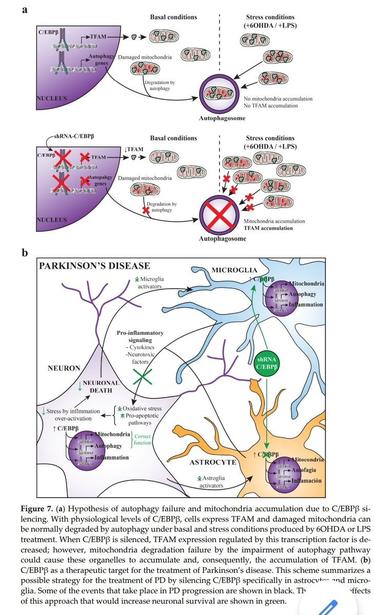

Parkinson’s disease (PD) is a neurodegenerative disorder that results from the degeneration of dopaminergic neurons in the substantia nigra pars compacta (SNpc). Since there are only symptomatic treatments available, new cellular and molecular targets involved in the onset and progression of this disease are needed to develop effective treatments. CCAAT/Enhancer Binding Protein β (C/EBPβ) transcription factor levels are altered in patients with a variety of neurodegenerative diseases, suggesting that it may be a good therapeutic target for the treatment of PD. A list of genes involved in PD that can be regulated by C/EBPβ was generated by the combination of genetic and in silico data, the mitochondrial transcription factor A (TFAM) being among them. In this paper, we observed that C/EBPβ overexpression increased TFAM promoter activity. However, downregulation of C/EBPβ in different PD/neuroinflammation cellular models produced an increase in TFAM levels, together with other mitochondrial markers. This led us to propose an accumulation of non-functional mitochondria possibly due to the alteration of their autophagic degradation in the absence of C/EBPβ. Then, we concluded that C/EBPβ is not only involved in harmful processes occurring in PD, such as inflammation, but is also implicated in mitochondrial function and autophagy in PD-like conditions.

Intestinal dysbiosis is a key feature in the pathogenesis of inflammatory bowel disease (IBD). Acyl-homoserine lactones (AHL) are bacterial quorum-sensing metabolites that may play a role in the changes in host cells-gut microbiota interaction observed during IBD. The objective of our study was to investigate the presence and expression of AHL synthases and receptor genes in the human gut ecosystem during IBD. We used an in silico approach, applied to the Inflammatory Bowel Disease Multi’omics Database comprising bacterial metagenomic and metatranscriptomic data from stools of patients with Crohn’s disease (CD) (n = 50), ulcerative colitis (UC) (n = 27) and non-IBD controls (n = 26). No known putative AHL synthase gene was identified; however, several putative luxR receptors were observed. Regarding the expression of these receptor genes, the luxR gene from Bacteroides dorei was under-expressed in IBD patients (p = 0.02) compared to non-IBD patients, especially in CD patients (p = 0.02). In the dysbiosis situation, one luxR receptor gene from Bacteroides fragilis appeared to be over-expressed (p = 0.04) compared to that of non-dysbiotic patients. Targeting LuxR receptors of bacterial quorum sensing might represent a new approach to modulate the gut microbiota in IBD.
 plgepts
 Jose A. Morales-García
 Marcelino Suzuki