Quote of the day, 25 November: Blessed Anne of Jesus

“You have entered an Order so holy and perfect, that by keeping its rules and constitutions faithfully, one will go directly from her deathbed to her home in heaven.”

Blessed Anne of Jesus

The powerful intercession of Anne of Jesus and Anne of St. Bartholomew were to work… prodigies near their holy relics. A spiritual daughter of Madame Louise of France—a Carmelite of St. Denis, Madame de Chamboran—imbibed the fire of divine charity and the strength of martyrdom.

Led to the scaffold several years later, she made her confession: “I am a child of the Catholic Church.” After these words, adorned with the blood of martyrdom, she went to join in heaven the daughter of St. Louis.

Animated with the same heroism, the Carmelites of Compiègne went to the scaffold singing hymns, and radiant as angels, they gathered the palm of martyrdom. Happy virgins! With their Sisters of St. Denis, they bequeathed to the Carmel of France an eternal title of glory: first among all the daughters of St. Teresa, they shed their blood for Jesus Christ.

And if, during the tortures of the Revolution, all the daughters of St. Teresa in France proved themselves angels of virtue before the world, one need not be astonished. Anne of Jesus and Anne of St. Bartholomew were interceding with God for this Carmel, which they have so deeply imbued with the spirit of the holy Foundress.

Marcel Bouix, S.J.

Preface, Autobiography of the Blessed Mother Anne of Saint Bartholomew

Anne of St. Bartholomew, M; Bouix, M 1917,  Autobiography of the Blessed Mother Anne of Saint Bartholomew, inseparable companion of Saint Teresa, and foundress of the Carmels of Pontoise, Tours and Antwerptranslated from the French by Michael, M A, H. S. Collins Printing Co., Saint Louis.

Featured image: This painting features a trio of foundresses: Anne of Jesus, Teresa of Avila, and Anne of St. Bartholomew. This image graces Stella Maris Church in Haifa, Israel. Image credit: Adobe Stock (Stock photo)

#blessedAnneOfJesus #blessedAnneOfStBartholomew2 #frenchRevolution #intercession #martyrsOfCompiegne

Quote of the day, 22 September: Saint Teresa of St. Augustine

You will never be able to take from our hearts our devotion to Louis XVI and to his august family. Your laws can never impinge upon that feeling: they cannot dominate the affections of our souls. God and God alone has the right to judge such things.

Saint Teresa of St. Augustine

The last one to climb the scaffold steps was in fact the prioress, Madame Lidoine herself who, presiding over the sacrifice to the very end, blessed each of her fifteen daughters as they fulfilled the community oblation she herself had proposed.

What Madame Lidoine had proposed, however, was never a “vow of martyrdom” as one reads in the fictional versions, but rather an “act of consecration” whereby each member of the community would join with the others in offering herself daily to God, soul, and body, in holocaust to restore peace to France and to her church.

This proposal, we now know, was made sometime between the expulsion from their monastery on September 14, 1792, and the November 27 following, on which date we have confirmation that the consecration was already an established part of the community’s daily life.

The community sacrifice was moreover presided over by Madame Lidoine, its one true mother and Compiègne’s great prioress, inspiring, animating, and transfiguring all by her mystical insights.

William Bush

Chapter 1, Martyrdom and France, literature and revolution

Note: Saint Teresa of St. Augustine, the prioress of the martyred Discalced Carmelite nuns of Compiègne, France, was born Marie-Madeleine-Claudine Lidoine in Paris, 22 September 1752. 

Bush, W 1999, To quell the terror: the mystery of the vocation of the sixteen Carmelites of Compiègne guillotined July 17, 1794, ICS Publications, Washington, D.C.

Featured image: Soprano Adrianne Pieczonka appears in the role of Madame Lidoine in the Canadian Opera production of Dialogues of the Carmelites (2013). Image credit Michael Cooper / Canadian Opera Company via Flickr (Some rights reserved)

#ActOfConsecration #history #MadameLidoine #MartyrsOfCompiègne #StTeresaOfStAugustine

17 July: Saint Teresa of St. Augustine Lidoine and Companions

July 17
SAINT TERESA OF SAINT AUGUSTINE LIDOINE AND COMPANIONS

Virgins and Martyrs

Memorial

As the French Revolution entered its worst days, sixteen Discalced Carmelites from the Monastery of the Incarnation in Compiègne offered their lives as a sacrifice to God, making reparation to him and imploring peace for the Church. On June 24th, 1794, they were arrested and thrown into prison. Their happiness and resignation were so evident that those around them were also encouraged to draw strength from God’s love. They were condemned to death for their fidelity to the Church and their religious life and for their devotion to the Sacred Hearts of Jesus and Mary. Singing hymns, and having renewed their vows before the superior, Teresa of St. Augustine, they were put to death in Paris on July 17th, 1794. They were beatified by Pope St. Pius X on May 13, 1906. Their equipollent canonization was decreed on December 18, 2024.

From the Common of Martyrs or the Common of Virgins, except the following:

Office of Readings

HYMN

Let Carmel echo joyfully
The dying hymns that soared above
When Compiègne so gladly gave
Its greatest witness to God’s love.

These virgin-martyrs gave their lives.
For sin’s atonement, like their Lord;
They died to bring a troubled Church
The peace of Christ as love’s reward.

May we like them serve Holy Church
And build it up in unity,
Until at last in heav’n’s pure light
We gaze on God the Trinity.

Our Queen and Mother, Carmel’s joy,
Look down with love on us who sing
The praise of those who died for love
Of Jesus Christ, your Son, our King.

Bless God the Father, source of love,
Bless God the Word, his only Son,
Bless God the Spirit, Dove of peace,
One God, while endless ages run.

L.M.
Fr. James Quinn, S.J.

The Second Reading

Ch. 12, 1-3

From the Way of Perfection of St. Teresa of Jesus

The life of a good religious and a close friend of God is a long martyrdom

It all seems very hard work, this business of perfection — and so it is: we are waging war on ourselves! But as soon as we get down to it God becomes so active in our souls and showers so many mercies on them that whatever has got to be done in this life seems insignificant. And as we nuns do so much already, giving up our freedom for love of God and subjecting it to someone else, what excuse have we got for holding back when it comes to interior mortification?

That is where the secret lies of making all the rest so much more meritorious and perfect, not to mention doing it more easily and peacefully. The way to acquire it, as I have said, is to persevere bit by bit in not doing our own will or fancy, even in tiny things, till the body has been mastered by the spirit.

Let me repeat that it is all — or nearly all — a matter of getting rid of self-interest and our preoccupation with our own comfort. If you have started serving God seriously, the least you can offer Him is your life! If you have given Him your will, what are you afraid of? If you are a real religious, a real ‘pray-er,’ and want to enjoy God’s favors, you obviously can’t afford to shy away from wanting to die for Him, and undergo martyrdom. Don’t you realize, sisters that the life of a good religious — a person who wants to be one of God’s really close friends — is one long martyrdom? I say ‘long’ because in comparison with those whose heads have been chopped off in a trice we can call it long, but all our lives are short, very short in some cases. And we don’t even know whether our own won’t be so short that it will come to an end an hour, or even a second, after we have made up our mind to serve God fully. That could happen.

We have just got to take no account of anything that will come to an end, least of all life, for we can’t count on a single day. If we remember that every hour might be our last, is there a single one of us who will feel inclined to shirk?

Well, there is nothing you can be more certain of, believe me! So we must train ourselves to thwart our own wills in every way; then, if you try hard, as I have said, though you won’t get there all of a sudden, you will gradually arrive, without realizing it, at the peak of perfection.

Responsory

R/. Rejoice that you share the sufferings of Christ, * for when His glory is revealed you will be filled with joy.
V/. Blessed are you when you are persecuted for Christ’s sake, * for when His glory is revealed you will be filled with joy.

Morning Prayer

Hymn

Voice of the Bridegroom: now is winter passing,
Rain falls no longer, gardens yield their fragrance,
Spring blooms appearing, trees resound with birdsong —
Rise, my beloved.

Go out to meet him, virgins all exulting,
See he approaches, crowns you for your nuptials —
Rapture and gladness, when he leads you homeward
Sharing his kingdom.

Love for the Bridegroom filled your whole horizon,
Making you fearless in the face of danger;
Like him, your Master, life itself you offered,
Sacrificed for him.

Joyfully faithful to your holy calling,
Nothing could daunt you, or your lamps extinguish;
Shining and glowing you would bear them to him
Through cloud and tempest.

11.11.11.5
Sr. Margarita of Jesus, O.C.D.

Canticle of Zechariah

Ant. Prepare your lamps, you wise virgins, for behold, the Bridegroom is coming: go out and meet Him.

Prayer

Lord God,
you called Saint Teresa of St. Augustine and her companions
to go on in the strength of the Holy Spirit
from the heights of Carmel to receive a martyr’s crown.
May our love too be so steadfast
that it will bring us
to the everlasting vision of your glory.

We ask this through our Lord Jesus Christ, your Son,
who lives and reigns with you and the Holy Spirit,
God, for ever and ever.

Evening Prayer

Canticle of Mary

Ant. You virgins of the Lord, who have endured the great ordeal, come and rejoice with God forever.

Plaque in Picpus Cemetery marking the two common graves where the martyrs are buried | Wikimedia Commons

Catholic Church 1993, Proper of the Liturgy of the Hours of the Order of the Brothers of the Blessed Virgin Mary of Mount Carmel and the Order of Discalced Carmelites (Rev. and augm.), Institutum Carmelitanum, Rome.

Featured image: This stained glass window depicting the Carmelite Martyrs of Compiègne was designed by stained glass artist Sister Margaret of the Mother of God, O.C.D. (Margaret Rope). It is one of her most famous windows in the chapel of the Carmel of Quidenham, England. Image credit: Discalced Carmelites

#LiturgyOfTheHours #MartyrsOfCompiègne #Memorial #optionalMemorial #StTeresaOfStAugustine

New Obligatory Memorial on 17 July

Following their canonization by Pope Francis on 18 December 2024, the memorial of St. Teresa of St. Augustine Lidoine and Companions, Virgins and Martyrs—the Martyrs of Compiègne—on 17 July changes from optional to obligatory.

When Mother Teresa of St. Augustine and her companions were beatified in 1906, their liturgical observance was assigned the rank of optional memorial. As canonized saints, their memorial is now obligatory for Discalced Carmelite friars, nuns, and seculars.

The canonization used an equipollent process, recognizing the longtime veneration of these women executed during the French Revolution. Their feast day remains 17 July.

Featured image: Memorial plaque for the sixteen Carmelites of Compiègne at Picpus Cemetery, Paris 12th arrondissement. Image credit: © Mu (CC BY-SA 3.0) via Wikimedia Commons.

#canonization #MartyrsOfCompiègne #ObligatoryMemorial #StTeresaOfStAugustine

Quote of the day, 25 June: Martyrs of Compiègne

In June 1794, the Reign of Terror was at its height. The cult of the Supreme Being had replaced the worship of the God of Jesus Christ. On June 10, a new law abolished the right of the accused to be interrogated before the court or defended by a lawyer. The verdict was now either acquittal—or death.

On the evening of June 21, the Carmelites, returning to Compiègne, informed Saint Teresa of St. Augustine (Lidoine) of a search by the Committee of Surveillance. The official record stated:

“Considering that a denunciation already exists in our registers; that these women still live together in community; that they remain subject to the fanatical rule of their cloister; that there may be a criminal correspondence between them and the fanatics in Paris; that their gatherings may be directed by fanaticism…”

Thus, the search resumed the next day.

On June 23, the Carmelites were arrested and taken to the former Visitation convent, which had been converted into a prison. In the adjoining room, English Benedictines from Cambrai—considered foreigners and suspects—had been confined since October 1793.

On June 25, the zealous Committee of Surveillance forwarded to Paris the letters and documents seized during the search. On July 12, the Committee of General Security ordered the Carmelites to be brought before the Revolutionary Tribunal. The community was to be transferred to the Conciergerie.

Stéphane-Marie Morgan, o.c.d.

Introduction

Morgain, S 2023, Les Carmélites Martyres De Compiègne : Pour La Paix De L’église Et De L’état, Nouvelle édition revue et augmentée, Éditions du Carmel, Toulouse.

Translation from the French text is the blogger’s own work product and may not be reproduced without permission.

Featured image: A vaulted stone ceiling inside the Conciergerie in Paris, once used as a prison during the French Revolution. Image credit: beatrix kido, Adobe Stock (Asset ID#143369916)

⬦ Reflection Question ⬦
When you see faithfulness condemned as fanaticism, how do you stay rooted in Christ?
Join the conversation in the comments.

#FrenchRevolution #MartyrsOfCompiègne #prison #ReignOfTerror #StTeresaOfStAugustine

Marie du jour, 27 May: Holy Martyrs of Compiègne

Before mental prayer

My God, I offer unto Thee the prayer which I am now about to make, and I unite it to that which my Saviour ceaseth not to offer Thee for me in the Most Blessed Sacrament of the Altar. I beseech Thee to grant me the grace to make it in a manner worthy of Thee.

After mental prayer

My God, I give Thee thanks for the grace which Thou hast deigned to bestow upon me, in permitting me to abide in Thy holy presence. I implore Thy pardon, O my God, for all the distractions into which I have suffered myself to fall during this time of prayer. I offer unto Thee the resolutions which, by Thy mercy, Thou hast inspired within me. I entreat Thee to grant me the graces needful for their fulfillment, through the merits of our Lord Jesus Christ, and by the intercession of the Most Holy Virgin, of Thy holy angels, and of all the saints.

Saint Teresa of St. Augustine and Companions

Prayers written on the inside cover of the Psalter of the Virgin

Note: These prayers appear to have been handwritten on the inside cover of a printed Psalter of the Virgin, possibly used by the Carmelite Martyrs of Compiègne. These devotional books, often attributed to St. Bonaventure and widely printed in the 17th–18th centuries, offered a Marian framework for mental prayer and spiritual offering. According to Father Stéphane-Marie, o.c.d., the volume is preserved today in the Archives of the Carmelite Monastery of Le Havre (Archives du Monastère des Carmélites du Havre), where these prayers were found on the pages de garde.

Morgain, S 2023, Les Carmélites Martyres De Compiègne : Pour La Paix De L’église Et De L’état, Nouvelle édition revue et augmentée, Éditions du Carmel, Toulouse.

Translation from the French text is the blogger’s own work product and may not be reproduced without permission.

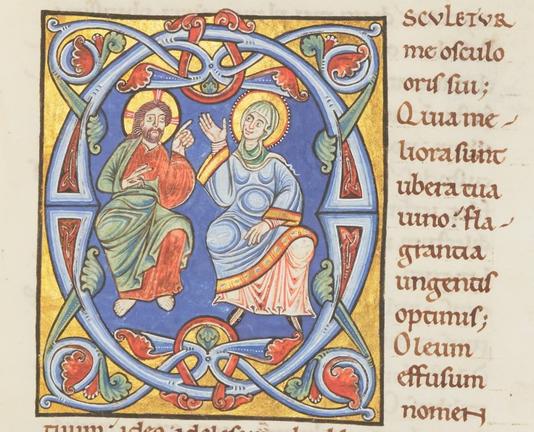
Featured image: Christ in dialogue with the Virgin Mary, illumination from the Chartres Bible, Chartres, 1146–1155. Bibliothèque nationale de France, Latin 116, fol. 12r. (Public domain). You can learn more from the British Library’s Medieval Manuscripts Blog.

⬦ Reflection Question ⬦
Which prayers do I habitually offer before and after my time of mental prayer? Or, what prayers might help me to begin practicing Carmelite mental prayer?
Join the conversation in the comments.

#MartyrsOfCompiègne #mentalPrayer #MotherOfGod #offering #StTeresaOfStAugustine #thanksgiving #vocalPrayer

Quote of the day, 27 May: St. Elizabeth of the Trinity

Throughout her stay in Carmel, Elizabeth lived with the very real threat of being expelled from France, along with her entire community. The liturgical calendar of Carmel, composed in 1905 (for the year 1906) mentions that, out of the 117 French Carmels, 38 actually were expelled.

On 1 July 1901, one month before Elizabeth entered Carmel, the Waldeck-Rousseau government promulgated the law concerning associations, which was aimed primarily at religious congregations. They had to ask for legal authorization before October 3, present their financial balance sheet, and an inventory of their goods.

For decades, the Catholic Church in France had been facing a headwind. The painful memory of the French Revolution and its martyrs a century earlier was still alive and, in the minds of young Christian idealists like Elizabeth, the idea of martyrdom could resurface from time to time, following the example of the Carmelites of Compiègne who were guillotined. She entered Carmel with this readiness for martyrdom, as she had declared to Marguerite Gollot when they were postulants “outside the walls”: “So, what happiness to go together to martyrdom!… I can hardly think of it… it’s too good!” (Letter 57).

Conrad De Meester, O.C.D.

Chapter 22, Partir en exil à l’étranger?

Note: The Mass and rite of beatification of Mother Teresa of St. Augustine and the Martyrs of Compiègne took place in Rome on Sunday, 27 May 1906. Later that year, St. Elizabeth of the Trinity attended a triduum celebrated in mid-October by the Carmel of Dijon in their honor. Their canonization—formally approved by Pope Francis on 18 December 2024—was the final one he authorized before his death.

de Meester, C 2017, Rien moins que Dieu: sainte Elisabeth de la Trinité, Presses de la Renaissance, Paris.

Translation from the French text is the blogger’s own work product and may not be reproduced without permission.

⬦ Reflection Question ⬦
How am I inspired by the Holy Martyrs of Compiègne in my own faith and witness?
Join the conversation in the comments.

#anniversary #beatification #CarmelOfDijon #history #inspiration #martyrdom #MartyrsOfCompiègne #StElizabethOfTheTrinity

Marie du jour, 14 May: St. Teresa of St. Augustine

O loving Queen, Mother of might most holy,
O deign to place us all within thy breast!
For in thy power, thy children all, though lowly,
Do set their hope, trusting in thy behest.

Saint Teresa of St. Augustine

Excerpt from a Christmas carol

Note: Saint Teresa of St. Augustine, the prioress of the martyred Discalced Carmelite nuns of Compiègne, was born Marie Madeleine Claudine Lidoine in Paris on 22 September 1752. When she presented herself as a candidate for formation in the Carmel of Compiègne, she lacked the necessary dowry that postulants were expected to provide to support the community’s needs.

At that time, the prioress of the Carmel of Saint-Denis was Venerable Mother Teresa of St. Augustine—lovingly remembered by her baptismal name, Madame Louise—the daughter of King Louis XV. Upon learning of the young candidate’s financial difficulty, Madame Louise generously supplied the remaining funds needed for Madame Lidoine’s admission.

In gratitude for her benefactor’s generosity, the novice took the same religious name: Teresa of St. Augustine. That generosity would be repaid in sanctity. As prioress of Compiègne, Mother Teresa of St. Augustine led her sisters joyfully and courageously to the scaffold in revolutionary Paris on 17 July 1794. On 18 December 2024, the Church declared them Saints by equipollent canonization.

Virgin and Child, Anthony van Dyck (1620)

Bush, W. 1999, To quell the terror: the mystery of the vocation of the sixteen Carmelites of Compiègne guillotined July 17, 1794, ICS Publications, Washington, D.C.

Featured image: Virgin and Child by Anthony van Dyck (Flemish, 1599–1641), oil on wood, ca. 1620. Image credit: Metropolitan Museum of Art, New York. (Public domain)

⬦ Reflection Question ⬦
How can I entrust my hopes to Mary, asking her to hold me close within her heart?
Join the conversation in the comments.

#dowry #hope #MadameLouise #MartyrsOfCompiègne #MotherOfGod #QueenAndBeautyOfCarmel #StTeresaOfStAugustine #trust

Quote of the day, 7 May: Pope Pius VI

As revolutionary forces targeted France’s monasteries, Pope Pius VI turned to faithful bishops with a plea: defend the nuns. Among them were the Discalced Carmelites of Compiègne, who would one day offer their lives rather than renounce their vows. And in their hour of trial, the voice of Peter answered their faith with fatherly courage.

To what we have already said regarding the vows of religious, we must now add the inhuman decree pronounced against the consecrated virgins—that they be removed from their cloisters, as Luther did, who (to use the words of Adrian VI) “did not fear to profane those vessels consecrated to God, to drag out of their monasteries the virgins dedicated to Jesus Christ who had professed the monastic life, and to return them to the world—or rather, to the devil, whom they had previously renounced.”

And yet the nuns—who are in fact the most illustrious part of Christ’s flock—have often, by their prayers, averted immense calamities from cities. Saint Gregory the Great recalls that this happened in his time in Rome: “If there were no consecrated virgins among us, not one of us would have survived for so many years in this place amidst the swords of the Lombards.” And Pius VI, speaking of his own nuns in Bologna, testifies that “this city, long oppressed by many misfortunes, could not have endured had divine wrath not been in some measure appeased by the continual and fervent prayers of our religious women.”

Meanwhile, the nuns of France—now in the deepest desolation—move our hearts with the tenderest compassion. Many of them, from across the provinces, have written to us of their anguish: they are being prevented from persevering in their institutes and from observing their solemn vows. Yet they have also declared to us their firm and unwavering resolve: they are determined to endure every hardship rather than abandon their vocation.

Therefore, beloved sons and venerable brothers, we cannot help but commend to you, in the fullest manner, their steadfastness and courage. We earnestly entreat you to encourage them with your exhortations, and to offer them—so far as lies within your power—every possible assistance.

Pope Pius VI

Quod Aliquantum, 10 March 1791

Pius VI 1791, Breve Quod Aliquantum, Rome, 10 March. Addressed to Dominique Cardinal de La Rochefoucauld, Archbishop of Rouen, and to Archbishop Jean-de-Dieu-Raymond de Boisgelin de Cucé of Aix, along with other bishops who had signed the Exposition on the Principles of the Civil Constitution of the Clergy. Italian text available at vatican.va.

Translation from the Italian text is the blogger’s own work product and may not be reproduced without permission.

Featured image: This detail from a stained glass window depicting the Carmelite Martyrs of Compiègne was designed by stained glass artist Sister Margaret of the Mother of God, O.C.D. (Margaret Rope). It is one of her most famous windows in the chapel of the Carmel of Quidenham, England. Image credit: Discalced Carmelites

⬦ Reflection Question ⬦
What does it mean for me to stand with those who remain faithful at great personal cost?
Join the conversation in the comments.

#FrenchRevolution #MartyrsOfCompiègne #nuns #perseverance #PopePiusVI #repression #StTeresaOfStAugustine #vows

Breve Quod aliquantum (Roma, 10 marzo 1791)

Il dramma sofferto dalla Chiesa Cattolica di fronte ai provvedimenti adottati negli anni della Rivoluzione francese rivive in questo Breve di Pio VI, che analizza in particolare il testo e le conseguenze della Costituzione Civile del Clero Gallicano decretata dall’Assemblea Nazionale il 12 luglio 1790. Il documento, pubblicato nello stesso 1791 dalla Tipografia della Camera Apostolica, è regolarmente definito Breve, in quanto emesso con la caratterizzante espressione sub anulo piscatoris. Nell’edizione pubblicata nel 1871 da Propaganda Fide (Pii VI Acta quibus Ecclesiae Catholicae calamitatibus in Gallia consultum est, tomo I, p. 62) esso è definito Epistola decretalis

Quote of the day, 22 January: Blessed Teresa of Guadalajara

Blessed Teresa of the Child Jesus and St. John of the Cross: Her desires for martyrdom

Let us begin by recounting the episode that happened to Sister Teresa when the parish priest in her hometown of Mochales headed a letter to her in (he thought) a joking and witty way, and wrote, “Viva la Republica!” (“Long live the Republic!”).

Sister Teresa, with her characteristic ardor, responded:

“To your ‘Viva la Republica!’ I answer with a ‘Viva Cristo Rey!’ (“Long live Christ the King!”), and I hope someday to be able to shout it or say it before a firing squad!”

Her desire was to turn into a prophecy, and the prophecy did indeed have its bloody fulfillment. The letter to her friend, Sister Maria of Saint Teresa… was indeed headed with the words “Viva Cristo Rey!” Other letters had this heading too. It seems that this was a dress rehearsal, in ink, of the final cry of her life, which would be empurpled with her generous blood.

Concerning Sister Teresa, always the intrepid one, another nun commented:

“I remember that she used to voice her desire for martyrdom; she and I used to vie for the honor of breaking through the turn and going to save the Blessed Sacrament, if the Reds were to enter the monastery.”

During one of the last meals that the community ate in the monastery, Sister Teresa said with great enthusiasm, “We must eat a lot in order to have plenty of blood to shed for Cristo Rey.”

Throughout her religious life, Sister Teresa manifested her desire for martyrdom many times. She aroused her ardor by reading of the blessed fight waged by the Catholics in Mexico during the “Cristero” rebellion. On extraordinary recreation days, when the younger sisters would present performances of a spiritual nature, she loved to act out scenes of the Mexican martyrs, who died with the cry, “Viva Cristo Rey!” Here we see another rehearsal of what awaited her.

It is not surprising that we find a holy card of the Martyrs of Compiègne among the mementos of Sister Teresa.

José Vicente Rodríguez, o.c.d.

Chapter 5, Martyrdom

Blessed Teresa of the Child Jesus and St. John of the Cross
Image credit: Discalced Carmelites

Rodriguez, J 2016, The Dialogues of the Carmelites of Guadalajara: The Story of Three Martyred Carmelite Nuns of the Spanish Civil War, translated by the Carmel of St. Joseph, Carmelite International Publishing House, Trivandrum.

Featured image: The Blessed Martyrs of the Carmel of Guadalajara, Spain are depicted in this painting. Image credit: Discalced Carmelites

#BlessedMartyrsOfGuadalajara #BlessedTeresaOfTheChildJesusAndOfStJohnOfTheCross #holyCard #lastWords #martyrdom #MartyrsOfCompiègne #practice #VivaCristoRey