2026-05-13 00:00:00 UTC (Delta: 24 hours)

WHERE IS 2025-010D?
- Discarded SpaceX Falcon 9 upper stage on lunar intercept
- Geocentric speed: 0.84 km/s (-0.05 km/s)
- Lunar impact in: 84 days

⚪ Relative to Moon
- Distance: 823,136.53 km (+13,419.87 km)
- Lunar distance: 2.14 LD (+0.03 LD)
- Light travel time: 2.75 s (+0.04 s)

🌎 Relative to Earth
- Distance: 477,740.57 km (+23,674.77 km)
- Light travel time: 1.59 s (+0.08 s)

#SpaceX #Falcon9 #LunarImpact #Object2025010D #SpaceDebris

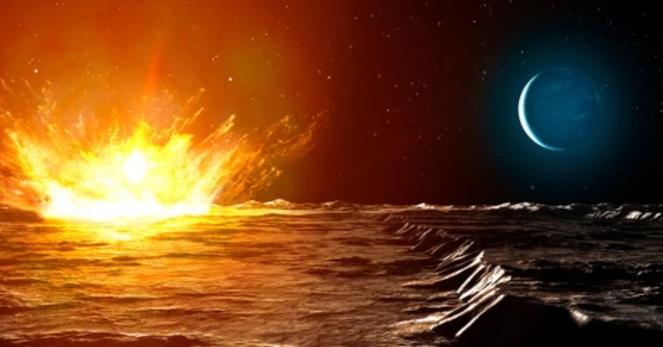
Lunar Impact Flashes NASA Artemis

NASA의 Artemis 2 임무 중 우주비행사들이 달 표면에서 발생하는 유성 충돌로 인한 순간적인 빛의 섬광을 직접 관측했다. 이 관측은 달의 충돌 빈도, 에너지 방출, 분화구 형성 과정을 이해하는 데 중요한 실시간 데이터를 제공하며, 특히 달의 지구 반대편에서 이루어진 관측이라는 점에서 의미가 크다. 지상 시민 과학자들과의 협업을 통해 관측 데이터의 신뢰성을 높였고, 이러한 연구는 미래 달 기지 건설 시 미세운석 충돌 위험 평가와 방호 설계에 활용될 전망이다. Artemis 임무는 앞으로도 달 충돌 활동 모니터링과 탐사 전략 수립에 핵심적인 역할을 할 것이다.

https://nbsla.ca/lunar-impact-flashes-nasa-artemis/

#nasa #artemis #lunarimpact #moonexploration #citizenscience

Lunar Impact Flashes NASA Artemis: How Artemis 2 Astronauts Witnessed Hidden Meteoroid Explosions On The Moon

The lunar impact flashes NASA Artemis mission has opened a new chapter in lunar exploration, giving scientists rare real-time evidence of meteoroid impacts on

nbsla.ca

Yacy (#decentralized search engine) can view a saved copy of a webpage anonymously, without even being online. Using the parser option, after crawling (which does require a previous internet connection), you can later see the text of the page, without actually visiting the website! It could also be crawled by a peer and not by your machine.

In this example, I am reading about those flashes of light on the moon.

#Yacy #moon #lunarimpact #lunarflash #privacy

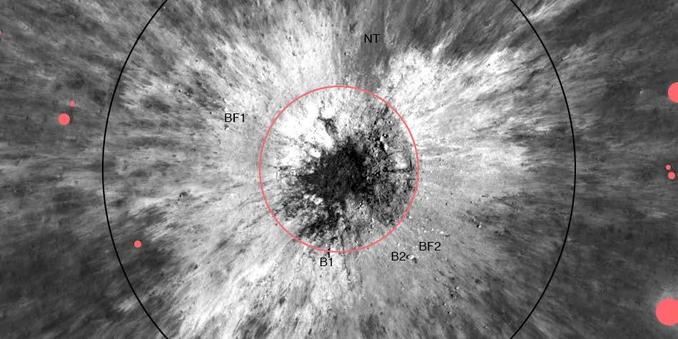
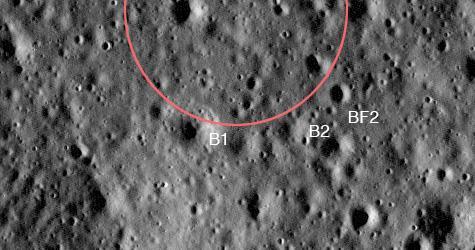
Apparently there's a new 225-meter #crater on the #Moon (as of spring 2024).
Reported at #LPSC by a team from #IntuitiveMachines based on #LRO imagery.
"a crater of this diameter should form every 139 years"
https://www.hou.usra.edu/meetings/lpsc2026/pdf/1896.pdf
#LunarImpact

Weekly Update from the Open Journal of Astrophysics – 20/09/2025

It’s Saturday again, so it’s time for a summary of the week’s new papers at the Open Journal of Astrophysics. Since the last update we have published two new papers, which brings the number in Volume 8 (2025) up to 136, and the total so far published by OJAp up to 371.

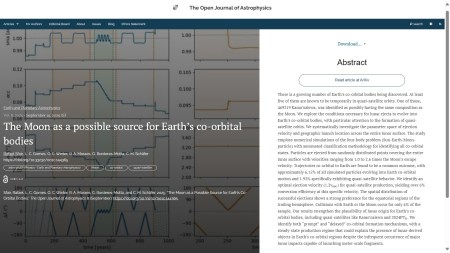
The first paper to report this week is “The Moon as a possible source for Earth’s co-orbital bodies” by Rafael Sfair, L. C. Gomes, O. C. Winter & R. A. Moraes (São Paulo State University, Brazil), G. Borderes-Motta (Astronomical Institute of the Czech Academy of Sciences, Czech Republic) and C. M. Schäfer (Universität Tübingen, Germany). This paper was published on Monday 15th September, in the folder Earth and Planetary Astrophysics, and it presents a numerical exploration of the ejection velocities and launch locations necessary for lunar ejecta to evolve into Earth’s co-orbital bodies.

The overlay is here:


You can make this larger by clicking on it.  The officially accepted version of this paper can be found on the arXiv here.

The second paper this week, published on Friday 19th September in the folder Solar and Stellar Astrophysics, is  “Jet-Driven Formation of Bipolar Rings in Planetary Nebulae: Numerical Simulations Inspired by NGC 1514” by Muhammad Akashi, Ealeal Bear, and Noam Soker (Technion, Haifa, Israel). This paper presents evidence from numerical simulations notion that jets play a substantial role in shaping planetary nebulae (PNe).

The corresponding overlay is here:


You can find the officially accepted version on arXiv here.

#arXiv250509066v2 #arXiv250723670v2 #CoOrbitalBodies #DiamondOpenAccess #EarthAndPlanetaryAstrophysics #jets #LunarImpact #OpenJournalOfAstrophysics #planetaryNebulae #SolarAndStellarAstrophysics #TheOpenJournalOfAstrophysics

Un astéroïde de ~60 m a 4 % de chances de frapper la Lune en 2032, projetant des débris qui pourraient menacer satellites 🚀
https://bulletindescommunes.net/les-repercussions-inattendues-de-limpact-de-lasteroide-2024-yr4-avec-la-lune/
#Space #Astrophysics #LunarImpact #SatelliteSafety #2024YR4
Les répercussions inattendues de l'impact de l'astéroïde 2024 YR4 avec la Lune

Découvrez les dernières informations sur l'astéroïde 2024 YR4 et son impact potentiel sur la Lune suite aux estimations de la NASA.

Bulletin des Communes
Moon Strike Could Trigger Meteors

This is a follow-up to our earlier post about asteroid 2024 YR4, a near-Earth object that drew international attention for its initially uncertain trajectory. While earlier projections ruled out any…

The Broad Lens