 The Community Edition
KHAN PHADY’S MUAY THAI
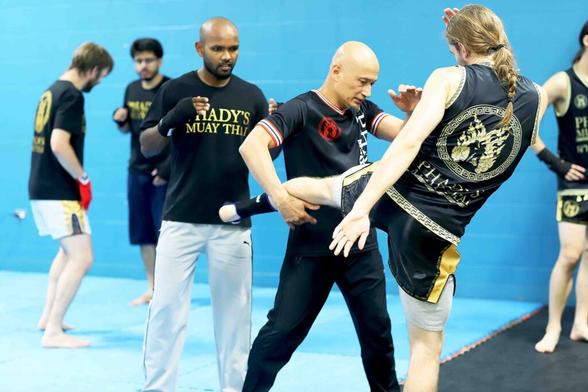
In the 1980s, faced with a lack of Muay Thai in the region, Khan Phady founded Phady’s Muay Thai. The gym is one of the earliest Muay Thai gyms in Canada and opened in Cambridge in 1987.
“There was Western kickboxing, Kung Fu, Karate and Taekwondo. At that time, that was it. And so I joined a kickboxing club…it’s not the same,” Phady said.
“I decided…I want to start up something.”
Phady was born in Vientiane, Laos while a communist revolution was underway. In 1974, he migrated to Thailand with his family as a refugee and in 1980, the Phady family made their way to Canada.
Phady’s father, Thep Phady, introduced him and his brothers to Muay Thai. Thep Phady was the owner of a construction company, who initially forayed into Muay Thai as a means to maintain his health and went on to own two stadiums in Laos. Thep Phady went on to inspire all of his children to embrace Muay Thai and the Phady family has been practicing the art for four generations.
“So my dad started it, and he just liked fighting, and he got us into it…dads always take you where [they want] to go and we would follow,” he said.
Although the gym faced some bureaucratic difficulties in the earlier years, Phady and his team navigated the system and founded the Canadian Amateur Muay Thai Association in 2003 and the World Amateur Muay Thai Association Canada in 2009.
Lukman Patel, one of the head coaches at Phady’s Muay Thai, has been surrounded by the martial art since he was a child. He started learning Muay Thai as a toddler.
Muay Thai originates from Muay Boran, an older and more brutal art taught in the Kingdom of Siam. As such, other countries, such as Laos and Cambodia, have nearly identical boxing styles. Patel said he appreciates the warrior spirit of Muay Thai, as well as the focus on community, fitness and goal-setting.
“There [are] a lot of people that are very, very shy, and this is something that gives them that confidence in themselves…it gives them a sense of being involved in something as well, too, so they feel included now,” he said. “All sports are kind of like that, right?”
Phady said Muay Thai is not about anger and conflict—respect, sportsmanship and camaraderie are major aspects.
“If you have anger problems, try to go up there and fight, it doesn’t work. You have to control yourself. It’s sports. When you lose, show respect,” he said. “You win the fight, don’t override your opponent too much, because…he’s helping you win that fight.”
Both Phady and Patel recognize the substantial cultural aspects of martial arts. For example, the Wai Kru is an interpretive dance done by fighters before a fight that acknowledges their fighting heritage, teachers and community.
“It’s tradition, culture; and it brings us together. When we’re done fighting, no matter how hard we hit each other, at the end, we apologize to each other,” Phady said. “That’s what I love about Muay Thai. It shows not just about fighting…it doesn’t create hate.”
Phady is supported by a community—his family, older students, volunteers and other members of the community. The goal is to always improve, he said. For example, as someone who has run over 150 shows, Phady strives to help others run shows as well.
“I have a lot of student who help and friends and connection is very important…All these people helping me, like before they’re not sure it’s gonna happen,” he said.
“I don’t mind sharing my knowledge. That’s what it’s about. You build a community.
If I die one day, somebody’s gonna be able to run better show than mine. And I want to see better show than [mine], not just [mine],” Phady said.
Now, Muay Thai is gaining recognition worldwide and there is a growing possibility of it being included in the Olympics. Patel said Muay Thai has grown even in Canada, with many
of Phady’s previous students opening their own gyms or becoming professional fighters and traveling to Thailand.
“We want to focus on bringing them back here to Canada, getting them working here so they can represent Canada on an international level at the World Olympics,” Patel said.
Phady said he hopes to continue growing the Muay Thai community in Canada and in the region. Eventually, he hopes to create a stadium for Muay Thai in Cambridge.
“What I want to do for City of Cambridge is to have our own stadium here…because Cambridge is a muay thai city, because we started here,” Phady said.
“That’s my dream,” he said.
For more information, visit phadysmuaythai.ca.
#boxingStyles #Cambridge #canadianAmateurMuayThaiAssociation #CityOfCambridge #communistRevolution #HarleenKaurDhillon #immigrant #karate #khanPhady #kingdomOfSiam #kungFu #localGym #localSports #martialArts #muayThai #Olympics #phadysmuaythai #Refugees #siam #taekwondo #thailand #thepPhady #vientiane #worldAmateurMuayThaiAssociationCanada