 Eureka Jeans
1940s Lee Riders (7 and final)
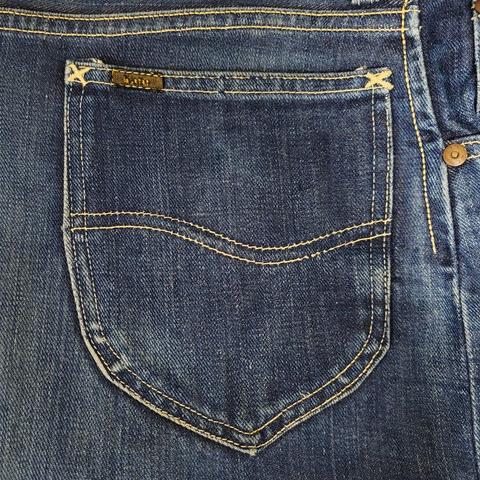
Finally, I'll take a closer look at the back pockets. Here it is not so much the sewing that is sloppy, but rather the folding of the pockets. I assume these were hand-folded as they were being sewn, without ironing.
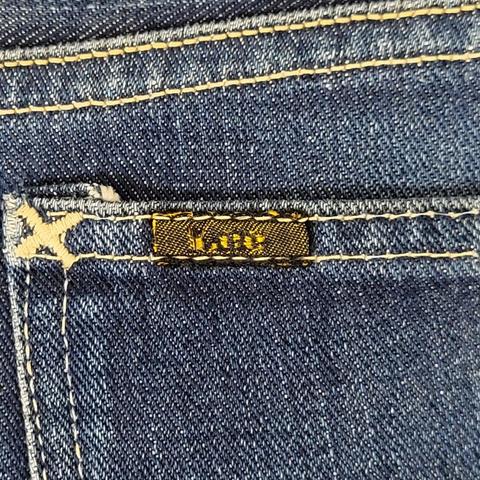
The tab on the right pocket is the old type without the "R" trademark. It is so heavily faded that "Lee" is still barely legible.
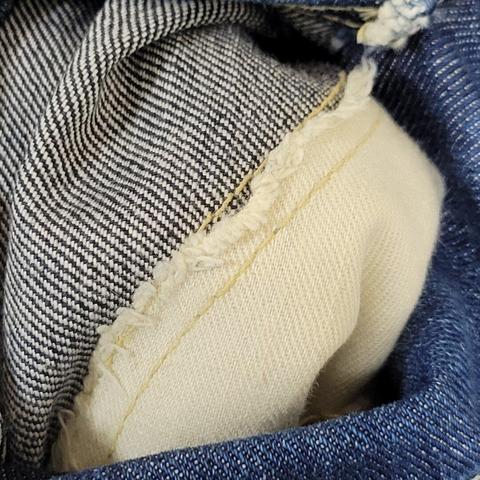
The pockets are reinforced with the same cloth as that used for the front pocket bags, and they feature the "lazy S" stitch design sewn with a double-needle lockstitch machine. One thing I like a lot about old Lee jeans is that the stitch design on the back pockets actually had a purpose, namely to hold the pocket reinforcement in place, while the Levi's arcuate stitch design was purely decorative. Of course, in the later Lee 200 model the pocket reinforcement was abolished, and still later the lazy S stitch was sewn with a double-needle chainstitch machine (which is more efficient for mass production as the bobbin doesn't need to be changed all the time, and was possible because of the lazy nature of the design, while it wouldn't be possible with the Levi's arcuate design, but that's a whole different story...)
The left back pocket has a union ticket in it, which was sewn on first, and then the pocket was sewn on continuously in the same motion with the same machine.
I could go on with more details, but I think this covers most of what I find really special about these Lee 101 Riders jeans.
I'll take a bit of a break now, but I'll do this again once in a while with some other garments in my little collection. Next time I'll probably introduce a pair of 1950s JC Penney's Foremost jeans that I bought new old stock about 20 years ago -- another real favorite of mine and a great source of inspiration for Eureka jeans.
#vintagedenim #vintagejeans #realvintage #pocket #backpocket #reinforcedpocket #unionticket #tab #lee #lee101 #leeriders #eurekajeans
Finally, I'll take a closer look at the back pockets. Here it is not so much the sewing that is sloppy, but rather the folding of the pockets. I assume these were hand-folded as they were being sewn, without ironing.
The tab on the right pocket is the old type without the "R" trademark. It is so heavily faded that "Lee" is still barely legible.
The pockets are reinforced with the same cloth as that used for the front pocket bags, and they feature the "lazy S" stitch design sewn with a double-needle lockstitch machine. One thing I like a lot about old Lee jeans is that the stitch design on the back pockets actually had a purpose, namely to hold the pocket reinforcement in place, while the Levi's arcuate stitch design was purely decorative. Of course, in the later Lee 200 model the pocket reinforcement was abolished, and still later the lazy S stitch was sewn with a double-needle chainstitch machine (which is more efficient for mass production as the bobbin doesn't need to be changed all the time, and was possible because of the lazy nature of the design, while it wouldn't be possible with the Levi's arcuate design, but that's a whole different story...)
The left back pocket has a union ticket in it, which was sewn on first, and then the pocket was sewn on continuously in the same motion with the same machine.
I could go on with more details, but I think this covers most of what I find really special about these Lee 101 Riders jeans.
I'll take a bit of a break now, but I'll do this again once in a while with some other garments in my little collection. Next time I'll probably introduce a pair of 1950s JC Penney's Foremost jeans that I bought new old stock about 20 years ago -- another real favorite of mine and a great source of inspiration for Eureka jeans.
#vintagedenim #vintagejeans #realvintage #pocket #backpocket #reinforcedpocket #unionticket #tab #lee #lee101 #leeriders #eurekajeans