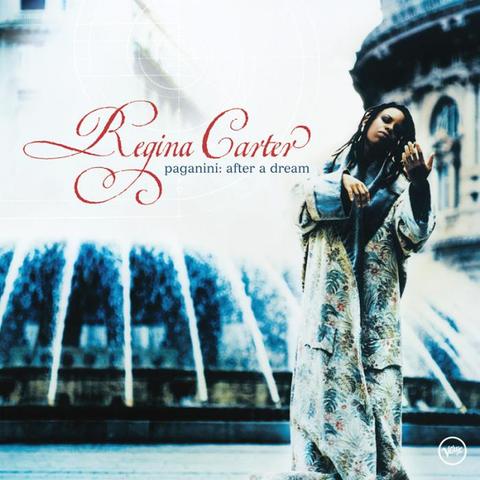
Regina Carter Plays “Pavane”

Listen to this track by classically-trained violinist and musical boundary crosser Regina Carter. It’s “Pavane”, a beloved and deeply melancholic piece by French composer Gabriel Urbain Fauré. Carter’s rendition appears on her 2003 record, Paganini: After a Dream on the legendary jazz label Verve. Trading as it does on improvisation within the confines of a timeless melody, the jazz label certainly applies. But this piece is one that finds her embracing her roots in the world of European classical music as well.

Fauré composed the piece in 1887, written originally for piano but then rearranged and popularized for full orchestra and chorus. The piece is named after a tradition associated with a processional dance that originated from 16th Century Spain, inspiring a listener’s imagination to entertain romantic images of another age. Updated here in a jazz format and with subtle bossa nova flourishes, Regina Carter’s version is appropriately evocative in a similar way even as her arrangement proves the melody’s sturdiness for a jazz ensemble and strings. Carter’s career seemed to be fully engaged in an exchange between present and the distant past, invited into classical traditions in a way that most American jazz musicians, and musicians in general, are not.

At the end of 2001 and post 9/11, Carter played a concert in Genoa. On that occasion, the appearance was notable not only for her virtuoso skills as a violinist. It was the specific instrument she was playing that helped to make the appearance all the more special. The violin in question was Il Cannone Guarnerius, made in 1743 by Italian luthier Giuseppe Bartolomeo Guarneri. Violin virtuoso and famous one-time Genoa resident Niccolò Paganini who came to own the instrument called it “my cannon violin” due to the power and resonance it provided.

Receiving it as a gift from a generous benefactor, Paganini would play it for the rest of his life. In 1840, the year of his death, the instrument was bequeathed to the city of Genoa where Regina Carter would appear on stage with it 161 years later.

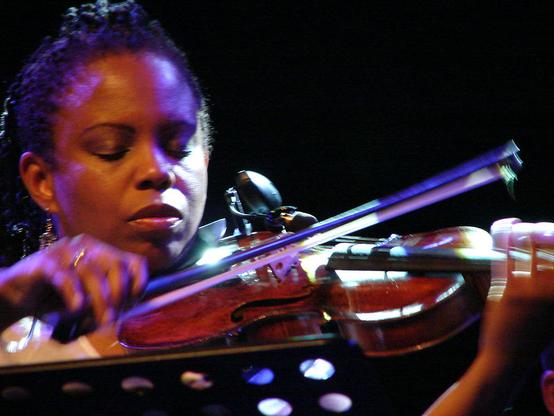
Regina Carter in 2006 in performance with her quintet at the North Sea Jazz Festival.
image: Bob Travis
.

When a violin has its own name, you know that you’ve achieved a rarified level of honour in being invited to play it. Regina Carter was the first jazz musician and African-American to do so. To her, it really must have felt like a dream. To get to record an album while playing that same instrument must have felt like a career milestone as well, although there were restrictions placed upon what kind of music she could play while using the famous instrument.

“I was told that the music had to match the violin, and my roots are in classical European music,” Carter says. “The compositions were set up so that the main melodies segue into solo sections where I could improvise and then return to the familiar melodies.”

~ “Paganini’s Violin Inspires Regina Carter’s ‘Dream’”, Billboard Magazine, April 2003 (read the whole article)

With those rules in place, Carter and her ensemble set up the dynamics that bring out the strengths of the traditions they combine so seamlessly here. They preserve familiar classical melody and place it in the context of new chord structures that affect its temperature and mood. In doing so, the band inject a bit of lightness into the proceedings to enhance that melody that borders on the sombre, but without taking away from the understated reverence that Fauré put into it over a century before.

This arrangement also underscores how accessible “Pavane” is and has been since Fauré wrote it. It’s almost a pop song in how singable it is, being a compact and self-contained melody that is also fluid and inviting. But like many of the tunes Carter chose for the record, “Pavane” also serves as a welcoming platform for improvisation. She injects lilting turns of musical phrase with a just a hint of the blues which might have been unforeseen by Paganini, but sure to have intrigued him.

Carter frames the whole piece in a kind of cinematic sheen, with many of her phrases effective enough just to set the mood as if as a part of a soundtrack to an unfolding drama. As far as her use of The Cannon goes, she manages to coax a lightness of tone out of the instrument. Her lines are marked not so much by power, but by the control of it in her sense of restraint.

The dynamics between Carter’s violin and pianist Werner “Vana” Gierig, who also conducts the 18-piece orchestra on this track, sound symbiotically bonded. Both these musicians, along with the core jazz ensemble double bassist Chris Lightcap, drummer Alvester Garnett, and percussionist Mayra Casales, greatly benefit from the limitations that traditional classical intepretation places on their respective parts as jazz players.

In this way, the beauty of the melody is served in a modern context, with the solos and the backing rhythms being interesting enough to have a life of their own outside of the source material. This is the core reason this works so well as a seamless amalgam of classical structure as it’s met with jazz improvisation and instrumental dynamics.

Another takeaway here with its connection to musical traditions and celebrated figures of the past is that melodies and sounds project a sense of vital continuity between musical eras, paradigms, and cultural backgrounds. Sometimes, in playing and appreciate great music, musicians and listeners alike temporarily have the power to transcend the limitations of time itself. In playing the music, the lines between traditions seem immaterial. As an American jazz musician with a mastery in classical technique and sensibilities, Carter’s role in the music here proves that well.

Listening to this piece, a work that was written to evoke the past when Fauré first penned it, it feels like no time exists between eras and musicians at all.

Regina Carter is an active musician, bandleader, and composer today. In addition to working in the jazz field, she’s also worked with pop rock singer-songwriter Joe Jackson, salsa musician Eddie Palmieri, rap and R&B vocalist Lauryn Hill, country music maven Dolly Parton, and many more. Learn more about her at reginacarter.com.

Check out the story of Regina Carter and “The Cannon” by listening to this May 2003 interview with Regina Carter on NPR.

Enjoy!

#2000sMusic #classicalMusic #jazzArrangement #JazzImprovisation #ReginaCarter
#jazzstandards #jazzimprovisation #modernjazz” / “Salt Peanuts - Paulina Przybysz” (1 user) https://www.youtube.com/watch?v=DZ6tbCccug4
Salt Peanuts - Paulina Przybysz

YouTube
maf #449 – Mane and Friends

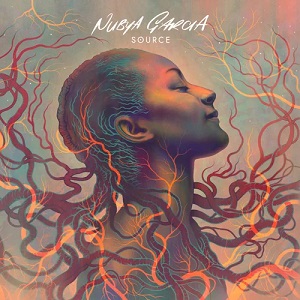
Nubya Garcia Plays “Source”

Listen to this track by British saxophonist and jazz mixologist Nubya Garcia. It’s “Source”, the title track to her second record that came out in August 2020. This cut was a single, released simultaneously with the album from which it comes and is indicative of the themes of the whole record; connection, identity, and the power of community. Without lyrics, those themes are communicated musically, incorporating reggae along with classic post-bop jazz on this track specifically. Garcia comes by this amalgam of stylistic ingredients pretty honestly, citing British reggae outfit Steel Pulse among her musical influences along with Sonny Rollins.

Garcia established her pedigree in formal musical instruction from very early on, learning her instrument from the age of 11 after having also studied the violin, piano, and clarinet. After a stint in the Camden Youth Jazz Band and in other community-based programs in London including Tomorrow’s Warriors, she studied music formally at the Royal Academy of Music and on a five-week scholarship at none other than the Berklee College of Music in Boston.

As evidenced on this track alone, and beyond her musical education, she also has something important to say through her art. Her music suggests that the very source of musical traditions that spring from Africa, the Caribbean, and America are all a part of a great continuum. These musical streams continue to impact musicians in Britain and in Europe, with new forms emerging as a result, becoming a part of that whole.

“Source” is an expression of that, and a part of a series of musical statements on the album about what it is to feel connected to something bigger and far older than oneself. The concept takes on many forms across the whole album, including the powerful connections to a history of people and experiences across continents and eras before its composer was even born.

The vitality heard in this song is also a reflection of the scenes and journeys that Garcia came out of personally, immersed in a niche of jazz culture in London, cutting her teeth as a participant in jam nights while building her confidence as a bandleader and writer simply by playing live – a lot.

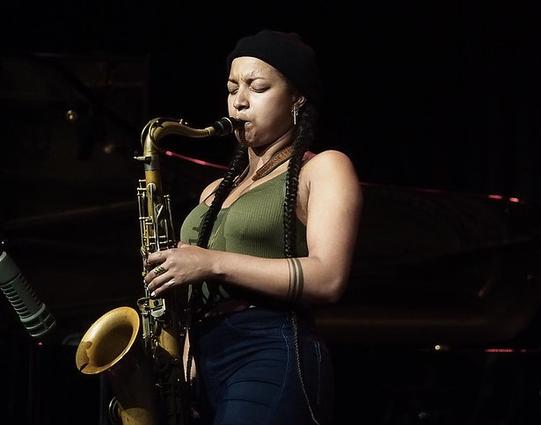
Nubya Garcia on stage, April 2019. image: Joachim Bomann (cropped).

Garcia and her band – Sam Jones on drums, Daniel Casimir on double bass, and Joe Armon-Jones on keyboards – create a stew of sounds that draw from these multiple musical streams to show how connected they are. They’re joined by vocalists Sheila Maurice Grey (aka Ms. Maurice), Cassie Kinoshi, and Richie Seivwright, all three of them instrumentalists in their own right – trumpet, saxophone, and trombone respectively. Intrisic to the music is in finding connections and commonalities in disparate musical forms, and also between each other as collaborative musicians with a shared vision.

The song kicks off with a reggae and dub-inspired groove between keyboards, bass, and drums as the voices float in, a herald to Garcia’s ruminative melodic tenor saxophone lines that sound like vocal parts themselves. Then, the song dives into a canyon of jazz chords before returning to the meditative groove again, making this song sound like sacred music; spacious, celebratory, and soaked in echo.

The interplay between the blended voices, Armon-Jones’ keyboards, and Garcia’s tenor are at the melodic forefront. This is while drummer Sam Jones’ elemental, polyrhythmic playing interlocks with Daniel Casimir’s resonant bass lines. They shift seamlessly between reggae and jazz until the two become a unified whole.

This title track and the rest of the record came out of gathering these kinds of musical ideas together while remaining conscious of keeping it as open stylistically as possible. This mindset is one of the defining tenets of jazz in the 21st century which has been true of the music since King Oliver and Louis Armstrong, relying on a balance between personal exploration and those explorations and curiosities shared between musicians in the moment. Within that, genres and styles become entirely secondary whether the music is infused with reggae, dub, hip-hop, Afrobeat, or any other musical ingredient.

As hard as it has been to define jazz in terms of strict musical territory, this is a vital portion to understanding and appreciating it. This is particularly true now as the ingredients that feed jazz are more numerous, and with an emerging generation of musicians dedicated to pushing its boundaries. Garcia’s music is a high standard to illustrate this sense of movement, but not in any kind of academic way. This is an expression of the heart.

Nubya Garcia is an active musician, writer, and bandleader today.

You can learn more about her and the various projects in which she’s been involved at nubyagarcia.com. You can read about new releases, tour dates, and other goodies.

For more on the Source record and the musical ingredients that make it up, check out this October 2020 interview with Nubya Garcia.

And to hear another take on this track and others on the record, here’s Nubya Garcia’s Tiny Desk Concert, filmed remotely due to the lockdown precautions at the time. Instead of the titular tiny desk at NPR’s offices, Garcia’s session took place in the interior of a moored boat on the Thames in London.

Enjoy!

#2020sMusic #BritishReggae #Jazz #JazzImprovisation #Saxophonists

Your First 5 Jazz Licks (Beginner’s Guide To Arpeggios) - Jens Larsen

Everywhere you look a Jazz teacher is telling you that you should practice arpeggios if you want to play Jazz, but it is just as important that you know how to turn that arpeggio into music, into something you can play that also sounds like Jazz. https://www.youtube.com/watch?v=TDV25qbNA-A&list=PLWYuNvZPqqcH6f2Jy4MAyN1jadGPTYO-U&index=1 In this video, I'll show you why you

Jens Larsen - Jazz Guitarist and Composer
Your First 5 Jazz Licks (Beginner’s Guide To Arpeggios) - Jens Larsen

Everywhere you look a Jazz teacher is telling you that you should practice arpeggios if you want to play Jazz, but it is just as important that you know how to turn that arpeggio into music, into something you can play that also sounds like Jazz. https://www.youtube.com/watch?v=TDV25qbNA-A&list=PLWYuNvZPqqcH6f2Jy4MAyN1jadGPTYO-U&index=1 In this video, I'll show you why you

Jens Larsen - Jazz Guitarist and Composer
Your First 5 Jazz Licks (Beginner’s Guide To Arpeggios) - Jens Larsen

Everywhere you look a Jazz teacher is telling you that you should practice arpeggios if you want to play Jazz, but it is just as important that you know how to turn that arpeggio into music, into something you can play that also sounds like Jazz. https://www.youtube.com/watch?v=TDV25qbNA-A&list=PLWYuNvZPqqcH6f2Jy4MAyN1jadGPTYO-U&index=1 In this video, I'll show you why you

Jens Larsen - Jazz Guitarist and Composer
Your First 5 Jazz Licks (Beginner’s Guide To Arpeggios) - Jens Larsen

Everywhere you look a Jazz teacher is telling you that you should practice arpeggios if you want to play Jazz, but it is just as important that you know how to turn that arpeggio into music, into something you can play that also sounds like Jazz. https://www.youtube.com/watch?v=TDV25qbNA-A&list=PLWYuNvZPqqcH6f2Jy4MAyN1jadGPTYO-U&index=1 In this video, I'll show you why you

Jens Larsen - Jazz Guitarist and Composer
Your First 5 Jazz Licks (Beginner’s Guide To Arpeggios) - Jens Larsen

Everywhere you look a Jazz teacher is telling you that you should practice arpeggios if you want to play Jazz, but it is just as important that you know how to turn that arpeggio into music, into something you can play that also sounds like Jazz. https://www.youtube.com/watch?v=TDV25qbNA-A&list=PLWYuNvZPqqcH6f2Jy4MAyN1jadGPTYO-U&index=1 In this video, I'll show you why you

Jens Larsen - Jazz Guitarist and Composer