
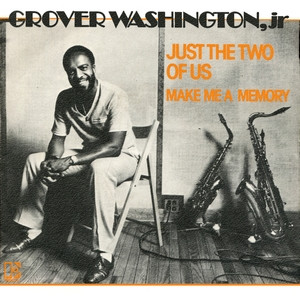
Grover Washington, Jr. Plays “Just the Two of Us” feat. Bill Withers

Listen to this track by smooth jazz saxophone kingpin Grover Washington, Jr. along with supremely soulful vocal stylist and songwriter Bill Withers. It’s “Just the Two of Us”, a smash hit single that crossed over the charts, taken from Washington’s 1980 record Winelight. The single became an international staple on top 40 radio during an era of the late 1970s and early 1980s in which jazz-oriented instrumental tracks sat very comfortably on the charts alongside songs with vocals. Chuck Mangione’s “Feels So Good” and Herb Alpert’s “Rise” are two high-profile examples of this.

This song stood out as an exemplary fusion of jazz and soul, scoring number 2 on the Billboard Top 100 where it stayed for three weeks upon its release in February of 1981. It won Best R&B Song at the 1981 Grammys, while the platinum-selling Winelight record was nominated for Best Album. In the meantime, “Just the Two of Us” kept company with Kim Carnes’ “Bette Davis Eyes”, Dolly Parton’s “9 to 5”, John Lennon’s “Woman”, and Kool & the Gang’s “Celebration” among other hit songs of the era. Ah, the wonderful stylistic chaos that was early Eighties radio!

Being Washington’s sole top 40 song, he really made it count. It did well on the charts at the time of its release as mentioned. But the song also remained as a pop cultural touchpoint for years to come. This came in the form of cover versions from everyone from Will Smith to Dr. Evil. It’s been sampled by Eminem, 2Pac, and many others. In addition to there being a precedent for smooth jazz tunes on pop radio at the time of the song’s release, it helped that “Just the Two of Us” features the distinctive vocals of Bill Withers, who also served as co-writer.

The song’s co-authors Ralph McDonald and William Salter had penned material for Grover Washington, Jr. before, among other artists. They invited Bill Withers to sing on it. A deft hand as a songwriter himself, Withers couldn’t help but see that “Just the Two of Us” had potential beyond what he’d been given.

From an October 2024 article in American Songwriter :

“I’m a little snobbish about words, so they sent me this song and said, ‘we want to do this with Grover, would you consider singing it?’ I said, ‘yeah, if you’ll let me go in and try to dress these words up a little bit.’ Everybody that knows me is kind of used to me that way. I probably threw in the stuff like the crystal raindrops. The ‘Just the Two of Us’ thing was already written. I was trying to put a tuxedo on it. I didn’t like what was said leading up to ‘Just the Two of Us.’”

~ Bill Withers (read the whole article)

Withers’ seemingly natural gift for crafting pop songs that have a life of their own is an undeniable force to affect how well this tune comes off as a composition. His voice helps that along as a completely effortless texture to convey the sentiments of a man who values the simplicity of love and the optimism for the future it inspires. Besides the quality of his voice, it’s Withers ability to fully take on the role of the song’s narrator that really makes a difference to how emotionally resonant it is. In this, Withers was the perfect collaborator on this cut. He brings his signature bright and life-affirming spirit to this song infused into so many of his other hit songs from “Lean on Me” to “Lovely Day”.

Aside from Withers’ significant contribution, a big part of the reason for the song’s success is down to how well Washington understood how to translate jazz phrasing into pop hooks. All of his instrumental interjections and interludes are letter perfect. They contain hook-laden phrases equal to anything Withers delivers in the main melody. If one was to isolate a single instrumental passage from Washington’s saxophone from this song, it would still recognizably register to listeners as “Just the Two of Us” as a whole. In this, the song is a true collaboration between two distinctive artists who find common ground between jazz and soul while also putting forward their signature sounds in perfect balance.

Besides how musically deft it is, another strength of “Just the Two of Us” is that its skillful execution by the two principal artists are entirely beside the point. This song is designed for a single purpose; make the listener feel good. It is a vehicle for listeners to consider the value of their own relationships, inspire the same kind of optimism, and add a bit of subtle sex appeal at the same time. The song’s melody is deceptively intricate. But its sentiments certainly are not. “Just the Two of Us” is song of supreme positivity and an anthem for overcoming obstacles by loving and trusting another person. It’s a love song that goes beyond just its surface sentiments, containing a potent vision for what love can mean between two people and in any capacity. No wonder it did well in the charts.

For Bill Withers, “Just the Two of Us” remains among his most impactful achievements as a songwriter and performer, and one of his last major artistic statements. Withers would happily retire from the music business in 1985, never to return as a performer and recording artist. But like Washington did with his sole top 40 hit, Withers made his relatively short career count. His songs, many of which have become pop and soul standards, have been covered time and time again over the years by artists ranging from Club Nouveau, to Jim White, to Holly Golightly. He’d continue to be a stylistic influence in the decades to follow after his retirement, with artists ranging from Sade, to Ron Sexsmith, D’Angelo, to Ed Sheeran citing him as an influence.

Grover Washington, Jr. would continue to record and tour well after his biggest crossover hit song before his untimely death in 1999. He is recognized today as an innovator of soul jazz and smooth jazz, having earned a place in those genres along with the likes of George Benson, Bob James, Wes Montgomery, and Roy Ayers.

In more recent years, “Just the Two of Us” became a meme on Tik Tok in the form of various musicians on the platform performing the song. This is yet another tribute to how resonant the song remains to be across generations and musical eras. Here’s a particularly good one from a honey-voiced subway-riding busker playing the song on a ukulele while singing to his fellow riders.

For more on Bill Withers, there’s always the 2009 documentary Still Bill to consider. Here’s the trailer to that movie.

Enjoy!

#80sMusic #BillWithers #GroverWashingtonJr #Saxophonists #songsAboutLove #SoulJazz
Nubya Garcia Plays “Source”

Listen to this track by British saxophonist and jazz mixologist Nubya Garcia. It’s “Source”, the title track to her second record that came out in August 2020. This cut was a single, released simultaneously with the album from which it comes and is indicative of the themes of the whole record; connection, identity, and the power of community. Without lyrics, those themes are communicated musically, incorporating reggae along with classic post-bop jazz on this track specifically. Garcia comes by this amalgam of stylistic ingredients pretty honestly, citing British reggae outfit Steel Pulse among her musical influences along with Sonny Rollins.

Garcia established her pedigree in formal musical instruction from very early on, learning her instrument from the age of 11 after having also studied the violin, piano, and clarinet. After a stint in the Camden Youth Jazz Band and in other community-based programs in London including Tomorrow’s Warriors, she studied music formally at the Royal Academy of Music and on a five-week scholarship at none other than the Berklee College of Music in Boston.

As evidenced on this track alone, and beyond her musical education, she also has something important to say through her art. Her music suggests that the very source of musical traditions that spring from Africa, the Caribbean, and America are all a part of a great continuum. These musical streams continue to impact musicians in Britain and in Europe, with new forms emerging as a result, becoming a part of that whole.

“Source” is an expression of that, and a part of a series of musical statements on the album about what it is to feel connected to something bigger and far older than oneself. The concept takes on many forms across the whole album, including the powerful connections to a history of people and experiences across continents and eras before its composer was even born.

The vitality heard in this song is also a reflection of the scenes and journeys that Garcia came out of personally, immersed in a niche of jazz culture in London, cutting her teeth as a participant in jam nights while building her confidence as a bandleader and writer simply by playing live – a lot.

Nubya Garcia on stage, April 2019. image: Joachim Bomann (cropped).

Garcia and her band – Sam Jones on drums, Daniel Casimir on double bass, and Joe Armon-Jones on keyboards – create a stew of sounds that draw from these multiple musical streams to show how connected they are. They’re joined by vocalists Sheila Maurice Grey (aka Ms. Maurice), Cassie Kinoshi, and Richie Seivwright, all three of them instrumentalists in their own right – trumpet, saxophone, and trombone respectively. Intrisic to the music is in finding connections and commonalities in disparate musical forms, and also between each other as collaborative musicians with a shared vision.

The song kicks off with a reggae and dub-inspired groove between keyboards, bass, and drums as the voices float in, a herald to Garcia’s ruminative melodic tenor saxophone lines that sound like vocal parts themselves. Then, the song dives into a canyon of jazz chords before returning to the meditative groove again, making this song sound like sacred music; spacious, celebratory, and soaked in echo.

The interplay between the blended voices, Armon-Jones’ keyboards, and Garcia’s tenor are at the melodic forefront. This is while drummer Sam Jones’ elemental, polyrhythmic playing interlocks with Daniel Casimir’s resonant bass lines. They shift seamlessly between reggae and jazz until the two become a unified whole.

This title track and the rest of the record came out of gathering these kinds of musical ideas together while remaining conscious of keeping it as open stylistically as possible. This mindset is one of the defining tenets of jazz in the 21st century which has been true of the music since King Oliver and Louis Armstrong, relying on a balance between personal exploration and those explorations and curiosities shared between musicians in the moment. Within that, genres and styles become entirely secondary whether the music is infused with reggae, dub, hip-hop, Afrobeat, or any other musical ingredient.

As hard as it has been to define jazz in terms of strict musical territory, this is a vital portion to understanding and appreciating it. This is particularly true now as the ingredients that feed jazz are more numerous, and with an emerging generation of musicians dedicated to pushing its boundaries. Garcia’s music is a high standard to illustrate this sense of movement, but not in any kind of academic way. This is an expression of the heart.

Nubya Garcia is an active musician, writer, and bandleader today.

You can learn more about her and the various projects in which she’s been involved at nubyagarcia.com. You can read about new releases, tour dates, and other goodies.

For more on the Source record and the musical ingredients that make it up, check out this October 2020 interview with Nubya Garcia.

And to hear another take on this track and others on the record, here’s Nubya Garcia’s Tiny Desk Concert, filmed remotely due to the lockdown precautions at the time. Instead of the titular tiny desk at NPR’s offices, Garcia’s session took place in the interior of a moored boat on the Thames in London.

Enjoy!

#2020sMusic #BritishReggae #Jazz #JazzImprovisation #Saxophonists

Kamasi Washington Plays “Claire De Lune”

Listen to this track by saxophone savant and new guard jazz figurehead Kamasi Washington. It’s “Claire De Lune”, a cut from his colossally-scaled 2015 album appropriately-titled The Epic. The record is most assuredly that, clocking in at a staggering 173 minutes and change. That’s nearly three hours of progressive and stylistically varied jazz fit for the 21st century. On it, Washington and his musical compatriots reveal the depth of their musical commitment to the material and to their cohesion as a unit.

The personnel on this cut and on the album in general is made up of likeminded players; Miles Mobley on acoustic bass, Ryan Porter on trombone, Cameron Graves on piano, Brandon Coleman on organ, and Tony Austin on drums. On this cut and on others, they are joined by a choir and strings in places, supplementing the band’s enormous capacity for stylistic depth, lyrical lines, and interlocked rhythms on a piece that was written for the early 20th century, not specifically for the 21st or even for jazz.

Among originals and jazz standards like Ray Noble’s “Cherokee” made famous in a jazz context by Charlie Parker, how does the work of a French Impressionist composer like Claude Debussy fit into all that as well? The beginnings of the answer goes back to Kamasi Washington’s roots as a UCLA music student and as a part of his apprenticeship as a jazz musician.

First, some background. French Impressionist composer Claude Debussy crafted this immortal slice of dreamlike music at the end of the 19th century. It eventually appeared as the third movement to his 1905 Suite Bergamasque for piano, in turn inspired by Paul Verlaine’s poem, also entitled “Claire De Lune”. One hundred and ten years later, Kamasi Washington’s rendition appears on the final third of of his universally-acclaimed triple album, his third as a leader.

In a time when the future of jazz had been called into question for years and even decades, Kamasi Washington learned to ignore musical boxes and the rigidity of genres. The weight of the title Saviour of Jazz is pretty heavy. Faced with that, Washington just wanted to play his horn without the baggage. The result of this is his sterling work with a wide variety of artists across the stylistic spectrum.

This has included singer-songwriter Ryan Adams. It also includes rappers Snoop Dogg and Kendrick Lamar and progressive hip-hop artists like Run the Jewels and Flying Lotus. The latter founded Washington’s label, Brainfeeder. Washington’s worked with some bona fide jazz people too, including George Duke, Stanley Clarke, Robert Glasper, and Harvey Mason.

Type your email…

Subscribe to The Delete Bin

Another composer he joined in musical collaboration was his professor at UCLA, Gerald Wilson. The professor lived near where Washington’s mother lived, and heard a young Kamasi practicing. By the time Washington was college age, he was in Wilson’s orchestra, sitting in as one of two saxophonists.

During his tenure with Wilson, the orchestra recorded “Variations on Claire de Lune” arranged in a straight-ahead big band jazz style by Wilson himself. It’s inclusion in their repertoire was based on a common ingredient found across a range of popular music over a century and more; romance and sensuality as it’s met with a kind of melancholic reverie. On that score, it’s hard to beat Debussy.

Kamasi Washington at Coachella, April 17, 2016 (photo: Fred von Lohmann, Publc Domain).

Taking cues from that experience in Wilson’s orchestra, Washington’s take on the material on The Epic is both faithful as an interpretation of the musical text, and an exploration of the various stylistic avenues and textural possibilities that the piece allows room to inject. His version includes some unexpected sonic ingredients, including the weeping strings and choral voices mentioned earlier that act as a kind of musical seasoning, along with some gospel-informed organ that lends it a spiritual quality.

Each texture and solo enhances the music as it is and puts a series of personalized touches on it at the same time, taking left turns and exploratory excursions while keeping everything in balance, respectful of the piece but reflective of the experiences that the musicians bring to it. That’s what really makes Washington’s take on the piece so resonant. There’s an honesty to it that raises it above what could have been just an intellectual exercise, a way to show off classical chops or credentials, or as a kind of curiosity or novelty of bringing musical worlds together.

Instead, this rendition shows that the idea of separate planets for different kinds of music is a pretty strange idea as opposed to playing music that is simply soulful, as in for the soul. Debussy’s piece is certainly that, with its intrinsic romantic appeal that has not let up in the century and more its existed. And what concept has bound so many disparate strains of popular music together more than romance?

Once again, as with his mentor Gerald Wilson’s approach to the music, the object is always to identify what’s common in any kind of music, and find a way to express that in an authentic way. Jazz has come to mean a lot of things by now, burdened by decades of history, baggage, and a certain amount of critical snobbery along with thousands of fine recordings. But when it comes to what jazz is or isn’t today or what its future might be, this approach and philosophy to finding the soulfulness in all music lies at the heart of it, in whatever form it takes.

Kamasi Washington is an active musician, composer, and record-maker today. You can learn more about him and his music at kamasiwashington.com.

Enjoy!

#2010sMusic #classicalMusic #Debussy #KamasiWashington #modernJazz #Saxophonists

What Kind of Artist Was Wayne Shorter?

Richard Brody on Dorsay Alavi’s three-part documentary, “Wayne Shorter: Zero Gravity,” which chronicles the life and work of the jazz saxophonist Wayne Shorter.

The New Yorker
The Heaven-Longing Saxophone of Wayne Shorter

Richard Brody on the jazz musician Wayne Shorter, who died on Thursday, and who was not only a consequential sideman but a triumphant and ethereal soloist.

The New Yorker