Urify is a toilet-cleaning tablet that helps diagnose kidney disease

A toilet-cleaning pod that doubles as a kidney disease screening device has been shortlisted as a global finalist in the James Dyson Award, recognising the best inventions by student and graduate designers.

Student Yidan Xu created the Urify screening tablet after her father was diagnosed with chronic kidney disease (CKD), which had caused irreversible damage due to being identified too late.

Urify is a toilet-cleaning tablet that helps diagnose kidney disease

Urify aims to make it easier for the estimated 800 million people worldwide who have CKD to detect the condition without requiring clinical tests.

The toilet cleaning tablet releases a reagent that changes colour if it detects the urinary albumin protein, allowing users with no symptoms to spot irregularities and seek medical assistance.

The tablet releases a reagent that changes colour if it detects urinary albumin

"Inspired by my father's late diagnosis of kidney disease, I wanted to find a simple, accessible way for anyone to detect early signs of illness through their daily routine," said Xu, who completed a masters degree in Innovation Design Engineering run jointly by the Royal College of Art and Imperial College London.

"With Urify, I hope to help people catch silent diseases before they become life-changing, and make early health detection really possible for everyone," she continued.

Each tablet lasts 3-5 days

A lack of publicly available early screening tools for CKD prompted Xu to seek out simple ways to integrate diagnosis into everyday life.

The presence of the protein albumin in urine is the best early indicator of kidney damage, especially in people with diabetes or high blood pressure, so using Urify once or twice a year could help save lives.

As people use the toilet every day, the screening system can be incorporated with no extra effort. Each tablet lasts 3 to 5 days and the foam also acts as a cleaning solution.

The Urify tablet is fixed discreetly under the toilet rim and releases a foam when the toilet is flushed. Elevated levels of urinary albumin trigger a visible colour change in the foam, from pale yellow to blue.

Read: AirPot inflatable toilet enables "convenient and responsible" pooing on hikes

An accompanying colour wheel can be used to ensure accurate diagnosis in various lighting and water conditions, while a computer-based colour detection tool offers suggestions in unusual circumstances relating to urine contamination or premature reactions.

Input from GPs and experts from the London Kidney Network highlighted that urinary albumin levels fluctuate daily due to diet, hydration and exercise, meaning that testing across several days was required to produce accurate results.

A computer-based colour detection tool offers suggestions in unusual circumstances

Xu pointed out that Urify requires no additional cost, behavioural change or conscious effort, providing a potentially life-saving solution without any disturbance to users' daily routines.

"What makes Urify unique is its dual-purpose design and integration with an existing habitually used toilet-cleaning product," she explained.

"It delivers both a practical cleaning function and an invisible health benefit, transforming a common cleaning product into a health-enabling tool."

Xu has submitted a patent application for Urify, which she plans to refine in collaboration with research institutions. She is also seeking commercial partners to help support the product's development and distribution.

Urify is one of 20 shortlisted entries for the global James Dyson Award, which challenges young inventors to develop solutions to real-world issues.

British engineer and inventor James Dyson will select the global winners, who will be announced on 5 November and will each receive £30,000 to develop their project.

Previous winners of the national and international awards include a scalp-cooling helmet for cancer patients and a pinecone-shaped wildfire detector made from wax and charcoal.

The photography is courtesy of the James Dyson Award.

The post Urify is a toilet-cleaning tablet that helps diagnose kidney disease appeared first on Dezeen.

#all #design #toilets #health #jamesdysonawards #healthproducts #productdesign

Rebecca Weiss designs ultrasound-powered male contraception device

German design graduate Rebecca Weiss has won a James Dyson Award for a male contraceptive device called Coso, which uses ultrasound waves to temporarily halt sperm regeneration.

Weiss's Coso device is designed to be a reversible contraceptive solution. To use it, a person would fill the device with water up to the indicated mark, turn it on so it heats to operating temperature, and sit for a few minutes with their testicles dipped into it.

Coso is a male contraceptive device that applies ultrasound waves to the testicles

The ultrasound waves temporarily halt sperm regeneration, with contraceptive effectiveness beginning two weeks after the first application.

The effect is reversible, with fertility expected to return no later than six months after the last application.

Weiss began designing the male contraceptive device after being diagnosed with a cervical cancer precursor that meant she could no longer take the pill.

When she and her partner looked for alternative methods and found there were no male-centred options beyond the condom or a permanent vasectomy, she started exploring the topic as part of her master's thesis in industrial design at the Technical University in Munich.

The designer imagines making it in different colours

"The problem is not unique to me personally," she said. "It affects many others as well. This is also evident in the current growing public discussion about the lack of contraceptive alternatives."

Her design for Coso is based on research that found ultrasound contraception has been successful on animals, but has so far been untested on humans. She hopes her design promotes further testing.

Coso is a small bowl-like device, with a smooth coloured exterior that looks similar to premium domestic gadgets.

Appearance and ease-of-use were key to the design brief Weiss set herself, to encourage uptake where no invention has previously succeeded.

The top section is like a small bowl, while the base contains the ultrasound module

Attempts to make a male contraceptive pill were abandoned after they caused side effects, even though they were arguably no worse than those caused by the female contraceptive pill. Others failed due to a lack of user-friendliness, according to Weiss.

"Coso, in contrast, offers a user-friendly contraceptive approach that is easy to use without any kind of physical intervention, pain or previously known side effects," said Weiss.

"New technologies only work if they are accepted by users and society."

To address this problem, Weiss involved her target demographic closely in the design of the product, surveying 422 participants and conducting co-design workshops with 25 of them.

Workshop participants contributed their thoughts on the requirements for the device and were also asked to draw their own ideas for an ultrasound device.

Weiss evaluated the ideas together with experts from urology, andrology, sexual therapy and psychotherapy and then began making and testing cardboard prototypes.

Weiss's design process focused on making Coso extremely user-friendly

The final design is a detailed CAD model, with defined colours and materials that have been evaluated with users.

Its features include auto-shutoff after treatment and an accompanying app to monitor progress.

The device has a battery, microcontroller, ultrasound module and LED strip in its base, with a status display and water level mark in the well providing a user interface.

The water level mark would need to be set by a doctor to suit the user's specific testicle size.

The idea for ultrasound contraception comes from a 2012 study by the Parsemus Foundation, which tested on animals, so its application to humans is hypothetical at this point.

There would need to be financial support for clinical trials before the product can launch.

"Without valid data, the project cannot be realised," said Weiss. "I am therefore looking for contacts with research institutions and industry partners who are willing to fund clinical trials."

The James Dyson Awards recognise excellence in student design and engineering from around the world.

Having won the German heat, Coso will now be considered in the international stage of the award. The shortlist will be announced on 13 October.

Another of this year's national award-winning designs was a knife-wound-healing device named REACT, designed by the UK's Joseph Bentley.

The post Rebecca Weiss designs ultrasound-powered male contraception device appeared first on Dezeen.

#products #all #design #technology #sex #gadgets #jamesdysonawards

Rebecca Weiss designs ultrasound-powered male contraceptive device

German design graduate Rebecca Weiss has invented a male contraceptive device that uses ultrasound waves temporarily halt sperm regeneration.

Device to reduce blood loss from knife wounds named James Dyson Award UK winner

Loughborough University graduate Joseph Bentley has created a device for first responders that he claims could stop haemorrhages from knife wounds in under a minute.

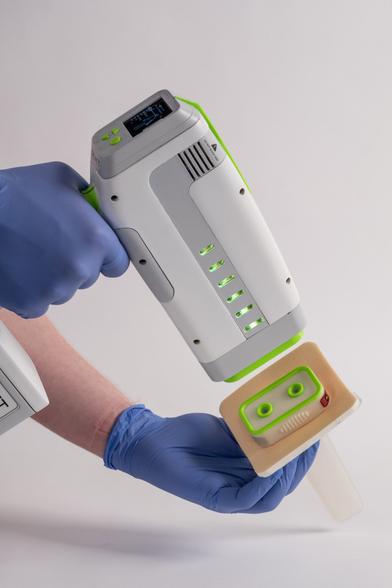
Recently named the UK winner of this year's James Dyson Award, the device would be used to insert a medical-grade silicone balloon tamponade into a wound to reduce bleeding.

Joseph Bentley designed the REACT device

Named REACT, which stands for Rapid Emergency Actuating Tamponade, the device was designed by Bentley in response to the large number of stabbings in the UK.

"Knife crime is a topic that is personal to me, as two of my friends were victims of knife-related incidents," said Bentley, who recently graduated from the product design and technology course at Loughborough University.

"Thankfully both incidents were not fatal, but this is often not the case for so many others," he continued.

"Seeing the profound effect that it had on my friends and their families urged me to try and create a solution that could help others in the future."

The device is designed to reduce blood loss from knife wounds

The REACT device is designed to be used by first responders – who are often police, according to Bentley's research – to reduce bleeding before paramedics arrive at an incident. In the UK the average wait time for an ambulance is around eight minutes, while someone can bleed to death in five minutes.

Bentley's device would be used to insert a silicone balloon tamponade into the stab wound, which would then be inflated to place internal pressure on the cut.

The inflation levels would be determined by the location of the wound using an interface on the device.

According to Bentley, this would replicate a wound management technique used by paramedics, where they pack a wound with gauze.

The device inserts a medical-grade silicone balloon into a wound

Bentley believes that if deployed to first responders, his device could save hundreds of lives each year.

He has developed a prototype of the device and will use the £2,000 prize from the James Dyson Award to start commercialising the design.

"The REACT concept could have real-world benefits and a positive impact on society," Bentley said.

"Although medical device testing takes a long time, I'm looking forward to using the prize money to develop my innovation further and hopefully see the device in the hands of first responders saving lives."

Bentley's design will now progress to the international stage of the James Dyson award. The shortlist for this will be announced on 13 October.

Also aiming to reduce the impact of knife-related incidents, British cutlery company Viners released a collection of kitchen knives with rounded tips.

The post Device to reduce blood loss from knife wounds named James Dyson Award UK winner appeared first on Dezeen.

#all #design #jamesdysonawards #graduates

Device to reduce blood loss from knife wounds named James Dyson Award UK winner

Loughborough University graduate Joseph Bentley has created the REACT device for first responders that could stop haemorrhage from knife wounds in under a minute.