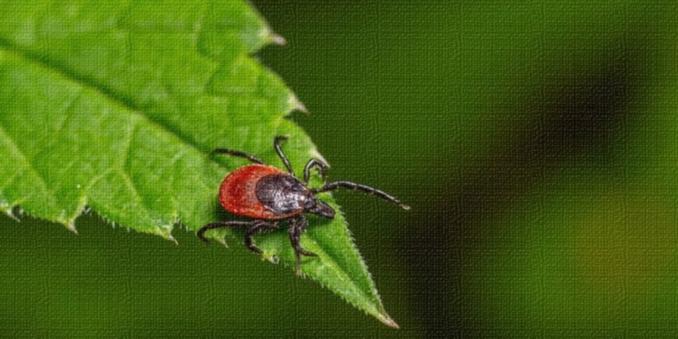
'Spatial distribution of Ixodes ricinus in forest habitats: a comparative study of the northern and southern slopes of Mount Slavnik, Slovenia' - an article published in #ParasiteJournal by @EDPSciences on #ScienceOpen 📄🔓🔎 https://www.scienceopen.com/document?vid=e79590fa-5940-474a-9edb-e2d7b30031bc

#IxodesRicinus #TickBorneDiseases #ClimateChange #VectorEcology

Spatial distribution of <i>Ixodes ricinus</i> in forest habitats: a comparative study of the northern and southern slopes of Mount Slavnik, Slovenia <span class="so-article-trans-title" dir="auto"> Translated title: RĂ©partition spatiale d’ <i>Ixodes ricinus</i> dans les habitats forestiers : Ă©tude comparative des versants nord et sud du mont Slavnik, SlovĂ©nie </span>

<p xmlns:xsi="http://www.w3.org/2001/XMLSchema-instance" class="first" dir="auto" id="d4156074e149">While previous studies have examined the elevational limits of <i>Ixodes ricinus</i> in Central Europe, this study is the first to investigate the influence of slope orientation on tick distribution in Slovenia. Our results provide new insights into how two important microclimatic factors, temperature and humidity, vary between the northern and southern slopes, and how these differences affect the abundance of <i>I. ricinus</i>, a factor that has not been studied in this region before. We found that nymph density was highest on the southern slope at intermediate elevations (720 m) and increased with temperature. In contrast, fewer adult ticks were found on the southern slope compared to the northern slope, most of them at 720 m elevations. The significantly higher abundance of adult ticks on the northern slope is probably related to the cooler temperatures, higher relative humidity, denser ground vegetation and greater availability of hosts such as roe deer. Although these results are regionally specific, they contribute to a more comprehensive understanding of the ecological factors influencing the distribution of <i>I. ricinus</i> in Central Europe. </p><p xmlns:xsi="http://www.w3.org/2001/XMLSchema-instance" class="first" dir="auto" id="d4156074e161">Des Ă©tudes antĂ©rieures ont examinĂ© les limites d’altitude d’ <i>Ixodes ricinus</i> en Europe centrale, mais cette Ă©tude est la premiĂšre Ă  examiner l’influence de l’orientation des pentes sur la rĂ©partition des tiques en SlovĂ©nie. Nos rĂ©sultats apportent de nouvelles informations sur la façon dont deux facteurs microclimatiques importants, la tempĂ©rature et l’humiditĂ©, varient entre les versants nord et sud, et sur l’impact de ces diffĂ©rences sur l’abondance d’ <i>I. ricinus</i>, un facteur qui n’avait jamais Ă©tĂ© Ă©tudiĂ© dans cette rĂ©gion auparavant. Nous avons constatĂ© que la densitĂ© de nymphes Ă©tait maximale sur le versant sud, Ă  des altitudes intermĂ©diaires (720 m), et qu’elle augmentait avec la tempĂ©rature. En revanche, moins de tiques adultes ont Ă©tĂ© trouvĂ©es sur le versant sud que sur le versant nord, la plupart Ă  720 m d’altitude. L’abondance significativement plus Ă©levĂ©e de tiques adultes sur le versant nord est probablement liĂ©e aux tempĂ©ratures plus fraĂźches, Ă  une humiditĂ© relative plus Ă©levĂ©e, Ă  une vĂ©gĂ©tation au sol plus dense et Ă  une plus grande disponibilitĂ© d’hĂŽtes tels que les chevreuils. Bien que ces rĂ©sultats soient spĂ©cifiques Ă  chaque rĂ©gion, ils contribuent Ă  une comprĂ©hension plus complĂšte des facteurs Ă©cologiques influençant la distribution d’ <i>I. ricinus</i> en Europe centrale. </p>

ScienceOpen
Now published in Peer Community Journal, #infections section: The distribution, phenology, host range and pathogen prevalence of #Ixodesricinus in France: a systematic map and narrative review. https://doi.org/10.24072/pcjournal.291
The distribution, phenology, host range and pathogen prevalence of Ixodes ricinus in France: a systematic map and narrative review

FÀstingjakt med P1 morgon igÄr. Med en vit fleecefilt samlade jag pÄ ett par minuter in ett femtiotal fÀstingar.
https://sverigesradio.se/artikel/p1-morgon-ger-sig-ut-pa-fastingjakt

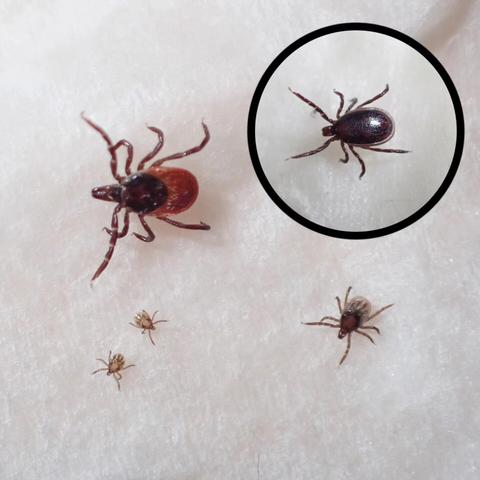
FÀstingar suger blod tre gÄnger, först som larv (de tvÄ nere till vÀnster), sedan som nymf (den ner till höger), och slutligen som vuxen (de tvÄ övre, hona till vÀnster och hane till höger). Hanen Àr inklippt, den fick jag inte med fleecen, utan den satte sig fast under byxlinningen under kvÀllens svamptur.
#fÀsting #ixodes #ixodesricinus

P1 Morgon ger sig ut pÄ fÀstingjakt

Efter en lÄng period av regn ger sig mÄnga nu ut i skogen pÄ jakt efter svamp. Men det Àr Àven högtid för fÀstingar, som sÀgs gilla fuktiga miljöer.FÀstingar ...

Sveriges Radio
A new #preprint #OpenScience #PeerReview by @PCI_Infections: Perez, G. et al. The distribution, phenology, host range and pathogen prevalence of #Ixodesricinus in France: a systematic map and narrative review. #bioRxiv #Infections. https://doi.org/10.1101/2023.04.18.537315
Engorged #IxodesRicinus with a male at the ready to fertilize the eggs.

It's a boy!

#IxodesRicinus