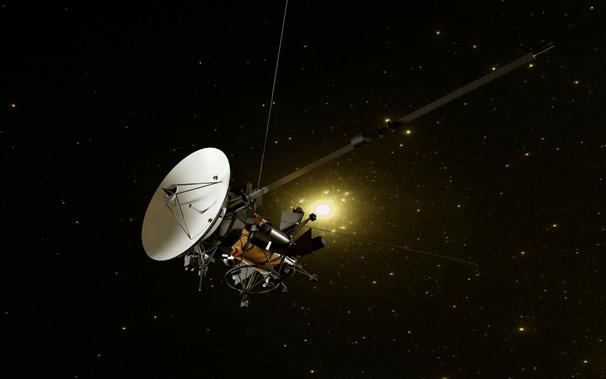
Voyager’s interstellar mission shows how 1970s spacecraft are still teaching NASA engineers new lessons
On April 17, 2026, NASA shut down another instrument on Voyager 1 to keep the 49-year-old spacecraft alive. The full story of the Interstellar Mission, the engineering lessons nobody planned for, and what comes next.
Beam me up, jellyfish: experts unveil spaceships to take us to the stars
Winner of Project Hyperion design contest envisions polyamorous people thriving onboard cigar-shaped craft

How to use fusion to get to Proxima Centauri's potentially habitable exoplanet
Proxima Centauri b is the closest known exoplanet that could be in the habitable zone of its star. Therefore, it has garnered a lot of attention, including several missions designed to visit it and send back information. Unfortunately, due to technological constraints and the gigantic distances involved, most of those missions only weigh a few grams and require massive solar scales or pushing lasers to get anywhere near their target.

New Propulsion Systems Could Enable a Mission to Sedna
The dwarf planet Sedna will reach its closest point to the Sun in 2075, the ideal time to send a mission to study this world that takes 11,000 years to orbit the Sun. In a new paper, researchers consider two exotic propulsion systems for a mission like this: a direct fusion drive, and an enhanced solar sail. Both methods could allow a spacecraft to reach Sedna in under a decade of flight time.

Traveling to Mars and Ceres Using Lunar Gateway as a Springboard
How can humanity use the developing Lunar Gateway as an appropriate starting point for advancing human space exploration beyond the Moon? This is what a recent study presented at the 56th Lunar and Planetary Science Conference (LPSC) hopes to address as a team of researchers evaluated a myriad of ways that Lunar Gateway could be used as a testbed for future technologies involving sending humans to Mars and Ceres. This study has the potential to help scientists, engineers, astronauts, and mission planners develop novel strategies for advancing long-term human space exploration.

Advancing Deep Space Travel with Nuclear Propulsion
How can fission-powered propulsion help advance deep space exploration, specifically to the outer planets like Jupiter, Saturn, Uranus, and Neptune? This is what a recent study presented at the 56th Lunar and Planetary Science Conference (LPSC) hopes to address as a pair of researchers from India investigated the financial, logistical, and reliability of using fission power for future deep space missions. This study has the potential to help scientists, engineers, and future astronauts develop next-generation technologies as humanity continues to expand its presence in space.

What happens to the human body in deep space?
Bone and muscle deterioration, radiation exposure, vision impairment—these are just a few of the challenges space travelers face on long-duration missions, even before considering the psychological toll of isolation.
Hopefully Voyager 1 can survive until later. In this 2025, Voyager 1 has been at a distance of 25.0 billion kilometers from Earth and will continue to fly away until later even when contact with Earth is lost in about 2036. It is the most distant human-made object from Earth.
#voyager1 #voyager #spaceexploration #space #outerspace #deepspace #deepspaceexploration #astronomy #galaxy #galaxies #nasa #astrophysics #solarsystem #interstellarspace #earth #spacenews #star #stars #universe
 Michael / Chgowiz 🎲🎲
 K.Llewellin
 Sofia Florina