 Radio 1190 Playlist
🎶 3:22pm Meet Me Halfway by iSing from iSing Pop Hit Instrumentals.
DJ Seagull - Into the Aquifer
#iSing #DJSeagull #IntotheAquifer #Radio1190 #KVCU
DJ Seagull - Into the Aquifer
#iSing #DJSeagull #IntotheAquifer #Radio1190 #KVCU

We study the transient between a fully disordered initial condition and a percolating structure in the low-temperature non-conserved order parameter dynamics of the bi-dimensional Ising model. We show that a stable structure of spanning clusters establishes at a time $t_p \simeq L^{α_p}$. Our numerical results yield $α_p=0.50(2)$ for the square and kagome, $α_p=0.33(2)$ for the triangular and $α_p=0.38(5)$ for the bowtie-a lattices.We generalise the dynamic scaling hypothesis to take into account this new time-scale. We discuss the implications of these results for other non-equilibrium processes.
Learned at a conference a couple of days ago that our Ising model proposed in 2017 to describe collective U-turns in fish schools could now be labelled as a 'non-reciprocal Ising model'; how cool that there is a name for this class of models -- meaning it is of interest for physicists!
Our early non-reciprocal Ising model: https://doi.org/10.1098/rspb.2018.0251 🐟
Emergent Equilibrium in All-Optical Single Quantum-Trajectory Ising Machines
https://arxiv.org/abs/2412.12768
#physics #ising #isingmodel #isingmachines #quantumphysics #quantum
We investigate the dynamics of multi-mode optical systems driven by two-photon processes and subject to non-local losses, incorporating quantum noise at the Gaussian level. Our findings show that the statistics from a single Gaussian quantum trajectory exhibit emergent thermal equilibrium governed by an Ising Hamiltonian encoded in the dissipative coupling between modes. The driving strength sets the system's effective temperature relative to the oscillation threshold. Given the ultra-short time scales typical of all-optical devices, our study demonstrates that such multi-mode optical systems can operate as ultra-fast Boltzmann samplers, paving the way toward the realization of efficient hardware for combinatorial optimization, with promising applications in machine learning and beyond.
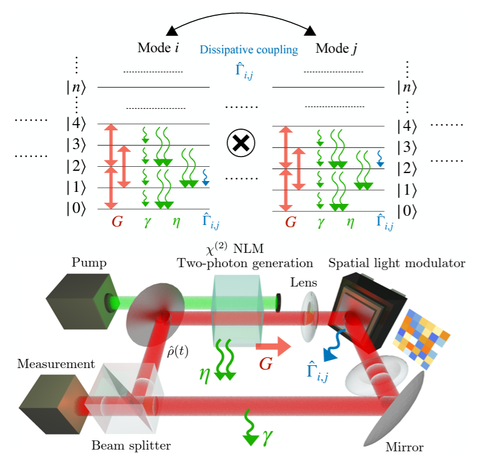

We investigate the dynamics of multi-mode optical systems driven by two-photon processes and subject to non-local losses, incorporating quantum noise at the Gaussian level. Our findings show that the statistics retrieved from a single Gaussian quantum trajectory exhibits emergent thermal equilibrium governed by an Ising Hamiltonian, encoded in the dissipative coupling between modes. The system's effective temperature is set by the driving strength relative to the oscillation threshold. Given the ultra-short time scales typical of all-optical devices, our study demonstrates that such multi-mode optical systems can operate as ultra-fast Boltzmann samplers, paving the way towards the realization of efficient hardware for combinatorial optimization, with promising applications in machine learning and beyond.
the #Droitwich #iSing #Choir performing #Elbow’s #OneDayLikeThis at the town’s #SaltFest yesterday: great to see locals of different ages and abilities performing together.
I hear their soloist was pretty good too!
Have to brush up 🧹 my Monte Carlo knowledge for an interview. Turns out, the exact definition of a Monte Carlo method/simulation is somewhat subjective.
However, when looking for a cool gif I found this neat #julia package: https://github.com/genkuroki/Ising2D.jl
Thanks @genkuroki for building it 😃
 Paul Balduf
 Valentin Lecheval
 Claudio Conti
 Dailingual
 Giulio
 Stefan Zitz