
Due to life decisions that I am comfortable with , I use my SDRs over the network with my own goofball protocol.

Existing apt installable programs don't support it, so I figured it was high time to do what any normal person would do -- convincingly implement librtlsdr.so off my rust sdr codebase (sparky) and make it work without any other changes. Obviously.
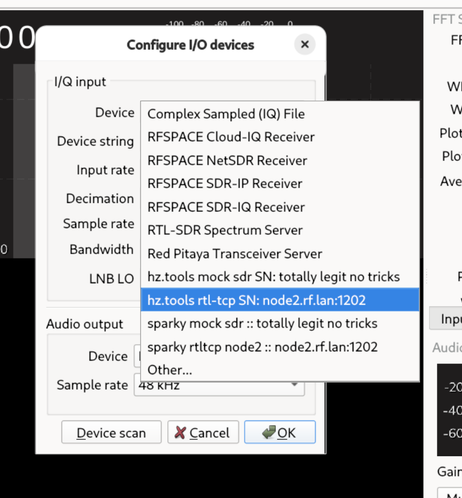
https://k3xec.com/sparky-rtlsdr/

#hztools #radio #rf #sdr #rtl #rtlsdr #rust


A few nights ago I bought some restaurant pagers off the internet and blind reverse engineered them for fun! It wasn't quite the adventure I wanted but still an excellent exercise never the less

I wrote about it here https://k3xec.com/td158/

#sdr #hztools #rf 

Reverse Engineering a Restaurant Pager system 🍽️

Let's reverse engineer a restaurant pager system I bought off the internet!

 I wrote a few words about my bootleg phased array simulator and some renders over at https://k3xec.com/simulating-phased-arrays/ published this morning. Enjoy the 90s screensaver vibes! Hopefully more to come soon!

#hztools #rf

Writing a simulator to check phased array beamforming 🌀

Paul writes a simple RF simulator to generate some GIFs!

Dorking around with some different antenna configurations has made for some mesmerizing renders

This is a 1.25 lambda baseline 2x2 grid of antennas sweeping in azimuth, then a sweep on elevation #hztools #rf

I lied last one #hztools #rf (2x2, sweep on azimuth, then a sweep on elevation)
(probably) last one for the night: a 2x2 grid of antennas (fixed camera) #hztools #rf

I wrote a janky little renderer for my #hztools simulator's point clouds to check my beamforming code in 3D

First GIF: The camera is rotating around the 1x4 line of antennas beamforming at the horizon

Second GIF: The camera is fixed, and the beamformming is sweeping from 0 to 360

Enjoy! This was a *ton* of fun to write. #rf

I finally got around to thinking about 3-D beamforming, ported a branch of my beamformer and wrote up a quick "simulator" to test it -- it's a lot harder to view this than the 2-D images I posted a while back, but I exported it as a point-cloud and opened it with Blender (nice!).

This is the 3-D render of a 1-D line of antennas spaced a quarter wavelength apart on the X axis -- I expected to see a torus (and did!)

#hztools

I've been goofing off using #hztools and asterisk to tune into FM over the VoIP network in the house, and @mikey pointed me to AudioSocket, a very handy (but underdocumented) protocol that Asterisk can use to patch a call into a TCP connection.

There's not a *ton* on the Asterisk docs, so here's my small contribution as I implemented support for it https://hz.tools/audio_socket/

Also, it's pretty rad to have a phone get answered and hear local FM traffic 📻

Overview of the AudioSocket protocol

When working on my #hztools #rf OFDM PHY, I wound up using the 802.3an LDPC matrices, and found doc typos. I've kept a thread over email alive for a few months where David Law (not on fedi?) shepherded an oddball email into a maintenance request, now live at https://www.ieee802.org/3/maint/requests/maint_1404.pdf

Wild to see how things like 802.3 works, I don't know what I expected but it's been a total learning experience. The 802.3 maintainers put *so* much time and effort into the spec, and I appreciate them so very much!