 Gangleri's Grove
Sharing A Glimpse of My Ballet Collection
As an ancestor worker, I honor my ballet lineage in many different ways. Over the past two years, I have been pushed to collect material culture: ephemera like playbills, photographs, and articles as well as pointe shoes, often signed by the dancer in question. The latter started when I was asked to guest lecture for a class in modern history. The teacher uses technology as a lens through which to examine history. She asked me to discuss the development of the pointe shoe, and in doing so to present on the development of ballet and its intersection with politics, aesthetics, and historical events. I agreed and as is my wont, started thinking about what material culture I could bring in to augment my lecture.
I do this quite frequently in my own classes because I have found that holding a thing, a page from a 14th c. manuscript, a woman’s seal from the early medieval period, old Roman coins, arrow heads from 9th century Germany, etc. changes the way students respond to the material on which I’m teaching. It becomes real for them, concrete. So, I thought about what would do that with ballet and since the teacher for whom I was guest lecturing wanted me to look at pointe shoes, I decided to collect a few. I was originally aiming to show the development from 19th century dancing shoe that any girl would wear to a ball all the way through to our modern pointe shoe, which now includes shoes made not only of canvas, cardboard, satin, and glue but also synthetics made of any number of materials, including 3D printed models. My preference is for the traditionally made shoe, but it’s nice to see that technology and innovation is still happening
Once I acquired a few shoes (my own went missing when I moved to my house, a loss I still mourn), my cadre of ballet-lineaged dead pushed me to keep going. More than any other symbol, a ballet dancer is defined by the pointe shoe, and it represents both the beauty and the pain of this art. There have been improvements in the canvas shoe, used by female dancers to warm up, and by male dancers as their primary shoe: Orza Brand have revolutionized the flat slipper, but my focus was and is on the pointe shoe alone.
I started collecting and almost immediately, amazing finds fell into my lap. I firmly believe this was the work of my ballet dead. I would mention in passing to my husband that ‘Oh, I wish I had X dancer’s shoes, but I’ll never be able to find them.” A day or two later, I’d find them at an auction site, a ballet company’s shop or kiosk (most companies will sell signed shoes during performances), an autograph and ephemera dealer, on eBay, or elsewhere. I’d not just find them; they’d be priced at ridiculously low prices. Twice, I’ve gotten three for the price of one. I know what the cost should be for certain dancer’s signed shoe and in some cases, I’ve paid less than a third of what they should be.
The pointe shoe is so central to a ballet dancer’s identity. It is a visual representation of my connection to this family of dead. I reverence that. Just today, I received a package of four shoes, one of which I was sure I’d never ever find or be able to afford. Here is a photo of the four I received and two that I bought myself last time I went to the NYCB.
Starting at the bottom with the black shoes. They are NYCB corps dancer Maya Milic. She is very good and her shoes are pieces of magic. She writes little messages to herself inside of them, in Russian, Latin, or English (those are what I’ve seen so far). Sometimes it’s a simple “I was ready.” in Russian, sometimes a funny phrase related to the ballet in English, sometimes a Latin phrase. I don’t know why she does this, but it makes every shoe a mystery to be solved, a bit of magic to be unraveled.
Moving up to the left, the jewel of my collection, a signed slipper of Maya Plisetskaya. She signed in Russian and English. The shoes are heavily broken in. I had strong feet when I danced, but these shoes are too broken for me to ever have worn! there is literally no blocking left in them. They’re darned around the tip; extra stitches are added at the vamp to add support for the dancer ( Soviet shoes were notorious for breaking down mid-performance) and stitching along the side to take up slack and highlight the foot. They’re absolutely broken and absolutely gorgeous. One of the things I find fascinating with shoes is that, having been a ballet dancer myself, I can read the shoes: date them, look at the ways they’ve been broken in or prepared for use and tell something of the dancer. Here, her shoes tell me she was a powerhouse with incredibly strong feet.
Moving upward in a clockwise manner, there is one shoe signed by Yekaterina Maximova (sort of in English!). Her shoes are even more visibly modified.
Next, there is a shoe signed by Galina Panova. This shoe was not worn. A collector had her sign a new Capezio shoe. This isn’t uncommon and dancers will often sign unworn shoes. I prefer shoes that have been worn by the dancer in question, but if one is going for the autograph, unworn is sometime better. I snapped it up, because her shoes are fairly rare. She studied at the Maryinsky eventually under the tutelage of the legendary Galina Ulanova. She and her husband defected in the early seventies, settled in Israel, danced all over Europe, and eventually founded a company with her husband.
Finally, we come full circle with a signed pointe shoe of American Ballet Theatre’s Paloma Herrera. I’m assuming this is dated from early 2000s but it could be slightly earlier.
For those who wonder how I store pointe shoes (signed shoes for sure, but also pointe shoes that are from brands now defunct, and thus highly sought by collectors), I wrap them in acid free tissue paper and store them in carefully labeled archival boxes. They’re stacked under one of the tables in my ancestor room (though that might eventually change).
Do we really need physical objects to connect to our beloved dead? Of course not, but such items can help augment one’s connection and to preserve ephemera and material culture so crucial to a craft that a certain group of dead spent their lives painfully perfecting seems a very good way to honor them. These shoes are a lens through which to view an entire world and when I teach, I open that world up to my students, just as it once was opened to me. Each shoe is a touchstone of a particular dancer, a particular set of experiences, at a particular time in our history.
#Art #Ballet #balletLineage #collection #honoringAncestors #honoringLineageDead #pointeShoe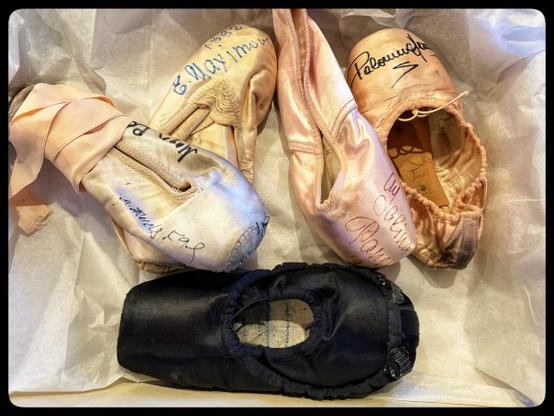
 S. E. Wigget
 Cheryl