Battle of The Beanfield
There are certain moments in modern British history that seem to sit just beyond the edge of official memory. Events that everybody vaguely remembers, yet somehow never quite make it into the comfortable national story we tell ourselves.
The Battle of Orgreave is one. The miners’ strike is another. The poll tax riots. Hillsborough. Brixton. They linger in photographs, old television footage and the memories of those who were there, carrying the uncomfortable reminder that Britain is not always as civilised, measured and orderly as it likes to imagine itself to be.
The Battle of the Beanfield belongs firmly in that category.
Forty years on, it remains one of the most controversial policing operations in modern British history. More than 1,300 police officers confronted a convoy of around 600 New Age Travellers attempting to reach Stonehenge on 1 June 1985. By the end of the day, dozens of people had been injured, hundreds had been arrested and an entire way of life had effectively been marked for destruction.
What happened in that Hampshire beanfield has never been the subject of a full public inquiry. Yet for many people who witnessed the decline of Britain’s traditional industries during the Thatcher years, the images remain painfully familiar.
I grew up in Yorkshire through the 1970s, 1980s and 1990s. I watched pit villages hollow out. I watched steelworks close. I watched communities that had existed for generations suddenly find themselves described as obstacles to progress. There was a language that emerged during those years. Certain groups became “the problem”. Miners. Trade unionists. Travellers. Alternative communities. Anyone who stood outside the increasingly rigid idea of what Britain was supposed to become.
That is one reason the Battle of the Beanfield still matters.
To understand the confrontation itself, we first need to understand the strange, colourful and often misunderstood world that produced it.
The Stonehenge Free Festival began in 1974. It emerged from the wider countercultural movements of the late 1960s and early 1970s, combining music, environmentalism, spiritual exploration, political activism and communal living. Over the following decade it grew steadily, becoming one of the largest free gatherings in Britain. By the early 1980s thousands of people travelled to Stonehenge each summer to celebrate the solstice. The festival attracted an eclectic mix of punks, bikers, druids, musicians, environmental campaigners, anarchists, hippies and families living on the road.
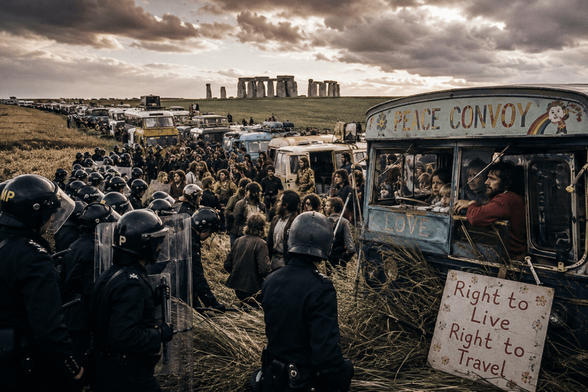
The people who became known as the Peace Convoy were not a single organisation. They were a loose collection of travellers, festival-goers and alternative communities who spent much of the year moving between free festivals, protest camps and temporary settlements. Some were escaping unemployment. Some rejected consumer culture. Others simply wanted a different way of living. Many travelled in converted buses, coaches, ambulances and vans that doubled as homes.
To their supporters they represented freedom, creativity and resistance to conformity.
To their critics they represented disorder.
By 1984 tensions were reaching breaking point. The Stonehenge festival had become enormous. Estimates suggested attendance reached around 100,000 people. Concerns were raised about damage to the archaeological landscape, litter, unauthorised trading and open drug use. English Heritage, which had recently taken over management of the site, came under increasing pressure to act. Local authorities and police forces were equally determined that the gathering should not continue in its existing form. A High Court injunction was obtained to prevent the 1985 festival from taking place. The state had drawn a line.
On the morning of 1 June 1985, the Peace Convoy left Savernake Forest and began moving towards Stonehenge. Around 140 vehicles carried approximately 600 people. Many were families. Children were travelling alongside adults who had spent years living on the road. They knew there would be police opposition. Few appear to have anticipated what was waiting for them.
Police had prepared extensively.
The miners’ strike had ended only months earlier. During that bitter industrial conflict police forces had developed new methods of coordination, rapid deployment and large-scale public order operations. Senior officers later openly acknowledged that lessons learned during the strike had informed preparations for dealing with the travellers.
A four-mile exclusion zone had been established around Stonehenge. Roadblocks were prepared. Officers from multiple forces were assembled. Some estimates place police numbers at around 1,300. Others suggest even higher figures by the end of the operation.
The convoy encountered its first major roadblock near Shipton Bellinger, several miles from Stonehenge. According to police accounts, some traveller vehicles attempted to push through the blockade and rammed police vehicles. Travellers and independent witnesses tell a very different story. They describe a convoy seeking negotiation before finding itself trapped and surrounded.
Whatever happened during those first moments, the situation rapidly escalated.As vehicles attempted to leave the road and move into adjacent fields, police began smashing windows and making arrests. The convoy became scattered across farmland. Families were separated. Children became lost in the confusion. What followed would become one of the most infamous confrontations in modern British policing.
Television footage remains difficult to watch even now.
Officers in riot gear strike vehicle windows with truncheons. People are dragged from buses and vans. Terrified children can be seen inside shattered vehicles. Journalists and witnesses described police hitting men and women indiscriminately. Several accounts alleged pregnant women and individuals carrying babies were assaulted during the operation. Numerous vehicles that functioned as homes were systematically damaged.
The Earl of Cardigan, whose family owned Savernake Forest and who had followed the convoy on a motorcycle, later provided testimony that proved deeply damaging to official police narratives. He described officers rushing vehicles with drawn truncheons, shouting at occupants and creating scenes of intimidation and violence that contradicted many early police claims.
Journalists present that day reported similar concerns.
ITN footage captured scenes that shocked many viewers. Photographer Alan Lodge later described the event as an ambush rather than a battle. Others argued the very name “Battle of the Beanfield” created a misleading impression of two evenly matched sides. One side possessed riot shields, command structures, communications systems and overwhelming numerical superiority. The other consisted largely of civilians living in vehicles.
By the end of the operation, 537 people had been arrested. It remains one of the largest mass arrests of civilians in modern British history. Most of the charges eventually collapsed or were dismissed.
That fact alone raises uncomfortable questions.
If hundreds of supposedly dangerous lawbreakers had been lawfully apprehended while carrying out serious criminal acts, one might expect hundreds of successful prosecutions to follow. Instead, much of the legal case simply evaporated.
Years later, travellers successfully pursued civil actions against Wiltshire Police. Damages were awarded for wrongful arrest, false imprisonment and property damage. One police sergeant was convicted of actual bodily harm arising from the events of that day.
Yet despite these outcomes, there has never been a full public inquiry.
Perhaps that is because the Battle of the Beanfield was about more than Stonehenge.
Looking back now, it feels impossible to separate it from the wider atmosphere of Britain in the mid-1980s. This was a country being transformed at extraordinary speed. Traditional industries were disappearing. Unemployment was soaring in many regions. Entire communities were fighting for survival. Alternative lifestyles increasingly found themselves portrayed as threats to public order rather than expressions of individual freedom.
For many people in mining and industrial areas, there is a recognisable pattern.
First comes the language.
A group is described as troublesome, outdated or undesirable.
Then comes the media narrative.
Then comes the justification.
Then comes the force.
That does not mean every traveller was a saint, any more than every miner was. Human beings are messy. Large gatherings bring problems. Some attendees at the Stonehenge festivals undoubtedly caused damage. Some individuals within the traveller movement undoubtedly committed crimes. A serious historical assessment has to acknowledge that reality. The archaeological concerns surrounding Stonehenge were genuine. Local residents had legitimate complaints. Authorities were entitled to seek solutions.
But none of that explains the scale of what happened on 1 June 1985.
The images of smashed homes, frightened children and riot police advancing across fields continue to disturb because they seem wildly disproportionate. They suggest a state determined not merely to enforce an injunction but to send a message.
And the message was received.
The traveller movement never fully recovered.
Legislation introduced during the following years increasingly restricted nomadic lifestyles and unauthorised gatherings. The Public Order Act 1986 and later the Criminal Justice and Public Order Act 1994 created new powers that made life significantly harder for travellers, free festivals and eventually the emerging rave culture.
In many ways the Beanfield became a blueprint. The same language used against travellers would later be applied to ravers, squatters, protesters and environmental activists. Alternative communities were increasingly framed not as citizens exercising freedoms but as public order problems requiring management.
Yet the legacy of the Beanfield refuses to disappear.
Songs were written about it. The Levellers turned it into a folk-punk anthem that introduced a new generation to the story. Hawkwind referenced it. Writers, filmmakers and activists kept returning to it. Every summer solstice the memory resurfaces among those who remember what happened.
Perhaps that is because the Battle of the Beanfield sits at the crossroads of so many larger questions.
Who gets to occupy public space?
Who decides what constitutes a legitimate way of living?
How much power should the state possess when dealing with communities that reject mainstream norms?
And perhaps most importantly of all, what happens when governments begin to see certain groups not as citizens but as enemies?
Forty years later those questions feel remarkably current.
The travellers who set out for Stonehenge in 1985 were not trying to overthrow the government. They were trying to reach a festival. They were trying to celebrate a solstice. They were trying, in their own eccentric and imperfect way, to live differently.
Many paid a heavy price for that.
For those of us who grew up watching pits close, furnaces go cold and communities written off as inconvenient relics of the past, the Beanfield feels like part of the same story. Different people. Different landscape. Different politics perhaps. But the same underlying lesson.
When power decides a group no longer belongs, it rarely begins with dialogue.
It begins with exclusion.
Then comes the roadblock.
Further Reading
Andy Worthington, The Battle of the Beanfield
Christopher Chippindale, Stoned Henge: Events and Issues at the Summer Solstice, 1985
Emma Hallett, BBC News, Summer Solstice: How the Stonehenge Battles Faded
Tony Thompson, The Observer, Twenty Years After, Mystery Still Clouds Battle of the Beanfield
English Heritage, Stonehenge 1977–85: A Dig in Time and a Confrontation
Copyright © Mysterious Times 2026. All rights reserved. This article may not be reproduced, distributed or transmitted in any form without prior written permission from Mysterious Times, except in the case of brief quotations used for review, criticism or scholarly reference.
#1980sBritain #1985Events #AlternativeBritain #AlternativeCommunities #AlternativeLifestyles #BattleOfTheBeanfield #BritishCounterculture #BritishFolklore #BritishHistory #BritishProtestCulture #BritishSociety #BritishSubcultures #CivilLiberties #CivilRights #ContemporaryHistory #CounterculturalHistory #Counterculture #CountercultureHistory #culturalHeritage #CulturalResistance #Druidry #EnglishCountryside #EnglishHeritage #FestivalCulture #ForgottenHistory #FreeFestivals #FreeSpiritBritain #FreedomOfMovement #Hampshire #HiddenHistory #HistoricalAnalysis #HistoricalConflict #HistoricalControversies #HistoricalMysteries #HistoryFeatures #LongReadHistory #LostBritain #MargaretThatcher #MiningCommunities #ModernBritishMythology #ModernFolklore #ModernLegends #MysteriousTimes #NewAgeMovement #NewAgeTravellers #Paganism #PeaceConvoy #PeopleSHistory #PoliceHistory #PoliticalHistory #ProtestHistory #ProtestMovements #PublicOrder #RoadProtestHistory #RuralEngland #SocialChange #SocialCommentary #socialHistory #SocialJustice #SolsticeCelebrations #SolsticeTraditions #StatePower #Stonehenge #StonehengeFreeFestival #StonehengeHistory #SummerSolstice #ThatcherEra #Thatcherism #TravellerMovement #TravellerRights #TravellingCommunities #UKHistory #UndergroundBritain #UnofficialBritain #Wiltshire #WorkingClassHistory #YorkshireHistory Ancient Origins
 Hacker News
 Kirst Mason D'Raven