 NASA
NASANASA’s Hubble Identifies One of Darkest Known Galaxies https://science.nasa.gov/missions/hubble/nasas-hubble-identifies-one-of-darkest-known-galaxies/ #NASA #Astrophysics #AstrophysicsDivision #DarkMatter #Galaxies #GlobularClusters #GoddardSpaceFlightCenter #HubbleSpaceTelescope #TheUniverse

Hubble Digs Up Galactic Time Capsule https://science.nasa.gov/missions/hubble/hubble-digs-up-galactic-time-capsule/ #NASA #Astrophysics #AstrophysicsDivision #GlobularClusters #GoddardSpaceFlightCenter #HubbleSpaceTelescope #StarClusters #Stars #TheUniverse

Hubble Observations Give “Missing” Globular Cluster Time to Shine https://www.nasa.gov/image-article/hubble-observations-give-missing-globular-cluster-time-to-shine/ #NASA #GlobularClusters #HubbleSpaceTelescope

 Steve Dustcircle 🌹
#GlobularClusters: The #VeraRubinObservatory is Just Getting Started
https://www.universetoday.com/articles/globular-clusters-the-vera-rubin-observatory-is-just-getting-started
#space #cosmos

Globular Clusters: The Vera Rubin Observatory is Just Getting Started
The long-awaited Vera Rubin Observatory has delivered some preliminary observations of the globular cluster 47 Tucanae field. 47 Tuc is the Milky Way's second-brightest globular cluster, second to Omega Centauri. The Rubin Observatory's data demonstrates the telescope's promising scientific potential.
 Daniel Pomarède
The Palomar 8 Globular Cluster captured by Hubble, as part of a study intended to resolve individual stars of the entire globular cluster system of the Milky Way.
Credits: NASA, ESA, and D. Massari (INAF — Osservatorio di Astrofisica e Scienza dello Spazio); Processing: Gladys Kober (NASA/Catholic University of America)
#Hubble #stars #MilkyWay #GlobularClusters #astronomy #astrophysics #astrodon #Palomar8
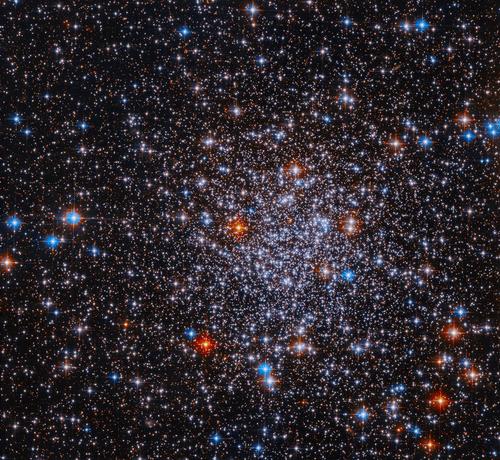
Hubble Observations Give “Missing” Globular Cluster Time to Shine https://science.nasa.gov/missions/hubble/hubble-observations-give-missing-globular-cluster-time-to-shine/ #NASA #Astrophysics #AstrophysicsDivision #GalaxiesStarsBlackHoles #GlobularClusters #GoddardSpaceFlightCenter #HubbleSpaceTelescope #StarClusters #Stars

Hubble Visits Glittering Cluster, Capturing Its Ultraviolet Light https://science.nasa.gov/missions/hubble/hubble-visits-glittering-cluster-capturing-its-ultraviolet-light/ #NASA #Astrophysics #AstrophysicsDivision #GlobularClusters #GoddardSpaceFlightCenter #HubbleSpaceTelescope #StarClusters #Stars #TheUniverse

 In the Dark
It’s Saturday morning again and time to post an update of activity at the Open Journal of Astrophysics. As last week there are six papers to announce, bringing the count in Volume 7 (2024) up to 93 and the total altogether up to 208.
In chronological order, the six papers published this week, with their overlays, are as follows. You can click on the images of the overlays to make them larger should you wish to do so.
First one up, published on Monday 14th October 2024, is in the folder marked Cosmology and NonGalactic Astrophysics and is called “Backreaction in Numerical Relativity: Averaging on Newtonian gauge-like hypersurfaces in Einstein Toolkit cosmological simulations“. This paper presents a numerical study of the effect of local inhomogeneities on the dynamical evolution of the Universe, i.e. the so-called “backreaction” problem; the authors are Alexander Oestreicher and Sofie Marie Koksbang of the University of Southern Denmark, Odense, Denmark.
Here is a screen grab of the overlay, which includes the abstract:
You can find the officially accepted version of the paper on the arXiv here.
The second paper to announce, published on 15th October 2024, is “Weak-Lensing Shear-Selected Galaxy Clusters from the Hyper Suprime-Cam Subaru Strategic Program: II. Cosmological Constraints from the Cluster Abundance” by I-Non Chiu (National Cheng Kung University, Taiwan) and 11 others based in Taiwan, Japan, India and the USA. This paper, which is also in the folder Cosmology and NonGalactic Astrophysics presents constraints on cosmological parameters obtained from a sample of galaxy clusters
You can see the overlay here:
The accepted version of this paper can be found on the arXiv here.
The third paper is “Image formation near hyperbolic umbilic in strong gravitational lensing” by Ashish Kumar Meena (Ben Gurion University, Israel) and Jasjeet Singh Bagla (IISER Mohali, India). It presents a detailed theoretical discussion of a particular form of strong gravitational lensing and its observational consequences; it is in the folder Astrophysics of Galaxies and was published on October 15th 2024.
The overlay is here:
The officially accepted version can be found on arXiv here.
The fourth paper, published on 16th October 2024 and in the folder Astrophysics of Galaxies, is “Weak Gravitational Lensing around Low Surface Brightness Galaxies in the DES Year 3 Data” by N. Chicoine (University of Chicago, USA) et al. (105 authors; DES Collaboration). It presents a demonstration of the viability of using weak gravitational lensing to constrain the halo masses of low surface brightness galaxies.
The overlay is here
You can find the officially accepted version of this paper here.
The fifth paper in this batch is “Imprints of interaction processes in the globular cluster system of NGC 3640” by Ana I Ennis (Waterloo, Canada) and Juan Pablo Caso & Lilia Patricia Bassino (Instituto de Astrofísica de La Plata, Argentina). This one was also published on 16th October 2024 and is in the folder Astrophysics of Galaxies, Here is the overlay
You can find the official accepted version on the arXiv here.
Finally for this week we have “On the nature of the C IV-bearing circumgalactic medium at 𝒛∼𝟏” by Suyash Kumar, Hsiao-Wen Chen, Zhijie Qu & Mandy C. Chen (U. Chicago), Fakhri S. Zahedy (U. North Texas), Sean D. Johnson (Carnegie Observatories), Sowgat Muzahid (IUCAA, India) and Sebastiano Cantalupo (U. Milan Bicocca)
The overlay is here
You can find the officially-accepted version on arXiv here.
That’s it for now. More next week!
https://telescoper.blog/2024/10/19/six-new-publications-at-the-open-journal-of-astrophysics-2/
#240719081v2 #arXiv240300065v2 #arXiv240516826v2 #arXiv240611970v2 #arXiv240803049v1 #arXiv240815824v2 #AstrophysicsOfGalaxies #Backreaction #CarbonIVAbsorbers #CosmologyAndNonGalacticAstrophysics #DarkEnergySurvey #DES #EinsteinToolkit #galaxyClusters #globularClusters #NGC3640 #NumericalRelativity #strongGravitationalLensing #weakGravitationalLensing
 Matt Willemsen
Mystery in the Stars: Hubble Unveils Omega Centauri’s Hidden Monster
https://scitechdaily.com/mystery-in-the-stars-hubble-unveils-omega-centauris-hidden-monster/ #astronomy #OmegaCentauri #BlackHole #IMBHs #GlobularClusters
https://scitechdaily.com/mystery-in-the-stars-hubble-unveils-omega-centauris-hidden-monster/ #astronomy #OmegaCentauri #BlackHole #IMBHs #GlobularClusters

Mystery in the Stars: Hubble Unveils Omega Centauri’s Hidden Monster
Using two decades of Hubble Space Telescope data, scientists found seven unusual stars in Omega Centauri, indicating the presence of an intermediate-mass black hole, potentially the nearest of its kind to Earth and reshaping theories on black hole environments. An international team of astronomer
 CosmicRami
*** SCIENCE GOODIE*** 📡
A few weeks back wrote an article about the news of the Intermediate-Mass Black Hole inferred at the centre of Omega Cent. and wrote how we can use millisecond pulsars to really zone in on it.
https://www.spaceaustralia.com/news/omega-centurais-monster-black-hole
Well, a team did this & say it might NOT be an IMBH!
https://arxiv.org/abs/2408.00939
This is very cool and I hope it evolves into a fun, science battle!
📷 ESO
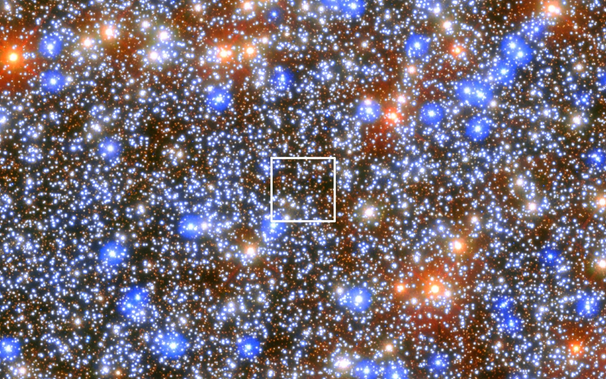
Omega Centurai’s Monster Black Hole | Spaceaustralia
University of Queensland astronomer Dr Holger Baumgardt has played a role in an international team to help find the strongest evidence yet of an Intermediate-Mass Black Hole at the heart of the largest Globular Cluster that orbits the Milky Way – Omega Centauri.