 GeekProjects News
Korean Multifunction Counter Teardown https://hackaday.com/2024/07/07/korean-multifunction-counter-teardown/ #frequencycounter #testequipment #workbench #Teardown

Upgrade Puts a Lot of Zeroes on Kit-Built Frequency Counter https://hackaday.com/2023/12/07/upgrade-puts-a-lot-of-zeroes-on-kit-built-frequency-counter/ #temperaturecompensated #crystaloscillator #frequencycounter #calibration #ToolHacks #reference #standard #VCTCXO

Simple STM32 Frequency Meter Handles Up To 30MHz With Ease https://hackaday.com/2023/09/28/simple-stm32-frequency-meter-handles-up-to-30mhz-with-ease/ #frequencycounter #ToolHacks #stm32

Vintage Digital Frequency Meter Teardown https://hackaday.com/2023/07/19/vintage-digital-frequency-meter-teardown/ #frequencycounter #digitaldisplay #Teardown #racal

 Søren Kjærsgaard
The 10MHz oven option in my #Agilent #frequencycounter is really quite accurate, I’m 0.07Hz away from a GPS reference 😎😎 #hamradio #hamr #electronicsengineering #engineer #testandmeasurement #metrology
 hackaday unofficial
Clock Testing Sans Oscilloscope?
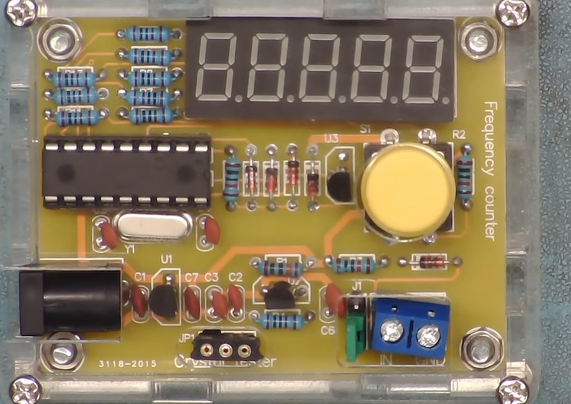
Like many people who repair stuff, [Learn Electronics Repair] has an oscilloscope. But after using it to test a motherboard crystal oscillator, he started thinking about how people who don't own a scope might do the same kind of test. He picked up a frequency counter/crystal tester kit that was quite inexpensive -- under $10. He built it, and then tried it to see how well it would work in-circuit.
The kit has an unusual use of 7-segment displays to sort-of display words for menus. There is a socket to plug in a crystal for testing, but that won't work for the intended application. He made a small extender to simplify connecting crystals even if they are surface mount. He eventually added a BNC socket to the counter input, but at first just wired some test leads directly in.
So how was probing with the frequency counter compared to using the scope? You would think it should work with no real problem. On the one hand, it should be easier to read the frequency from the counter, especially if you don't have a scope that displays waveform data. On the other hand, the counter doesn't give you any data about the quality of the clock source. Is it noisy? Clean? 50% duty cycle or 10%? Can't tell without the scope. Turns out, though, that the cheap counter wouldn't read high-frequency clock signals from a motherboard for some reason. It was, however, able to measure fan PWM signals.
We assume the cheap frequency counter doesn't have a proper input stage and was loading down the crystal oscillators. The wire probe probably didn't help any either. A proper frequency counter would probably work, but a cheap meter that had a frequency counter function didn't do any better. He also connected a scope probe to both devices with no better results. We wondered if the 10X setting on the probe might have loaded the circuit less. We also think the preamp hack we've covered before might have helped.
In the end, the cheap little device didn't seem to meet his original purpose. But for a simple crystal tester and frequency counter, it was inexpensive enough. While a proper frequency counter would probably work, scopes are getting pretty low-cost, and they can do a lot more.

Edge-Mounted Meters Give This Retro Frequency Counter Six Decades of Display
With regard to retro test gear, one's thoughts tend to those Nixie-adorned instruments of yore, or the boat-anchor oscilloscopes that came with their own carts simply because there was no other way to move the things. But there were other looks for test gear back in the day, as this frequency counter with a readout using moving-coil meters shows.
We have to admit to never seeing anything like [Charles Ouweland]'s Van Der Heem 9908 electronic counter before. The Netherlands-based company, which was later acquired by Philips, built this six-digit, 1-MHz counter sometime in the 1950s. The display uses six separate edge-mounted panel meters numbered 0 through 9 to show the frequency of the incoming signal. The video below has a demo of what the instrument can do; we don't know if it was restored at some point, but it still works and it's actually pretty accurate. Later in the video, he gives a tour of the insides, which is the real treat -- the case opens like a briefcase and contains over 20 separate PCBs with a bunch of germanium transistors, all stitched together with point-to-point wiring.
We appreciate the look inside this unique piece of test equipment history. It almost seems like something that would have been on the bench while this Apollo-era IO tester was being prototyped.
#retrocomputing #teardown #decade #electroniccounter #frequencycounter #germanium #movingcoil #ocxo #ovencontrolledcrystaloscillator


NTP, Rust, and Arduino Make a Phenomenal Frequency Counter
Making a microcontroller perform as a frequency counter is a relatively straightforward task involving the measurement of the time period during which a number of pulses are counted. The maximum frequency is however limited to a fraction of the microcontroller's clock speed and the accuracy of the resulting instrument depends on that of the clock crystal so it will hardly result in the best of frequency counters. It's something [FrankBuss] has approached with an Arduino-based counter that offloads the timing question to a host PC, and thus claims atomic accuracy due to its clock being tied to a master source via NTP. The Rust code PC-side provides continuous readings whose accuracy increases the longer it is left counting the source. The example shown reaches 20 parts per billion after several hours reading a 1 MHz source.
It's clear that this is hardly the most convenient of frequency counters, however we can see that it could find a use for anyone intent on monitoring the long-term stability of a source, and could even be used with some kind of feedback to discipline an RF source against the NTP clock with the use of an appropriate prescaler. Its true calling might come though not in measurement but in calibration of another instrument which can be adjusted to match its reading once it has settled down. There's surely no cheaper way to satisfy your inner frequency standard nut.


 janPiteJanseke
word frequency counter
#frequenciser #frequencycounter #wordcounter #tool #ilo_toki