 Kirst Mason D'Raven
The Murder of the Scottish Pedlar
We haven’t had a ghost story for a while, so here’s one that is a bit grim and grisly to satisfy your morbid cravings. It’s based just up the road from me in Stoney Middleton and there just might be a little bit of truth in it.
Pull up a knapsack…
There are some stories that refuse to die.They linger in old villages, whispered across generations, attached to particular buildings and particular stretches of road. Long after the witnesses are gone and the facts have blurred into folklore, the tale remains. Such is the case with the murder of the Scottish pedlar of Stoney Middleton, a story that has haunted the Peak District for more than two centuries.
The story begins long before Tiktok started spilling the long protected secret of our fish and chips shops and quarry pools. In fact it starts way back in the eighteenth century, during the annual Wakes celebrations in the neighbouring plague village of Eyam.
Now, these fairs and feast days drew traders, entertainers and travelling merchants from all across the country, and among them was a Scottish pedlar who had made the journey south to sell his wares. His name has been lost to history, though in local tradition he is often referred to simply as “the Scotch Pedlar”, but I’m going to call him Robbie.
Pedlars occupied a curious place in society. They were essential carriers of goods, news and gossip, travelling between isolated communities long before railways or modern shops existed. Yet they were also outsiders, viewed with suspicion and frequently finding themselves in conflict with local traders.
According to local tradition, the Scottish pedlar discovered that a group of rival traders were operating without the necessary licences. He reported them to the authorities and the offenders were forced to stop trading. Unsurprisingly, this did little to endear him to those whose livelihoods he had interrupted. The result, if the legend is true, was a grudge that would end in murder.
One account suggests that concern for the pedlar’s safety was already growing by the time the fair ended. The landlord of the Bull’s Head in Eyam is said to have arranged for a companion to escort him as far as Stoney Middleton. Whether this happened or not is impossible to prove, but it demonstrates how deeply rooted the story became in local memory.
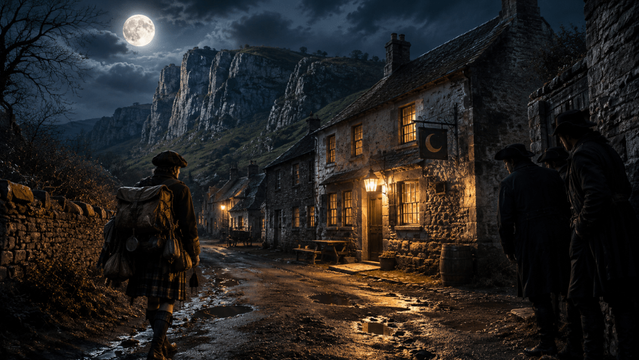
So, the pedlar reached Stoney Middleton and took lodgings at the Moon Inn which was then located on a different site from the present building. This little factoid is important, so just keep it in mind.
What happened next exists somewhere between historical record and folklore.
According to the traditional account, his enemies followed him to the inn. There, in one of the outbuildings, they attacked and murdered him. The landlord allegedly turned a blind eye to the crime, perhaps unwilling to interfere or perhaps fearful of the consequences. Once dead, the pedlar’s body was loaded onto a horse and carried away under cover of darkness. His killers disposed of the corpse in nearby Carlswark Cavern, a cave system in Middleton Dale. There the body remained hidden for around twenty years.
The murderers were never successfully prosecuted and, if the story is accurate, escaped justice altogether. – not unlike the Winnets Pass murderers. Can I just point out that the Peaks are a lot less lawless these days and with the amount of prowling around the countryside in the dark looking for ghosts that I do, I am eternally grateful that the Derbyshire rozzers have upped their game a bit these days.
Anyway… The discovery of the remains is itself wrapped in competing traditions.
One version claims the body was found by a man prospecting for lead. Another speaks of prophetic dreams that revealed the location. A Victorian account tells of a shoe discovered near the cave entrance, while a particularly grisly variation claims floodwaters washed a human foot, still wearing a shoe, from the cavern. Whatever the truth, there is at least some documentary evidence suggesting that human remains were indeed discovered in a cave.
The Eyam parish register records that in March 1773 a “corpse and other human bones” were found in a cavern in Eyam Dale by someone searching for lead. Many local historians believe this may represent the historical foundation beneath the legend. The remains were reportedly identified through distinctive silver shoe buckles remembered by local people. In one of those strange details that folklore never forgets, a local bell-ringer named Matthew Hall is said to have taken the buckles for himself, while the bones were eventually buried in Eyam churchyard. And there the story might have ended.
Except it didn’t.
People began seeing him.
Throughout the nineteenth and twentieth centuries, Carlswark Cavern developed a reputation as a place to avoid after dark. Local accounts described sightings of a ghostly figure believed to be the murdered pedlar. Horses reportedly became nervous when passing the cavern entrance, refusing to proceed or shying violently at seemingly empty air. Such stories were once common throughout Britain, with animals often regarded as more sensitive to spirits than human beings.
But the haunting was not confined to the cavern. Over time the pedlar’s ghost also became associated with the Moon Inn itself.
Patrons and locals spoke of an uneasy presence within the building and the story became one of Derbyshire’s best-known village ghost legends. An interesting complication arises here – remember I told you to keep a little factoid in mind earlier? – The present Moon Inn stands on a different site from the original eighteenth-century inn where the murder allegedly occurred. The licence and name transferred during the nineteenth century, meaning the building associated with the haunting is not actually the building where the crime supposedly took place. This has not prevented the ghost from making the move in local folklore. Perhaps, as one writer dryly observed, the spirit transferred with the licence.
The tale gained national attention in 2007 when the television programme Most Haunted investigated Stoney Middleton. The team visited the Moon Inn, Eyam churchyard and Carlswark Cavern in search of evidence connected to the murdered pedlar. During their investigation, medium David Wells claimed to sense the presence of the victim and asserted that the pedlar still haunted both the pub and the cave. As with all paranormal television, opinions remain divided, but the programme introduced the legend to a new audience.
The great frustration for historians is that the story sits in an uncomfortable middle ground. We possess enough evidence to suggest that a body was discovered in a cave in the eighteenth century. We have longstanding local traditions connecting those remains to a murdered Scottish pedlar. Yet the surviving records are insufficient to prove the full story beyond doubt. The names of the killers are unknown. The identity of the victim remains uncertain. The details have become tangled with two centuries of retelling.
And this, dear reader, is why the story survives.
A solved crime belongs to history. An unsolved one belongs to folklore.
Standing outside the Moon Inn today, with Middleton Dale rising steeply above the village and Carlswark Cavern hidden among the limestone scars of the hillside, it is not difficult to understand why the story took root. The Peak District has always been a landscape where history and legend overlap. Lead miners vanished underground. Highwaymen stalked lonely roads. Lovers leapt from cliffs. Villagers survived plague.
And somewhere in the midst of all that, if the old stories are to be believed, a Scottish pedlar arrived to sell his wares and never made the journey home.
Whether his spirit still walks the dale is another question entirely.
But more than two hundred years after his death, people are still telling his story.
Further Reading
Thomas E. Cowen, History of the Village of Stoney Middleton (1910)
Eyam Parish Registers, 1768–1812
Bernard Bird, Perambulations of Barney the Irishman (1854)
Clarence Daniel, A Peakland Portfolio
Stoney Middleton Heritage Centre and Community Group archives
Local investigations featured on Most Haunted: Midsummer Murders (2007)
Sources:
Stoney Middleton Heritage Centre and Community Group;
Moon Inn historical notes;
Eyam Parish Register references;
Local folklore collections and historical summaries.
#CarlswarkCavern #DarkHistory #DerbyshireFolklore #DerbyshireGhosts #DerbyshireHistory #EnglishFolklore #Eyam #folkloreAndLegend #ghostStories #Ghosts #HauntedBritain #hauntedDerbyshire #hauntedInns #HistoricalCrime #localLegends #MoonInn #MostHaunted #Murder #MurderMystery #newsAndGossip #ParanormalDerbyshire #PeakDistrictFolklore #strangeBritain #UnsolvedMysteries #VillageLegends