 Stan Carey
"In the beginning was the word, and the word is lost."
Francis Gooding on the origins of language, specifically of arbitrary words: https://www.lrb.co.uk/the-paper/v48/n07/francis-gooding/rocket-science-for-monkeys
"In the beginning was the word, and the word is lost."
Francis Gooding on the origins of language, specifically of arbitrary words: https://www.lrb.co.uk/the-paper/v48/n07/francis-gooding/rocket-science-for-monkeys
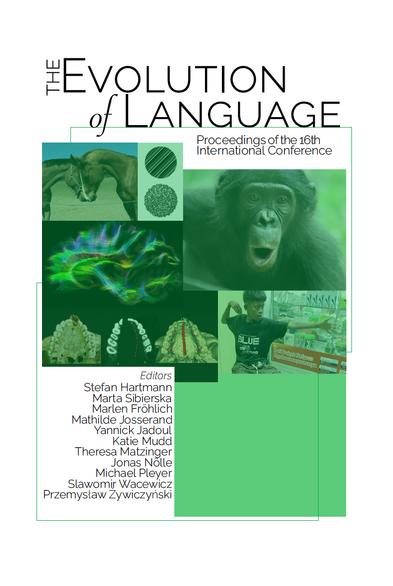
There are many theories about the origins of language. I like Jane Wagner's: "I personally think we developed language because of our deep inner need to complain."
#language #evolution #evolang #humour #JaneWagner #GivingOut
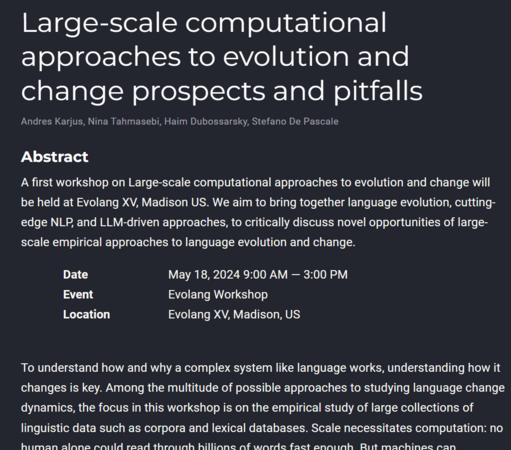

A first workshop on Large-scale computational approaches to evolution and change will be held at Evolang XV, Madison US. We aim to bring together language evolution, cutting-edge NLP, and LLM-driven approaches, to critically discuss novel opportunities of large-scale empirical approaches to language evolution and change.
Been following the Bentz et al line of #language #complexity research since the 2018 #evolang workshop, great to see this paper out now: https://www.degruyter.com/document/doi/10.1515/lingvan-2021-0054/html?lang=en
But also cool, more thinking in #ensembles!
Us in https://arxiv.org/abs/2205.10271: "instead [of a single metric of visual complexity] use an array of estimates that captures complimentary aspects of complexity"
Bentz et al: "capture the complexity of a language by a vector of measurements, rather than a single value"

In linguistics, there is little consensus on how to define, measure, and compare complexity across languages. We propose to take the diversity of viewpoints as a given, and to capture the complexity of a language by a vector of measurements, rather than a single value. We then assess the statistical support for two controversial hypotheses: the trade-off hypothesis and the equi-complexity hypothesis. We furnish meta-analyses of 28 complexity metrics applied to texts written in overall 80 typologically diverse languages. The trade-off hypothesis is partially supported, in the sense that around one third of the significant correlations between measures are negative. The equi-complexity hypothesis, on the other hand, is largely confirmed. While we find evidence for complexity differences in the domains of morphology and syntax, the overall complexity vectors of languages turn out virtually indistinguishable.

 Stefan Hartmann
 Andres Karjus
 Gareth Roberts