Having covered the Gallo-Greek votives, I'll be resuming the #eurises series now with Gaulish votives in the Latin alphabet.

For now, I will only cover the so-called "lapidary" (stone monument) inscriptions, since the RIIG has not added their data on instrumenta yet. (Hopefully that data will be available before too long, but there is probably a large body of it).
#eurises #gaulish #polytheism #votives

6. Lost bilingual capital votive from Nîmes.
https://riig.huma-num.fr/documents/GAR-10-03

There are a few more probable votive inscriptions, but which are merely ceramic or lead fragments that only preserve part of the dedicant's name (so no verb or theonym, and no clear religious format, like an altar).

Another votive basin may have been found recently, but until the findings are published I think this wraps up the Gallo-Greek portion of the #eurises series!

Additional Gallo-Greek inscriptions that are fragmentary or uncertain, but which may possibly be votives:

1. Stela to Belenos?
https://riig.huma-num.fr/documents/BDR-07-01

2. Basin to Belenos?
https://riig.huma-num.fr/documents/BDR-12-01

3. Lost altar to Dios?
https://riig.huma-num.fr/documents/BDR-12-04

4. Inscription on a wall, marking the area's consecration to the Matronas?
https://riig.huma-num.fr/documents/BDR-17-01

5. Lost votive from a fountain in Nîmes, possibly to Goddesses Whose name ends in -wā.
https://riig.huma-num.fr/documents/GAR-10-02

#eurises

(cont.)

What follows are fourteen more Gallo-Greek inscriptions, which are either incomplete or uncertain, but which may be votive in nature too. #eurises

Segomaros' offering of a nemēton was given by a different verb: eiuru. This is perhaps related to the word I understand to mean 'dedicants': #eurises. Although it only appears once in Gallo-Greek votives, we more of it in the Italic inscriptions.

#nemeton #gallogreek

That handful of inscriptions concludes the more-or-less complete or intelligible Gallo-Greek #votives I could find so far. To recap:

The #eurises (dedicants) named were:

Alleteinos
[C]artaros Illanuiacos
Cassitalos Uersicnos
Cornelia
Ecillios Roumanios
Segomaros Villoneos
Vebrumaros
Voteporix Iugilliacos

The gods they offered to were:

Ala[-]inos
Andounnas
Belenus
Bēlēsama
Carnonos Alisonteas
Matres Glanicas
Matres Namausicas
[Ro]Cloisias
Taranus

#gaulish #polytheism #gallogreek

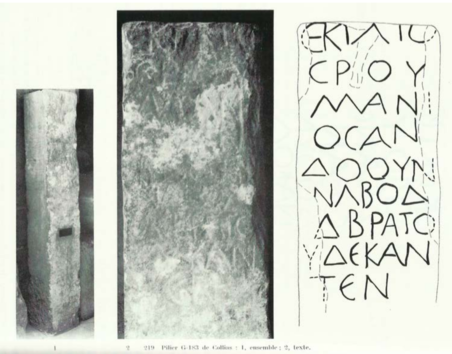
Collias, G-183 (1869), limestone pillar.

εκιλιος ρ.ουμαν[ι]ος ανδοουναβο δ[ε]δ[ε] βρατου δεκαντεν

ecilios roumanios andounabo dede bratu decanten

"Ecilios of Romanos, unto The Andounnas, gave due tithe"

The Andounnas are another example of plural Gaulish goddesses. Their name is generally agreed to mean something like 'water below', in contrast with another attested theonym, Uxouna ('water above'). These water-based epithets could be similar to nymphae, or derive from placenames.

#eurises

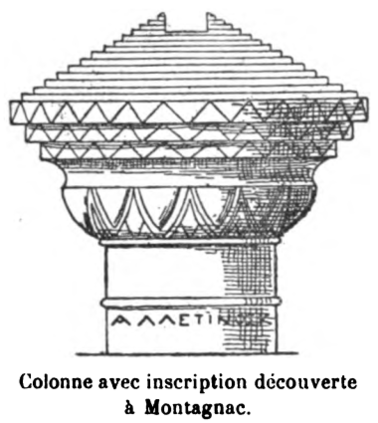
Montagnac, G-224 (1894), stone capital.

αλλετ[ει]νος καρνονου αλ[ι]σο[ντ]εας

allet[ei]nos carnonu al[i]so[nt]eas

"Alletinos to Carnonos of Alisontia"

There is some debate over how to read the inscription, and whether this is a votive or a funerary monument.

#eurises

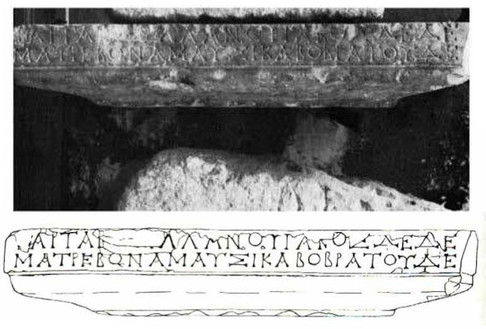
Nîmes (1742), capital.

[-]αρταρ[ος ι]λλανουιακος δεδε ματρεβο ναμαυσικαβο βρατου δε[καντεν]

[-]artaros illanuiacos dede matrebo namausicabo bratu decanten

"**Cartaros, (son?) of Illanuios, gave unto the Nîmoises Mothers due tithe"

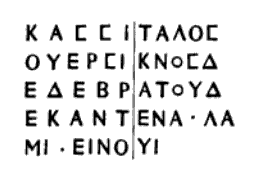
Nimes (1876), block of stone.

κασσιταλος ουερσικνος δεδε βρατου δεκαντεν αλα[-]εινουι

cassitalos uersicnos dede bratu decanten ala[-]inui

"Cassitalos, Versios' son, gave due tithe unto Ala[-]inos"

#eurises

The Gaulish God to Whom Vebrumaros offered is typically called "Taranis" today, following the spelling in Lucanus' Pharsalia. But Gaulish votive inscriptions like the above imply a nominative of Taranus instead.

It's anybody's guess why Lucanus spelled it as Taranis, and he wasn't necessarily wrong! But the form found in #Gaulish #votives themselves should be given more attention and precedence than they have heretofore received.

#Taranis #Taranus #eurises