Transport mode choice affects BMI
cfr. Cross-sectional and longitudinal evidence from #EUPASTA

• Lowest BMI is observed in cyclists and highest in car drivers.

• Riding an e-bike associated with an elevated BMI.

• Adult male who switches from car to daily bike use loses on average 0.75 kg.

• Frequent cyclists who stop cycling, increase their BMI with 0.417 kg/m2.
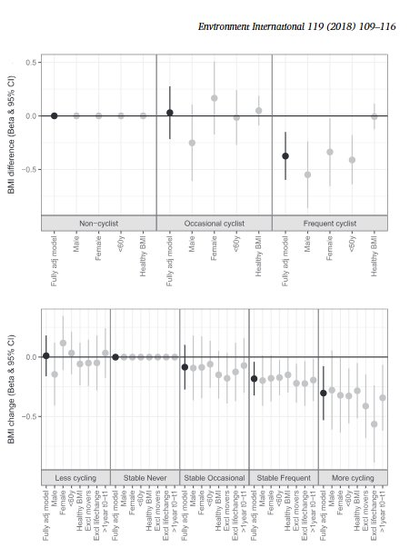
https://doi.org/10.1016/j.envint.2018.06.023

Data integrity is key to science and evidence based policy. That is why there is only one version of the #EUPASTA dataset.

To fix peer review, break it into stages https://www.nature.com/articles/d41586-022-03791-5

To fix peer review, break it into stages

All data should get checked, but not every article needs an expert.

Active Travel’s Contribution to Climate Change Mitigation: Research Summary and Outlook

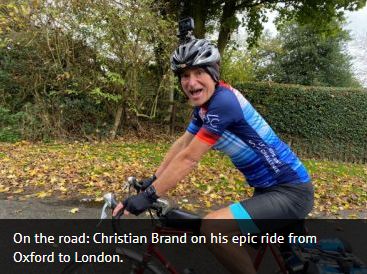
By #EUPASTA colleague Christian Brand of #Oxford university, our #climate expert.
https://doi.org/10.16997/ats.1036

Active Travel’s Contribution to Climate Change Mitigation: Research Summary and Outlook

Active travel (walking, cycling or scooting for transport) is considered a healthy and sustainable form of getting from A to B. The net effects of active travel on mobility-related carbon dioxide (CO<sub>2</sub>) emissions are complex and remarkably under-researched across a wide range of settings. This paper seeks to provide a summary of research on active travel as a low carbon mobility option in the context of the climate emergency. Key gaps are identified and discussed. The paper concludes with a projection of future research.

Active Travel Studies

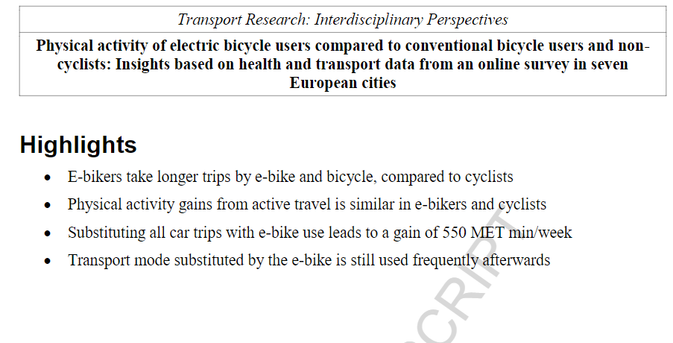
#EUPASTA #openaccess science paper on #ebike & #health

Physical activity of electric bicycle users compared to conventional bicycle users and non-cyclists: Insights based on health and transport data from an online survey in seven European cities.

https://doi.org/10.1016/j.trip.2019.100017

Expert Comment by #EUPASTA colleague Christian Brand:
Is the future of transport electric? We have to do everything, and fast

| University of Oxford https://www.ox.ac.uk/news/2022-11-09-expert-comment-future-transport-electric-we-have-do-everything-and-fast

Refers to our earlier #climate & #cycling research published here: https://doi.org/10.1016/j.trd.2021.102764

Expert Comment: Is the future of transport electric? We have to do everything, and fast | University of Oxford

Focusing solely on electric vehicles and technology that is not proven at scale is actually slowing down the path to zero emissions - it diverts resources and political will away from other solutions.  In reality, if we are to meet the decarbonisation targets of the Paris Agreement by 2050, we also need to focus on the movement of people and goods – and look at introducing

Transport mode choice and body mass index: Cross-sectional and longitudinal evidence from a European-wide study published in Environment International by the #EUPASTA team.
https://doi.org/10.1016/j.envint.2018.06.023

#sustainable health #sustainable cities #BMI

The effects of transport mode use on self-perceived health, #mentalhealth, and social contact measures: A cross-sectional and longitudinal study from #EUPASTA

In multiple transport mode models, bicycle use was associated with good self-perceived health [OR (CI 95%) = 1.07 (1.05, 1.08)], all the mental health measures [perceived stress: −0.016 (−0.028, −0.004); mental health:  0.11 (0.05, 0.18); vitality: = 0.14 (0.07, 0.22)], and with fewer feelings of loneliness.

https://doi.org/10.1016/j.envint.2018.08.002

NEW!
#openaccess
#EUPASTA

Day-to-day intrapersonal variability in mobility patterns and association with perceived stress: A cross-sectional study using GPS from 122 individuals in three European cities
by Jon Olsen et al.

Among individuals living in
London the median daily distance travelled was 14106.4 m, whereas it was 12956.8 m in Antwerp, and 9976.8 m in Barcelona.

Today I explained the WHO tool HEAT to my students at Hasselt University.
#who #bicycle #walk #activemobility #health #eupasta