 Andreas Warburton
Belle II reported the first evidence for the rare "missing energy" decay B → K νν̅ at the #EPSHEP2023 conference this summer. Now our journal paper describing the analysis has appeared on
@arXiv_hepex_bot https://arxiv.org/abs/2311.14647
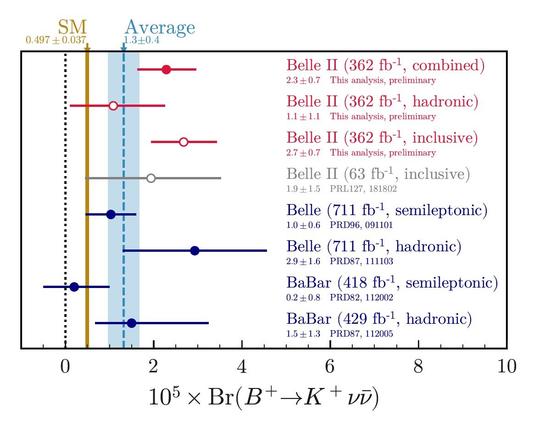
Our result BR(B⁺ → K⁺νν̅ ) = [2.3 ± 0.5(stat)+0.5−0.4(sys)] × 10⁻⁵ provides the first evidence for this decay and is 2.7 standard deviations larger than the SM expectation. This figure can be found as Figure 23 in the paper on
@arXiv_hepex_bot : https://arxiv.org/abs/2311.14647


Evidence for $B^{+}\to K^{+}ν\barν$ decays
We search for the rare decay $B^{+}\rightarrow K^{+}ν\barν$ in a $362\ \rm{fb}^{-1}$ sample of electron-positron collisions at the $Υ(4S)$ resonance collected with the Belle II detector at the SuperKEKB collider. We use the inclusive properties of the accompanying $B$ meson in $Υ(4S) \to B\kern 0.18em\overline{\kern -0.18em B}{}$ events to suppress background from other decays of the signal $B$ candidate and light-quark pair production. We validate the measurement with an auxiliary analysis based on a conventional hadronic reconstruction of the accompanying $B$ meson. For background suppression, we exploit distinct signal features using machine learning methods tuned with simulated data. The signal-reconstruction efficiency and background suppression are validated through various control channels. The branching fraction is extracted in a maximum likelihood fit. Our inclusive and hadronic analyses yield consistent results for the $B^{+}\rightarrow K^{+}ν\barν$ branching fraction of $\left[2.7\pm 0.5(\mathrm{stat})\pm 0.5(\mathrm{syst})\right] \times 10^{-5}$ and $\left[1.1^{+0.9}_{-0.8}(\mathrm{stat}){}^{+0.8}_{-0.5}(\mathrm{syst})\right] \times 10^{-5}$, respectively. Combining the results, we determine the branching fraction of the decay $B^{+}\rightarrow K^{+}ν\barν$ to be $\left[2.3 \pm 0.5(\mathrm{stat})^{+0.5}_{-0.4}(\mathrm{syst})\right]\times 10^{-5}$, providing the first evidence for this decay at $3.5$ standard deviations. The combined result is $2.7$ standard deviations above the standard model expectation.


 CMS Experiment
 Freya Blekman